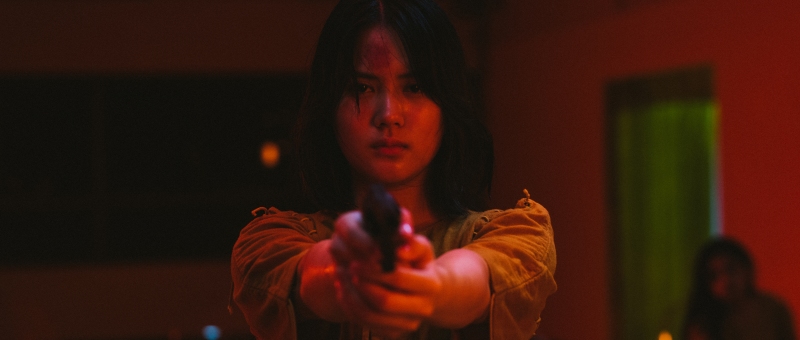
God Skin (หมัดเทวา ท้าเดิมพัน, Paween Purijitpanya, 2026) [Fantasia 2026]

In the closing moments of Paween Purijitpanya’s God Skin (หมัดเทวา ท้าเดิมพัน), protagonist Win (Sutthirak Subvijitra) remarks that the question isn’t if we can win the game, but if it was always rigged against us from the start. The house always wins, the film seems to say, though most people never even realise they were playing the game. Win comes to the realisation only too late, reflecting that he was suckered in by that first win that encouraged him to think that the system was fair when, in reality, it was anything but.

Set in the near future, Win is one of many regular office workers who’ve lost their jobs to AI. He now works as a food delivery driver, but struggles to meet his expenses while caring for his mother who has serious health issues. When he runs into old school friend It seemingly by chance, he’s introduced to an underground world of illicit prizefighting in which the wealthy and powerful bet on augmented matches in which they can award special items to fighters enhanced with all-powerful nanobots. Evicted from his apartment and with his mother hospitalised awaiting expensive medical treatment, Marwin decides it might be worth stepping into the ring despite his age and lack of familiarity with the game.

The fact is that in this world, Win’s physicality is almost irrelevant while his body is exploited as a tool for wealthy men to fight each other by proxy. Against the odds he manages to make it past the first round with the help of unlikely patron Guan Yu, an anime obsessive nicknamed “nerdass”, who takes a liking to him because of his bold, underdog spirit. Though he swore to do this only once to get the money for his mother’s operation, Win is emboldened by his unexpected success, and decides to continue playing despite knowing the potential health risks involved with upgrading his nanobots and exposing himself to physical punishment in the ring. 

In a way, this kernel of greed that exists within Win’s desire for success subtly undercuts the film’s sense of rebellion against the inherent unfairness of a capitalistic system especially once it becomes clear that some of what’s happening to him is a direct consequence of questionable choices he himself may have made. Then again, perhaps it’s fairer to say that he fell victim to an irresponsible product designed to prove addictive and exploit a sense of dissatisfaction with the system even if it seems his life may have been comfortable enough as it was without being tricked into always wanting more.

But in the world of underground prizefighting, he can convince himself he’s not fighting for himself but for others. After covering his mother’s medical expenses, he becomes determined to pay off the debts of his high school girlfriend Praewa who has apparently been sold to the bar as a hostess to satisfy her father’s debts. There are two female fighters, one a former hostess and the other a transwoman, who are also challenging this system in the ring though it seems fighting to protect his mother and girlfriend becomes a key factor in Win’s sense of himself as a masculine hero succeeding through physical dominance of other men in the gladiatorial ring. He is unwilling to fight women on an equal footing, and when he discovers that his opponent is only a teenager refuses to fight altogether while taking It to task over the game’s questionable ethics. 

Nevertheless, Win stays in this world because he still thinks he can win even as his body begins to betray him. It isn’t really about Praewa or his mother, he wanted to be a winner without realising that the only “winners” are the men upstairs and you can’t become one of those by playing the game honestly. It may have succeeded in becoming one, but only by accepting that being an elite means exploiting other people’s desperation to get them to fight for you while creaming most of the profits. That’s not even something that’s really occurred to Marwin, who is as the mad scientist nanobot tattooist says, not someone who’s naturally disposed to hurting other people which makes him a natural sucker for this game. Bleak and dystopian in the extreme, the conclusion seems to suggest that in the end, Win was a victim of his own deluded hopes who never realised the only way to win was not to play in the first place.


God Skin screened as part of this year’s Fantasia International Film Festival.
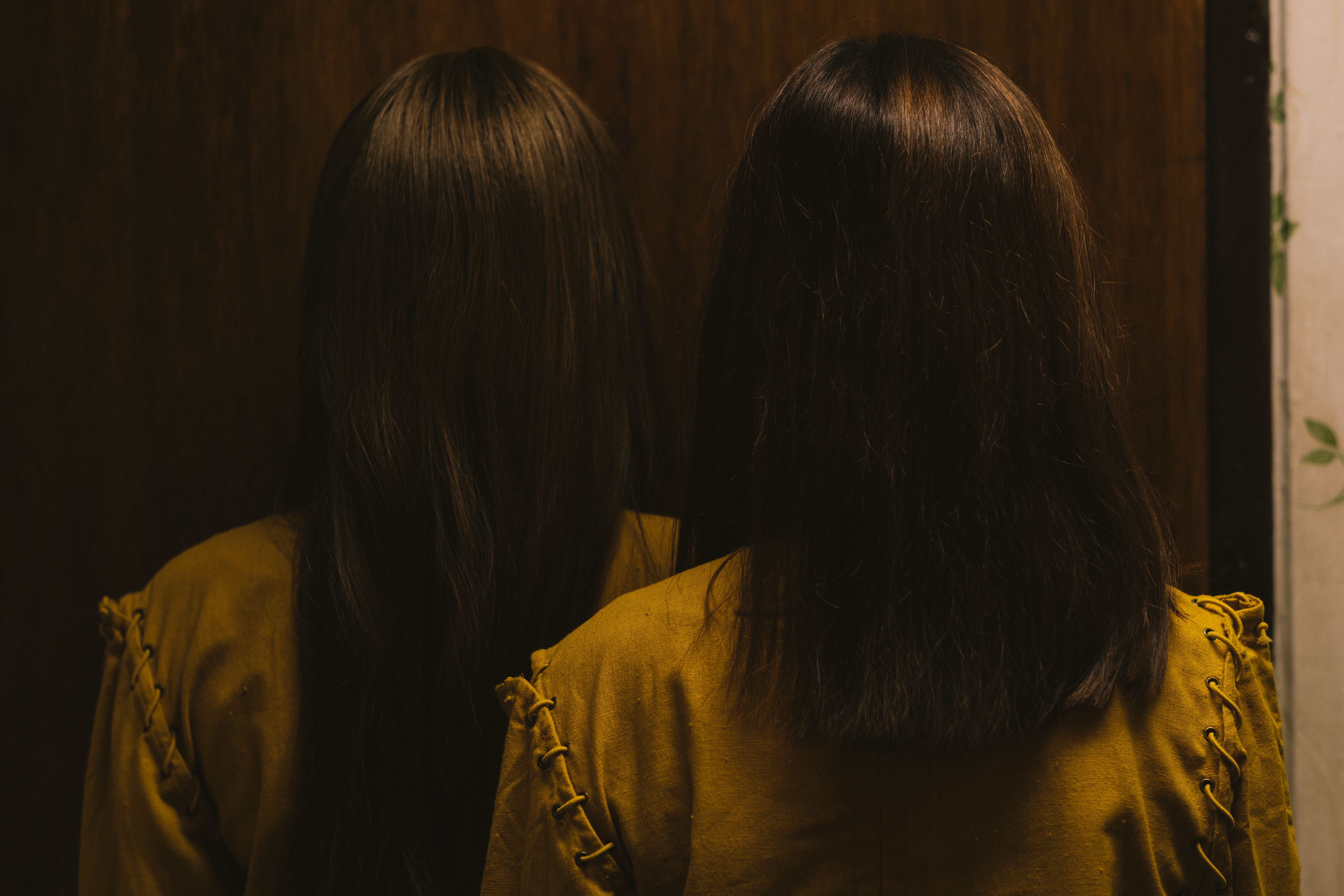
Faces of Anne (แอน, Kongdej Jaturanrasmee & Rasiguet Sookkarn, 2022)

A young woman wakes up in a grimy hotel room with floral wallpaper marked by damp stains. She discovers that the window is frosted over and won’t open while she has no idea of how she got there or who she is but otherwise instinctively knows that the face she sees in the mirror does not belong to her. She tries to call out and hears a voice from an adjacent room telling her to be quiet and that her name is “Anne”. Anne asks her how she knows if she can’t see her, but the voice just tells her that she knows her name is Anne with no further explanation. 

As it turns out in Kongdej Jaturanrasmee & Rasiguet Sookkarn’s Faces of Anne (แอน) every girl in the place has the same name and as gradually becomes apparent are all reflections of a single personality. The key Anne discovers that her face seems to change seemingly at random leaving her uncertain even within the bounds of her fractured identity. A psychiatrist tells her that a name is “not as important as who you are” while encouraging her to learn to accept the face she sees as her own, but she remains confused, abstracted from herself, and unable to reconcile her selfhood with its reflection. Meanwhile, she is stalked by a violent demon in the guise of a deer name Vitigo who wanders the hospital corridors taking out any Annes that it finds. 

What seems to be going on is an attempt to reintegrate the shards of a fractured personality into a coherent whole only it’s manifesting as a massacre of the self as the demon bumps off each of the multiple Annes insisting that only one, the “real” Anne, can be allowed to leave. But then no one is really only one person but presents a series of personas to the outside world all of whom can be said to be “real” even if otherwise inauthentic. In an illuminating flashback, high school girl Anne chats with another couple of girls about fake online profiles where they can share their “real” selves each of which of course have a completely different profile photo much as the serial Annes have a different face. What we can assume to be the key Anne expresses that she just wants to find a place where she can be completely herself and thinks she has one in a relationship with a boyfriend whose face we never see but had shades both of a man who might be her father and the hero of a video game the atmosphere of which seems to have coloured the aesthestics of her eerie mindscape. 

Some might find it easy to dismiss her identity crisis as teenage angst or to suggest that what she’s suffering from is a broken heart though Kongdej Jaturanrasmee & Rasiguet Sookkarn also make reference to a number of problems faced by young people in contemporary Thailand such as online harassment and bullying, sexual harrassment at school and the bad student movement protesting an oppressive educational environment laying bare the pressures on key Anne’s mind that might cause her to become estranged from herself. Asking probing questions about identity, the film wonders if Anne can learn to find herself as distinct from all of these images or if in the end identity and image are inextricably linked to the extent that they can no longer exist distinctly and Anne has no power to identify herself but must rely on the identification of others. Then again, the voice from the other room knows she is Anne without seeing her precisely as she is also Anne, identifying herself in the absence of image. 

Eerie and filled with a Lynchian dread in its hellish lightning and grimy hotel room setting, the film turns Anne’s psychodrama into an existential slasher in which she awaits the arrival of the Final Girl. Retracing her steps, she seeks escape in a pattern of trial and error unwittingly at war with herself even as tussles over identity and authenticity while trying to reconstruct a shattered identity by reclaiming the images of the past or perhaps as simply as the psychiatrist had put it learning to accept the face she now wears as her own. Haunting and empathetic, the film has only sympathy for the wandering ghosts of a fractured mind and the vague hope that together they can put Anne together again. 


Faces of Anne screened as part of this year’s New York Asian Film Festival

Original trailer (English subtitles)

Images: © M Pictures Entertainment Public Company Limited.

Krasue: Inhuman Kiss (แสงกระสือ, Sitisiri Mongkolsiri, 2019)

Inhuman kiss poster 2Vengeful ghosts are one thing, but what if you get possessed by a malevolent entity and go about committing evil deeds during the night only to forget them by the morning? A Krasue, in Thai mythology, is a supernatural creature which infects an ordinary woman with a curse which causes her head to detach from her body at night to devour nearby cattle. The heroine of Krasue: Inhuman Kiss (แสงกระสือ) received the curse as an overly curious child only for it to activate on entering puberty during which time she is also caught between the love of her two childhood best friends.

The gentle Sai (Phantira Pipityakorn) first encountered the Krasue when dared to go into a creepy “haunted” cottage by her cowardly friends who largely stayed outside. 10 years later, she still misses her best friend Noi (Oabnithi Wiwattanawarang) to whom she gave her protective amulet, while her other best friend, Jerd (Sapol Assawamunkong) silently pines for her but despite his confident persona is too shy to declare his feelings. Shortly after Noi returns from Bangkok in order to escape the approach of the war, a Krasue comes to town. Gradually, Sai begins to worry something is wrong when she keeps waking up with bloodstained sheets but is at a loss for what to do. Meanwhile, a band of bandit Krasue hunters has also descended on the village with the intention of “purifying” it of the troublesome curse.

Set around the time of the Second World War, Krasue: Inhhuman Kiss takes place in a rural idyll untouched by conflict but also home to ancient superstition and primitive prejudice. Though belief in the Krasue is fading, the evidence of its reappearance is undeniable and even if the townspeople can consider themselves “safe” because the monster only targets cattle, they still fear it and that their wives and daughters could become infected. Noi, who left the village long ago for Bangkok, has come back in search of safety but finds himself longing once again for the civilisation of the big city where monstrous curses are regarded as ridiculous superstition and modern medicine a potential cure for any ailment.

Thus when he realises that Sai has become a Krasue, his ultimate plan is to flee with her to the city where they might find help or at least different kind of safety in the midst of civil unrest. Originally horrified, Noi turns to a local monk for advice who counsels him that he should believe what he sees, but do as his heart tells him. Therefore he tries to protect Sai by preparing food for the Krasue so she won’t have to leave her house and risk discovery while he looks for a cure.

Meanwhile, Jerd becomes increasingly jealous of the obvious bond between Sai and her childhood friend but lacks the courage do much more about it than pout and resent Noi’s unexpected reappearance. Jerd joins the hunters, seemingly looking to emphasise his manliness against Noi’s intellectualism while allying himself with strong male role models like the worryingly intense Tat (Surasak Wongthai). In the end, however, both men act to protect the woman that they love albeit in different ways even as they fear she has become monstrous and a danger to herself.

The curse of the Krasue is, it turns out, the legacy of an ancient love triangle and an all powerful man who couldn’t accept that the woman he loved had fallen in love with someone else. Tat’s band of rage fuelled bandits are as much about misogynistic prejudice towards transgressive women as they are about protecting cattle from “supernatural” threat and their intimidating presence eventually puts a stronghold on the increasingly jumpy village in which the torches and pitchforks eventually come out in a show of intense paranoia.

The wartime corruption has finally reached the village, rendering it no safer than the city and infected with a deeper, older anxiety born of wounded male pride and female subjugation. Selfless love struggles to endure but may be no match for the humiliated rage of a spurned lover leaving acts of mutual sacrifice perhaps the only path towards salvation. A supernaturally tinged coming of age tale in which a teenage love triangle neatly overlaps with an ancient curse, Krasue: Inhuman Kiss is a surprisingly rich and delicate experience which imbues its essential horror with genuine warmth and deeply felt compassion.


Krasue: Inhuman Kiss was screened as part of the 2019 Udine Far East Film Festival.

International trailer (English subtitles)