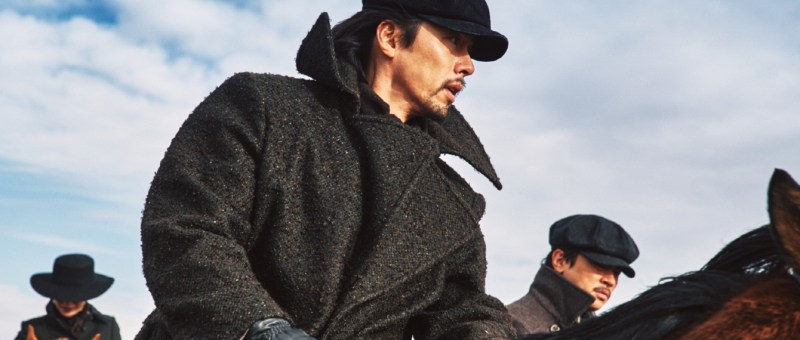
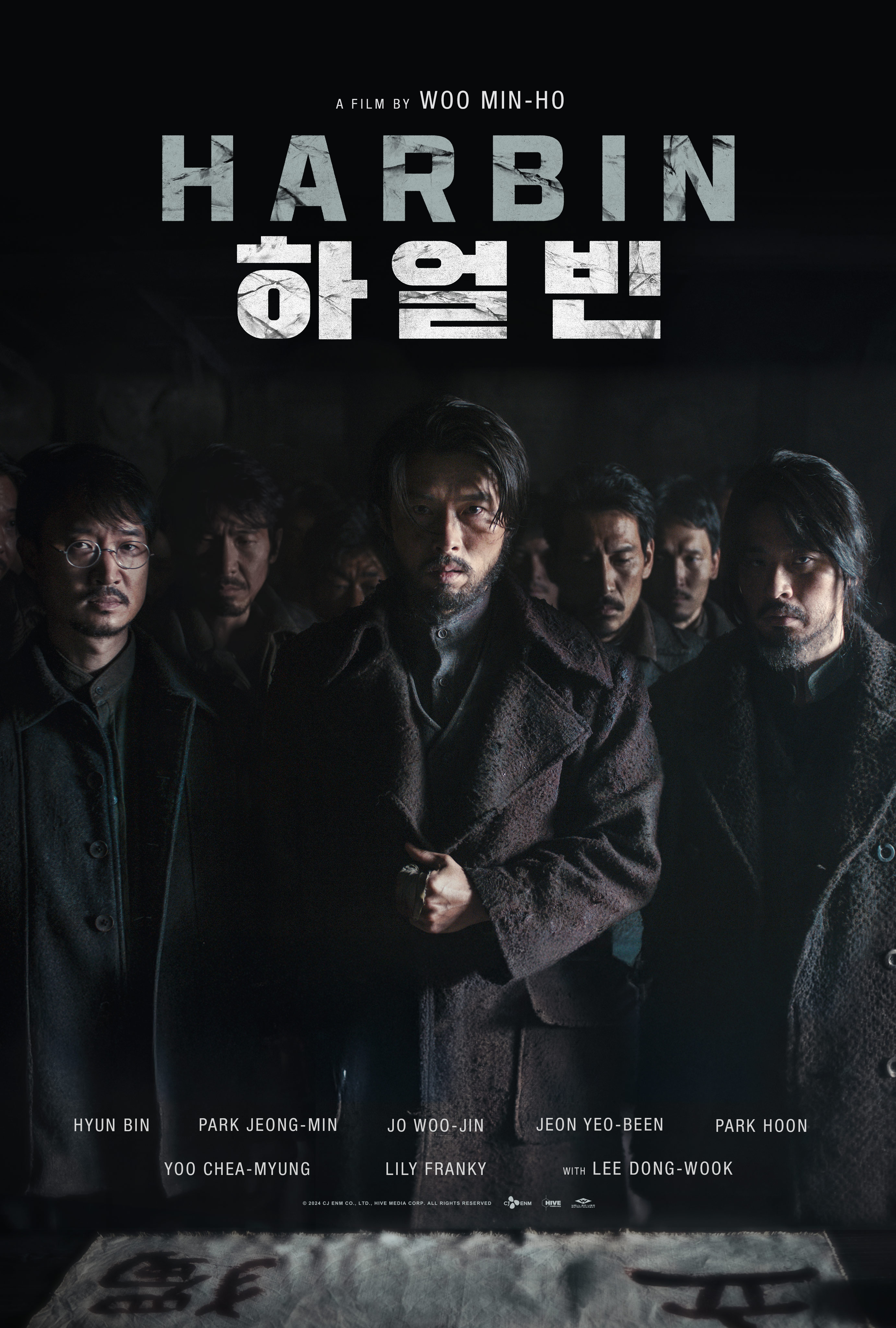
Harbin (하얼빈, Woo Min-ho, 2024)

Ahn Jung-geun is one of the most well-known figures of modern Korean history and his story has indeed been dramatised several times before, but what’s unusual about Woo Min-ho’s espionage thriller Harbin (하얼빈) is the way it tries to sublimate Jung-geun the individual in favour of making him an emblem of the common man. As such, the film is more egalitarian than might be assumed and ultimately praises the integrity and resilience of the Korean people who save their country and their culture in a more spiritual than literal sense.

Indeed, Ito Hirobumi (played by Japanese actor Lily Franky), former prime minister of Japan and the first Resident General of Korea after it became a Japanese protectorate, remarks that he has always been sceptical of the annexation because though they have been ruled by “foolish kings and corrupt officials” the Korean people will continue to be a thorn in his side. Toyotomi Hideyoshi’s attempt to invade Korea was defeated by a volunteer army and a charismatic admiral, Yi Sun-sin. Then again, a Japanese soldier remarks that it will be difficult to find such a hero in the Korea of today, a pointed comment that implies Ahn Jung-geun is just such a hero through the film skirts around the fact his assassination of Ito did not in the end prevent Korea’s annexation which was completed in 1910, while the Independence Movement did not succeed in liberating in Korea which regained its independence when the Japanese Empire collapsed at the end of the war and even then was subjected to a period of occupation by US forces before its sovereignty was restored. 

What Jung-geun becomes is a kind of torch bearer for another Korea serving as a moral compass and preventing those around him from becoming just as bad as the Japanese whose cruelty they resist. As the film opens, Jung-geun’s comrades are awaiting his return after going missing following a disastrous encounter with Japanese forces. Despite having won the initial battle while heavily outnumbered, Jung-geun’s decision to release the Japanese commander, Mori (Park Hoon), as a prisoner of war results in a counterstrike in which his forces are all but wiped out. His comrades had been against the decision and now doubt his abilities and judgement along with a new suspicion that should he return he may have been captured and turned by the Japanese to spy on them. But Jung-geun’s decision signals his righteousness and refusal to give in to the cruelties of war. He releases Mori because it is the right thing to do. Executing prisoners of war is immoral by commonly held standards of war, and he pities Mori as a husband and father. He perhaps also hopes that it is a gesture of good will that shows him the Independence fighters are just and reasonable. 

But just and reasonable the Japanese are not, and so Mori betrays his trust. Deluded by the death cult of militarism, Mori is humiliated by Jung-geun’s magnanimity which is after all a show of power and that he has overturned the dynamics by granting Mori his life. Mori asks to die as as loyal soldier of Japan by committing ritual suicide but is denied in this both by Jung-geun who tells him he must live and by Chang-sup (Lee Dong-wook) who wants to execute him. This deep sense of humiliation and shame in remaining alive after defeat spurs Mori into a personal vendetta against Jung-geun to reclaim his honour and that of Japan which leaves him almost indifferent to Ito’s fate though nominally in charge of preventing his assassination at the hands of Jung-geun. Jung-geun is also trying to redeem himself for the loss of his men’s lives and has in a sense declared himself already dead in that he lives only for the souls of dead men and has embarked on what is in effect a suicide mission to kill “the old wolf” as a means of atonement and the eventual liberation of his country. 

But then his comrades are already weary and some are already beginning to ask themselves if it’s really worth it. How many more men will have to die before they win their freedom? Sang-hyun (Lee Dong-wook) laments that if the Japanese write their history, his name will be forgotten and he will have left no mark upon the world. They are grieving what they’ve lost in more personal terms aside from their lost nation. In order to get the dynamite to blow up Ito as a backup plan, the gang have to make contact with a former comrade who has since abandoned the cause to become a bandit (Jung Woo-sung). Having lost his eye and his brother, who was also the husband of another committed revolutionary Ms. Gong (Jeon Yeo-been), he decided it wasn’t worth it anymore and chose a different kind of freedom. “If we all die like dogs, no one will remember us,” Sang-hyun later laments. But Jung-geun, who will be remembered, is less concerned with his legacy insisting that even those who may have betrayed them should be given a second chance for they will eventually see the light. Like Ito, he believes in the Korean people and that they will come together to carry the light into the darkness. 

What he does is light the way, and as the closing scenes imply pass the torch to others who will each keep it alight until the dawn of liberation. Nevertheless, Jung-geun does have an unfortunate habit of getting those around him killed while the horror of the battle scenes, the grimness of decapitated and limbless bodies along with the constant sense of loss and defeat seem to imply that perhaps it isn’t worth fighting in this way lending further justification to Jung-geun’s conviction that taking out the leadership is the only way to turn the tide of this war of attrition. In sacrificing his own life, he becomes a kind of martyr, wearing traditional Korean white clothing as he goes to his death knowing that others will come after him. Rich with period detail and tense in its sense of intrigue, the film ultimately argues for a more compassionate sense of revolution governed by righteousness in opposition to the rather cynical justifications made by Ito for the cruelties of Japanese imperialism.


Harbin is released in the US on on 4K Ultra HD, Blu-ray™ and DVD courtesy of Well Go USA.

International trailer (English subtitles)

The Man Standing Next (남산의 부장들, Woo Min-ho, 2020)

“You have my full support. Do as you please” so says the dictator, unambiguously manipulative but still somehow inspiring the loyalty of his many underlings perhaps still too wedded to an idea or at least an ideology to countenance moving against him. It turns out that nothing really changes and whether it’s feudal Joseon or the modern nation state, there is intrigue in the court. Neatly adopting the trappings of a ‘70s conspiracy thriller, Woo Min-ho’s The Man Standing Next (남산의 부장들, Namsanui Bujangdeul) explores the events which led to the assassination of President Park Chung-hee, father of the recently deposed president Park Geun-hye, by a member of his own security team. Many of the names have been changed and historical liberties taken, but the lesson seems to be that there is always a man standing next in readiness to inherit the throne. 

Our hero is KCIA chief Kim Gyu-peong (Lee Byung-hun), preparing as the film opens to halt Park’s (Lee Sung-min) increasing authoritarianism by assassinating him. A combination of the personal and the political Gyu-peong’s eventual epiphany is precipitated by an old friend’s “defection”. Park Yong-gak (Kwak Do-won), former director of the KCIA which operated as a secret police force propping up Park Chung-hee’s oppressive regime, is giving testimony to an American inquiry into the so-called “Koreagate” scandal in which the KCIA is accused of bribing members of Congress to propagate favourable views of the Korean president and reverse Nixon’s decision to pull US troops from South Korea. Yong-gak uses the opportunity to denounce Park Chung-hee, planning to publish a memoir titled “Traitor of the Revolution” as an exposé of the inner workings of the KCIA.  

Somewhat ironically, Gye-peong and Yong-gak are old comrades who fought together in the “revolution” led by Park in the early 1960s following the ousting of corrupt autocrat Rhee Syngman. Yong-gak has become disillusioned with their cause and with Park himself, but this largely ignores the fact that Park’s revolution was mainly a repackaging of Japanese militarism, something signalled by an exchanged between Park and Gye-pyeong in Japanese to the effect that their days of revolution were their best. All of which makes Yong-gak’s wistful eulogising of a betrayed ideal along with his supposed admiration for democracy somewhat ironic. The essential motivator in their loss of faith, however, is also a militaristic one. They learn firstly that like any dictator Park has been embezzling from the state for years and has a collection of slush funds in Switzerland. That’s not the problem, the problem is that to manage them he’s been running a “private” intelligence service unknown even to the KCIA. They’ve been displaced, and their hurt is personal more than it is political. 

Yong-gak calls Park a traitor to their revolution and objects to the continuing human rights abuses for which he himself as a member of the KCIA has been directly responsible. All of this creates a series of crises for Gye-peong who is torn between loyalty to his old friend and Park while increasingly worried for his own safety. He begins to suspect that Gwak (Lee Hee-joon), Park’s security officer who had not fought with them in the revolution, may be the mysterious “Iago” figure Yong-gak had been warned about by the CIA. Increasingly sidelined, Gye-peong continues to do Park’s dirty work but draws attention to himself in his resistance towards the president’s increasingly militaristic rhetoric. Pro-democracy protests have already broken out in Busan in response to Park’s “unfair” treatment of the city’s governor and the opposition party. Gye-peong advises reinstating the governor with an apology. Gwak says frame the protestors as communists and Northern sympathisers and send in the tanks. “Cambodia killed three million people, is it such a big deal if we kill one or two million?” Gwak blurts out in a quip which seems to catch Park’s attention, the president now thinking himself untouchable. A militarist perhaps but an educated man who speaks good English and gets on well with the Americans, Gye-peong does not see the Khmer Rouge as a source of inspiration nor, like Yong-gak, does he think those values align with the ones he fought for bringing Park to power. 

Then again, even in the immediate chaos of the early ‘60s, it’s difficult to see how you could join that particular revolution without assuming it would come to this. Gye-peong has apparently been OK with human rights abuses and mass oppression, but has been quietly reassuring himself and others that Korea is changing, Park is preparing to move aside, and they are progressing towards democracy. In true conspiracy fashion, Woo paints Gye-peong as a tragic hero, unable to reconcile himself with the choices he has made or the radically different version of the world he is now seeing, but taking what is essentially a personal revenge in return for a slighting from a man to whom he’d given his life. Perhaps in a sense he thinks he’s saving Park from himself, or merely protecting the revolution he fought for from a cruel traitor, but in the end lacks the courage to carry it through. He thought Gwak was his Iago, but he missed the “man standing next” in the shadows. As the April Revolution led only to Park, so Park leads only to Chun and second military coup even more brutal than the last. Nothing really changes, but the next revolution will have to be one enacted by more peaceful means because the spectre of authoritarianism is eclipsed only in the freedom from fear.


The Man Standing Next is available to stream in the UK from June 25 and on download July 5 courtesy of Blue Finch Releasing.

International trailer (English subtitles)

The Drug King (麻藥王 / 마약왕, Woo Min-ho, 2018)

Drug King posterKorean cinema has been in a reflective mood of late, keen to re-examine the turbulent post-war era in the wake of a second wave of democratic protest and political turmoil. Even so, dealing with the difficult Park Chung-hee era has remained sensitive with the legacy of life under a repressive regime apparently very much still felt. Woo Min-ho’s Drug King (麻藥王 / 마약왕, Mayakwang) is first and foremost a crime doesn’t pay story, but it’s also a subtle condemnation of authoritarianism and the corruption and cronyism that goes along with it. Painting its hero’s rise as a consequence of the society in which he lives, it perhaps implies the new wind of egalitarian democracy made such amoral venality a thing of the past but then again is at pains to show that nothing really changes when it comes to greed and resentment.

Our hero, Lee Doo-sam (Song Kang-ho), starts out as a jeweller dabbling in smuggling in Busan in 1972. Just as the smuggling business starts to take off, Doo-sam’s boss falls out with his friends in high places and decides to throw him to the wolves while he escapes abroad to safety. Doo-sam, not one to be beaten, starts coming up with ideas. Mobilising his wife (Kim So-jin) to get him out of jail through a combination of bribery and blackmail, he teams up with the area’s smuggling king to act on a tip-off he got from a Korean-Japanese yakuza and begins producing popular drug Crank for export to Japan.

As the opening voice over explains, Crank is a dangerous stimulant developed by the Japanese during the war and given to factory workers and kamikaze pilots because of its ability to eliminate both fear and fatigue. It is also highly addictive and provides an extreme high which have made it a popular recreational drug but, crucially, the real value is economic. The rising Japan is keen to make use of foreign labour, and Korea is keen to up its export capability. This, coupled with poor regulation of the workforce, has led to extreme exploitation in which factory workers are encouraged to hop themselves up on stimulants to keep working overtime for the sake of economic expansion. Thus, the influx of Crank is, in many ways, simply another facet of ongoing Japanese imperialism.

Not that Lee Doo-Sam cares very much about that. An honest prosecutor later puts it to him that he’s contributing to the exploitation of ordinary workers who might earn a few pennies extra for working a few more hours but at the cost of their health and wellbeing, while he gets filthy rich off the back of their misery. Doo-sam is, however, unrepentant. In the beginning he just wanted to provide for his wife, children, and unmarried sisters, but perhaps he also wanted to kick back against his reduced circumstances and he certainly did enjoy playing the big man. In any case, it has paid off. Doo-sam too has friends in high places and they won’t want to let him sit in a police cell for long in case he starts feeling chatty.

Times change, however, and whatever standing and influence Doo-sam thought he’d accrued his life is built on sand. When Park is assassinated by a member of his own security team, all those contacts are pretty much useless because the cronies are now out in the cold. There are protests in the streets and the wind of a new era is already blowing through even if it is still a fair few years away. That bold new era will, it hopes, do away with men like Doo-sam and their way of thinking, eradicating corruption and backhanders in favour of honest meritocracy. Naive, perhaps, and idealistic but it is true enough that Doo-sam is a man whose era has passed him by while he, arrogantly, burned all his bridges and gleefully sacrificed love and friendship on the altar of greed and empty ambition.

Hubris is Doo-sam’s fatal flaw, but he remains a weasel to the end only too keen to sell out his associates in order to save his own skin. He may claim he was only trying to live a “decent” life, but his definition of “decent” may differ wildly from the norm. Nevertheless, perhaps he was just like many scrappy young men of post-war years, desperate, hungry, and left with few honest options to feed his family if one who later found himself corrupted by backstreet “success” and the dubious morals of the world in which he lived which encouraged him to disregard conventional morality in favour of personal gain. Much more about life in Korea in the authoritarian ‘70s than it is about crime, The Drug King is nevertheless an ironic tragedy in which its drug peddling hero eventually enables the birth of a dedicated narcotics squad and helps to dismantle system which allowed him to prosper all while grinning wildly and, presumably, planning his next move.


Currently available to stream online via Netflix in the UK and possibly other territories.

International trailer (English subtitles)

Key tracks from the (fantastic) soundtrack:

Jung Hoon-Hee – Flower Road

Kim Jung Mi – Wind