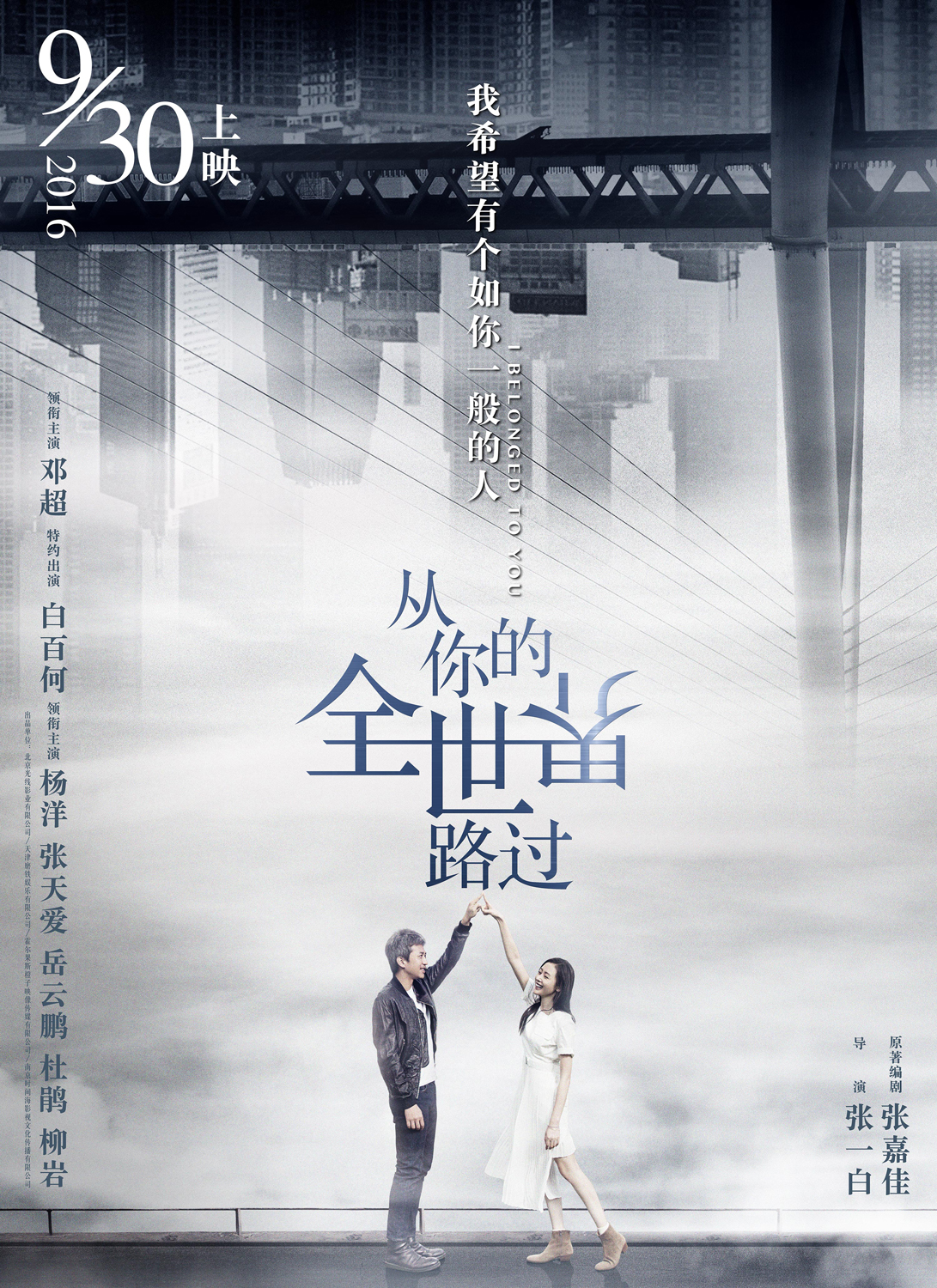
A collection of lovelorn souls meditate on love and loneliness in Zhang Yibai’s adaptation of a series of popular short stories by internet author Zhang Jiajia. Perhaps misleadingly titled, I Belonged to You (从你的全世界路过, Cóng nǐ de Quánshìjiè Lùguò) is less tearjerking melodrama than humorous exploration of romantic disaffection in the modern society in which even love itself has perhaps become both duplicitous cliché and an unattainable dream. For smug DJ Chen Mo (Deng Chao), being in love means staying together forever, but for his co-host/longterm girlfriend Xiaorong (Du Juan) adolescent love has already run its course. Thoroughly fed up with his empty, somewhat cheesy words of advice to lovelorn callers, she abruptly breaks up with him live on air.
Two years later Chen Mo hosts the show alone amid declining ratings, listeners now fed up with with his total capitulation to depressed cynicism and advertisers getting ready to pull the plug. Xiaorong has joined station management but seemingly has little desire to save the show, later entering into an unwise bet that should Mo be able to climb to the number one spot, she’ll marry him but if he fails he must parade through the town with a sign reading “I’m an idiot” which, as we later discover, is a callback to their uni days when they were young and in love. Mo laments that the only couple still together from way back when is his best friend Chubby (Yue Yunpeng), who currently lives with him, and the beautiful Yanzi (Liu Yan) whose heart he won being the only person willing to defend her when she was accused of thievery. Pure-hearted, Chubby does every job going, even allowing people to punch him for monetary compensation, so he can send the money to Yanzi who is currently abroad travelling the world. Mo seems fairly unconvinced by the arrangement, but also regards Chubby as his “anchor”, that as long as Chubby loves Yanzi, they are all still young and love is real.
His other roommate, meanwhile, his cousin Shiba (Yang Yang) is being semi-stalked by the local police woman whose constant flirting he doesn’t seem to have picked up on. As we later discover, Officer Lychee (Bai Baihe) has also been disappointed in love, previously jilted at the altar by a foreign boyfriend who apparently did a disappearing act, but has apparently maintained her faith eventually entering to a wholesome relationship with the eccentric young man who spends all his time inventing new gadgets. Despite the evidence, however, Mo remains cynical and hung up on Xiaorong who seems to have defied the narrative destiny of their uni love story. Describing him as immature, she feels as if something changed with Mo during the radio show, that somewhere along the way he lost his sense of warmth. “It’s only when we are filled with love that our show passes on love. When we feel lonely we can’t warm anybody up” she tearfully explains taking over the broadcast, adding that Chen Mo might be the loneliest of all in his false bravado and prickly tendency to make off-colour jokes as a childish defence mechanism.
Ironically, however, the ratings start to pick up thanks to mild-mannered intern Birdie’s (Zhang Tianai) unexpected outburst at a disgruntled caller who took Mo to task for his terrible, unsympathetic advice for his romantic problem. Silently in love with Chen Mo after his certain presence on the radio saved her from loneliness, Birdie does her best to “save” him, even later giving up her dream of romance to try and help him win back Xiaorong only for him to get the message too late, realising that Xiaorong has outgrown him and they’re on different paths while maybe what he needed was a spiky little bird to peck him out of his shell.
Chen Mo called his show “Passing Through Your World” as if in acknowledgement that some people are supposed to brush past each other meeting only for a moment, but naively hoping to encounter someone that would make the world brighter just by being in it. Shooting with a whimsical arthouse lens, Zhang opens in a rainy Chongqing as if reflecting the loneliness and despair which plague each of his protagonists who each in one way or another find solace in the presence of Chen Mo through his radio show acting as a beacon for lonely souls everywhere, before ending in bright sunshine and golden fields leaving the neon-tinted city behind for a dream of a more innocent love. Nevertheless, not everyone gets their happy ending, and there’s something in the film’s most romantic gesture being the drawing of an umbrella on cutesy mural to help a lost little girl weather the storm. A breezy stroll through urban malaise and millennial love, I Belonged to You ultimately sheds its cynicism for a pure hearted faith in romantic destiny but does so with a healthy dose of maturity in acknowledging that the path of true love never did run smooth.
I Belonged to You streams in the US Feb. 12 to 18 as part of Asian Pop-Up Cinema’s “Happy Lunar New Year!”
Original trailer (English subtitles)

 Windows on Worlds