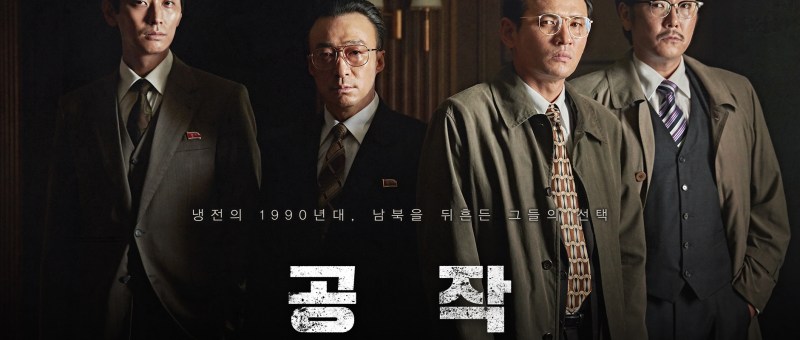
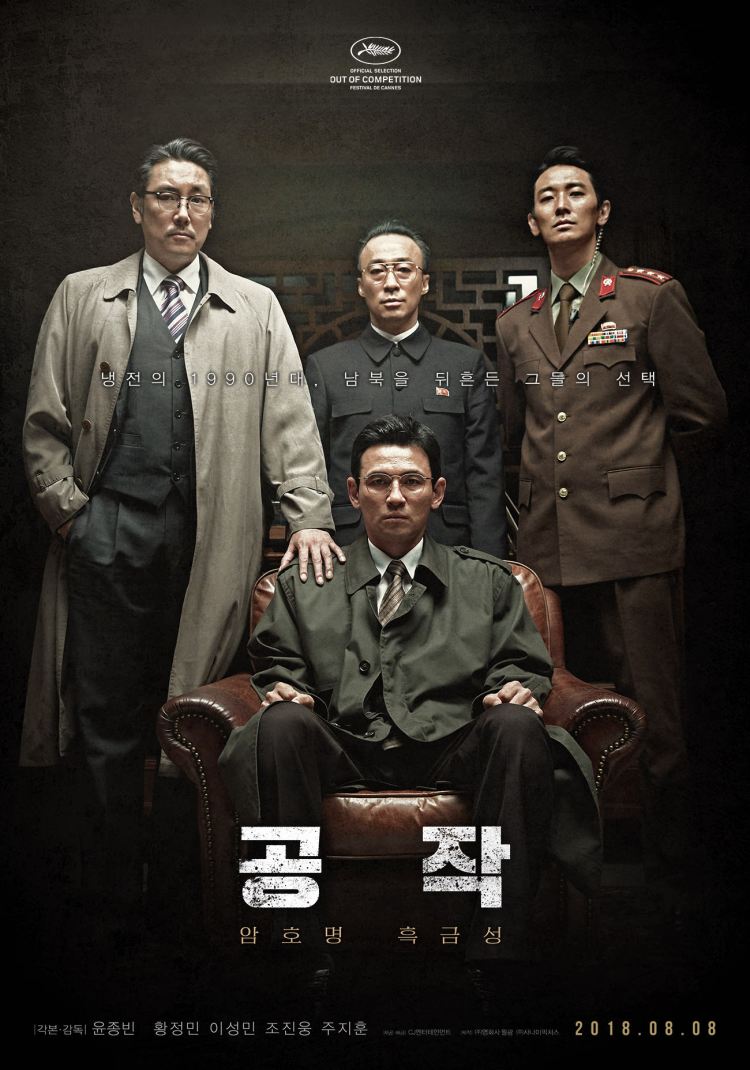
 Some might say the first lesson of spying is not too ask too many questions. The hero of Yoon Jong-bin’s Spy Gone North (공작, Gongjak) may wish he’d heeded this advice as his ongoing mission to gain access to North Korea’s nuclear secrets by way of an unlikely advertising scheme sets him on a dark path towards the realisation that he might not be working for the good guys after all. In geopolitical terms, an enemy is sometimes more helpful than a friend – especially if your “enemy” is working on the same system and can be relied upon to play along when the occasion calls.
By the early ‘90s, South Korea has emerged from a lengthy period of military dictatorships into a fledgling democracy. Tensions with the North are running high as the nation has announced an intention to withdraw with from the Nuclear Proliferation Treaty on grounds of national security. Fearing that the North has already successfully developed nuclear weapons, the South decides to ramp up intelligence gathering activity which is where “Black Venus” comes in. Shedding his old identity by appearing to lose himself in drink and gambling, intelligence officer Park Suk-young (Hwang Jung-min) poses as a sleazy businessman with the intention of gaining access to the North Korean elite through their external trade commission operating out of Beijing.
Improbable though it seems, Park manages to engineer a genuine friendship with the cold and austere North Korean trade official Ri Myong-un (Lee Sung-min) with whom he eventually shares unexpected common ground. Strapped for cash after the South sets them up by getting them in hock to China over a mislabelled walnut scandal, the North needs money fast, which is why they’re prepared to talk to someone as shady as Park’s cover. Park sells them an unlikely solution which runs contrary to their core philosophies in exploiting the exoticism of the forgotten North to sell capitalistic decadence in the South through selling licenses to shoot commercials on North Korean soil (which also allows him to travel about the country with a camera), but he doesn’t quite see the added value of his mission even while almost forgetting about the need to get close to the site of the supposed nuclear research facility.
While Park finds himself an “honoured guest” of the Dear Leader (Gi Ju-bong) whose presence evokes both fear and awe, he is also faced with a pressing political crisis at home as the nation prepares for an upcoming presidential collection. Despite the democratic revolution, the same party has been in power for the last 30 years and the recent swing towards the liberal opposition party has many running scared, especially as taking a softer line towards the North is a prominent manifesto pledge – alongside a reform of the security services, which is obviously distressing news for Park’s bosses. In order to maintain the sense of fear which keeps the right-wingers in power, the security services have been secretly communicating with the North and bribing them to create disturbances at politically advantageous times to manipulate the outcome of elections. Park is not exactly a liberal, but he has to admit this is not a good look and if you’re just going to parrot the “for the people” line perhaps you’re not much better than the thing you claim to hate.
Meanwhile, Park is also witness to a side of North Korea outsiders don’t generally see filled with the starving and the destitute. Loyalists all, there are those among the North Korean elite who want to see conditions improve and worry that thanks to the intense stranglehold of the ruling regime they never will. As in everything, business interests trump all. Park and Ri are fighting for the same thing, aware their fledging enterprise is a subterfuge but also that it’s a huge and dangerous first step towards a happier future. After 40 years of mutual manipulations, however, not everyone is keen on abandoning the status quo especially as the two nations have developed an intensely symbiotic relationship founded on mutual demonisation and a friendly willingness to conspire in ensuring the survival of a useful evil. Still, the strangely fraternal relationship between Park and Ri – two fiercely patriotic men from opposing sides who each identify goodness in the other becomes the heart of the film, holding out hope for empathy and compromise when most prefer enmity and chaos.
Screened as part of the 2018 BFI London Film Festival.
International trailer (English subtitles)
 Review of Zhang Lu’s A Quiet Dream (춘몽, Chun-mong) first published by
  Windows on Worlds