
Linda Linda Linda (リンダ リンダ リンダ, Nobuhiro Yamashita, 2005)

“We’ve only got a little more time to be the real us,” according to a young woman making a promo video for the upcoming school festival, but who really is the “real us”? Now celebrating its 20th anniversary, Nobuhiro Yamashita’s wistful high school dramedy Linda, Linda, Linda (リンダ リンダ リンダ) is in many ways about the process of coming into being along with the anxieties of what comes next. “We won’t end here,” the girl later adds, “We won’t let our high school days become a memory,” yet they already are in a kind of contemporaneous nostalgia and elegy for idealised youth.

Or at least, there’s already a kind of reaching back taking place as the tracks the girls pick for a replacement act are by The Blue Hearts, a 1980s punk band that has become a kind of cultural touchstone echoing a sense of youthful alienation and rebellion. “Linda Linda” is the kind of song everyone knows, and even if for some reason they don’t or don’t even speak Japanese, can at least join in with the riotous chorus. It’s this sense of universality that eventually gives it its power as torrential rain brings the entire school inside just in time to see the girls’ belated act and find themselves captivated by its infectious energy and an identification with their own sense of insecure anxiety.

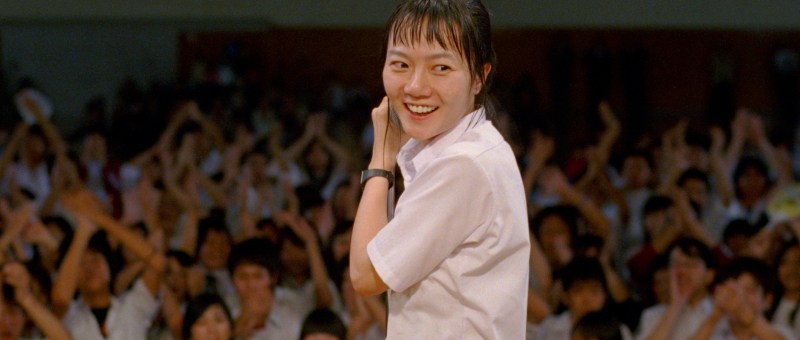
It’s also the serendipitous rain that allows lonely songstress Takako an opportunity to perform having previously declined to do because it’s no fun playing on your own and all her former bandmates graduated the previous year. Moe, the girl who broke her fingers playing basketball in PE leaving the original band members unable to take the to the stage, also gets an opportunity to sing having otherwise been denied a moment of closure in being prevented from taking part in her final school festival. While Moe feels intensely guilty about rendering all their time spent rehearsing somewhat pointless, it’s really the drama between founding members Kei and Rinko that leads to the band’s demise in Rinko’s conviction that it’s “meaningless” to continue while the others decide to go ahead anyway asking Korean exchange student Son (Bae Doona) to be their vocalist because she just happened to come down the stairs at the right moment and said yes because she didn’t really understand what they were saying.

Prior to her involvement with the band, Son had been a rather isolated figure trapped in the “Japan-Korea Culture Exchange Exhibit” which seems to have been more her teacher’s idea than her own and in any case gets no actual visitors. Her Japanese is a bit limited and most of her interactions are with a little girl who lends her manga to help her learn quickly, but becoming part of the band allows her to find her voice both literally and figuratively in taking the lead as the vocalist. A boy who claims to have fallen in love with her (Kenichi Matsuyama) goes to the trouble of learning a long speech in Korean to convey his feelings, yet a bemused Son replies to him in Japanese that she’s pretty indifferent to his existence before switching to Korean to explain that she’s leaving because she’d rather be hanging out with her friends with an expression that implies she’s only just realised that’s what they are. By contrast, she has a bilingual conversation with guitarist Kei (Yu Kashii) in which they seem to understand each other perfectly and each express how glad they are that they got to be in the band together. 

Similarly, it’s the concert itself that seems to heal rifts with a simple “Are you alright?” from Rinko (Takayo Mimura) to Kei whose friendship might, as someone says, essentially be too close for them to really get along. Drummer Kyoko (Aki Maeda) decides to declare her feelings for a longstanding crush before the concert. In the end she doesn’t manage it, but it doesn’t quite matter somehow because their performance is itself a kind of coming into being in which “the real us” comes into focus if also in a moment that itself becomes romanticised or idealised as an encapsulation of youth. Yamashita travels through the school festival as if it were a passage from one state of being to another, from the noodle stalls and crepe stands to haunted houses and the boy creating his own moment through encapsulating them on film, before ending with an unending song “so we can laugh tomorrow,” and the “real us” lives on.


Linda Linda Linda opens in US cinemas 5th September courtesy of GKIDS.

Trailer (English subtitles)

You’re Not Normal, Either! (まともじゃないのは君も一緒, Koji Maeda, 2021)

What’s so great about being “normal” anyway? As the title of Koji Maeda’s quirky screwball comedy You’re Not Normal, Either! (まともじゃないのは君も一緒, Matomo Janai no wa Kimi mo Issho) suggests neither of its heroes is quite in tune with the world around them but then again, is there really such a thing as “normal” or is it more that most people are making themselves unhappy by settling for less simply because they think that’s just how things are and resistance only makes you seem awkward? 

Nerdy cram school maths teacher Yasuomi (Ryo Narita) thought he was OK with being a little different, but just recently he’s begun to feel lonely and fears the possibility of being alone for the rest of his life. Perhaps inappropriately, he looks to one of his students, forthright high schooler Kasumi (Kaya Kiyohara), for romantic and life advice hoping that she will teach him how to be, or at least present as, more “normal”. Unbeknownst to him, however, Kasumi is not quite “normal” herself and is in fact obsessed with a tech entrepreneur, Isao (Kotaro Koizumi), who is all about a new and freer future in which humanity is freed from the burden of labour. Finding out that her crush is already engaged to Minako (Rika Izumi) the daughter of a hotel magnate, Kasumi hatches a plan to break them up while training Yasuomi in the art of seduction. 

Kasumi’s insecurities seem to be down to her failure in her middle school exams, attracted to Isao’s philosophies because they offer a possibility of freedom outside the rigid demands of academic success in Japan. She tells Isao in a not quite by chance meeting that she wants to become a teacher in order to expand children’s minds rather than force them into a fixed perspective as the rather authoritarian, rote learning system of education often does. Yet she also feels out of place among her peers whom she sees as vacuous always gossiping about part-time jobs and boys. She frowns at Yasuomi when he accidentally cuts the conversation dead with an awkward comment while attempting to chat up a pair of bubbly office workers in a bar, but often does the same thing herself while sitting with her high school girl friends who fall silent and then change the subject after she injects a little realism into their mindless chatter. 

Yasuomi had viewed himself as “normal” and never understood why others didn’t, noticing that people often stopped associating with him but not knowing the reason why. Obsessed with pure mathematics, over literal, and overstimulated by the complications of life he takes refuge in the forest and the sensory overload of its nocturnal creatures speaking quite eloquently about the beauty of numbers and actually fairly emotionally intelligent in his understanding of the two women. Resolutely failing at Kasumi’s Cyrano act, he comes into himself only when speaking more honesty much to Kasumi’s annoyance actually hitting it off with Minako who is herself just as lonely and alienated but perhaps wilfully trapped. 

Predictably enough, Isao isn’t exactly “normal” either or perhaps he is but only in the most depressing of ways, his rosy vision of the future delivered with more than a little snake oil and just as much sleaze. Minako may know what sort of man Isao is, that her marriage is largely a dynastic affair set up by her overbearing, authoritarian father, but she too may think this is “normal” and might have preferred not to have to confront her sense of existential disappointment while attempting to fulfil the role of a “normal” woman content with creating a comfortable space in which her husband can thrive.  

Romantically naive, Kasumi wonders how people come to fall in love informed by two relatively mature classmates that for them at least falling in love is a gradual process of increasing intimacy generated through casual conversation. This turns out to be pretty much true for Kasumi too, though in ways she didn’t quite expect watching as Yasuomi opens up to Minako and finding herself unexpectedly jealous while reluctant to let go of the idealised vision she had of Isao as some kind of messiah for a better Japan. There is something a little uncomfortable in the potentially inappropriate relationship between a student and her teacher even as the roles are, on one level at least, reversed but there’s also a kind of innocence in their childish friendship and later determination to start small and let things grow while abandoning the idea of the “normal” altogether to embrace their true selves in a freer future of their own creation. 


You’re Not Normal, Either! screens in Chicago on Oct. 7 as part of the 13th season of Asian Pop-Up Cinema 

Original trailer (English subtitles)

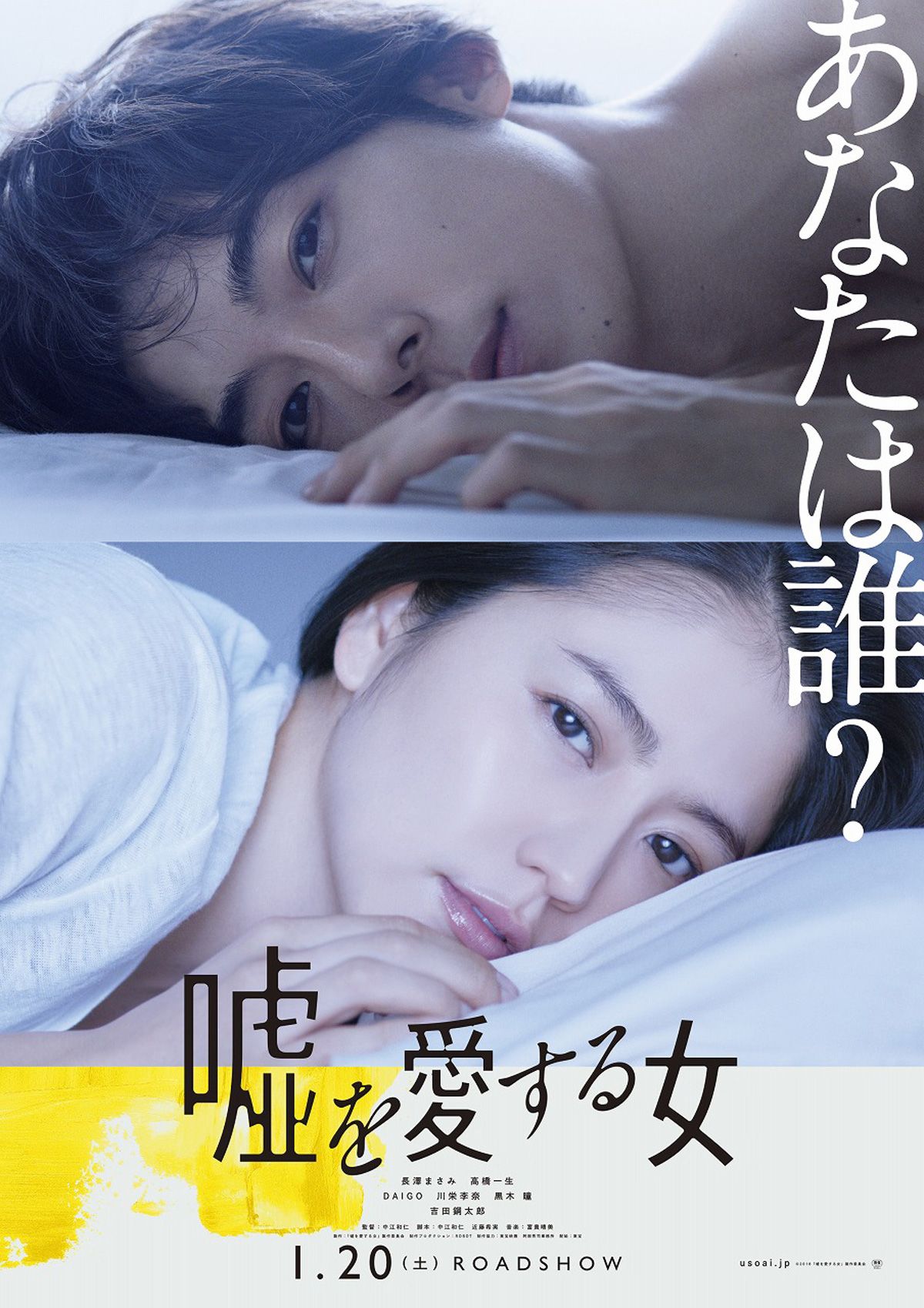
The Lies She Loved (嘘を愛する女, Kazuhito Nakae, 2018)

lies she loved posterHow well do you really know the people with whom you share your life? Or, perhaps, how honest have you really been with those closest you? Inspired by a notorious newspaper article, The Lies She Loved (嘘を愛する女, Uso wo Aisuru Onna) has a few hard questions to ask about the nature of modern relationships and the secrets which often lie at their hearts. Yet the message is perhaps that there are different kinds of truths and the literal may be among the least important of them. The salient message is that consideration for the feelings of others and a willingness to share the burden of being alive are the only real paths towards a fulfilling existence.

30-something Yukari (Masami Nagasawa) is a workaholic career woman currently at the top of her corporate game. Unmarried, she’s been living with impoverished medical researcher Kippei (Issey Takahashi) for the last five years and is happy enough with him (save the occasional one night stand) but also feels as if there’s something missing. She’s angry when he doesn’t show up to a pre-arranged dinner where he’s supposed to meet her mum, leaving her to deal with her mother’s disapproving scorn all alone, but chastened when it’s revealed he was found collapsed in a local park and is currently in the hospital after suffering a brain haemorrhage. If that weren’t enough chaos for the hyper organised Yukari, the police tell her Kippei’s ID is fake. He doesn’t work where he said he said worked and no one seems to have heard of him. Remembering a conversation about cheating spouses, Yukari turns to the detective uncle (Daigo) of one of her work friends for help but starts to wonder what sort of answers it is that she’s really looking for.

An intriguing mystery, The Lies She Loved begins in worrying fashion as if it wants to punish Yukari for her obsessive workaholic lifestyle and avoidance of the traditionally feminine roles of wife and mother. The couple aren’t married, but Kippei is for all intents and purposes a kept man and house husband. He doesn’t earn enough to contribute to the household economy, but makes up for it by handling the domestic tasks usually the domain of a “wife”, i.e. cooking and cleaning. Meanwhile, Yukari works insane hours and often stays out drinking with colleagues, claiming this valuable out of hours time as part of the job but sometimes spending it with other men. We see her “lie” to Kippei, telling him a large bouquet of snacks won from an amusement stand was a gift from a female friend when it came from a “date”, while he reproves her with coldness for her excessive drinking and the tendency it provokes in her for unsolicited cruelty.

Yet moving on we see that a woman’s career, or man’s lack of one, is not the issue at all. The issue is neglect, a taking for granted of other people’s feelings and their willingness to provide support and affection while getting nothing in return. Rather than going to work, Kippei had been spending time in a coffeeshop writing something that’s somewhere between novel and therapy about a happy family living on an idyllic island. We discover that he too once took something for granted, became wrapped up in his career, and overburdened someone else by allowing them to take on the entirety of their mutual responsibility with tragic consequences. Filled with remorse, he ran away from his crime and tried to forget.

The crime is not a woman working, but people in general working too much and knowing each other too little. Humiliated, Yukari wants answers about her immediate past, wanting to know if she was tricked by a conman in order to avoid facing the fact that she never really bothered to ask many questions about the man she invited into her home. Indeed, her decision to “invite” him in the first place is not altogether altruistic and cannot help giving off the scent of mild desperation as she tries to make the arrangement seem convenient while ensuring she retains the upper-hand in the power dynamics without giving too much away. What she really wants to know, without really wanting to admit it, is if her lover really loved her despite his “lies”, but to know that she’ll have to deal with her own longstanding intimacy issues and accept that a loving home is a balanced one in which both partners are equal and agree to share their burdens with openness and generosity. A progressive, nuanced look at modern romance The Lies She Loved is a surprisingly effective defence of love and a mild rebuke of the society which does its best to undermine it.


Original trailer (no subtitles)