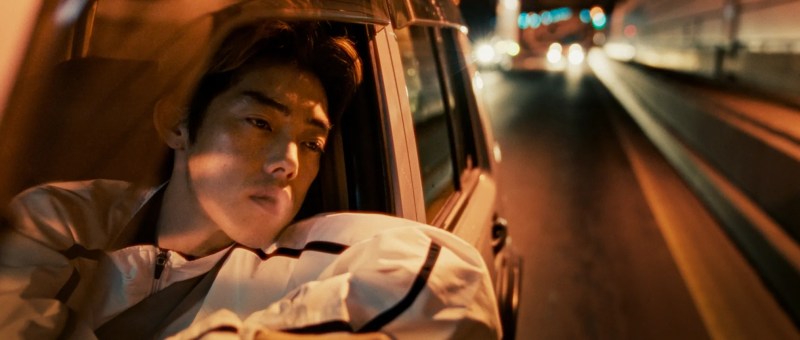

Welcome Back (Naoto Kawashima, 2024)

“Once you play the heel, you can’t go back,” according to up-and-coming boxer Teru’s (Kaito Yoshimura) coach, but it turns out to be truer than for most for the aspiring champion for whom getting up off the mat proves an act of impossibility. While he plays the hero for younger brother figure Ben (Yugo Mikawa) and talks a big game before stepping into the ring, in reality Teru is riddled with insecurity and using bluster to overcome the fear that he can’t live up to the image Ben has of him.

The terrible thing is, he might be right and Ben, a young man with learning difficulties who later gives his age as 10 though clearly in his 20s, may be beginning to see through him. “I lost because I looked at you,” he later says of a failed attempt to fight off their chief rival, but it might as well go for his life which he’s spent in Teru’s footsteps ever since his mother abandoned him with Teru’s family when they were just children on the same housing estate.

As such, Teru does genuinely care for Ben, but has also been hiding behind him in allowing him to become something like a mascot or cheerleader, someone over whom he feels superior but also looks up to him as the sort of person he wants to be but perhaps isn’t. In any case, his boxing career has been going well and he’s on track to become the Japanese champion, but at the same time he’s proud and arrogant. He thinks he knows better than his coach, and likes to make a big entrance trash talking his opponents in a larger-than-life manner that might be more suited to pro-wrestling than the comparatively more earnest world of boxing and earns him a degree of suspicion as a result. His opponent Kitazawa (Yoshinori Miyata) is his opposite number in that, as Teru points out, he’s deathly serious and certain in his abilities which is why he’s able to KO Teru mere seconds into their title match. No longer “undefeated”, Teru simply gives up and retires from boxing only to spiral downward while working as a supermarket mascot, eg. Ben’s old job from which he also gets him fired by messing it up for both of them because of his pride and temper.

But for Ben, the certain truth of his life has been that “Teru never loses”. Now that Teru lost, something’s very wrong with the universe and he has to put it right, which is why he decides to fight Kitazawa himself even if he has to walk to Osaka from Tokyo to do it because they’ve got no money for transport. What neither Teru nor Aoyama (Yuya Endo), a boxer Teru once defeated in another title fight but ends up helping him and Ben on their quest, is that after obsessively watching Teru all this time, Ben is actually quite a talented, if untrained, fighter. They were hoping they could get him to give up on his plan by finding someone weaker than Kitazawa to defeat him so he’d know he had no chance, but he basically fights his way all across Japan to prove that Teru really is the hero he always thought him to be. 

This turns out to be inconvenient for Teru because inside he feels himself to be a loser and since his single defeat has been running away from the fight. As he later begrudgingly realises, none of this would be happening if he’d knuckled down done the training so he’d be able to beat Kitazawa in the first place rather than being consumed by his pride and arrogance. He should be the one fighting Kitazawa, not Ben who is putting himself in danger because the world doesn’t make sense to him any more. Kitazawa, meanwhile, has his number and seems to look down on him for his lack of fighting spirit, correctly surmising he will walk away from the chance to fight him for real when he opts for a last resort of trying to bribe him to fake a sparring match so that Ben will see him win and be able to go on with his life. 

But nothing quite goes to plan, and it seems like Ben might be starting to see that Teru might actually be using him to bolster his own sense of low self-esteem which obviously means that he does and always has looked down on Ben. Having come to a realisation that he needed to play the role of the hero that Ben needed him to be, perhaps what he sees is that Ben has outgrown him and that despite his constant insistence that “Ben is a child” is capable of doing what he couldn’t in fighting back even when the odds seem impossible. Teru is defeated by life, but fighting back in his case might look like something a little less glamorous that starts with eating some humble pie and calling in a favour to get a shot at a regular job he’ll have to take a little more seriously. In one way or another, their accidental road trip clarifies the dynamics of their “brotherly” relationship, but at the same time leads them to a point of division in which moving forward might necessarily mean they’re going in different directions.


Welcome Back screened as part of this year’s Camera Japan.

Trailer (no subtitles)

Strangers (Kenta Ikeda, 2024)

Naoko, the heroine of Kenta Ikeda’s Strangers, says she’s been pretending all her life. She’s been pretending to be what everyone wanted her to without really knowing or thinking about what it was she wanted to be or who she really is. On a baseline level, Ikeda suggests that we are and remain strangers to ourselves while equally confused about those around us, seeing what we want or expect to see rather than who they really are.

In part that may explain why Naoko has stayed with her unfaithful fiancé Takeo who got a colleague pregnant and then seemingly abandoned her. Shimizu then began harassing Naoko, stalking her and making silent calls. To make matters worse, Takeo is often away on “business trips”. He’s not currently responding to her phone calls or messages and has just embarrassed her by not turning up to a family event. Naoko’s sister thinks she should leave him and doesn’t understand why she hasn’t already. But Naoko just sighs that she’s decided not to expect too much from life and seems prepared to put up with this degradation because she doesn’t think she deserves anything better. 

That might be why she’s so drawn to her enigmatic colleague Yamaguchi who waltzes in past noon wearing a distinctive blue dress that floats in the air behind her. The other ladies at work gossip that their bullying boss Satome, who is married with two children, got her the job after picking her up on a dating app and the reason why she can get away with such unprofessional behaviour is because she’s sleeping with him. But Naoko later discovers that Yamaguchi’s dating app activities are a kind of side hustle in which she participates in idealised dating scenarios pretending to be the lover of lonely men who pay her handsomely for a few hours of fantasy romance.

Or as Yamaguchi describes it, the opportunity to experience only the good parts of love before you get sick of each other and run out of things to say. It sounds more than a little like the logic of someone who’s decided not to expect too much from life, and while it seems Yamaguchi may be trying to avoid her own grief and loneliness, it’s true that she otherwise remains a cypher. After losing contact with Yamaguchi and being left with her smartphone, Naoko receives a call from her handler who tells her that it doesn’t matter who she is or why she has “Yamaguchi’s” phone, all that matters is turning up at the appointment and never letting it slip that it’s all just role-play.

On her dating app profile, Yamaguchi’s face is blurred so that you only really see the image of her in her distinctive blue dress which Naoko too later starts wearing. The people around Naoko are often shot in soft focus so that we can’t really be sure of their identity beyond using their clothing to infer who they are. Men in particular are often shot from behind or with their faces out of frame as if they were all just a much of a muchness. We never even meet Takeo, who apparently does not return from his “business trip”. In any case, in agreeing to the fantasy date, Naoko is gradually taken over by the Yamaguchi persona. The spread of the graze she sustained at the beginning of the film seems to indicate the gradual erasure of her identity, yet in another sense becoming Yamaguchi also gives Naoko an excuse to stop pretending and accept herself or at least to start expecting more from life. She becomes more assertive, flirtatious, and confident in confronting Shimizu only to realise that she may not have been the mysterious force she felt watching her after all. 

In her Yamaguchi persona, Shimizu describes Naoko as a like a colourless and doorless detergent, but she replies she’s been hiding all her life. She ran ran away from her problems, refused confronting Takeo or Shimizu, avoided being honest with her family and simply played up to the image they had of her of a shy and obedient woman. There might be something in the fact that Yamaguchi kisses her suggesting that Naoko may have been running away from her sexuality, but equally it could just be that this is how the Yamaguchi curse is passed from woman to woman. Having once assumed it, Naoko now must try to shake it off but that too might not be as easy as she might assume. Meanwhile, those around her also have their own secret lives and faces they keep hidden from others. Ikeda creates a atmosphere of eeriness and hovering violence amid the faceless city where it doesn’t matter who you are so long as you show up and everyone is to some extent participating in a temporary fantasy in order to overcome the disappointment of life in which as Naoko had told herself it seems better not to expect too much.


Evil Does Not Exist (悪は存在しない, Ryusuke Hamaguchi, 2023)

Whatever happens upstream affects those further down according to the headman of a small village faced with incursion from city dwellers hoping to turn their peaceful idyll into a tourist hotspot in Ryusuke Hamaguchi’s eco drama Evil Does Not Exist (悪は存在しない, Aku wa Sonzai Shinai). He reminds them that those at the top have a responsibility to those below, and it’s only because of this sense of mutual consideration that life is possible here. It’s an obvious metaphor for the contemporary society in which those with money and power have largely forgotten about those without, but then the film’s title also asks us a question. What is “evil”, does it exist or not, or is it merely in inextricable part of nature human and otherwise that balances out the good?

After a long tracking shot along the trees shot from below, Hamaguchi focuses on the figure of Takumi, a man at home in nature patiently sawing and cutting logs. He teams up with another man, Kazuo, to harvest water from a local stream we later realise is being used by an udon restaurant for a superior taste. Takumi shows him wild wasabi and explains how the locals use it, suggesting that Kazuo consider adding some to his dishes. Like him, Takumi’s daughter also seems to be at home in the forest, wandering off to walk home alone when Takumi inevitably forgets to pick her up from school.

Takumi describes himself as a “jack of all trades” or more to the point a local odd job man, but seems in many ways he’s one who keeps the balance. The problem they have now, is that a company from Tokyo has bought some land and is intent on stetting up a “glamping” resort in the village. A pair of agents turn up from the city to give a kind of question and answer session, but as one of the attendees later suggests it’s mainly to make themselves look good. Unable to answer most of the villagers’ quite reasonable questions all they can do is state they’ll take their opinions into account while offering flawed promises of financial gain and insistence that people from Tokyo will visit as if that were some kind of honour. It doesn’t seem to occur to them that the villagers maybe happy as they are and aren’t interested in further material gain while understandably wary of the effects of the resort on the local area from increased traffic and pollution. The agents encounter unexpected resistance centring on the septic tank which has been penciled in for an area which would lead to the contamination of wells and groundwater while it’s also clear that the company are determined to cost cut with the agents blithely telling them that a little bit of sewage in your drinking water never harmed anyone and in any case it’s within the permitted amount. 

Others ask questions about fire risk and understaffing with the agents later asking Takumi to become the resort’s caretaker, insulting him with the implication that he’s some kind of layabout easily bought with a fat paycheque. He corrects them that he has a job and doesn’t need the money, though they persist with asking him to be a kind of advisor. Takahashi, a jaded manager, is soon captivated by the area and in particular Takumi’s manliness in his log splitting and mysterious demeanour but there’s something inevitably harsh and unforgiving about nature even if it’s man that has corrupted it. Gunshots are heard over the horizon, men hunting deer. Takumi and Hana walk past the carcass of one who bled out from a bullet wound and was presumably just left there dying for no real reason. Takumi tells the agents that their site is on a deer path, so they’d need high fences which might put the customers off but reflecting that wild deer aren’t usually “dangerous” unless they’re sick or have been shot. Takumi asks where the deer are supposed to go but gets only a shrug of the shoulders and “somewhere else” from Takahashi, but there are only so many other places, what if this is the last one? If you continue to displace things, there won’t be anywhere left for anyone.

Still, as Takumi says it’s not that villagers have already decided to resist the glamping project, only that they want their fair complaints to be addressed and are willing to engage with the process if only the agents would treat them with a little more respect. But that’s something thin on the ground from the execs in Tokyo who think they’re all a load of bumpkins easily bought off with promises of a better economic future. To Takumi it is really a matter of balance, something that should be maintained for one’s protection as much as anything else. The ominous score which frequently cuts out abruptly adds to an edge of unease and supernatural dread in the ancientness of the natural world even if as Takumi points out this isn’t their ancestral land. It’s a new village that originated in the immediate post-war era when returning soldiers were given land to farm. They are all to some degree outsiders, as perhaps are humans in this inhuman place, but also ones who’ve found a way to live in it that’s as much about respect for the land and others as it is about survival.


Evil Does Not Exist opens in UK cinemas of 5th April courtesy of Modern Films.

UK trailer (English subtitles)