Creation of the Gods I: Kingdom of Storms (封神第一部:朝歌风云, Wuershan, 2023)

A bad ruler, like a bad father, has only bad lessons to teach his sons and will receive the same in kind in Wuershan’s beautifully produced fantasy epic, Creation of the Gods 1: Kingdom of Storms (封神第一部:朝歌风云, Fēng Shén Dìyī Bù: Zhāogē Fēngyún). Inspired by the classic work of 16th century literature also known as Investiture of the Gods which serves as a kind of foundation myth, the film is the first of three and a 10-year labour of love from the director that began shooting in 2018 and took nearly four years to complete post-production. 

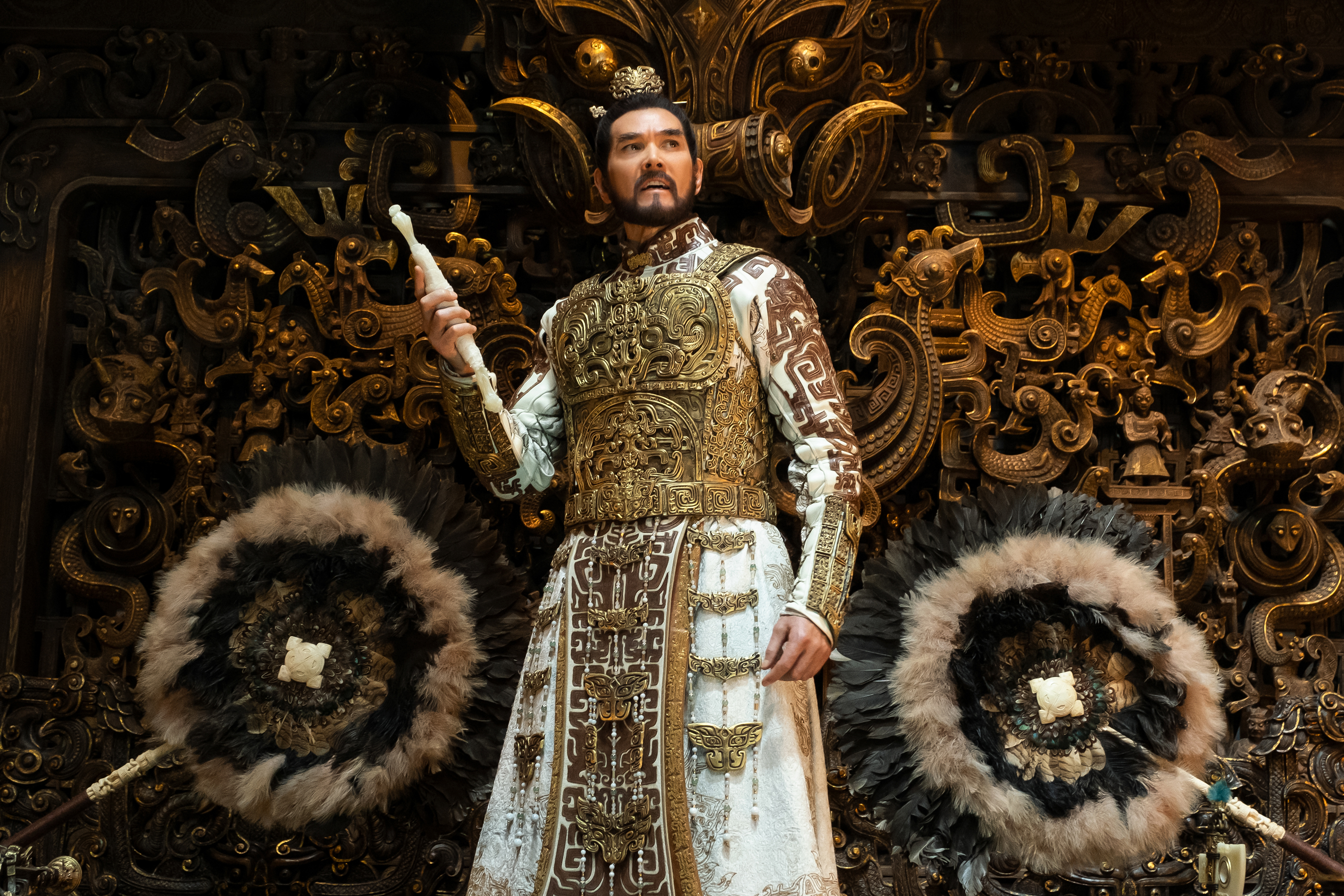
As the opening title card explains, the film focusses on the fall of the Shang dynasty at the hands of its last king and King of All the Realms Yin Shou (Fei Xiang), known posthumously as King Zhou. He is first introduced, however, through the eyes of the young man that is really the hero of the tale, Ji Fa (Yu Shi), who describes him as a hero of the kind he dreams of becoming. Yin Shou is charged with leading an attack on the compound of rebellious lord Su Hu who has refused to pay his taxes, taking with him the four hostage foster sons of the primary dukes along with that of Su Hu himself. The boy is sent to plead with him but gets no reply. In a show of what seems like kindness, Yin Shou asks him what sort of father his must be to give no reply and formally adopts the boy but only in the knowledge that honour dictates he now take his own life as proof of his loyalty to the Shang. 

These young men, Ji Fa included, are forced to ask themselves to whom they owe their loyalty, a man who gave them up and may long have forgotten them or Yin Shou who has in a sense raised them and demands their loyalty. Ji Fa is fiercely loyal to Yin Shou and thinks him everything a good father, a good commander and eventually king should be. Yet Yin Shou has extremely strong second son syndrome and resents his father and older brother for treating him as an also ran. Ji Fa meanwhile is still naive and egotistical, coming to the palace dreaming of becoming “a hero” with only a superficial understanding of what that would mean and easily swayed by Yin Shou’s majesty while Yin Shou in turn rejects his own son ironically fearful of him as a rival having watched the old king die at the hands of his brother while privately pleased that he will finally take his rightful place on the throne only to be told that the kingdom is in peril and the only way to save it is to commit public self-immolation. 

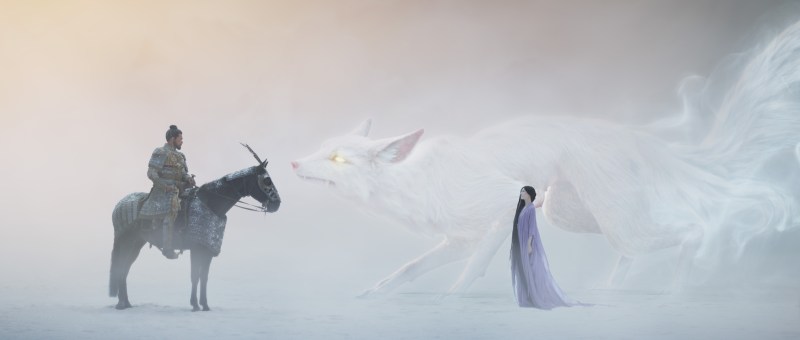
When the legendary heroes Jiang Ziya (Huang Bo), Nezha (Wu Yafan), and Yang Jian (Cisha) turn up with a magic scroll that can undo the Great Curse bearing down on the land, Yin Shou describes it as blessing on realising the talisman gains in power the more souls it receives. There may be something a little chilling the contemporary echoes of his paranoid authoritarianism as he actively begins to round up subversive elements even as he takes as a mistress the daughter of a man he beheaded who in reality took her own life and has been possessed by a fox spirit though it is also quite ironic that it is Su Daji (Narana Erdyneeva) who will bring down the Shang. 

In any case, Wuershan brings the classic tale to life with a sense of magic and wonder painstakingly recreating the fantasy world of feudal China with its beautiful landscapes marred by chaotic infighting and destabilised by dysfunctional filiality. In the end, Ji Fa will return to his true father and with him the path of righteousness which will overcome the Great Curse and begin to restore order laying the foundations for the Chinese society. Meanwhile, in this age of demons and strange creatures, interventions from the heavens and the mortal world in so much chaos that Nezha has been brought in to help, Wuershan discovers a kind of soulfulness embracing the timeless quality of this ancient mythological tale yet grounding it in a well honed sense of emotional reality.


Creation of the Gods I: Kingdom of Storms is in UK cinemas now courtesy of CineAsia.

Trailer (Simplified Chinese / English sutbtitles)

The Captain (中国机长, Andrew Lau, 2019)

The Captain poster 2Chinese cinema loves the miraculous, but it loves stories of ordinary heroism even more. Inspired by real events which occurred on 14th May 2018, not quite 18 months before the film’s release, The Captain (中国机长, Zhōngguó Jīzhǎng), is a classic story of everything going right after everything goes wrong. Implicitly praising the efficacy of a system which values military precision over individualistic handwringing, Lau’s dramatisation reserves its admiration for those who keep their cool and follow the rules in the midst of extremely difficult circumstances.

Beginning in true disaster movie fashion, Lau opens with a brief yet humanising sequence which sees the otherwise austere pilot Captain Liu (Zhang Hanyu) say goodbye to his little girl, promising he’ll be back in time for her birthday party that very evening. Thereafter, everything is super normal. The pilots and cabin crew arrive at the airport, get to know each other if they haven’t flown together before, and run through their drills. The cabin crew laugh through the “we’re professionally trained and are confident we can ensure your safety” mantra rehearsed in case of emergency hoping they’ll never actually have to say it, but disaster strikes a little way into the flight when the windscreen cracks, eventually shattering and sucking rookie co-pilot Liang Peng (Oho Ou) halfway out.

Of course, the story is already very well known so we can be sure that the plane will land safely with no one (seriously) hurt, but it’s still an incredibly tense time for all. As Liu explains to Liang Peng, everything in the cockpit must be done with the upmost precision. It’s when you get complacent that things will start to go wrong. A former air force pilot, Liu is not the most personable of captains with his permanently furrowed brow and serious demeanour, but he’s exactly the sort of person you need in a crisis, calmly and coolly making rational decisions under intense pressure. While he’s doing his best at the controls, the entirety of the Chinese air aviation authorities are springing into action to try and ensure the plane’s safe landing – airspace is cleared, the military monitor the situation, and the fire and ambulance services are already on standby in the hope that Liu can safely land at Chengdu airport.

Keeping the tension high, Lau resists the temptation to sink into melodrama, more or less abandoning a hinted at subplot about stoical cabin supervisor Nan’s (Quan Yuan) possibly unhappy home life while introducing a fairly random diversion in a group of aircraft enthusiasts furiously tracking the plane’s trajectory online and then heading out to the airport in the hope of witnessing a miracle. Before the potential catastrophe takes hold, the crew have to deal with unpleasant passengers intent on throwing their weight around, nervous flyers, and people travelling with small children, but do their best to provide service with a smile even in the most trying of circumstances. They are frightened too, but have to muster all of their professionalism in order to be strong for the passengers, keeping them calm and preventing them from creating additional problems while the guys in the cockpit try to find a solution that keeps everyone safe.

Released for National Day, The Captain’s brand of propagandistic patriotism is of the more subtle kind, only really rearing its head during the final moments during which awkward captain Liu suddenly starts singing a folksong in praise of the motherland while celebrating their lucky escape on its one year anniversary in the time honoured fashion of a group hot pot. Nevertheless, the point it’s making is in the virtues that Liu states after landing, valuing life and duty. Liu landed the plane because he followed procedure perfectly, kept his head, and made well-informed decisions. A master of understatement, his speech on landing is simply an apology to his passengers that he wasn’t able to take them safely to Lhasa. After waiting for the investigators, he thinks the passengers are hanging round outside the plane because they’re angry and want an explanation, little realising they are just overjoyed to be alive and wish to thank him for saving all their lives. A tense tale of selfless heroism aided by good training and immense professionalism, The Captain is a subtle endorsement of an authoritarian system but also of the importance of keeping cool in a crisis as the best weapon against catastrophe.


The Captain is currently on limited release in UK cinemas courtesy of Cine Asia, and in the US from Well Go USA.

Original trailer (English subtitles)

https://youtu.be/Vy3nA6VDGyw

Call of Heroes (危城, Benny Chan, 2016)

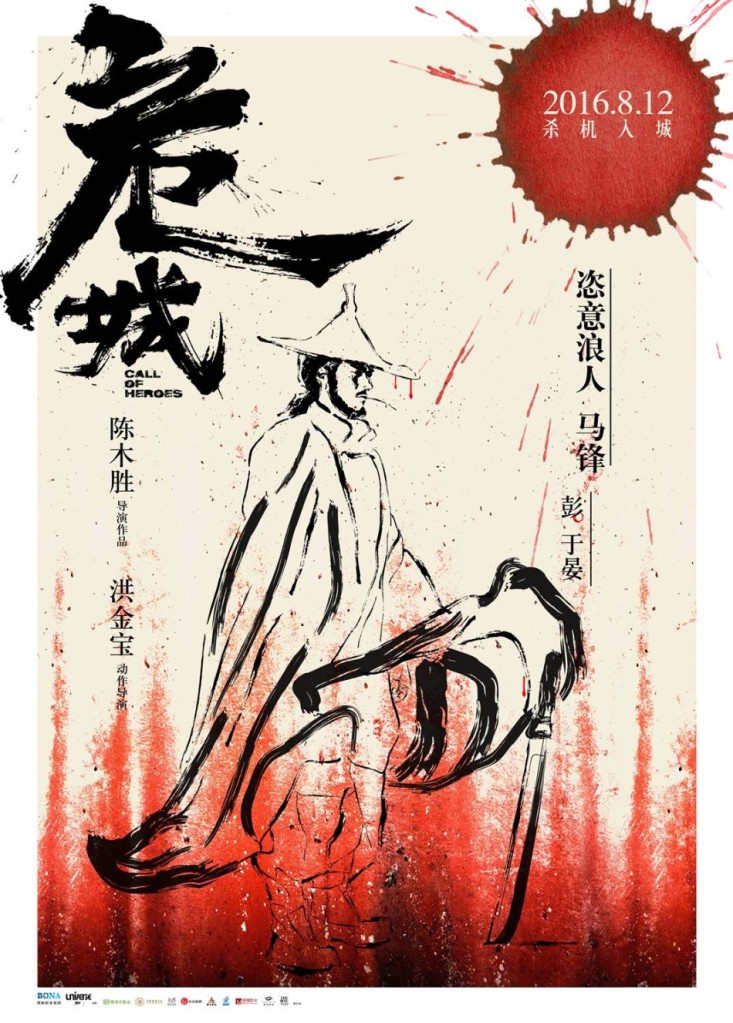
call of heroesA blast from the past in more ways than one, Benny Chan’s Call of Heroes (危城, Wēi Chéng) is a western in disguise though one filtered through Akira Kurosawa and Sergio Leone more than John Ford. Filled with Morricone-esque musical riffs and poncho wearing reluctant heroes, Chan’s bounce back to the post-revolutionary warlord era is one pregnant with contemporary echoes yet totally unafraid to add a touch of uncinematic darkness to its wisecracking world.

1914 – three years after the collapse of Chinese feudalism and warlords rule the land, each vying for power and terrain but taking little account of the displaced people in their path. The residents of Stone City find this out the hard way when notorious general Cao Ying wades into town and conducts a widespread massacre seemingly for the fun of it. Plucky school teacher Bai Ling manages to escape with some of her pupils even whilst other teachers and children are being summarily executed by Cao’s troupes.

Having left with nothing and walked miles, Bai and the children are near starvation when they stop into a noodle house to share a single bowl. Unfortunately the noodle house is about to be robbed but fortunately one of the diners is bearded wanderer Ma Feng (Eddie Peng) who isn’t up for anyone disturbing his serious food coma. Impressed with Ma’s skills, the kids and Bai make their way to Pucheng where Bai has a cousin but Cao is still on the warpath and trouble has a way of tracking good people down.

Pucheng (the name of which literally means ordinary town), is watched over by the noble sheriff Yang Kenan (Sean Lau Ching-wan) though the protective garrison has been sent to the front leaving them with only a skeleton defence. When a mysterious visitor arrives in town and proceeds to shoot dead a man, woman, and even a child, Yang arrests him but when the killer turns out to be Cao Ying’s unhinged son, a number of questions arise. Yang is committed to justice – no matter the man’s name, he ought to pay for his crimes. Yet, Cao Shaolun’s presence is sure to attract his father’s attention and so many of the townspeople feel it might be better to let Cao Shaolun go. Placate a tyrant and undermine the idea of justice by failing to enforce the law or sign your own death warrant by standing up for your principles, it’s a frontiersman’s dilemma.

The references to classic Hollywood westerns are obvious enough, particularly when the narrative takes a turn for the High Noons as Yang finds himself standing alone as the sole resistance to the oncoming militia man threat. Though the townspeople do not exactly turn on Yang in the same way they turn on Kane, they clearly choose appeasement over war. Yang’s dedication to justice is purehearted, there’s little hint of personal vanity in his decision to stand up for the rule of law but only the knowledge that folding now is the same as bowing to Cao’s tyranny.

Though introduced as a possible protagonist, Ma Feng takes a far smaller role in the action than might be expected. Clearly channeling Mifune’s Sanjuro, Peng’s wisecracking drifter and cynical, reluctant hero is almost at odds with the serious business of law vs politics over in Pucheng. His character centric subplot of conflict with a former friend who works for the other side is insufficiently developed to support the emotional weight it’s intended to carry and sometimes feels like a distraction from the main narrative though the great pot mountain based martial arts set piece is certainly one worth waiting for.

If Peng’s Ma Feng feels slightly misplaced with his cynicism and comic stunts, Louis Koo’s hammed up villain Cao Shaolun is in an entirely different film altogether. Wildly over the top, Koo plays Cao Shaolun as a permanently amused psychopath, all crazy eyes and manic laughter. A self consciously cool guy, Cao Shaolun dresses in white and murders innocents with a golden gun all the while knowing he can do as he pleases simply by the virtue of his name.

Shot with a heavily digital aesthetic, Call of Heroes’ evidently high production values are sometimes reduced to a televisual quality or otherwise let down by substandard CGI. The fight scenes themselves are filmed with an old fashioned rigour filled with innovative and exciting choreography and are refreshingly humour free. Like the best westerns, Call of Heroes contains its own parable in that the best weapon against tyranny is a strong and righteous populace but the final stretch almost undermines its noble aims by presenting what is either a revolutionary spring lead by the people for the people, or a worrying case of mob justice.

Prone to narrative dead ends in setting up major characters only to sideline or kill them off unexpectedly, Call of Heroes has a frustrated quality in not being able to decide whether it wants to be a serious call to arms for standing up for what’s right in the face of overwhelming force, or a comedic romp in which a cocky drifter sorts everything out by accident. Either way, Call of Heroes does provide a number of genuinely exciting martial arts set pieces even if floundering slightly in-between them.


Original trailer (Cantonese with Traditional Chinese/English subtitles)