Seppuku: The Sun Goes Down (陽が落ちる, Yuji Kakizaki, 2024)

What’s more absurd, that the shogun orders a man to take his own life in atonement for accidentally damaging his favourite bow or that the samurai actually does it without protest? There is something a little uncomfortable about Yuji Kakizaki’s Seppuku: The Sun Goes Down (陽が落ちる, Yo ga Ochiru) as it, unlike many similarly themed samurai dramas, seems to find only nobility in such a senseless death rather than outrage against a word in which a man must die for a careless and inconsequential mistake.

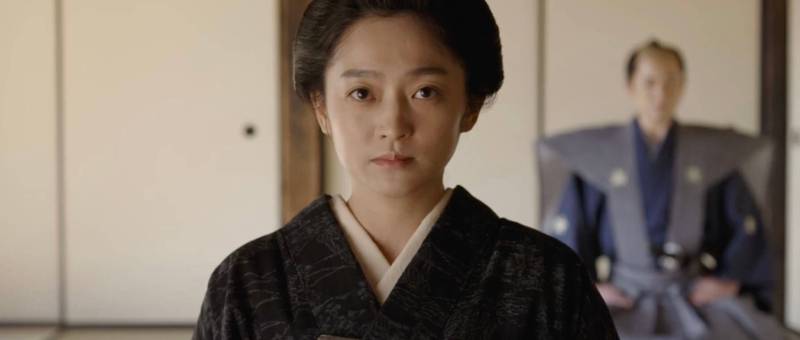
Indeed, the worst outcome Kyuzo envisages is that he’s going to get the sack from his job as a castle guard and his family will suffer both a reputational loss and financial hardship because of it. His wife, Yoshino, is quite prepared for the latter, stating only that they will soon adjust to living more simply. No one seems to be thinking that this is anything other than a minor incident that will soon blow over, which is why it comes as such a shock to Kyuzo’s best friend Denbei that his friend has been ordered to commit seppuku and that he must be the man to deliver the message the next morning. Kyuzo is currently under house arrest, which means that were Denbei to visit him before that, he too would be committing an offence and could end up suffering the same fate. The best thing he can do, as his wife advises, is to go there and sing a song outside conveying the difficult news through poetry while maintaining plausible deniability. 

Alternate forms of communication become a kind of theme with Yoshino deciding to fulfil the dreams of her loyal maid, Shige, by teaching her to read and write explaining that one may say in a letter that which they otherwise could not. Shige is from a peasant farming family and on her return to them after Yoshino decides to dismiss her so that she won’t be caught up in it when they deliver her husband’s death warrant which could, in fact, order everyone in the house to die, Shige’s family remark that they can’t understand these “cruel” samurai who are expected to surrender their lives over something so trivial. Yet Shige’s father who is currently bedridden with illness instructs her to go back knowing that it may mean her death because her duty is serve the family she was indebted to right until the very end. Shige even gives her father the comb and money Yoshino had given her to open a restaurant to pay for medical treatment but he won’t take it until she’s fulfilled her duty which rather undercuts any criticism of the samurai code.

Similarly, Yoshino struggles with the decision of whether to live on or take her own life alongside her husband. Her options are now few. She must either return to her birth family, if they agree to take her, or become a Buddhist nun, while their 10-year-old son Komanosuke would ordinarily be sent to his father’s relatives or placed into a temple as a monk. Denbei and his wife’s offer to adopt Komanosuke in the absence of an heir to their clan provides a neat solution, but leaves Yoshino’s fate in the balance now separated from both her son and husband. Only at the very end in her empty house does her resolve break as she cries out against the injustice and absurdity of it all.

Kyuzo, meanwhile, is expected to make his peace with his death having been given prior warning by Denbei and allowed to enjoy one last night with his family. He says that what he fears is “nothingness”, but as Yoshino tells him even if he were to reject his fate by running away he would endure a life of fear and misery on the run before he was caught and executed as a coward and a traitor. Yet what the film finds in his stoicism that takes on an uncomfortably elegiac quality that he is basically doing the right thing by submitting himself to the samurai code as cruel and arbitrary as it might seem to be with its overly enthusiastic magistrate who seems to relish the prospect of seeing Kyzuo’s head on a tray. He first gives Denbei the opportunity to leave out of consideration of their friendship knowing that he cannot accept the offer without incriminating himself, and then insists he be Kyuzo’s second as if to double down on the sadistic cruelty of ending a man’s life to demonstrate a capricious shogun’s power. Dramatising the submission of these people who seem to be good and kind yet caught in this absurd web of honour and power with sadness rather than anger leaves a slightly sour taste in the mouth in its implication that obedience to such an absurd social code constitutes nobility rather than foolishness and that the situation is merely a misfortune that must be quietly endured rather than an outrageous injustice that no one should defend.


Seppuku: The Sun Goes Down screened as part of this year’s Toronto Japanese Film Festival.

A Beautiful Star (美しい星, Daihachi Yoshida, 2017)

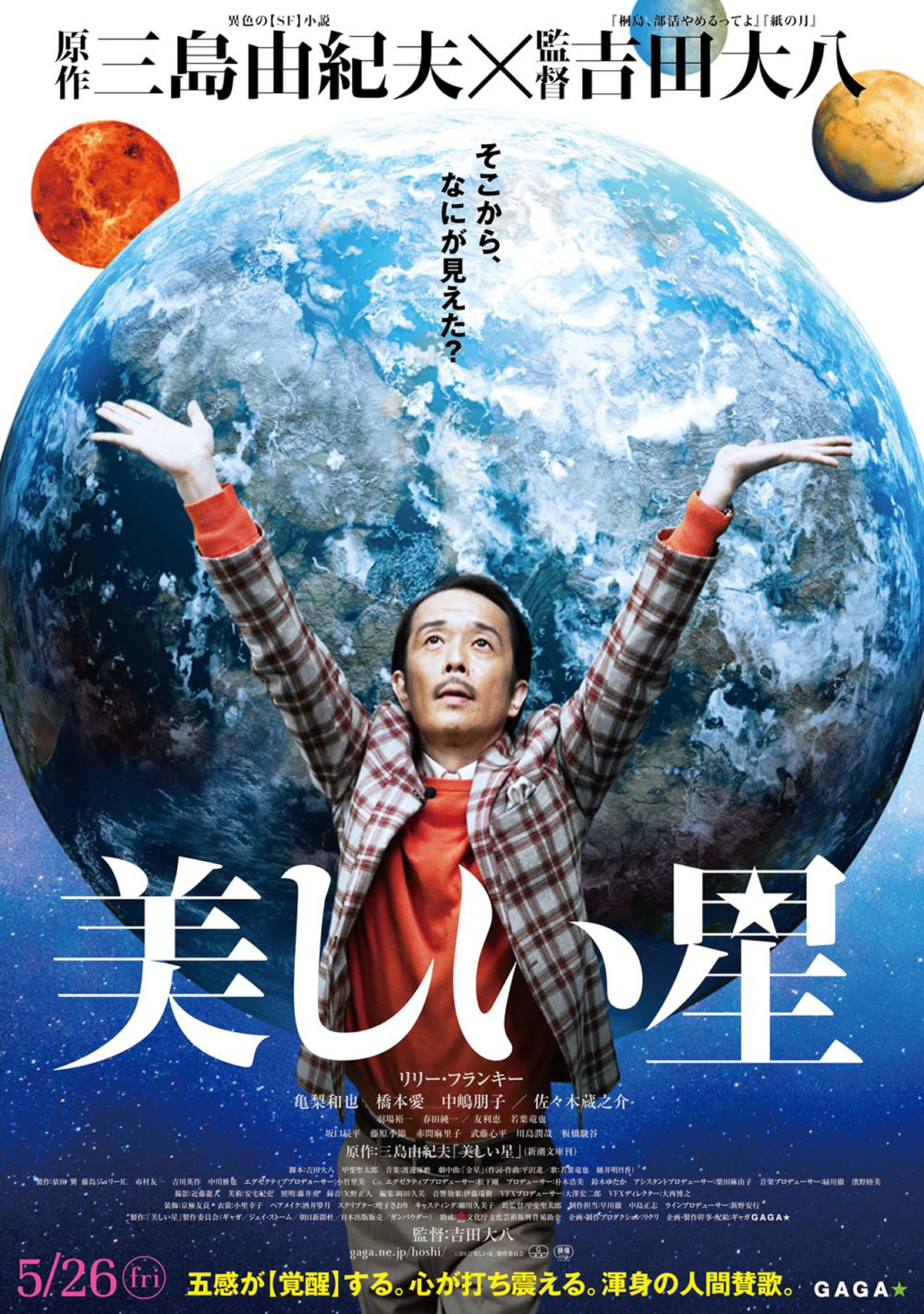
A Beautiful Star poster 1Given life’s anxieties, it can sometimes be hard to remember that the world is a beautiful place. If only we humans could learn to stop and smell the flowers every so often, we wouldn’t be so eager to destroy the place that gave us life. Loosely adapting a novel by Yukio Mishima, Daihachi Yoshida’s A Beautiful Star (美しい星, Utsukushii Hoshi) swaps Cold War nuclear paranoia for climate change anxiety as a collection of extra-terrestrials consider differing strategies to save the Earth, the most radical of them being the eradication of the human race.

Yoshida opens with the Osugi family, minus son Kazuo (Kazuya Kamenashi), “enjoying” a birthday dinner at an Italian restaurant. The tension between them is obvious as patriarch Juichiro (Lily Franky) bad mouths his absent son, daughter Akiko (Ai Hashimoto) sits sullenly not touching her food, and mum Iyoko (Tomoko Nakajima) tries to keep the peace. Juichiro, as we later realise, is a minor celebrity – a much loved TV weatherman whose predictions are not terribly good but he does have a very personable manner. Unfortunately, he’s not so nice offscreen and has been cheating on his wife with a much younger woman who is after his job. After a tryst at a love hotel, the pair get into some kind of bizarre car accident and Juichiro wakes up on his own in a field feeling not quite right. After a colleague suggests he might have been abducted by aliens, he develops an interest in UFOs and, after being moved to tears on air, comes to the conclusion that he is a Martian emissary from the League of Solar Planets come to enlighten the Earth to the dangers of global warming before it’s too late.

In fact, Juichiro is not the only member of the Osugis to believe he is not of this Earth. Except for mum Iyoko, everyone eventually realises they are actually from another planet but their feelings of “alienation” are perfectly Earthbound and born of extremely normal anxieties the like of which can cause discord in any family. Complaining about his son’s lateness to the birthday dinner, Juichiro runs down Kazuo’s lack of full-time employment and writes him off as “just an errand boy”. Kazuo, resentful of his father, feels an intense insecurity about his failure to forge a successful life for himself – something that is thrown into stark relief when he meets an old college buddy now a salaryman who seems to take pleasure in the fact that the captain of the basketball team has made a mess of things where he is now on the road to career success. So when Kazuo meets shady fixer Kuroki (Kuranosuke Sasaki), currently running the campaign for conservative politician and climate change denier Takamori (Jyunichi Haruta), and finds out he is actually from Mercury, it restores his sense of purpose even if it pushes him towards becoming a slightly dangerous right-wing manipulator.

His sister, meanwhile, is a lonely, depressed university student with a complex about her appearance. Approached by a creepy guy running some kind of campus beauty pageant, she can’t get away fast enough but is captivated by the song of a street busker who eventually tells her she likes his music because it’s inspired by their shared roots as Venusians and that the reason she “despises” her own beauty is that Venusians used to set the beauty standards on Earth but now they’ve been usurped. Feeling not quite so alone and more confident in her skin, Akiko decides to enter the pageant to “correct” the perception of beauty in human society.

“Beauty” seems to be the key. Iyoko finds herself sucked into a pyramid scheme selling “beautiful” water mostly out of a sense of lonely purposelessness. Apparently from power spot deep within the Earth, the water is supposed to be its rejuvenating life blood but like so much else, humanity has misused and commodified it. Juichiro’s Martians have a conventional solution to the present problem in that they want humanity to wake up and slow down. The Mercurians, however, have more radical ideas. Seeing as humanity is toxic to this planet that we all love, the obvious answer is simply to eliminate it, engineer a reset in which the Earth could heal itself after which point a new, more responsible humanity could be permitted to return. The problem, they say, is that humans do not think of themselves as a part of nature or realise that extinction is a perfectly natural part of the ecological life cycle. If they did, they might not be in this mess, but now they need to accept their responsibility and agree to a mass cull to save the planet.

Each of the Osugis has their insecurities wielded against them, and in the end each of them is in some way deceived. Kazuo’s resentful ambition is exposed by Kuroki, but he eventually realises he’s not much more than a patsy, while Akiko has to face up to the possibility that she’s been spun a yarn by an unscrupulous man who was only after the usual thing from a naive and vulnerable young woman. Iyoko’s deception is of the more usual kind as she figures out that “beautiful water” is an obvious scam she only bought into because of the false sense of belonging and achievement it afforded her, and Juichiro has to wonder if his Martian “delusion” has a medical explanation, but through their various deceptions the family is eventually forced back together again springing into action as a unit. The Mercurians dismissed humanity as unable to see the world’s beauty, remaining wilfully ignorant of the gift they had been given. The Osugis have at least been awakened to a kind of beauty in the world and in themselves as they face their alien qualities and integrate them with those of others. Yoshida may not have a clear answer for the problems of climate change (who does?), but he is at least clear on one thing – you lose that which you take for granted. Smell the flowers while the flowers last.


International trailer (English subtitles)