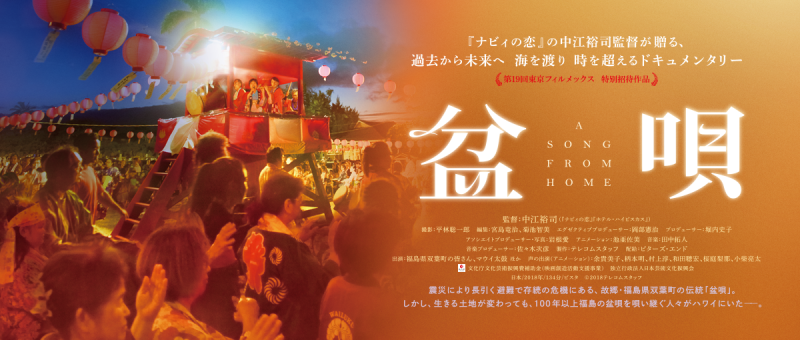
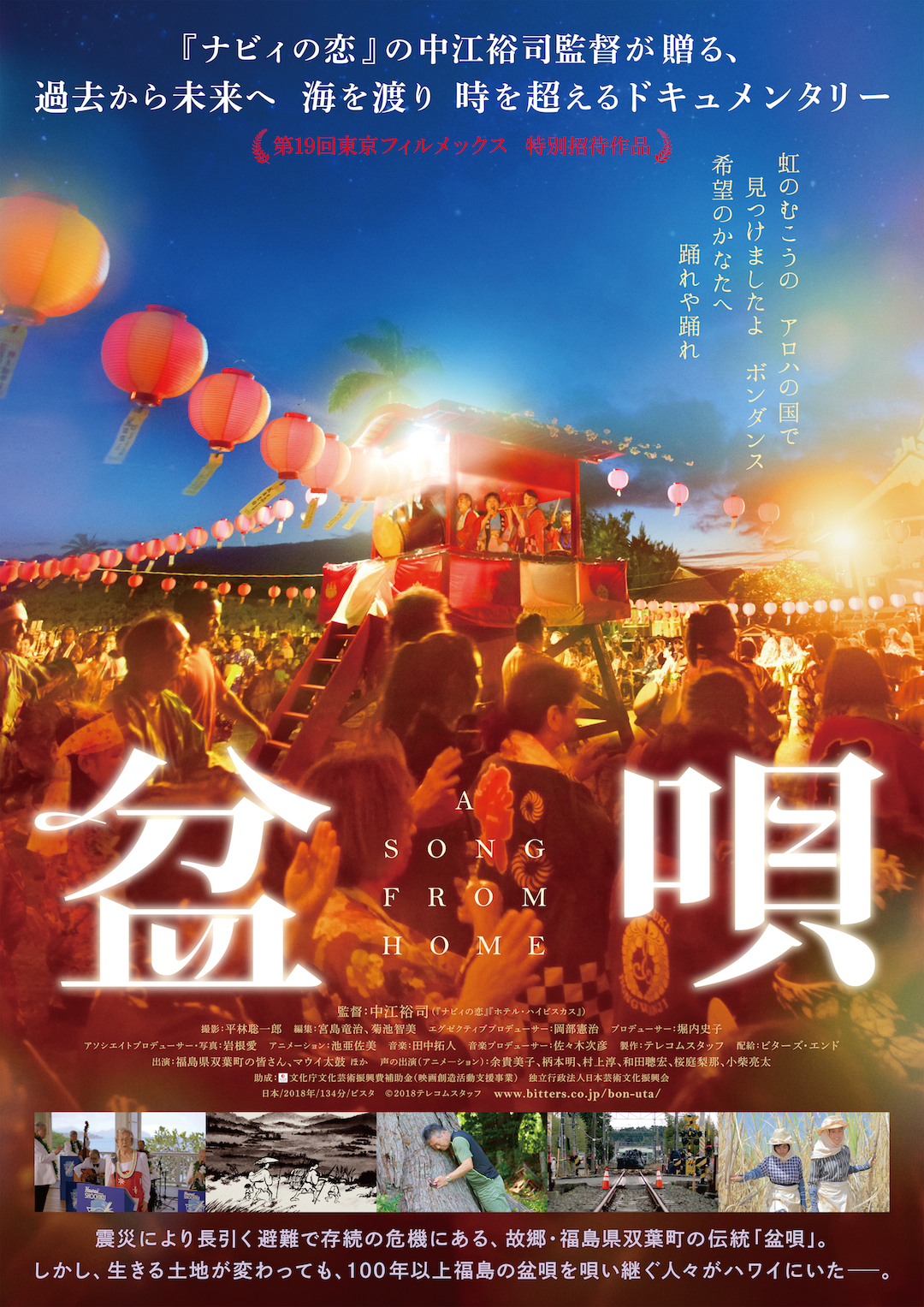
BON-UTA, A Song from Home (盆唄, Yuji Nakae, 2019)

Exiled from their homes, the residents of Futaba lost more than just their material possessions when the area was declared uninhabitable following the Fukushima nuclear disaster. With former residents scattered all over the country never knowing when or if they will be able to return, a community has been ruptured and its history is in danger of dying out. Yuji Nakae’s poignant documentary Bon-Uta (盆唄) explores this sense of loss through the prism of the Bon dance while meditating on the notion of exile in comparing the experiences of migrants and Hawaii and their descendants. 

A photographer, Ai, has been photographing Bon dances in Japan and Hawaii and was struck by the Hawaiian response to the 2011 earthquake, seeing as many of the Japanese-Americans living in Hawaii traced their ancestry back to the Fukushima area. Hisakatsu and Haruo, childhood friends from Futaba, travel to Hawaii and observe the Bon dance, reflecting that it is different from that in Japan but perhaps in some ways better. Seeing how they have incorporated many different styles of Bon dance gives them the idea that they could save the Futaba dance by teaching it to the Hawaiian dancers, placing it in a kind of depository so that in 50 or a 100 years if Futaba becomes habitable again, their descendants could relearn it. But what they quickly discover is that it’s difficult to teach something that each of them has spent their whole lives learning in a matter of days, while the fact is that the community itself is central to the dance which loses its meaning when performed by those who’ve never been there. 

Nakae begins to meditate on insiders and outsiders as an older woman returns to her family home in the exclusion zone and uncovers papers from the 19th century which recount the discrimination her own family faced on being encouraged to move to the village following a massive famine which had reduced its population by two thirds. Now outsiders in the areas in which they have resettled, the former Futaba residents lament that they can no longer practise their art because their homes are in much more urbanised locations where neighbours are in close proximity and they fear disturbing them with the noise. The film equates their yearning for their lost community to that felt by those who emigrated to Hawaii in the 19th century hoping to escape rural poverty but often found themselves trapped, unable to return because of the low pay and exploitative conditions of the island’s sugar plantations. 

The Hawaiian migrants sang songs of exile, of how they missed their homes and families and how hopeless felt in the false promises that had been made to them of better lives abroad. Even in this, their culture survived while another, now elderly, woman recounts singing for a Japanese orchestra during the war when such songs were technically forbidden as other young men keen to claim their identity as Japanese-Americans enlisted in the military. The former Futaba residents begin to see new hope that they too could find a way to preserve a sense of their hometown even if they can’t return to it, deciding to organise a Bon dance of their own in another town bringing together the unique dances of each district while honouring the spirits of those who have passed away. 

Hisakatsu writes a new Bon song of his own from the point of view of a cherry tree in Futaba to ward off the “ogres” which stand in for radiation as the tree looks forward to blossoming once again, hoping the people will eventually return. Featuring a lengthy animated sequence recalling the experiences of the 19th migrants to Futaba who found themselves rejected as outsiders while reflecting on the contemporary exile of the former residents, the film eventually discovers a note of positivity and hope that even now scattered and unable to return to their homes the community can survive through the practice of its culture in passing on the unique local Bon dance to successive generations just as the migrants in Hawaii passed theirs on to their children in the hope they too might one day be able to return home.


Trailer (English subtitles)
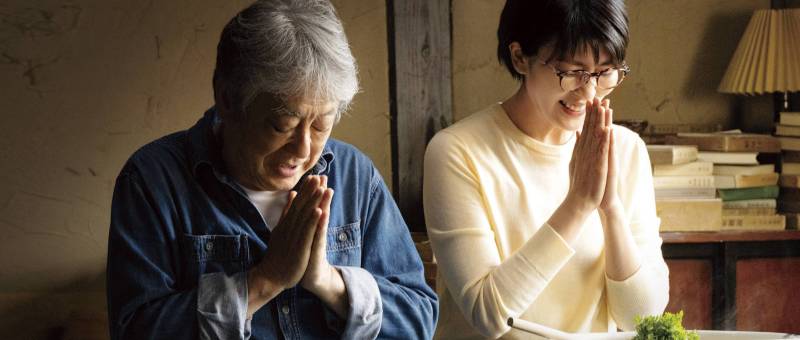
The Zen Diary (土を喰らう十二ヵ月, Yuji Nakae, 2022)

A romanticised idea of returning to the land has become a frequent motif in recent independent Japanese cinema as disillusioned youngsters crave freedom in simplicity but there’s no use denying the life of a mountain ascetic is not for everyone. Based on a 1978 essay by Tsutomu Mizukami, The Zen Diary (土を喰らう十二ヵ月, Tsuchi wo Kurau Junigatsu) is part foodie feature comfort film in the vein of The Little Forest and part melancholy contemplation on the cycle of life along with its inevitable end. 

Ageing widower Tsutomu (Kenji Sawada) lives in a cabin in the mountains with his beloved dog and is mostly self-sufficient, growing his fruit and vegetables for the largely vegetarian temple food he learned to cook as a novice monk. His peaceful days are sometimes interrupted by the arrival of his editor, Machiko (Takako Matsu ), in search of his latest manuscript but otherwise intent on staying for meal made with the freshest produce lovingly prepared by Tsutomu. It’s clear that their relationship is no longer strictly professional, if otherwise ill-defined, but equally that Tsutomu’s mountain life could itself be seen as a kind of limbo in his inability to move on from the death of his wife 13 years previously. Her ashes still sit in a box on his altar long after most would have them interred much to his elderly mother-in-law Chie’s (Tomoko Naraoka) consternation. 

Chie is also a mountain ascetic living in a cabin not far from Tsutomu’s where she apparently supplies half the local area with home made miso paste. This life is hard enough for Tsutomu, but must be verging on the impossible for a woman of Chie’s age. Nevertheless, she perseveres while apparently estranged from her surviving son (Toshinori Omi) with whose wife she did not apparently get along. Because of this apparent disconnect, Tsutomu is for some reason held responsible for her existence despite not being a blood relative, while her son is confused by her lifestyle and more or less refuses to have anything to do with her. 

Still, like Tsutomu she had perhaps also come to understand that life is movement and the simple routine of tending crops and preparing sustenance is the engine that drives existence. Divided into a series of vignettes following the traditional divisions of the year, the film lingers on seasonal details as Tsutomu painstakingly washes and prepares his homegrown veg and pickles to prepare for the upcoming season. A series of brushes with death, however, throw him into a contemplative mood realising that his ascetic lifestyle is also a flight from the inevitable and a refusal to face his fear of mortality. “Who in this world lives for eternity?” a folk song asks, while Tsutomu meditates on the zen teachings of his Buddhist upbringing and his life as a novice monk raised in a temple from the age of nine until he ran away at 13.

His reflections are perhaps more in keeping with the 1978 of the original essay than they are the contemporary setting of the film but also hint at the absurdity of class inequality. The crematorium has two doors, only one of them ornate, yet everyone leaves the same way and we are all equal in the end. He was sent to the temple because his family were too poor to feed him, though his temple life stood him in good stead for self-sufficiency and gave him the capacity for solitude. Though his family had lived on the edges of a graveyard, his father made coffins for a living, and temple life is necessarily bound up with death, Tsutomu had lived in its shadow never making his peace with mortality. Yet the seasons will also progress towards winter, and Tsutomu with them as his life draws towards its inevitable conclusion.

In any case, the film’s final words are those of thankfulness for all that life has to offer as represented in the fruits of the earth, gratefully received by an enlightened Tsutomu. In keeping with its subject matter, the unfussy yet often picturesque photography brings out the pleasures of a life of simplicity and the human warmth often to be found within it while also reflecting the intense melancholy of Tsutomu’s contemplative solitude as he meditates not only on mortality but what it is to live in sync with the rhythms of the natural world.


The Zen Diary screens at New York’s IFC Center on Feb. 12 & 16 as part of ACA Cinema Project’s New Films From Japan.

International trailer (English subtitles)