December (赦し, Anshul Chauhan, 2022)

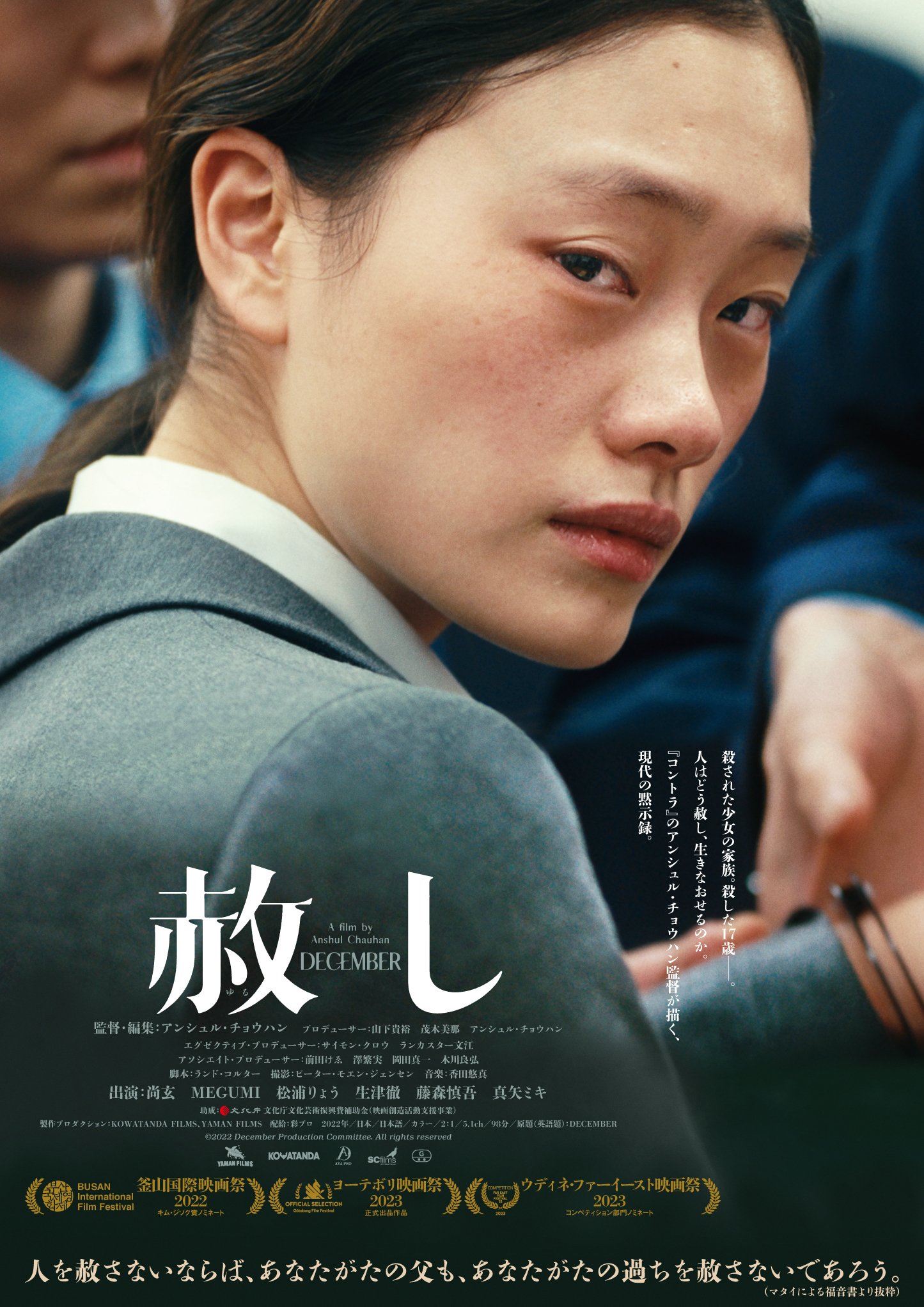
Where is the line between justice and vengeance? The grieving father at the centre of Anshul Chauhan’s December (赦し, Yurushi) is determined that the teenage girl who stabbed his daughter to death should never leave prison, but what he wants is a kind of equivalent exchange in that the person who stole his future along with his child’s should have no right to one herself. A more mainstream effort than either of his previous films Bad Poetry Tokyo and Kontora each of which dealt with similarly thorny themes, Chauhan’s unusually tense courtroom drama is the latest to put the legal system on trial while asking difficult questions about grief, guilt, and what exactly it is we mean when we talk about “justice”.

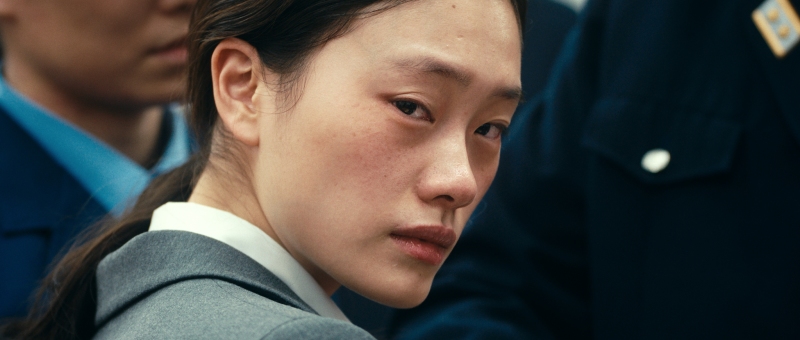
Seven years previously, 17-year-old Kana (Ryo Matsuura) stabbed her classmate Emi (Kanon Narumi) multiple times in a frenzied attack that resulted in her death. She was sentenced to 20 years in prison and has never attempted to deny her crime. It isn’t she who has asked for her sentence to be reviewed but an independent lawyer, Sato (Toru Kizu), who claims he’s doing it for “justice” though as Kana points out might have half an eye on compensation money she’d be able to claim for wrongful imprisonment if the case were successful. Sato seems to think it will be on the grounds that Kana was unfairly tried as an adult, mitigating circumstances were never brought to the defence’s attention, and the judge’s sentencing was swayed by personal feeling placing it outside of conventional guidelines that should be applied in cases like these.

For Emi’s parents, Katsu (Shogen) and Sumiko (Megumi), the appeal is a slap in the face. The couple have separated and while Sumiko has attempted to move on with her life, marrying a man she met in a support group for bereaved parents, Katsu has become a bitter alcoholic living a purgatorial existence of almost total inertia. Outraged, he is determined to make sure that Kana never leaves prison and is only sorry that she could not receive the death sentence because of her age, while Sumiko would rather not be involved at all, uncertain that she would be able to endure the emotionally draining process of another court case. They settle on presenting a united front, but discover that to do so is also to put themselves on trial while being confronted by a past neither has ever really faced.

The strain on Sumiko is evident as she walks along along a bridge at night and peers over the edge as if about to jump. She later learns that Kana had a mother too who did in fact take her own life after selling everything she owned to pay the compensation money that is used against them in court to imply that they’ve already been served “justice” in the form of monetary recompense from the defendant’s family which ought to declare the matter closed. Unlike Katsu, Sumiko had said her goal wasn’t vengeance but only to make sure that no other mother suffers as she has done, yet another mother already has for she lost a daughter too. Kana meanwhile has no one left to turn to even if she were released, she will have to make a new life for herself alone. Kana is herself victimised by an unforgiving society, the subtext suggesting that she was bullied for being the daughter of a single mother who was unable to fully care for her or provide the kind of material comfort children like Emi receive. The “happy family home” Katsu accuses her of destroying is also a symbol of everything Kana was denied but she did not kill out of jealousy or resentment only, ironically, to escape a kind of imprisonment and free herself of an oppressive bully.

Katsu says he’d kill her himself if he had the chance, but as Sumiko points out then he’d just end up in prison for the rest of his life with only his “righteousness” to comfort him. How could he claim to be any better? As Sato says, emotion has no place in a court of law. That’s why the law the exists and we mediate “justice” through a dispassionate third party to ensure the sentence is fair and not merely “vengeance”. Katsu certainly sees himself as a righteous man. In a repeated motif, Chauhan shows him taking the long way round by walking on the pathways of the grid-like forecourt leading to the courthouse while others hurriedly take the direct route crossing the squares at a diagonal angle. For him the answer is only ever black and white and he is very certain of his truths, but also blinded by his pain and unable to see that his desire for vengeance is more for himself than it is for Emi.

Only by accepting a painful truth can he begin to move past his grief, despite himself moved by Kana’s quiet dignity in which she admits her responsibility and suggests that she will never really be “free” even if she is released. What she offers, in her way, is peace allowing the bereaved parents to bring an end to their ordeal or least enter a new phase in their grief which allows them to move forward in memory rather than remaining trapped within the unresolved past. Perhaps in the end that’s what we mean by “justice”, a just peace with no more recrimination only sorrow and regret with renewed possibility for the future.


December screened as part of this year’s Osaka Asian Film Festival.

Original trailer (no subtitles)
Kontora (コントラ, Anshul Chauhan, 2019)

Copyright © 2020 Kowatanda Films

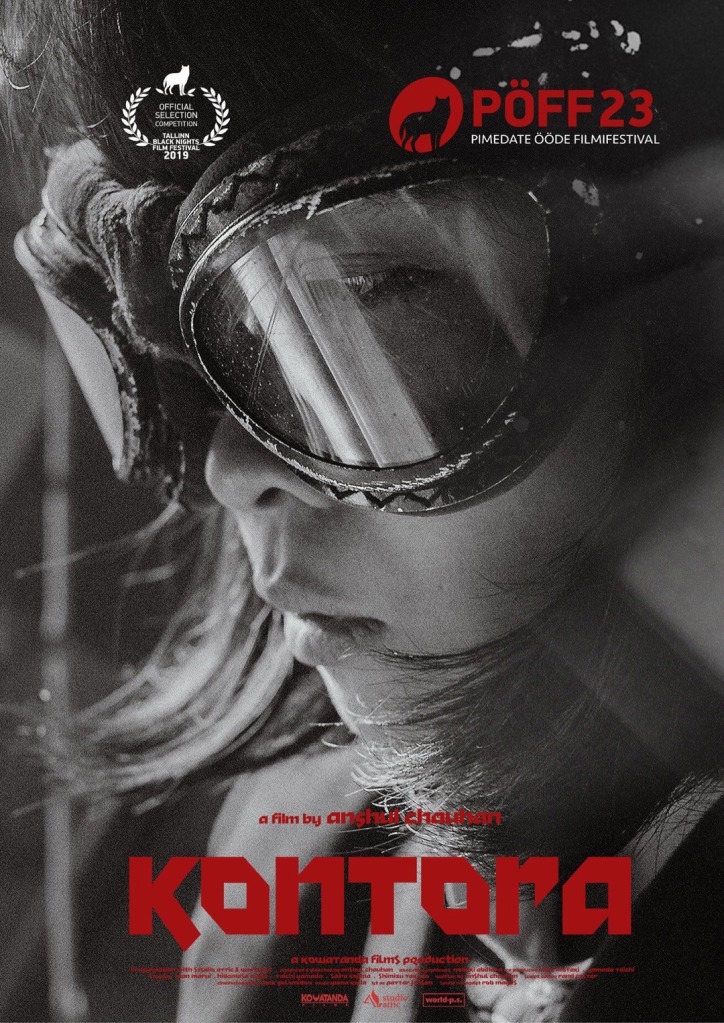
Life is a series of oppositions, the past conflicting with the future, the young with the old, selfishness with altruism, but without conflict there can be no sense of forward motion. That’s largely where the heroine of Anshul Chauhan’s second feature Kontora (コントラ) has found herself, stuck in a “one horse” town with no sense of excitement, longing for the bright lights of Tokyo while fiercely rejecting her distant father in favour of gentle companionship with her compassionate grandad. It’s not until after he passes away, however, that she begins to realise there were things in his life that he was never able to tell her. 

Teenager Sora (Wan Marui), in her final year of high school, discovers this on finding her grandfather’s body. Understandably panicked she looks over the box of World War Two mementos he appeared to have been poring over just before died and hurriedly hides them so her father (Takuzo Shimizu) won’t see. After the funeral she finds herself fondling his old pilot’s helmet and goggles while reading his war diary, filled with beautifully drawn illustrations and terrible memories of torture and privation. Writing such a diary must have been quite a risk, seeing as Sora’s grandfather recounts only fear and dissatisfaction, envious of the young men who failed the draft and got to continue with their student lives while he is lonely and desperate but claims no longer to be able to understand love. For Sora, however, the most important thing is that her grandfather mentions burying his “metal arm” in the forest. She commits herself to finding it, bunking off school to go digging on a nearby mountain. 

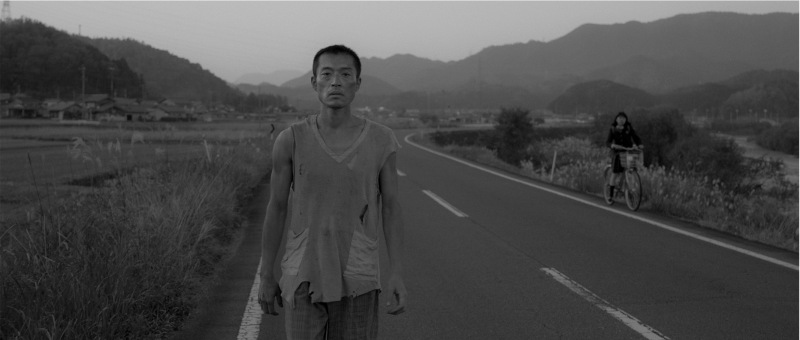
Meanwhile, she also begins spotting a strange young man (Hidemasa Mase) around town who is dressed in rags and seemingly can only walk backwards. The man enters her life in a more concrete sense when he literally collides with her father’s car while the pair are returning from a fairly disastrous family dinner over which her father’s cousin Yoshiji (Takuzo Shimizu) had made an inappropriate bid to get him to sell the family home so he could use it to house workers at his factory, even offering to give Sora a job to make sure she’s looked after. Questioned about her future plans, Sora had mentioned hoping to go to Tokyo, which comes as a shock to her dad and is abruptly shutdown by Yoshiji who can’t see what the point in that would be. His own daughter, Haru (Seira Kojima), went to Tokyo to become a dancer but seems to have returned somewhat chastened and now works in his factory, as if proving his point that there is no future for girls like Sora other than shifting straight into small-town life seconds after graduating high school. 

Sora’s dad leaves the gathering drunk and angry, which is why his first thought is abandoning the injured man on the roadside so he won’t have to deal with a drunk driving charge. Sora, however, refuses to abnegate her responsibly and insists on making sure the man is OK, leading to a compromise in which they take him home to monitor overnight. Still unconvinced, Sora’s dad kicks him out in the morning, but Sora chases him down and brings him back, dressing him in grandad’s clothes and stunned when she hears him singing one of grandad’s songs. 

The man’s presence highlights a key difference between Sora and her distant father. Sora is intrigued and unafraid, she tries to talk to the man and is very interested to find out why he only walks backwards but is also accepting of his silence. Her father meanwhile sees only danger. His first thoughts are only to expel the man by whatever means possible, eventually jumping to conclusions born of prejudice that he may have somehow harmed Sora. Sora, meanwhile, jealously keeps the diary to herself, never sharing her newfound quest with her father until forced into the open at which point she tells him that the diary had given her life a sense of purpose that she was reluctant to share with anyone else. Secrets revealed, the rift between father and daughter begins to heal while the mysterious man looks on in silence, perhaps knowing that grandad had other messages to give that are still waiting to be uncovered. 

Strangely, no one seems to stop to consider that grandad may have buried his “metal arm” for good reason, and that it should perhaps stay that way (especially if a heartless arch capitalist like Yoshiji ends up getting his hands on it). Nevertheless, unearthing the buried past begins to solve the mystery of grandad and enable a kind of healing. The man keeps walking round and round in circles, backwards as if walking against the future, caught on a treadmill of repetitive anxieties and unable to move forward. Sora may be at that point herself, stuck in a moment of adolescent confusion unable to step into adulthood and having lost her only guide and confidant. It may be, in some ways, troubling that she finds her direction through embracing a violent past, but there is indeed a moment of healing in two eras meeting which allows time to reassume its proper flow. Ethereal and mysterious, Kontora is both coming-of-age tale and a melancholy fable of griefs both national and personal in which forward motion is possible but only in facing the past head on and waving it goodbye as you turn around to walk towards a more positive future.


Kontora screens on March 12/13 as part of this year’s Osaka Asian Film Festival.

Original trailer (English subtitles)