The Midnight Maiden War (真夜中乙女戦争, Ken Ninomiya, 2022)

An apathetic college student is pulled between nihilistic destruction and the desire for life in Ken Ninomiya’s adaptation of the novel by F, Midnight Maiden War (真夜中乙女戦争, Mayonaka Otome Senso). “Do those who struggle for life deserve to be defeated as evil?” is a question that is put to him while he asks himself if there’s something wrong in his yearning for a “boring”, conventional existence with a good job, house in the suburbs and people to share it. Then again as the forces of darkness point out, those who long for normality usually cannot attain it which only fuels their sense of resentment towards a “rotten” society. 

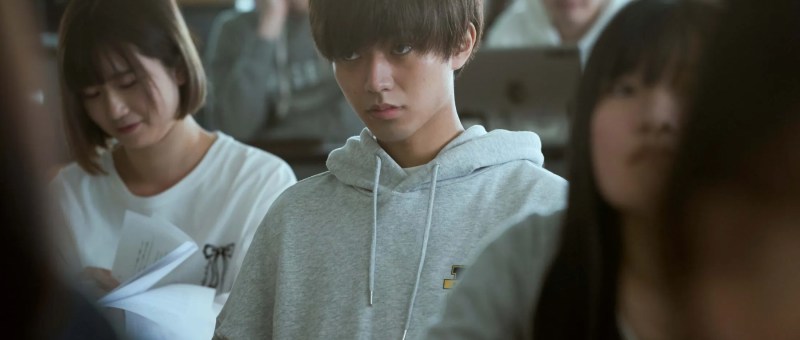
The unnamed protagonist (Ren Nagase) has come to Tokyo from Kobe to attend university and as his family are not wealthy is supposed to be studying for a scholarship exam while supporting himself with part-time jobs. Only as he’s abruptly let go from his side gig, he finds himself unfulfilled by his studies and wondering what the point is in wasting his youth just to lead a dull life of drudgery. In an intense act of self-sabotage which later goes viral, he tells his English professor (Makiko Watanabe) to her face that her classes are pointless while calculating exactly how much they cost per hour which turns out to be the equivalent to three hours of labour for his mother, the price of a new text book, or three months’ Netflix subscription which oddly becomes a kind of currency benchmark. He can’t see that anything he’s learning will be of much use to him in the further course of his life when the only prize is conventionality even if that conventionality might also provide basic comfort. 

After joining a mysterious “hide and seek” club and becoming distracted by a series of minor bombings of public bins on campus, the hero is pulled between a woman only known as “Sempai” (Elaiza Ikeda), and a man only known as “The Man in the Black Suit” (Tasuku Emoto) who sell him conflicting visions of hope and darkness. While Sempai thinks it’s wrong to belittle those who want to live their lives and are genuinely content with the conventional, The Man in the Black Suit quite literally wants to burn it all to the ground. What begins as an awkward friendship between two awkward men, soon develops into a cult-like organisation of, as the hero puts it, “social outcasts”, drawn to the Man in the Black Suit’s desire to destroy the rotten society which has rejected them through blowing up Tokyo on Christmas Day. 

Positing Tokyo Tower as the “root of unhappiness”, the hero claims he wants only to destroy, and most particularly himself along with everything else. Experiencing extreme ennui, he struggles to find meaning in his life yet is also conflicted in the breadth of the The Man in Black’s goals being fairly indifferent to the existence of others and unconvinced that those merely complicit in the system should also be targets of his social revenge. If not quite dragged towards the light, he realises that he must kill the nihilist within himself and in a sense be reborn, as the Man in Black puts it, as the god of a new world. “You’re alive, that’s good enough for me” Sempai echoes as the hero does at least in a sense embrace life even amid so much destruction. 

Ken Ninomiya has become closely identified with a singular style heavily inspired by music video and often taking place in Tokyo clubland. Midnight Maiden War is in many ways a much more conventional film mimicking the aesthetic of other similarly themed manga and light novel adaptations featuring only one real party scene and no extended musical sequences while routing itself in a more recognisably ordinary reality albeit one secretly ruled by a lonely tech genius. It does however feature his characteristic neon-leaning colour palate, focus pulls, and striking composition such as the revolving upside down shot which opens the film and hints at the unnamed protagonist’s sense of dislocation. Quite literally a tale of darkness and light, the film finds its dejected hero struggling to find meaning in a stultifying existence but perhaps finally discovering what it is to live if only at the end of the world. 


The Midnight Maiden War screened as part of this year’s Camera Japan.

Original trailer (English subtitles)

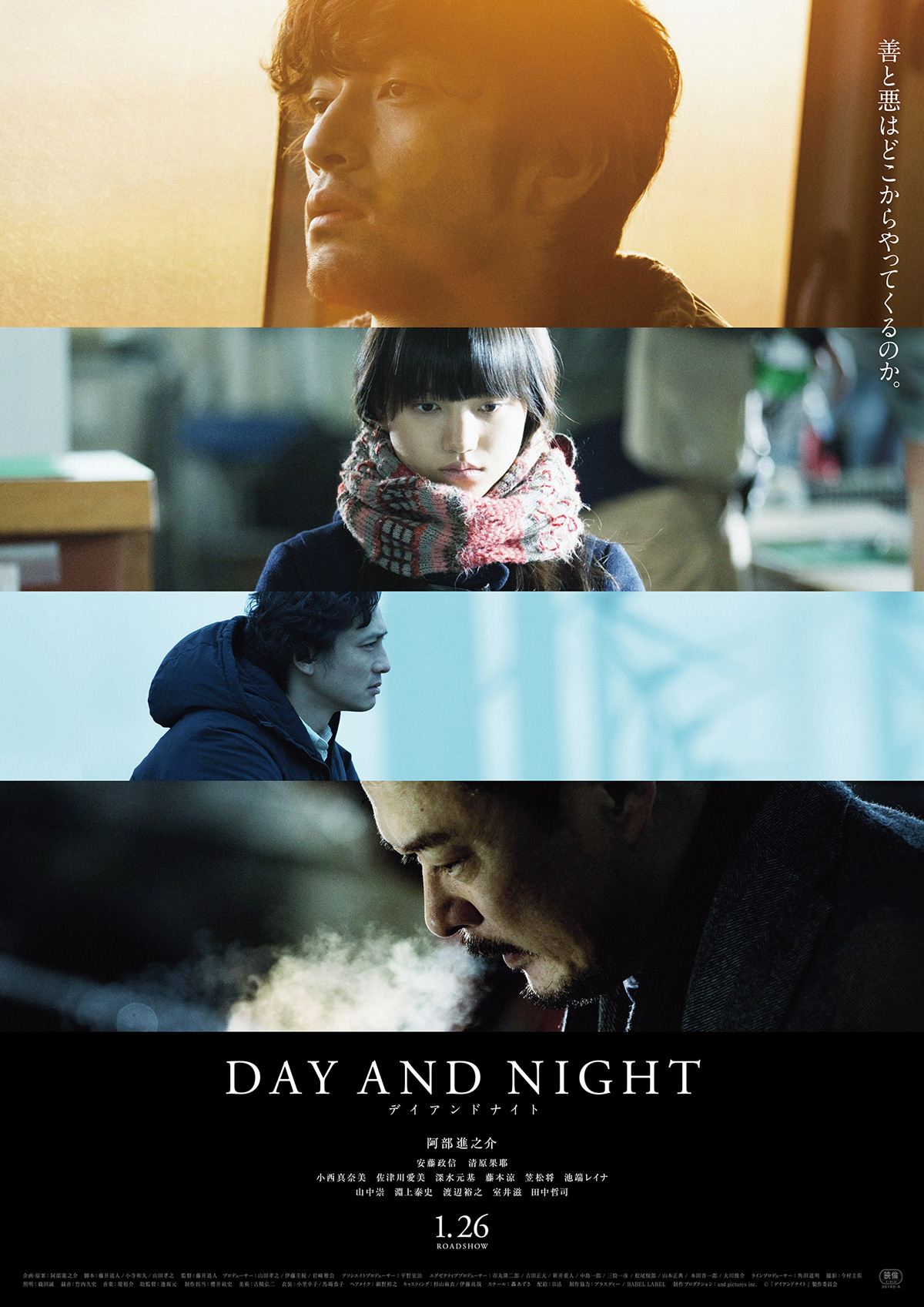
Day and Night (デイアンドナイト, Michihito Fujii, 2019) [Fantasia 2019]

day and night poster 1Can two wrongs ever really make a right? Michihito Fujii’s Day and Night (デイアンドナイト) wants to ask if the difference between good and evil is really as stark as that between dawn and dusk, or if life is really more like twilight in which morality is a relative concept and acts cannot by judged individually but only as a part of the whole. What the hero discovers, however, is that the world is an inherently unfair place and it may not be possible to “win” against the forces of self-interest solely through being pure of heart.

The drama begins with a stunned Koji (Shinnosuke Abe) returning to his small-town home to graffiti scrawled across his fences and his father lying in repose inside after having apparently taken his own life. No one will quite explain to Koji what exactly has happened, but it seems there has been some unpleasantness surrounding his father’s auto business. Though most of the other townspeople including his old friends are civil, they are also frosty and obviously unwilling to address the subject of Mr. Akashi save to press Koji for money they might still be owed as employees.

Meanwhile, poking around the garage in search of answers, he runs into the mysterious figure of Kitamura (Masanobu Ando) who claims to have known his father well though Koji’s mother claims never to have heard of him. Seeing as Kitamura is the only person willing to speak to him, Koji ends up taking a job at the orphanage where he works which turns out to be a little different than he thought seeing as Kitamura is actually the head of a local crime ring which exists with the sole purpose of keeping the orphanage running.

Though Koij, like his father, is an upstanding, law-abiding young man, he is quickly pulled into Kitamura’s world of moral justifications when presented with his personal philosophy in which the greater good remains paramount. Kitamura steals cars by night, stripping the unsellable ones for parts, which is where Mr. Akashi came in having succumbed to a life of “crime” in order to support himself while his business was suffering. He also does some possibly less justifiable work in the red light district while making a point of beating up drug dealers because 80% of the kids in his care have a parent in jail for crimes related to substance abuse. In Kitamura’s view at least, these are all “justifiable”, morally defensible “crimes” given that they are necessary to ensure the protection of the orphans. Though the money is good and Koji does need it, they are not in this for personal gain but to protect something they feel is important.

As Kitamura puts it, Mr. Akashi put his faith in laws that are meant to protect people but in the end it killed him. Having discovered a serious flaw in the auto parts he received from a local company he did the “right thing” and blew the whistle but Nakamichi Autos is the major player in the local economy and many people did not take kindly to having their reputation called into question. Nakamichi rallied its supporters and had Akashi hounded into submission. As one of the former employees tells Koji, the truth “hardly matters anymore”. Nakamichi doesn’t care there is a minor flaw in their products because they feel the chance of a fatal accident is slim enough not to need to worry about and happy to let the risk continue as long as they maximise their profits.

Miyake (Tetsushi Tanaka), Nakamichi’s CEO, also has his justifications, insisting that there’s no such thing as right and wrong only the cold logic of numbers and that the death of one man will not change anything. Increasingly pulled into Kitamura’s world of crime, Koji opts for underhanded methods to expose the truth about Nakamichi and clear his father’s name but finds in the end that no one is interested in facts. Listening in to some of his father’s old employees enjoying their belated severance pay he is dismayed to hear them too justifying their actions as they each insist that they did what they thought was “best” for everyone, for a peaceful life, for their families.

In truth, Koji claims he hated his father. That he resented him for always working all the time. Now however he begins to see that Akashi was only trying to protect his family by providing for it. His father was a “good” man, and he did the “right” thing, but he also became involved with Kitamura’s morally questionable crime syndicate. Kitamura wants to protect the orphans and takes care of them well, but can he really justify his actions solely on the grounds that there is no honest way to care for children who are often victims of an unfair society the pressures of which have pushed their parents from the “moral” path? What Koji’s left with, broadly, is that “good” people do “bad” things for “good” reasons, but bad people do bad things because they’re selfish and so they hardly care about the consequences of their actions. He starts to believe that the only way to resist is to fight fire with fire, but discovers that the little guy is always at a disadvantage when there is too much vested interest in not “making trouble”. It turns out everyone is OK with the status quo, so long as it’s not their car that might suddenly lose its wheels. As Miyake says, “that’s just how society works”.

A bleak meditation on the wider nature of justice and moral greyness of the world, Fujii’s noirish drama suggests good and bad are less like day and night than a shady evening in which the only shining light is the greater good. The world, however, continues on in self interest and the “good” will always lose to the “bad” as long it compromises itself trying to play by the other guy’s rules. Koji finds himself torn between a desire to avenge his father and a new sense of fatherhood fostered by bonding with a teenage girl at the orphanage as he contemplates the existence of a line between good and evil and his own place along it, but his old fashioned “nobility” finds no answer in the infinitely corrupt moral dubiousness of the modern society.


Day and Night was screened as part of the 2019 Fantasia International Film Festival.

Original trailer (no subtitles)