
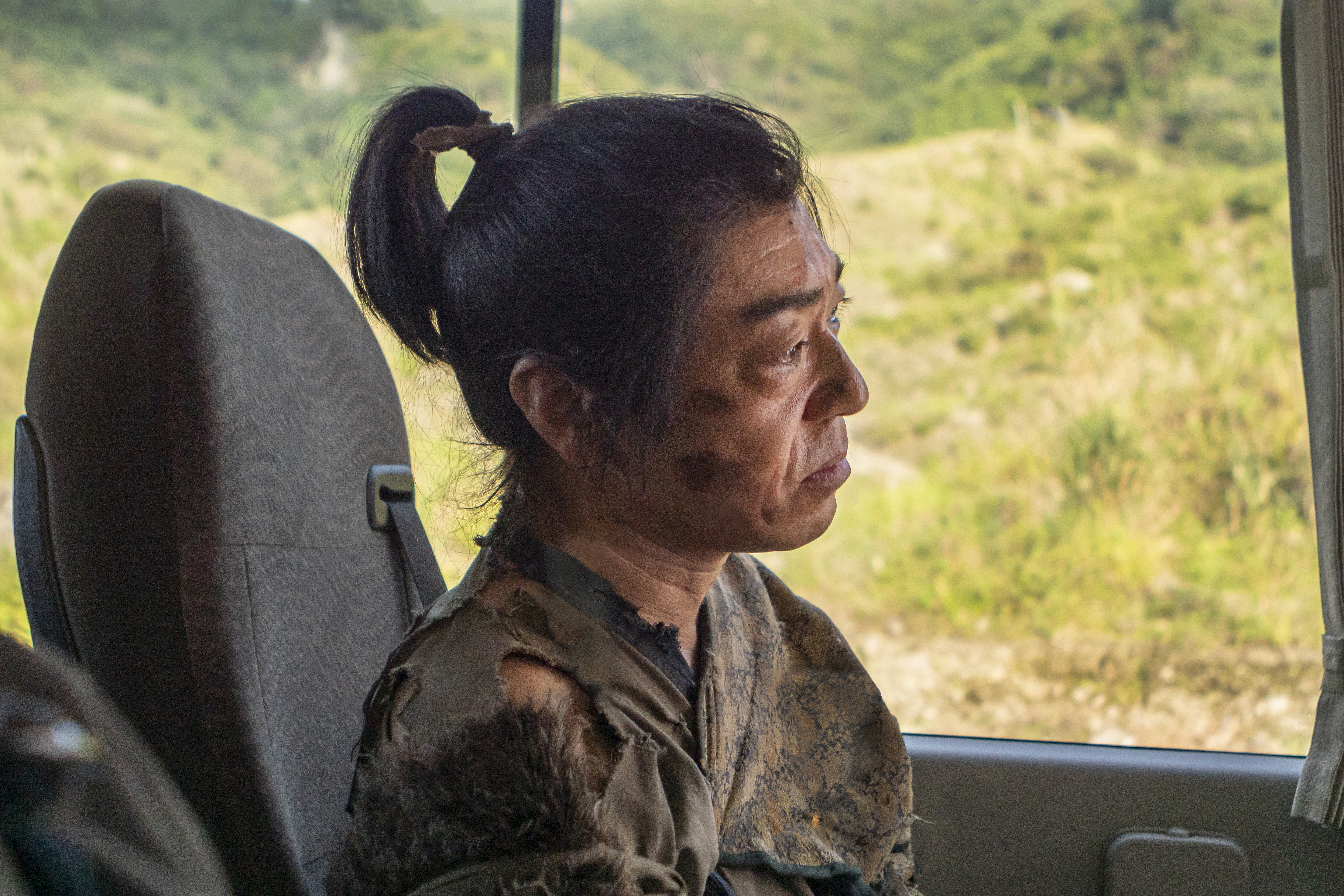
Ever felt like a bit player in your own life? For the hero of Masahiko Sato, Yutaro Seki and Kentaro Hirose’s Roleless (宮松と山下, Miyamatsu to Yamashita), it’s more like he lives ten thousand lives if only for an instant in his life as an extra and may have, in a way, cultivated an image of himself as a blank canvas who no longer exists in an absolute form. In a way you could call it multiverse living, but when confronted with a possible point of origin, a lost selfhood he may have forgotten or wilfully rejected, it presents him with an existential question not so much of who he wants to be but if he wants to be at all.
We first encounter him as an unlucky retainer in a jidaigeki who is quickly cut down only to rise again and run around the back to give his name as “Miyamatsu, a samurai” to the prop girl who gives him a different hat so can he go back out there and die a second time. Miyamatsu has an air of perpetual blankness in his often vacant expression as if he were both there and not. The film often wrong foots us and we can never be sure what is “real” and what part of a movie, except that it all obviously part of the movie we ourselves are watching. We see what we think are moments from Miyamatsu’s private life only to realise that the camera was rolling all along when someone shouts “Cut!” and it becomes apparent that Miyamatsu was not its main focus.
Along the way he gives hints of his loss of selfhood, earnestly replying that he doesn’t know when a fellow extra quizzes him on the watch he’s wearing and how he got it but his discomfort could stem from several places and it’s never quite clear how much of an interior life Miyamatsu creates for his various roles, whether he really does just see them as performers of an action, is playing “himself” as he peers over a police cordon at a crime scene, or is a fully fledged person with an individual history. Later he tells a colleague who admires the way he fills in forms at his part time job working at a cable car that he’s always enjoyed the process of filling in a predetermined frame but also that he likes the floating sensation the cable cars give him.
All of which might explain why he’s so destabilised when a man (Toshinori Omi) approaches him claiming that they worked together as taxi drivers more than a decade earlier and that his name is Yamashita. He apparently “disappeared” after sustaining a head injury and has been “missing” ever since. The man takes him back to the home of his much younger sister, Ai (Noriko Nakagoshi), who has since married and appears to be incredibly relived to see him even if it seems she might also be hiding something. He wonders if it’s suspicious that there are no photos of him in their family home, but is reminded that with the age difference he hadn’t lived there while she was a child and only came back after their parents died to take care of her because she was still in high school. Her husband, Kenichiro (Kanji Tsuda), seems to be constantly needling him though again, it isn’t always clear whether he actually wants him to remember or suspects that he already does and is choosing to pretend not to.
Even so, Miyamatsu slides into the life of Yoji Yamashita as easily as any other role finding his way back into the character with unexpected moments of connection such as the muscle memory that grants him a perfect baseball swing, or the strangely familiar taste of cigarettes to a non-smoker. Then again, there’s obviously something sinister going on, a darkness underlying his “personal” history that might have made him want to absent himself from himself or else an oppressive sense of bullying that is reflected in Ai’s hesitant answer when Yamashita remarks on what a good husband Kenichiro seems to be. Miyamatsu claims that he’s ever only played one “real” role, and in a way this is it as he begins to claim something like a backstory even if it’s one he may not ultimately want that nevertheless renders him a little less vacant. Mysterious and unsettling, the film asks some probing questions about the nature of identity, whether it is self-defined or gifted, but also discovers a kind of serenity in Miyamatsu’s free floating life of transient realities.
Roleless screened as part of this year’s Nippon Connection
Clip (no subtitles)
 Windows on Worlds