 Written by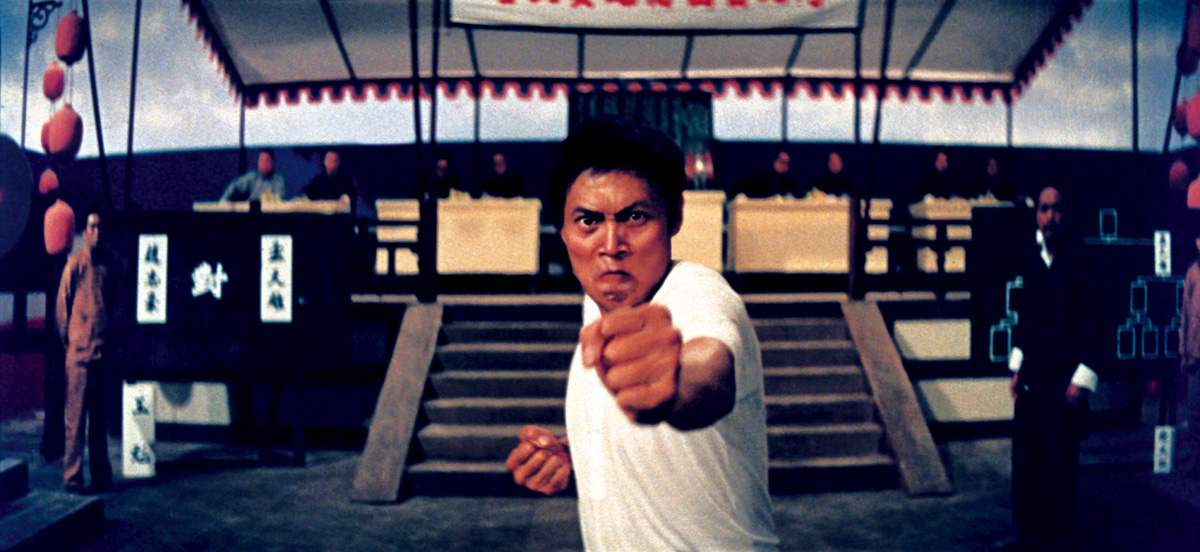
Legend has it that Shaw Brothers’ main motivation in making King Boxer (天下第一拳) was retaliation against Golden Harvest who’d managed to sign Bruce Lee after he turned them down because they offered him the standard studio contract which was at the very least unattractive. Until that point, the studio had mainly been making wuxia pictures and musicals, but had begun to shift towards unarmed combat with the success of The Chinese Boxer in 1970.
Released internationally under the title Five Fingers of Death, the film kickstarted the 1970s kung fu craze with its vast success in America and helped to solidify a new genre that was then only just being formed through the use of the trampoline technique pioneered by wuxia master King Hu along with his fast cuts and a surprisingly gory take on violence even having the floor shift and give off puffs of dust for added realism. Otherwise it weaves a fairly standard tale of warring schools each vying to win a top contest which confers on the winner the right to control five territories in the north, though this is not of course the goal of the righteous contenders who desire neither fame nor fortune only to improve their skills. The earnest Zhihao (Lo Lieh) just wants to stay with his master and adopted father, Song (Ku Wen-Chung), with whose daughter Ying-ying (Wang Ping) he has also fallen in love, but when and former pupil Daming (Jin Bong-Jin) returns after training with Master Sun and Song is attacked by bandits which leaves him feeling past his best, he decides Zhihao should be sent away too until he wins the contest and returns to take over the school.
Meanwhile, the evil Meng (Tien Feng) is scheming to have his son Tianxiong (Tung Lam), who lacks martial arts talent, win the contest so that they can control the territory and oppress everybody in its domain. Meng is fond of talking about honour and the martial arts spirit, but actually plans to win the competition by cheating which is why he had his goons attack Master Song. He plans to take out his rivals ahead of time so Tianxiong will have a clear path to victory.
Zhihao, however, is floundering, forced to toil in Sun’s kitchen’s for a year training through practical means before even being accepted as pupil. Sun’s top student, Han Long (Nam Seok-hoon), appears to take an instant dislike of him that may just be down to his insecurity and fear of competition but eventually becomes a source of weakness in the Sun school. It’s clear that Han resents Zhihao for stealing the place he feels to have been his by right, especially on learning that Sun has given him the manual for the Iron Palm technique, and is even more annoyed when he runs into singer Yan who asks him about Zhihao though he is obviously interested in her himself. This romantic rivalry seems to further undermine his sense of masculinity and causes him to betray everything he stands for as a martial artist by cutting a deal with Meng in the hope he’ll get rid of Zhihao so he can take his place in the contest even if doing so likely means he’ll have to lose to Tianxiong.
The romantic subplot has a gentle poignancy as we obviously know that Yan will never end up with Zhihao because he is in love with Ying-ying while Yan also tries to convince him to leave the martial arts world which is something that just isn’t going to happen. In any case, Zhihao remains committed to opposing injustice, facing off against Meng and battling the three karate masters he’s imported from Japan to do his dirty his work as well as the ace up his sleeve, wandering fighter Chen Lang (Kim Ki-Joo) who eventually begins to realise he’s chosen the wrong side on witnessing Meng’s ruthlessness which breaks every rule in the martial arts book.
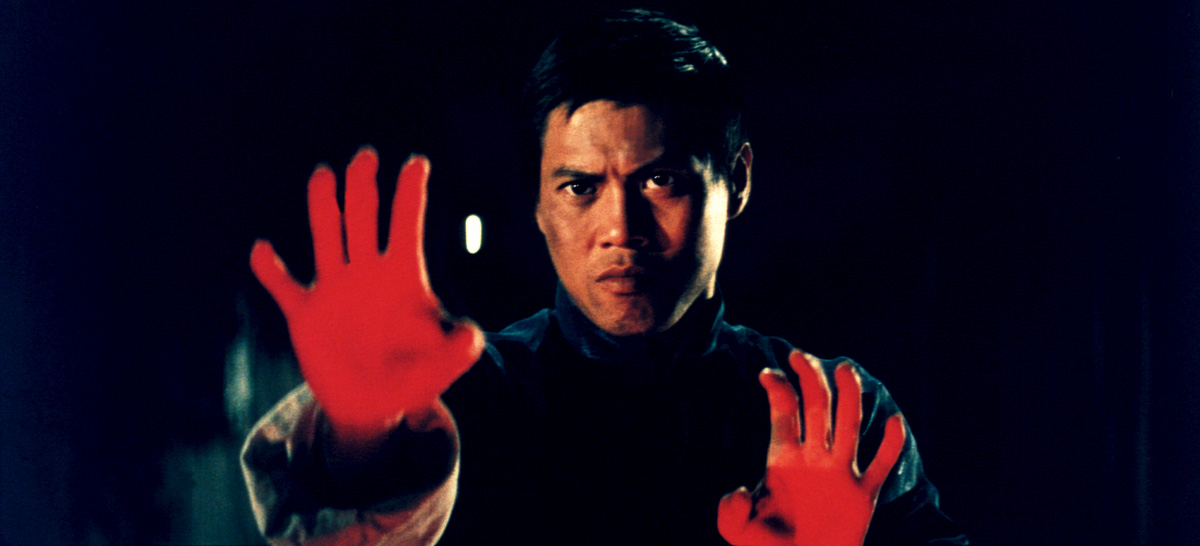
Korean director Jeong Chang-hwa, however, slightly wrong foots us denying Zhihao his vengeance against Meng while Han takes him on instead as an act of redemption though he too is eventually denied. This not quite final fight is among the most impressive in the film, fought in near darkness as Han has by this point lost his sight. Zhihao meanwhile takes on Okada (Chao Hsiung), the karate master, demonstrating his “Iron Palm” technique which Jeong lends an eerie supernatural quality through the use of red lighting and the sting of synths. Though the plot plays out like a western, Jeong’s aesthetics otherwise strongly recall the colour of Nikkatsu youth drama of the earlier 1960s most especially in his colour palette and lighting. Unfortunately this would be the last film he made for Shaw Brothers after apparently becoming fed up with Mona Fong’s cost cutting and jumping ship to Golden Harvest where he stayed for the rest of his career, but he did help to create a genre of kung fu cinema and popularise it all over the world.
 Windows on Worlds