 Written by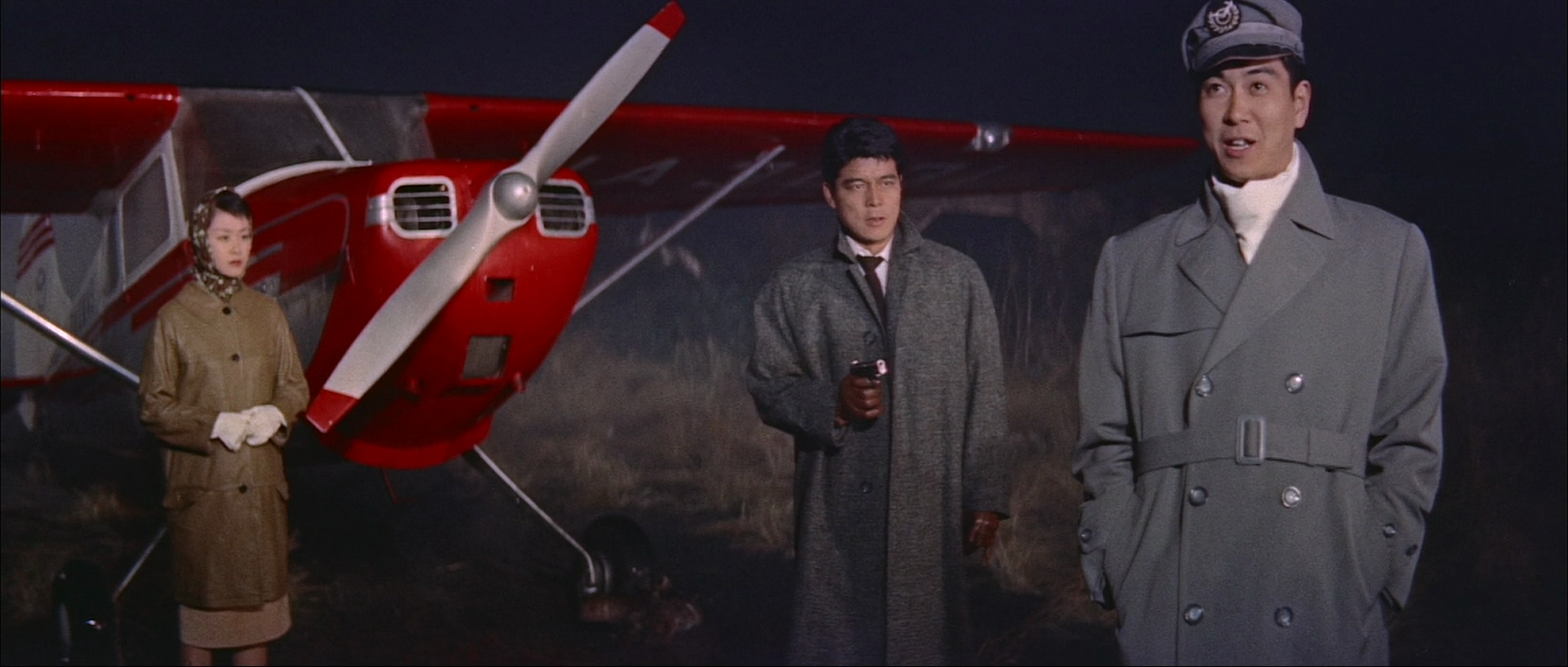
A heroic pilot on a mission to get life-saving medicine to a small boy on a remote island unexpectedly finds himself frustrated by a wanted man in Ko Nakahira’s aviation thriller, Crimson Wings (紅の翼, Kurenai no Tsubasa). This is of course a time in which air travel was still something new and exciting, but not only that, it also offered immense improvements to those living far flung areas making travel to the mainland far easier and much less time-consuming.
Time is, however, of the essence as a little boy on Hachijojima has contracted tetanus and the only stocks of the antidote on the island are out of date. If they can’t get replacements in the next few hours, it will be too late. Hachijojima is a fairly remote island in the Philippine sea that was used as a base for suicide submarine missions during the war but was developed as a tourist destination in the years afterwards in which it was dubbed “The Hawaii of Japan”. It didn’t quite take off until the 1960s tourism boom, but this is perhaps the reason why there’s an air shuttle service to Tokyo three times a week that is described by the stewardess as their most popular route. It might also explain why part of her job is acting as a tour guide, pointing out important Tokyo landmarks passengers can see from their windows as they come in to land. In any case, it’s the most obvious way to get the serum to the island seeing as there’s a charter flight set to leave in a couple of hours’ time.
But that same day across town, a CEO, Iwami (Toru Abe), is assassinated by a yakuza hitman named Itagaki (Hideaki Nitani). Predictably, he’s the one who’s charted the flight as a speedy getaway and he’s not all that keen on hanging around waiting for the delivery of the tetanus serum. One of the pilots describes Iwami as “take over king” and the “richest tycoon in post-war Japan”, which is to say they don’t have tremendous sympathy for him as someone who’s almost certainly made his money through nefarious means. Itagaki even remarks that he was “one of us,” the only difference between them being that where yakuza use guns he used money though his killing him was a matter of purely business. He didn’t ask or care why Iwami had to die, but obviously thought he was fair game anyway.
You can tell that Itagaki is not the sympathetic kind of gangster right away when he mows down a little girl while fleeing the scene, her little yellow balloon sadly flying off into the distance. His indifference to the girl’s death is ironic considering the rest of the film revolves around the struggle to save the life of a little boy, directly contrasting his callousness with the righteousness of the pilot, Ishida (Yujiro Ishihara), who is prepared to risk his own life to deliver the serum. Ishida hadn’t previously volunteered for the job because he was supposed to be going on a Christmas Eve date with stewardess Keiko (Shinako Mine), only she tells him she has to cancel because her father is on a surprise trip to town. Unbeknownst to him, however, she’s actually blown him off to go to a Christmas market with another man. In any case, with nothing else to do he accepted the job even though it involves going in a Cessna because of a malfunction on their regular plane that will take too long to repair.
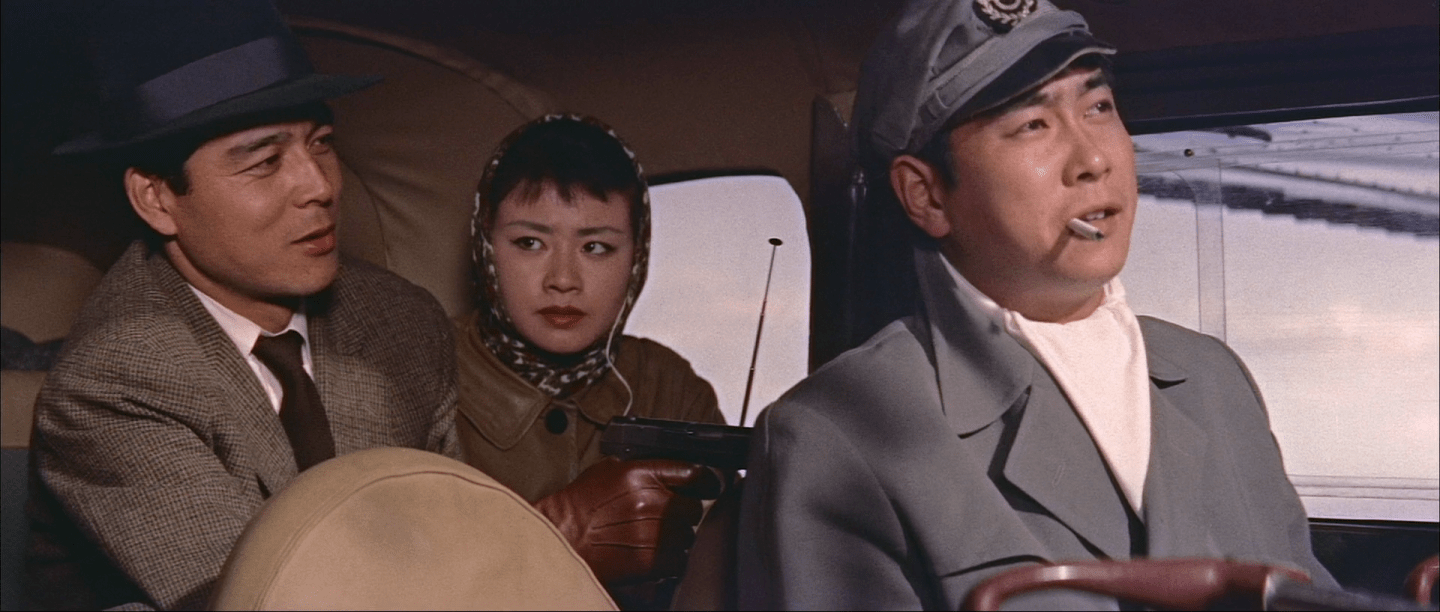
Aside from having to take Itagaki, who is pretending to be on an emergency trip to visit his mother’s grave, Ishida is also accompanied by pushy journalist Yumie (Sanae Nakahara) who was sent to the airport to interview Keiko as part of a series about “working girls” that she doesn’t seem particularly enthused by. In fact, she’s actually quite rude, elaborating that she’s already interviewed a TV producer and a continuity girl describing them all including stewardess as “glamour jobs” that don’t require very much in the way of brains as journalism obviously does. That might in a way reflect her own resentment in that it’s obvious she feels the paper’s not giving her a fair shake because she’s a woman which might be why she jumps so hard on the tetanus story sensing the potential for a heartwarming human interest article. She does however seem to genuinely care about the little boy on Hachijojima. Not only does she immediately arrange for a large amount of the serum to be delivered by police escort but insists on going to the island herself and after figuring out Itagaki is the fugitive thanks to her transistor radio sticks to the main mission rather than switching to the one about the CEO murder.
Ishida meanwhile remains a cool-headed wisecracker brazening it out against Itagaki in the knowledge that he can’t actually kill him because he doesn’t know how to fly a plane so all his threats are meaningless. There’s also a rather awkward subplot about Ishida’s brother being a kamikaze pilot during in the war which is intended to further bear out Ishida’s righteousness while his sister (Izumi Ashikawa) also makes a long speech about how he said if he had to he’d like to die like him and is the sort of person who can’t stand by and watch someone suffer. A lengthy sequence switches between various branches of the Japanese government and self-defence forces, as well as the US military, who all swap messages between themsleves and immediately scramble to find this one Cessna when it inevitably gets into trouble and drops off radar. The message seems to be that the system works and the authorities are ready to handle events such as this. Using some impressive aeroplane footage along with a series of split screens and a memorable opening POV shot to disguise the assassin’s identity, Nakahira gives the otherwise lighthearted thriller a little more weight while still allowing its wholesome goodness to shrine through as a collection of determined people come together to save a little boy they don’t even know who lives on a remote island where the children work in soil-pits to make extra money which might as well be a million miles away from the modern capital with greedy fat cat CEO’s and nihilistic yakuza.
Trailer (no subtitles)
 Windows on Worlds