Mission Milano (王牌逗王牌, Wong Jing, 2016)

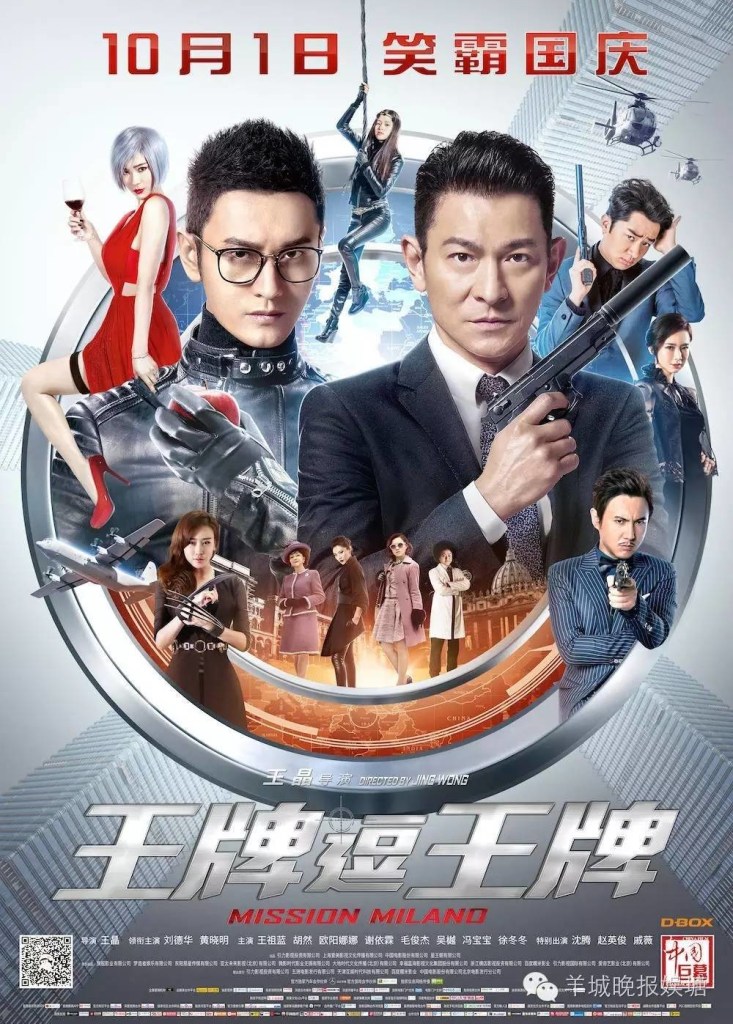
mission-milanoDespite its title, Mission Milano (王牌逗王牌, Wángpái Dòu Wángpái) spends relatively little time in the Northern Italian city and otherwise bounces back and forth over several worldwide locations as bumbling Interpol agent Sampan Hung (Andy Lau) chases down a gang of international crooks trying to harness a new, potentially world changing technology. Inspired by the classic spy parodies of old, Wong Jing’s latest effort proves another tiresome attempt at the comedy caper as its nonsensical plot and overplayed broad humour resolutely fail to capture attention.

The film opens with its strongest scene as Andy Lau’s bumbling Interpol agent Sampan Hung escapes from a Parisian hotel room after being attacked by a machine-gun wielding, cross-dressing French maid. Like much of the rest of the film this sequence is not particularly connected to the subsequent goings on, but on his return to China Hung begins investigating reports that a top technology firm run by the descendants of a famous Robin Hood inspired criminal is about to unveil a new bio product known as Seed of God. During the meeting, the Swedish professor presenting the research is kidnapped by a Japanese vigilante group known as Crescent which Hung believes is working for the evil worldwide organisation KMAX. Teaming up with the tech firm’s CEO Louis Luo (Huang Xiaoming), Luo’s sister (Nana Ouyang), and sidekick (Wong Cho-lam), Hung sets out to retrieve the technology before it falls into the wrong hands.

Seed of God is a bioengineered crop which can flower even if thrown on stony ground. All it needs is water and away you go – instant mango tree wherever and whenever you want. This discovery could end world hunger, but it would also be very bad news for anyone involved in traditional agriculture. Hung and Luo recognise the danger and neither want to see this new technology end up with KMAX who would not be particularly interested in applying it ethically.

Originally reluctant teammates, Hung and Luo build up a buddy buddy relationship through competitive games before eventually agreeing to work together. Luo does most of the hardline fighting while Lau’s Hung backs him up with splapstick-style comic relief. Though often mildly exciting, the action sequences have a comedy vibe dominated by Hung getting thrown into ladies’ bathrooms or knocked back on his behind by a skilled lady assassin while Luo keeps losing his glasses to a particularly mean opponent. Unfortunately, Wong relies heavily on CGI for many of the action set pieces beginning with the obvious rooftops of Paris backdrop, right up to the sports car meets heavy duty lorry incident in the middle and aeroplane based finale.

The humour itself has a heavily retro feel filled with sexist jokes such as Hung crashing into hotel bedroom containing a confused topless woman in the opening sequence and a seduction section in the middle in which a key asset is wooed using her teenage love of Alain Delon and supposed desperation for male attention. Hung is clearly modelled on Bond and even has the agent number 119 though in truth he’s more like Maxwell Smart meets Inspector Gadget with his clean cut nerdiness and ubiquitous trench coat. He even has a Q-style tech specialist (named Bing Bing so we have the “classic” Li vs Fan joke) who’s made him a killer phone with every kind of spy feature conceivable including lightsaber, but can’t actually make a phone call. Add in genre tropes of unusual weaponry and laser filled corridors, and Mission Milano is looking very uninspired.

Despite its Italian destination, Mission Milano employs a frequent musical motif that it is distinctly Spanish – another clue to how all at sea the film is in terms of coherence. A minimal stab at romance between Luo and a friendly agent on the other side, and Hung’s ongoing pining for his ex-wife who left him because his world saving habit was just too stressful, attempt to add some character drama to the piece which remains lukewarm in approach to its cast. Lau turns in an uncharacteristically large performance, grinning and gurning his way through the lacklustre script,  but not even his presence can heal the many problems plaguing the film. Never as funny as it desperately wants to be Mission Milano is a trying experience which, although intermittently amusing, (thankfully) proves instantly forgettable.


Original trailer (English/Traditional Chinese subtitles)

What’s in the Darkness (黑处有什么, Wang Yichun, 2015)

whats-in-the-darknessFirst time writer/director Wang Yichun draws on her own experiences for What’s in the Darkness (黑处有什么, Hei chu you shenme), a beautifully shot coming of age piece with serial killer intrigue running in the background. Seen through the eyes of its protagonist, What’s in the Darkness neatly matches the heroine’s journey into adolescence with the changing nature of Chinese society.

In May 1991 a series of horrific killings rock a small, rural town. Schoolgirl Qu Jing (Su Xiaotong) learns of the first murder of young and popular girl from the village when her policeman father Zhicheng (Guo Xiao) is called to investigate. A crowd has gathered around the crime scene where local women gossip and speculate, assuming the poor girl must have been raped and then murdered to prevent her going to the authorities.

Unaccustomed to such violent crimes, the police get busy but predictably lack the expertise to properly investigate. Zhicheng is unusual among his peers as he has a university degree and is keen on deduction, but his colleagues think his efforts are just going to make trouble for everyone and quickly decide on a suspect to beat a confession out of so that they will be seen to have done something. This plan goes haywire when a second murder occurs whilst the accused is in custody leaving the police with no option other than to allow him to “escape”. When one of Jing’s friends, whose estranged father is also a policeman, goes missing the stakes are raised but the possibility of successfully solving the crime seems increasingly remote.

Many things were changing in 1991, even in small rural towns. Jing is a wide eyed, naive and innocent girl with an intense curiosity and an ethereal nature which sets her apart from her more ordinary schoolmates. Her best friend, Zhang Xue (Lu Qiwei), is a slightly older, more mature girl ostracised by her peers who have decided that she is, in some way, immoral. Living within an extremely repressed society, Jing has very little concrete knowledge about sex or relationships – she even had to look up the word “rape” in a dictionary after hearing it at the crime scene because she’d never heard it before. Her only other information comes from pamphlets about pregnancy (with which she seems to be strangely fascinated) and her attempts to get more information out of the supposedly more experienced Xue backfire when she realises they’re both as clueless as each other.

Jing’s big hobby involves heading out to a disused factory area and singing pop songs to an imaginary crowd (and a boy who’s secretly watching her from the shadows). When she and Xue visit a hair salon there are pictures of movie stars all over the walls and the TV shows the fluffy pop entertainment of the day rather the propaganda films Jing’s parents might be more used to. Having lived through the Cultural Revolution, Jing’s mother and father have experienced far more hardship than she could ever know. Jing can’t understand their preoccupation with food, but to those who’ve experienced the threat of starvation, the presence of a full rice bowl makes almost anything endurable. Trained to keep their heads down and make sure they eat, the villagers of Jing’s parents’ generation are determined to maintain the status quo, even if it means continuing to reinforce the old values in order to avoid reprisal.

The trappings of communism are everywhere from the school room where the kids rehearse patriotic songs under banners of Marx, Engels, Lenin, Stalin, and of course Mao, to the security forces lurking in the background. Representing the state, the police force is staffed by a collection of lazy, corrupt petty officials content to throw their weight around in the absence of any real crime to deal with. Zhicheng refuses to engage in the same level of corruption as his comrades, but his honesty and steadfastness only arise resentment. Jing finds herself experiencing the same phenomenon when the headmaster finds out about her volunteering at the old people’s home and decides to give her an award thereby singling her out in front of her friends and irritating her harsh and grumpy teacher.

It’s at the old people’s home that Jing encounters her first randy old man when one of the residents she’s been asked to read to suddenly swaps out the book she’s been assigned for a probably banned erotic classical text with the only saving grace that Jing, even if she can read all the characters, does not quite understand what she’s reading.

Through Wang’s camera every man in town begins to look suspicious from the ice lolly seller eying up the behinds of the school girls as they walk away from him with their frozen treats, to an odd looking man with physical ailments who is often seen lurking in the background behind Jing. Visiting a friend’s house, Jing is unceremoniously dumped into a backroom when the older brother turns up with a porn film only for the house to be raided and everyone arrested. In a quest to finally find out what all of this is about, Jing buys a ticket for an adult movie from a man positively overjoyed at the idea of sending an underage girl into a room full of sweaty guys who all instantly turn away from the onscreen action to stare at the anomaly of Jing as she openly weeps at what she sees.

One of the benefits that communism claimed to bring was equality between the sexes. Women may hold up half the sky, but they still have to conform to an arcane set of social mores whilst they do so. Zhicheng forces Jing to ride sidesaddle on his bicycle rather than sit with her legs open and when she complains to him about the guy watching her sing, he tells her it’s all her fault for dressing in too alluring a manner. The murdered women are posthumously berated for their decision to be out on their own despite the fact that at least one of the killings must have occurred in broad daylight and when one of Jing’s schoolmates is feared to be the latest victim, their teacher reminds them that this is the kind of thing that happens when you fall in with a bad crowd. The police avoid serious investigation not only because they are lazy and corrupt, but because this kind of state sanctioned sexism is a tool they themselves (even if unwittingly) use to keep their womenfolk where they want them.

The identity of the murderer becomes irrelevant, this world is killing young women and it’s getting away with it because nobody cares. The women who die are written off as tainted, a lesson in failed femininity and evidence of what can happen if you don’t play by the rules. Little attention is paid to the perpetrator of the crimes who may also be a victim of this repressive environment as his desires are refused any other outlet than violence.

Although beginning in the vein of a serial killer movie, What’s in the Darkness is, at heart, a coming of age tale and social issue film. The era has shifted as the fear and austerity of the Cultural Revolution gives way to rising consumerism, placing a wedge between Jing’s generation and that of her parents. Wang rejects the classic procedural ending, leaving only questions in place of answers. As Jing stands alone with a little dog in her arms in the film’s final scene, she looks almost like Dorothy before the Emerald city as she plunges deeper into the reeds in search of answers, most definitely not in Kansas anymore. Jing’s eyes have been opened, her curiosity remains intact and unsated, as she alone remains unafraid to look at what’s really waiting for her out in the dark.


Reviewed at the BFI London Film Festival 2016

Original trailer (Chinese subtitles only)

The Vanished Murderer (消失的凶手, Law Chi-leung, 2015)

vanished-murderWhen The Bullet Vanishes was first released back in 2012, the film received unfair criticism in some quarters due to its enormous debt to Guy Richie’s then popular Sherlock Holmes. Derivative or not, The Bullet Vanishes remains an innovative and intricately plotted cerebral thriller, primed to launch the return of its central detective, former prison warden, Inspector Song (Sean Lau). Only slightly late, Song is finally back to address another series of baffling deaths and conspiracies in 1930s China only this time he’s landed in a pulpy LA noir rather than the cowboy-tinged action of the previous film.

The Murderer Vanishes (消失的凶手, Xiāoshī de Xiōngshōu) revolves around Song’s Irene Adler figure, Fu Yuan (Jiang Yiyan), whom we saw Song making frequent prison visits to in The Bullet Vanishes. Song is called to the prison because Fu Yuan has mysteriously disappeared from her cell leaving only a Shawshank Redemption inspired red herring behind her. The strange bond between Song and Fu Yuan in which they chastely dance around each other in the ultimate long distance romance, dictates that Fu Yuan send him a letter to tell him exactly where she is so he can come and arrest her all over again.

After a hot date at the cemetery, Fu Yuan takes Song to a philosophy lecture in which the speaker, Professor Hua (Gordon Lam), muses on a thought experiment in which he discusses the ethical problem of making an active choice to sacrifice one life in order to save multiple lives and whether making such a choice is any different from committing a murder – i.e. pushing another person in front of a moving train to stop it hitting a crowd further up the track. The experiment is eerily echoed when a body falls out of the sky just as Song is about to re-arrest Fu Yuan, allowing her to once again slip away.

Song investigates and is arrested only to be recruited to solve the mystery of why so many of the workers at evil corporate boss Gao Minxiong’s (Guo Xiaodong) string of factories are suddenly leaping to their deaths whilst wearing shirts bearing slogans which decry him as a slave driver.  Song is assisted by the girl he jilted at the alter eight years ago with whom he was improbably reunited on the train, Chang Sheng (Li Xiaolu), and a local policeman, Mao Jin (Rhydian Vaughan), as well as the philosophy professor but somehow this must all be linked to Fu Yuan’s mysteriously timed prison escape.

The biggest departure The Vanished Murderer has to deal with is the absence of co-star Nicholas Tse. Rather than give Song a new partner or attempt to ditch the buddy format altogether, Tse’s role has been awkwardly split into four with Song surrounded by his cohorts of varying stripes but never achieving the same kind of bond that made The Bullet Vanishes so satisfying. Many of the first film’s plot elements are also ported over wholesale, rehashing the same political subplots and betrayals but without the subtlety.

One again we have an exploited work force of factory workers suffering at the hands of a heartless capitalistic sociopath. Gao Minxiong is seen early on collaborating with a British businessman who warns him about the effects of the depression only for Gao to explain the “measures” he’s taken which include burning harvests to increase demand and therefore drive prices up, as well as closing factories to increase competition for jobs and therefore drive wages down. Gao also has a private militia he uses for strike breaking and indiscriminate massacre. The people suffer while the elites prosper, it’s an old story.

The Bullet Vanishes may have had one foot in the Old West, but The Vanished Murderer has stayed in the same geographical area whilst jumping fifty years into the future in terms of tone. Gone are the lawless, dingy back alleys and saloons – The Murderer Vanishes takes place under bright sunlight, in an airy city surrounded by green country estates. Song has even switched up his zany bowler hat from the first film for a wide brimmed fedora and the musical score also pulls in some Spanish guitar to ram home that West coast style. This is a land of flappers and jazz babies, filled with art deco elegance and international flair.

For all that it’s a pulp world too and as such exempts itself from the need to make any kind of real sense. The central mystery is nowhere near as compelling as that of The Bullet Vanishes and resolves in a less than satisfactory manner. In the great pulp tradition action set pieces become increasingly ridiculous until the point Song and Fu Yuan attempt to escape by riding a horse through a building. The film’s finale takes place entirely on a train and does at least make good use of its CGI budget even if it’s a disappointingly simple way to conclude.

A slight misstep after the well plotted charm of The Bullet Vanishes, The Vanished Murderer can’t live up to the promise of the first film. The relationship between Song and Fu Yuan ought to take centre stage but the pair spend too much time apart to make it work and the film kills off a promising ongoing plot strand for the sake of cheap melodrama in the closing moments. Still, The Vanished Murderer provides enough thrills of its own even if lighter in tone and with a weaker central mystery to make the continuing adventures of Inspector Song worth investigating.


Original trailer (Mandarin with English subtitles)

Call of Heroes (危城, Benny Chan, 2016)

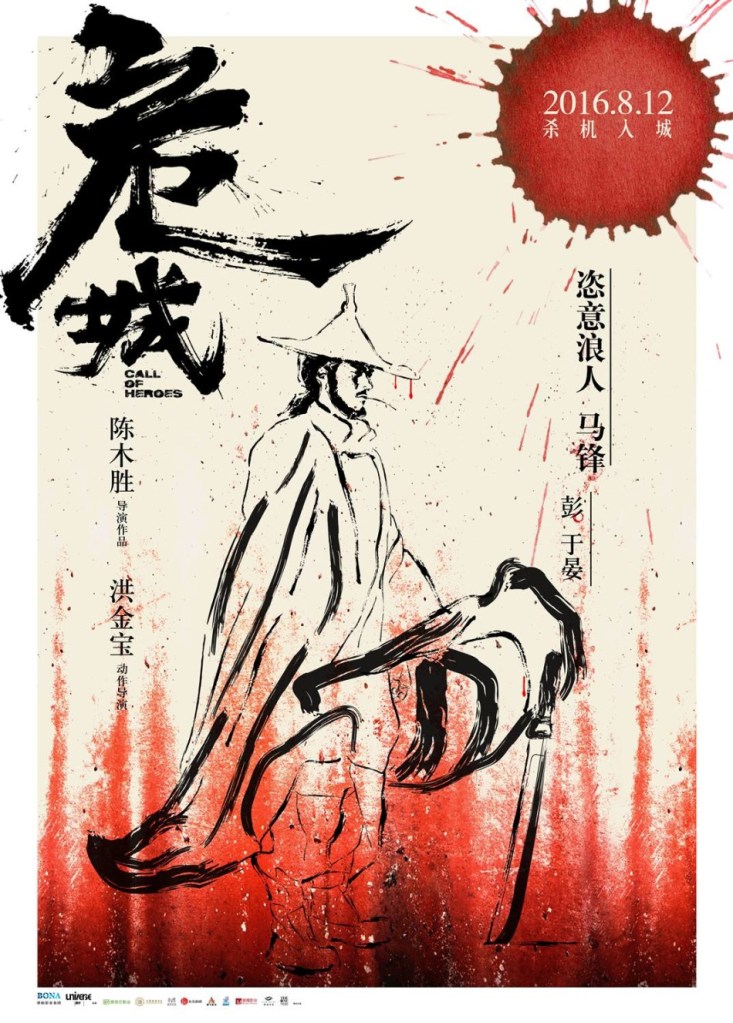
call of heroesA blast from the past in more ways than one, Benny Chan’s Call of Heroes (危城, Wēi Chéng) is a western in disguise though one filtered through Akira Kurosawa and Sergio Leone more than John Ford. Filled with Morricone-esque musical riffs and poncho wearing reluctant heroes, Chan’s bounce back to the post-revolutionary warlord era is one pregnant with contemporary echoes yet totally unafraid to add a touch of uncinematic darkness to its wisecracking world.

1914 – three years after the collapse of Chinese feudalism and warlords rule the land, each vying for power and terrain but taking little account of the displaced people in their path. The residents of Stone City find this out the hard way when notorious general Cao Ying wades into town and conducts a widespread massacre seemingly for the fun of it. Plucky school teacher Bai Ling manages to escape with some of her pupils even whilst other teachers and children are being summarily executed by Cao’s troupes.

Having left with nothing and walked miles, Bai and the children are near starvation when they stop into a noodle house to share a single bowl. Unfortunately the noodle house is about to be robbed but fortunately one of the diners is bearded wanderer Ma Feng (Eddie Peng) who isn’t up for anyone disturbing his serious food coma. Impressed with Ma’s skills, the kids and Bai make their way to Pucheng where Bai has a cousin but Cao is still on the warpath and trouble has a way of tracking good people down.

Pucheng (the name of which literally means ordinary town), is watched over by the noble sheriff Yang Kenan (Sean Lau Ching-wan) though the protective garrison has been sent to the front leaving them with only a skeleton defence. When a mysterious visitor arrives in town and proceeds to shoot dead a man, woman, and even a child, Yang arrests him but when the killer turns out to be Cao Ying’s unhinged son, a number of questions arise. Yang is committed to justice – no matter the man’s name, he ought to pay for his crimes. Yet, Cao Shaolun’s presence is sure to attract his father’s attention and so many of the townspeople feel it might be better to let Cao Shaolun go. Placate a tyrant and undermine the idea of justice by failing to enforce the law or sign your own death warrant by standing up for your principles, it’s a frontiersman’s dilemma.

The references to classic Hollywood westerns are obvious enough, particularly when the narrative takes a turn for the High Noons as Yang finds himself standing alone as the sole resistance to the oncoming militia man threat. Though the townspeople do not exactly turn on Yang in the same way they turn on Kane, they clearly choose appeasement over war. Yang’s dedication to justice is purehearted, there’s little hint of personal vanity in his decision to stand up for the rule of law but only the knowledge that folding now is the same as bowing to Cao’s tyranny.

Though introduced as a possible protagonist, Ma Feng takes a far smaller role in the action than might be expected. Clearly channeling Mifune’s Sanjuro, Peng’s wisecracking drifter and cynical, reluctant hero is almost at odds with the serious business of law vs politics over in Pucheng. His character centric subplot of conflict with a former friend who works for the other side is insufficiently developed to support the emotional weight it’s intended to carry and sometimes feels like a distraction from the main narrative though the great pot mountain based martial arts set piece is certainly one worth waiting for.

If Peng’s Ma Feng feels slightly misplaced with his cynicism and comic stunts, Louis Koo’s hammed up villain Cao Shaolun is in an entirely different film altogether. Wildly over the top, Koo plays Cao Shaolun as a permanently amused psychopath, all crazy eyes and manic laughter. A self consciously cool guy, Cao Shaolun dresses in white and murders innocents with a golden gun all the while knowing he can do as he pleases simply by the virtue of his name.

Shot with a heavily digital aesthetic, Call of Heroes’ evidently high production values are sometimes reduced to a televisual quality or otherwise let down by substandard CGI. The fight scenes themselves are filmed with an old fashioned rigour filled with innovative and exciting choreography and are refreshingly humour free. Like the best westerns, Call of Heroes contains its own parable in that the best weapon against tyranny is a strong and righteous populace but the final stretch almost undermines its noble aims by presenting what is either a revolutionary spring lead by the people for the people, or a worrying case of mob justice.

Prone to narrative dead ends in setting up major characters only to sideline or kill them off unexpectedly, Call of Heroes has a frustrated quality in not being able to decide whether it wants to be a serious call to arms for standing up for what’s right in the face of overwhelming force, or a comedic romp in which a cocky drifter sorts everything out by accident. Either way, Call of Heroes does provide a number of genuinely exciting martial arts set pieces even if floundering slightly in-between them.


Original trailer (Cantonese with Traditional Chinese/English subtitles)

Behemoth (悲兮魔兽, Zhao Liang, 2015)

behemothEvil, so a wise man said, begins when you start treating people as things. Fritz Lang’s Metropolis showed us a city that literally was its people – nothing but a vast yet perfectly functional machine with the workers little more than cogs to be replaced and discarded once worn out. Zhao’s Behemoth (悲兮魔兽, Bēixī Móshòu) is no fantasy but a very real journey through our own world and so we follow our narrator, a poetic, naked stand in for Dante’s Virgil, through hell and purgatory on a path to paradise only to find ourselves staring into a void filled with our unfulfilled desires and forlorn hopes.

On the fifth day God created Behemoth, and the mountain brings him forth food. Where once there was a paradise of verdant green fields and pastoral hills, now there are only quarries and the sounds of men at toil have replaced those of birds and other kinds of beasts. Our journey into hell takes us into a coal mine filled with noise and fires as the mountain is asset stripped right before our very eyes. We are witnessing a murder – the brutal slaughter of natural beauty for human gain, perpetrated by exploited workers who live in penury while their bosses rake off the profits from a safe distance.

Zhao’s workers labour at all hours under the searing heat of a midday sun or the bright glow of moonlight. He lingers on their faces, some old before their time but each tired, wrinkled. The workers are not provided with much in terms of infrastructure or facilities. They have no showers as Western coal miners might, they return home to scrape themselves with towels in an attempt to remove the stain of coal dust from their skin. Coal dust is a penetrative parasite, it sinks deep, falling into the creases each worker has developed through their strenuous efforts to earn the money to survive.

The dust does not stop at the skin. It runs deeper still, into the lungs where it stifles breath even once the unbreathable air of the furnace has been left behind. In what amounts to the naked dreamer’s path through purgatory, we see former workers lying listlessly on hospital beds as the black fluid is drained from their lungs. They cough, wheeze and struggle to breathe but they receive scant care or regard for their years or backbreaking toil. Some of them have formed a pressure group, hoping to get the government involved in their struggle to improve pay and conditions in the powerhouse of the nation but, as is expected, they receive little attention – after all, there are plenty more workers out there and leverage is small when jobs are in demand.

So what of Paradise? Paradise is empty, all the righteous are trapped in hell. Vast cities of high rise buildings lie vacant – a symptom of economic hubris as supply outstrips demand by an inconceivable margin. All this progress, and no one left to enjoy it. At the beginning our naked dreamer evokes Dante to tell us that there is no greater pain than desire without hope. It is unclear if Zhao’s Inner Mongolian workers would prefer this kind of paradise to their green rolling hills, but the decision has been made for them and even so, this is a workers’ paradise that is intended for a different kind of worker, there is no space here for any of Zhao’s coal smeared faces.

Our naked dreamer was guided here by a fellow plains dweller who does not know how to write poetry, but the eloquence of his heart is equal to Dante himself. The guide claims to show us a picture of the dead but the weight he carries on his back is a mirror – it shows us death wearing our own faces. Zhao shows us who we are – the faceless monster, Behemoth, is us or a manifestation of our relentless greed. We were born in paradise, and created ourselves a hell because we wanted more than the Earth could give us. This is our never-ending tragedy, overwhelmed by desire we destroy each other in an endless quest for an unattainable paradise that only exists in dreams.

Zhao’s background in photography comes to the fore as he captures these hellish scenes with an odd kind of beauty, mixing the bucolic with the brutal. Cattle grazes on the distant fields as fires burn in the background, and a baby boy plays innocently by madly digging at the ground as if mimicking the behaviour he sees all around him. At one moment the entire screen floods with red as the hellish glow of the smelting process momentarily blinds us, as does a dust cloud of white later on. For the most part, Zhao is content to show us the faces of these men and women, weathered by years of backbreaking labour yet he also tells us that he sees past their fatigue and their resignation to the people they once were that this environment has also destroyed. This is no social realist propaganda film, Zhao respects the sacrifice of these hard working people but it’s as far from glorification as it’s possible to be.

It’s tempting to say this is a China specific issue, brought about by the country’s unique political situation and rapid industrialisation but Zhao’s canvas is wider. This is a human problem that is not bound by national borders or cultural norms. We each live complicit with this system, so desperate to keep the lights on that we’ve become afraid to ask how it’s done. We can continue feed the monster that will one day devour us, or we can try to starve it out but that would require us to acknowledge the greed and selfishness that underline human nature. History is not on our side.


UK release trailer (ICA exclusive screening):

My Best Friend’s Wedding (我最好朋友的婚礼, Chen Feihong, 2016)

My Best Friend's WeddingChinese cinema screens are no stranger to the event movie, and so a Chinese remake of the much loved 1997 Hollywood rom-com My Best Friend’s Wedding (我最好朋友的婚礼, Wǒ Zuì Hǎo Péngyǒu de Hūnlǐ) arrives right on time for Chinese Valentine’s Day. Purely by coincidence of course! However, those familiar with the 1997 Julia Roberts starring movie may recall that My Best Friend’s Wedding is a classic example of the subverted romance which doesn’t end with the classic happy ever after, but acts as a tonic to the sickly sweet love stories Hollywood is known for by embracing the more realistic philosophy that sometimes it just really is too late and you have to accept that you let the moment get away from you, painful as that may be.

This time the story focuses on Gu Jia (Shu Qi), recently made editor-in-chief of a Chinese fashion magazine her career is riding high but there’s something nagging at Gu Jia’s happiness that she’s been content to keep on the back burner. On an important work assignment in Milan she begins remembering a wonderful holiday she had there with her childhood friend Lin Ran (Feng Shaofeng). Lin Ran is a football reporter who has been working in London with the BBC so he and Gu Jia have not seen each other for a while. Just as she’s going into her first fashion show, Gu Jia receives an unexpected phone call from Lin Ran who has some surprising news – he’s getting married. The following weekend. Suddenly Gu Jia’s world crumbles.

Jumping on the next plane to London, Gu Jia makes a fool of herself as a crying mess but meets a very nice, sympathetic guy who does a good job of pretending not to mind very much when she chucks champaign all over him during a drunken “conversation” with her mental Lin Ran. On arrival she’s thrilled to see the real Lin Ran but much less so to meet his wife to be – Xuan Xuan (Victoria Song), a very young, bubbly, and slightly silly girl from an extremely wealthy family. Gu Jia is even more determined than ever to derail Lin Ran’s wedding and win him back for herself.

There was undoubtedly something very 1990s about My Best Friend’s Wedding and its daring acknowledgement that sometimes the happy ending lies in learning to accept there are things you will always regret, but you just have to learn to live with them. Somehow it’s difficult to imagine a romantic comedy making a success of a “realistic” ending rather the dash to the airport final confessions and reconciliations the genre is known for in these more troubled times. It’s surprising that in switching the action to China the ages of the leads have increased – Julia Roberts’ character was 28 in the original film (the idea being to get married before 28) but Shu Qi and Feng Shaofeng are playing characters in their ‘30s who have already established themselves in extremely successful, international careers.

The majority of the film takes place in London and is filled with picturesque, touristy images of the various famous landmarks, sunshine filled green parks, and of course big red buses. This is the London inhabited by the elite super rich who flit between upscale boutiques and live in spacious Kensington townhouses with flashy convertibles parked in the paved driveway which is enclosed inside a large metal gate (at one point Gu Jia and Lin Ran take a ride on a double-decker as an “experience” because he hasn’t been on one in years). It’s all very “aspirational” in one sense, but also a little unpleasant as rich people hang out with other rich people because they’re all rich together and all anyone’s interested in is how much money everyone else has.

This becomes the film’s central problem as it indulges in some the least subtle product placement to ever grace the cinema screen. On arrival in Milan, Gu Jia heads into the Bulgari hotel which has adverts for Bulgari watches on the TV screens (as the real hotel undoubtedly does) with the brand then turning up on shopping bags and even prominently on the lid of a wedding ring box. The film also makes a show of everything from whiskies to airlines and fashion houses including an actual cameo from designer Christian Louboutin.

The one thing it doesn’t showcase is any kind of emotional connection with the material. Shu Qi does what she can with an extremely underwritten part which provides her with no real way to explain just why it is she finds it impossible to reveal her true feelings to Lin Ran, but there’s little chemistry between any of the co-stars and the various connections between them never ring true.  Unlike the original film, Gu Jia’s “boyfriend” stooge (a Mandarin speaking British Chinese guy, Nick, played by Rhydian Vaughn) is not gay though he does briefly pretend to be to open a path for Lin Ran to choose Gu Jia over his wife-to-be.

A big budget, prestige picture moving from upscale Chinese high rise cities to biscuit tin London and elegant, neo-classical Milan, My Best Friend’s Wedding is a shallow affair which attempts to cover up for its lack of soul with high production values. Shu Qi does her best and turns in another characteristically charming performance with good support from her co-stars but they can’t make up for the lack of any real connection throughout the overly glossy proceedings. A mild misfire despite its starry cast, My Best Friend’s Wedding fails on both the comedic and romantic fronts yet does offer some very pretty shots of various picturesque European locales.


Original trailer (English subtitles)

League of Gods (3D封神榜, Koan Hui & Vernie Yeung , 2016)

league of godsOften, people will try to convince of the merits of something or other by considerably over compensating for its faults. Therefore when you see a movie marketed as the X-ian version of X, starring just about everyone and with a budget bigger than the GDP of a small nation you should learn to be wary rather than impressed. If you’ve followed this very sage advice, you will fare better than this reviewer and not find yourself parked in front of a cinema screen for two hours of non-sensical European fantasy influenced epic adventure such as is League of Gods (3D封神榜, 3D Fēng Shén Bǎng).
Based on a classic Chinese text – the Ming Dynasty epic Investiture of the Gods by Xu Zhonglin, League of Gods begins with its despotic monarch, King Zhou (Tony Leung Ka-fei) and the story of how it was he came to lose his soul to Black Dragon and fall under spell of the nine-tailed fox, Daji (an underused Fan Bingbing). The couple have kidnapped Wizard Jiang (Jet Li), who may have been the only one with the knowledge to end their demonic rule – if it weren’t for the fact he’s subject to an anti-ageing curse and keeps regressing each time he uses his powers. Nevertheless, a group of warriors from Xiqi attempt to rescue Jiang and a group of orphan children who are also being held prisoner though their partial success leads them to undertake a new mission to find the Sword of Light which may finally help them to cut through the darkness and restore their kingdom to glory.

The primary bearer of this quest is Lei (Jacky Heung) who is second heir to the Wing Kingdom though also an embarrassment to his father because unlike his countrymen, he’s never been able to find his wings and fly like the rest of his brethren. Jiang entrusts him with three bags to help on his journey, one of which contains “magic grass” (ahem!) which is basically a healthier version of Clippy, the second a CGI baby version of once ruthless warrior, Naza, and the third a baby Merman who had his spine removed by Naza to stop him growing up and just wants to go home. Lei runs into automaton spy and tragic love interest Blue Butterfly (Angelababy) who does at least lend a degree of pathos to the proceedings and Louis Koo also turns up riding a giant panther, which is quite a ride, it has to be said.

The biggest problem facing League of Gods is one common to every fantasy film – that is, constructing a fantastical world which is still 100% internally consistent and completely believable throughout. League of Gods throws so much information out so quickly that it’s impossible to keep a handle on everything that’s going on, let alone try to work out how all of these various warring kingdoms fit together. There is a lot of story to go around, and directors Koan Hui and Vernie Yeung have recruited a host of China’s biggest stars to help tell it. This obviously means that some stars are appearing for mere minutes with barely anything to do save show their face, making an already bloated premise overloaded beyond any sustainable level.

Narrative excitement has largely been sidelined in favour of visual flair but League of Gods is constantly let down by poor quality CGI some of which might look more at home in a late ‘90s video game. League of Gods operates as a kind of hybrid movie, mixing heavy CGI animation with live action actors but can’t decide just how po-faced it really wants to be. Lei is accompanied on his quest by a fearsome warrior, Naza, apparently an arrogant and dangerous criminal who has been imprisoned in the body of a toddler. This CGI baby grins, burps, farts, and high kicks his way out of trouble in a decidedly bizarre fashion with his grown up language offered from a cute baby face. Naza is countered by his sometime enemy – an adorable Merman baby who just misses his dad but seems to have no other purpose so it’s a mystery why Jiang gave Lei this particular bag. Magic Grass is obviously an advisory figure, but is an apt way to try and explain what’s going on.

League of Gods moves from set piece to set piece with some muddled character development along the way as Lei finds love and develops his wings but never makes any kind of attempt at unifying its disparate plot strands. Squandering the talents of its extremely high level of A-list stars, League of Gods relies of campy fun to get by but is far too serious to make the most of its over the top potential. Disappointingly, after it’s intense build up League of Gods refuses to stage its finale – ending on a cliff hanger which is heralded by the most ridiculous evil laugh offered by a despot clutching a baby which is actually the regressed form of his rival and a formerly powerful wizard. It sounds good, but it isn’t. Read the small print, sign with caution.


US release trailer (English subtitles)

Happy Times (幸福时光, Zhang Yimou, 2000)

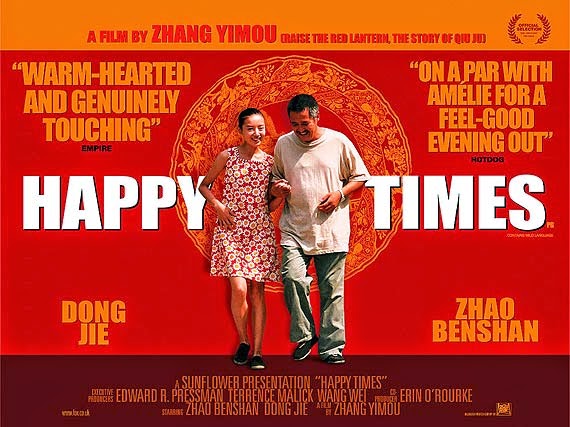
Happy TimesPossibly the most successful of China’s Fifth Generation filmmakers, Zhang Yimou is not particularly known for his sense of humour though Happy Times (幸福时光, Xìngfú Shíguāng) is nothing is not drenched in irony. Less directly aimed at social criticism, Happy Times takes a sideswipe at modern culture with its increasing consumerism, lack of empathy, and relentless progress yet it also finds good hearted people coming together to help each other through even if they do it in slightly less than ideal ways.
An older man in his 50s, Zhao is a bachelor afraid that life has already passed him by. Desperate to get married for reasons of companionship, he’s settled on the idea of finding himself a larger lady who, he assumes, will be filled with warmth (both literally and figuratively), have a lovely flat he can move into and will also be able to delight him with delicious food. Not much to ask for really, is it? Unfortunately, he ends up with a woman nicknamed “Chunky Mama” who is pretty much devoid of all of these qualities beyond the physical. She has an overweight son whom she spoils ridiculously and a blind stepdaughter she treats with cruelty and disdain.

Zhao is eager to please his new lady love and has told her a mini fib about being a hotel manager. He and his friend Li had been planning to open a “love hut” in an abandoned trailer in the forest but this plan doesn’t quite work out so when Chunky Mama asks him to give the blind girl, Little Wu, a job in the hotel Zhao is in a fix. Together with some of his friends, he hatches a plan to create a fake massage room in an abandoned warehouse where they can take turns getting massages from the girl in the hope that she really believes she’s working and making money for herself. However, though Little Wu comes to truly love her mini band of would be saviours she also has a yearning to find her long absent father who has promised to get her treatment to restore her sight, as well as a growing sense of guilt as she feels she’s becoming a burden to them.

Zhao decided to name his “love hut” the Happy Times Hotel – to him there’s really no difference between a “hut” and a “hotel”. In some ways he’s quite correct but the expectation differential isn’t something that would really occur to him, straightforward fantasist as he is. In fact, Zhao is a master of the half-truth, constantly in a state of mild self delusion and self directed PR spin as he tries to win himself the brand new life he dreams of through sheer power of imagination. His friends seem to know this about him and find it quite an amusing, endearing quality rather than a serious personality flaw.

Unfortunately this same directness sometimes prevents him from noticing he’s also being played in return. The ghastly stepmother Chunky Mama is in many ways a clear symbol of everything that’s wrong with modern society – brash, forceful, and materially obsessed. For unclear reasons, she’s hung on to Little Wu after the breakdown of the marriage to her father but keeps her in a backroom and forces her do chores while her own son lounges about playing video games and eating ice-cream. Ice-cream itself becomes a symbol of the simple luxuries that are out of reach for people like Little Wu and Zhao but quickly gulped down by Chunky Mama’s son with an unpleasant degree of thoughtless entitlement. The son is a complete incarnation of the Little Emperor syndrome that has accompanied the One Child Policy as his mother indulges his every whim, teaching him to be just as selfish and materially obsessed as she is.

For much of its running time, Happy Times is a fairly typical low comedy with a slightly surreal set up filled with simple but good natured people rallying round to try and help each other through a series of awkward situations but begins to change tone markedly when reaching its final stretch. Zhao and Little Wu begin to develop a paternal relationship particularly as it becomes clear that the father she longs for has abandoned her and will probably never return but circumstances move them away from a happy ending and into an uncertain future. The film ends on a bittersweet note that is both melancholy but also uplifting as both characters send undeliverable messages to each other which are intended to spur them on with hope for the future. “Happy Times Hotel” then takes on its most ironic meaning as happiness becomes a temporary destination proceeded by a long and arduous journey which must then be abandoned as the traveller returns to the road.


Retitled “Happy Times Hotel” for the UK home video release.

US release trailer (complete with dreadful voice over and comic sans):

Shower (洗澡, Zhang Yang, 1999)

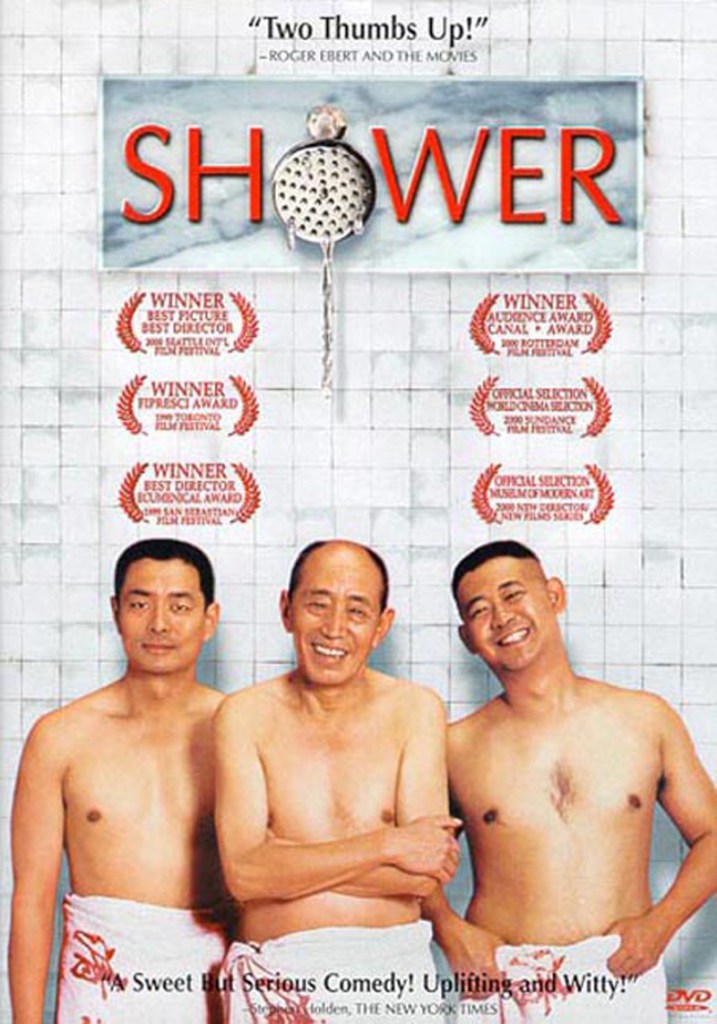
Shower posterChina is changing. Transforming faster than any other society at any other point in history. This brave new future, flooding in as it has across an ancient nation, has nevertheless left a few islands of dry land untouched by modern progress. Old Liu’s bathhouse is just one of these oases, far away from the big city with its frantic pace and high technology. In the city, you can step into a tiny cubicle and “undergo” a shower inside a contraption that’s just like a carwash, only for people. In Liu’s bathhouse you can relax for as long as you like, laughing and joking with old friends or just hiding out from the world.
Prodigal son Da Ming returns to this untouched relic from his past on a brief reprieve from his busy businessman life, attempting to reconnect with his distant father and younger brother, Er Ming, who has some learning difficulties. Da Ming left here for something better, he looks down on his father’s profession and its old fashioned insistence on taking one’s time, but gradually as he returns to the rhythms of his childhood the warmth of the bathhouse atmosphere begins to soak into his heart.

Most of Liu’s customers are older men who grew up in an era when going to the bathhouse was normal rather than bathing at home as younger people do. They use the bathhouse as some would use a teahouse or a bar, they spend all day there getting various treatments, racing crickets and bickering about the past. If it weren’t for the bathhouse many of these older men would have nowhere to get together. However, times have changed and even if the bathhouse were more popular with the young folk, it seems the entire block has been bought up by property developers intent on throwing up an array of tall buildings replacing the cosy, traditional atmosphere of the small town shops, restaurants and amenities which currently occupy it.

Da Ming keeps meaning to go home, he even books a return flight, but keeps putting it off. Eventually he begins to bond with his father again, going so far as climbing up to the roof to help him secure a tarpaulin during a heavy thunderstorm. He enjoys hanging out with his brother but after being away for so long has perhaps forgotten how much looking after he really needs with the consequence that Er Ming actually wanders off somewhere for the first time in his life. However, Er Ming is much more resourceful than his father had assumed and returns with a broad grin and pockets full of apples as if nothing out of the ordinary had happened.

In its final stretch, Shower makes a tonal shift to the arid deserts of Northern China and a story which happens to reflect the early life of Da Ming’s parents. In this dry land, water is worth more than all the gold in the world. There is an ancient custom that on the night before her wedding, each bride enjoys a hot bath – a true luxury in a place where death from thirst is a real possibility. The extreme measures her family have to go to to allow their daughter to perform this important ritual emphasise its importance as do the tears shed by the girl in question as she sinks into what is possibly the first and last time she will ever enjoy the simple pleasure of a hot bath. Water unites all things, as a TV broadcast watched by Er Ming reminds us, the elephant and the dung beetle have exactly the same dependency on water and their access to it is entirely in the hands of fate.

Liu’s bathhouse is a place of solace where men can come and talk through their troubles together. One local man has a series of marital problems with his rather feisty wife whereas another enjoys loudly singing O Sole Mio whilst having a shower but freezes up when he tries to sing on stage, and then there’s the old guys with their crickets and decades old arguments. Liu listens to them all, allowing their tensions to run away with the bathwater. The “human wash” shower cubicle might be efficient and undoubtedly useful in the quickening pace of modern life, but you go in there alone with all your thoughts and no one to gently lead you to the truths you always knew were there but were unwilling to see.

Shower is another China at the cross roads movie as older brother Da Ming represents the forward marching younger generation who’ve abandoned their old hometowns for the bright lights of the cities only to feel cheated out of something more essential. Returning home is a journey filled with ambivalence – being hit both by the backwardness of the place but also by its wholesome goodness and the warmth of community spirit. It may be too late to save the bathhouse, but that doesn’t mean all that it represents has to go with it. The future is uncertain for Da Ming and Er Ming, as it is for China itself, but if anything can hold back the erasure of centuries of culture it has to start here, with two brothers and a bathhouse, or doesn’t start anywhere at all.


Shower (洗澡, Xǐzǎo) is available on DVD in the UK from Momentum and in the US from Sony Pictures Classic.

US release trailer:

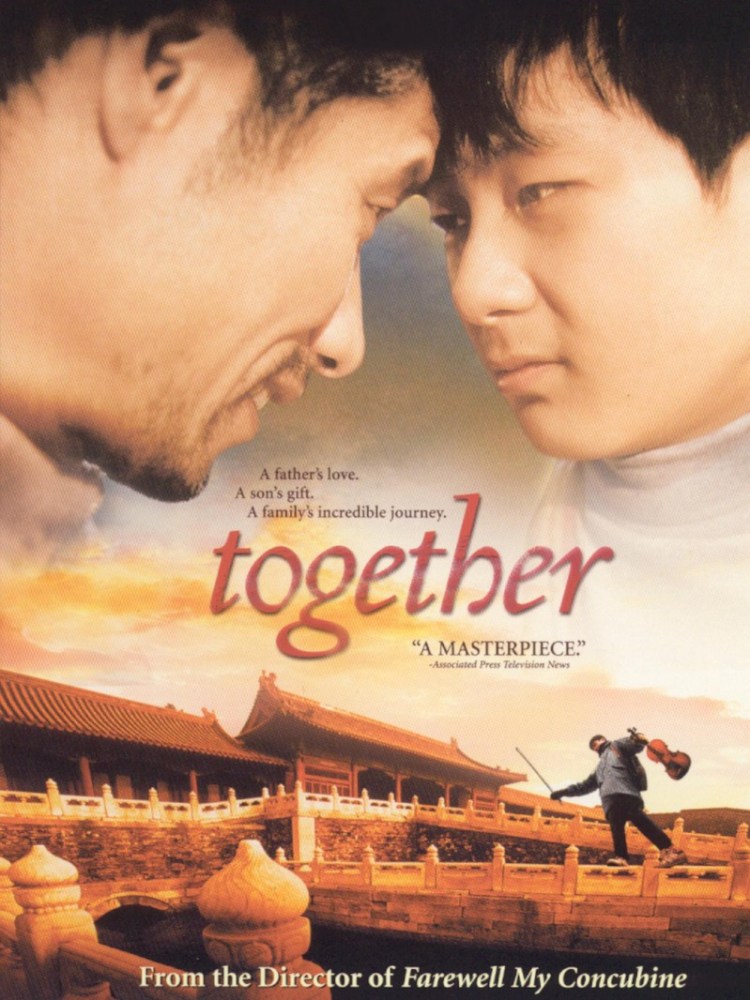
Together (和你在一起, Chen Kaige, 2002)

together engIt’s a sad truth, but talent isn’t enough to see you succeed in the wider world. In fact, all having talent means is that unscrupulous people will seek to harness themselves to you in the hope of achieving the kind of success which they are incapable of obtaining for themselves. 13 year old Xiaochun is about a learn a series of difficult life lessons in Chen Kaige’s Together (和你在一起, Hé nǐ zài yīqǐ), not least of them what true fatherhood means and whether the pursuit of fame and fortune is worth sacrificing the very passion that brought you success in the first place.

Xiaochun lives with his father Liu Cheng in a small rural town where he is known for his prowess with the fiddle. In fact, he even gets called in to play some calming violin music at the birth of a local bigwig’s child. After a little boy emerges safely into the world, the bigwig tries to give Liu some money which he refuses but Xiaochun later takes. The big wig congratulates Xiaochun on his understanding of how the world works, unlike his honest and sentimental father.

However, what Liu wants for his son is success so he takes the boy to the big city and enters him in a violin contest. He comes fifth but the contest is rigged in favour of donors to the school and no one wants to take on a poor country bumpkin for a pupil. Eventually Liu convinces an eccentric, lonely professor, Jiang, to give Xiaochun lessons and the pair start to build up a paternal relationship. Xiaochun also makes friends with the beautiful but equally eccentric woman from upstairs, Lili, while his father tries to find work to pay for all these lessons. Eventually Liu ends up at a swanky recital and tries to get Xiaochun to switch to the more successful professor Yu who’s all cold calculation and designer sweaters. This sudden bid for mainstream success drives a wedge between father and son who have very different ideas of what it means to be a “successful” person.

Together isn’t quite the film it seems to set out to be. You’d expect professor Jiang’s broken heart to take more of a centre stage but no sooner have we invested our time in Jiang’s back story of tragic romance than Xiaochun is swept away to the corporate music factory that is Yu’s upscale apartment. We’ve already seen how money and status are everything in this game, donate big bucks to the school and your kid gets the shiny trophy regardless of their actual talent. A depressingly realistic scene right after the contest sees Jiang trying to give a lesson to a clearly disinterested boy while his trashily dressed mother yells at someone on a blinged up cellphone from the other room. When the pair angrily declare they won’t be coming back, the boy is strangely grateful to Jian for “letting him quit” this annoying hobby that his mum obviously made him practice as a kind of status symbol despite the fact he has no ear for music.

Liu is just too bumpkinish for Beijing life, he’s simple and honest which are not good qualities to have in a big city. He insists on wearing a big red hat all the time which screams “not local”, and he even keeps his money in it so, of course, it gets stolen. That said, it’s Liu who wants his son to have the big bucks and a secure life of the kind that Yu can offer him. He sincerely wants this for Xiaochun and is prepared to get out of his way if necessary. Jiang wanted to teach him music and would have done it for free. Yu wants to use him to bolster his own success and is prepared to manipulate him in extremely cruel ways in order to get what he wants out of him. Tellingly, Yu already had a prize pupil living his apartment who is now forced to compete with Xiaochun for Yu’s attention. Now there’s a better prospect on the table, she is being abandoned despite a host of promises and all her hard work. Yu is a businessman, Jiang is an artist.

Now the boy has to choose between three fathers and three futures as he considers just giving up and going home with his father, giving in to Yu’s corporate demands and losing the love he had for playing his instrument in a simple and heartfelt way, or following Jiang’s teachings which, ironically, are all about following the heart. After an extremely late and cruelly presented revelation, Xiaochun has even more to think about with this question but ultimately what matters is heart more than money as a hand knitted sweater proves warmer than an expensive fur coat.

Together has a number of structural problems that frustrate its passage either as a Hollywood influenced feel good tale of a poor boy and his violin or a gritty indie movie about how talent doesn’t matter in a world ruled by social status and reputation (which is sort of like a futures market in an odd way, everyone buying into something which doesn’t quite exist). Liu and Xiaochun meet a lot of nice “salt of the Earth” people in the big city (except for Yu) but are perpetually locked out of the next stage of the game through not having the right connections. Liu, in his simple and honest way, doesn’t understand this so he’s able to pressure right through it but his son who is more pure hearted but also practical finds navigating its series of traps and temptations endlessly confusing. Edging into sentimentality in the final third, Chen can’t quite bring his sonata to the crescendo he seems to be aiming for but still finishes with a warmly received round of applause.


Together was released in the UK by Momentum under the title Together with You (presumably to avoid confusion with Lukas Moodyson’s film of the same title released not long before) which is a more literal, if slightly awkward, translation of the original Chinese. The disc itself and menu screen both remain “Together”. The UK disc may be technically OOP but the film is also available in the US from MGM.