
 “Respect” is a thorny issue, is it something which is conferred from a position of inferiority, an acceptance of equality, or taken by force? Should the older generation be “entitled” to the respect of the young simply for having been born earlier, lived longer, and have less time left, and should the state also be “entitled” to the respect of its citizens even if it abuses that respect? Respeto is the debut feature from Alberto (Treb) Monteras II but like much Philippine cinema it comes with heavy baggage as its scrappy youngster attempts to come of age in the hip hop dens of the Pandacan slums where all around him the increasingly oppressive Duterte regime brings back terrible memories for a generation only once removed from his own which paid a heavy price to rid themselves of a tyranny they now see returning.
Hendrix (Abra), a scrappy teen living with his older sister and her boyfriend who prides himself for his magnanimity in supporting his lover’s annoying kid brother, says he has the “mind of a gangster” and longs to prove himself in the underground rap battling world which represents a kind of escape from the harshness of his everyday existence. Hip hop maybe the music of the oppressed, but there’s little politicking in arcane world of petty gangsters and drugged up thugs. This is a world of humiliation – the rappers rap about rapping, about how their rhymes are sweeter than their opponent’s, how their opponent is weak and they are strong. Despite an often careful honing of a craft, this rap is vacuous – a misuse of words that could serve real purpose to do little more than replace the act of physical violence with macho male posturing.
This is certainly a very male, macho world. Inducted into the rap battle scene, Hendrix is tricked into battling an old veteran, Jambalaya – a larger lady with an intimidating presence, but all he can come up with is a steady stream of misogynistic fat jokes, badly delivered, before he wets himself live on stage. Jambalaya quite rightly destroys him with an elegantly delivered takedown which subtly suggests everything he’s just said is completely beneath him and is therefore doubly insulting. Hendrix is humiliated, as the loser of the battles is intended to be, but he’s slow to realise that the game itself is already a betrayal of its own power.
Having stolen the money to participate in the rap battle from Mondo (Brian Arda), his sister’s dodgy boyfriend, Hendrix hits on an extreme solution to pay him back – robbing the secondhand bookshop run by an old man, Doc (Dido De La Paz), seemingly suffering with the early stages of dementia. The plan fails because Hendrix and his buddies aren’t exactly master criminals, but as a result they find themselves tasked with having to repair the damage while Doc, mildly outraged by the youth of the day, begins to see enough potential in the obviously bright yet stubborn young man to want to try to save him.
What occurs between them is somewhere between a war of words and a war for words. Doc, now an old man, was an activist poet during the Marcos regime who lost a wife and child to its brutality. In the end, his words were not enough but unlike those of the rap battlers of Pandacan, they were both beautiful and filled with purpose. Doc’s verses were, in a sense, intended to humiliate a regime – in this they are not so different from Hendrix’s rhymes, but they failed to take the place of violence. A man of words faced with the possibility of revenge, Doc was not strong enough to resist but bought himself only more anguish in a single act of primal rage that soon forged another link in a chain stretching out in both directions across an eternity.
Peppered throughout, radio broadcasts make frequent reference to a debate surrounding the long delayed burial of former dictator Ferdinand Marcos who died in exile in 1989. The older generation fought an oppressive regime and thought they’d won only for their children to betray the revolution they gave birth to – literally in Doc’s case as his son became a corrupt policeman who abuses his power to humiliate those whose should “respect” he ought to earn through continued service. Rendered powerless by their oppressive environments, both Doc and Hendrix sought to reclaim their self respect by asserting their voice, but in the end their words find only empty air. Somehow awed by ancient technology, the kids find an old record of a Marcos era protest song in Doc’s bookshop and realise they already know the words. The singer, seemingly a young person, begs to be left out the political storm, not to be dragged into a war he sees as nothing to do with him, but an escape from this unending cycle of violence seems unlikely while words remain weightless.
Available to stream online via Festival Scope until 20th February 2018 as part of its International Film Festival Rotterdam tie-up.
Original trailer (English subtitles)
 Lav Diaz’s auteurist break through, Batang West Side is among his more accessible efforts despite its daunting (if “concise” by later standards) five hour running time. Ostensibly moving away from the director’s beloved Philippines, this noir inflected tale apes a police procedural as New Jersey based Filipino cop Mijares (Joel Torre) investigates the murder of a young countryman but is forced to face his own darkness in the process. Diaspora, homeland and nationhood fight it out among those who’ve sought brighter futures overseas but for this collection of young Filipinos abroad all they’ve found is more of home, pursued by ghosts which can never be outrun. These young people muse on ways to save the Philippines even as they’ve seemingly abandoned it but for the central pair of lost souls at its centre, a young one and an old one, abandonment is the wound which can never be healed.
 If
If 
 About half way through Lino Brocka’s masterpiece of Philippine cinema Manila in the Claws of Light (Maynila, sa mga Kuko ng Liwanag), the hero, Julio (Bembol Roco), sits watching the window where he thinks the woman he loves may be being held prisoner as a trio of guitar players strums out The Impossible Dream, unwittingly narrating his entire story. Julio is no Don Quixote but he has his own Dulcinea and, as the song says, without question or pause he is ready to march into hell for the heavenly cause of rescuing her from clutches of this cruel city. Not quite content to love pure and chaste from afar, Julio plays Orpheus descending into the underworld, plunged into a strange odyssey through a harsh and indifferent world driven by mutual exploitation and the expectation of violence.
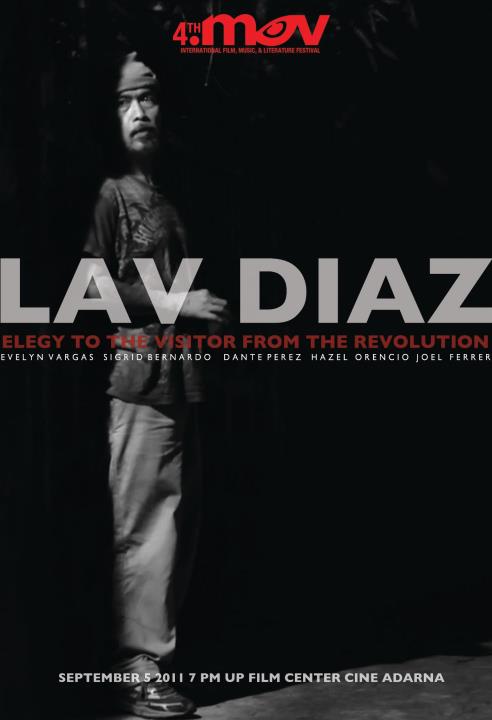 Lav Diaz is many things but he’s not especially known for his brevity. Elegy to the Visitor From the Revolution (Elehiya Sa Dumalaw Mula Sa Himagsikan) is something of a departure in that regard as it runs a scant eighty minutes but is, nevertheless, imbued with the director’s constant themes of loss, melancholy and despair conveyed across a tripartite structure peopled by three very different yet interconnected sets of characters. To say “only” eighty minutes long, yet Elegy to the Visitor From the Revolution first began as a one minute short, intended to form a part of Nikalexis.MOV – an omnibus dedicated to the memory of film critics Alexis Tioseco and Nika Bohinc tragically killed during a home invasion. Diaz’ film, however, outgrew its origins to become a stand alone feature in its own right.
 “Why is there so much madness and too much sorrow in the world? Is happiness just a concept? Is living just a process to measure man’s pain?” asks a key character towards the end of this eight hour film, but he might as well be speaking for the film itself as its director, Lav Diaz, delivers another long form state of the nation address. This is a ruined land peopled by ghosts, unable to come to terms with their grief and robbing themselves of their identities in an effort to circumvent their pain. Raw yet lyrical, Diaz’s lament seems wider than just for his damaged homeland as each of its sorrowful, disillusioned warriors attempts to reacquaint themselves with world devoid of hope.
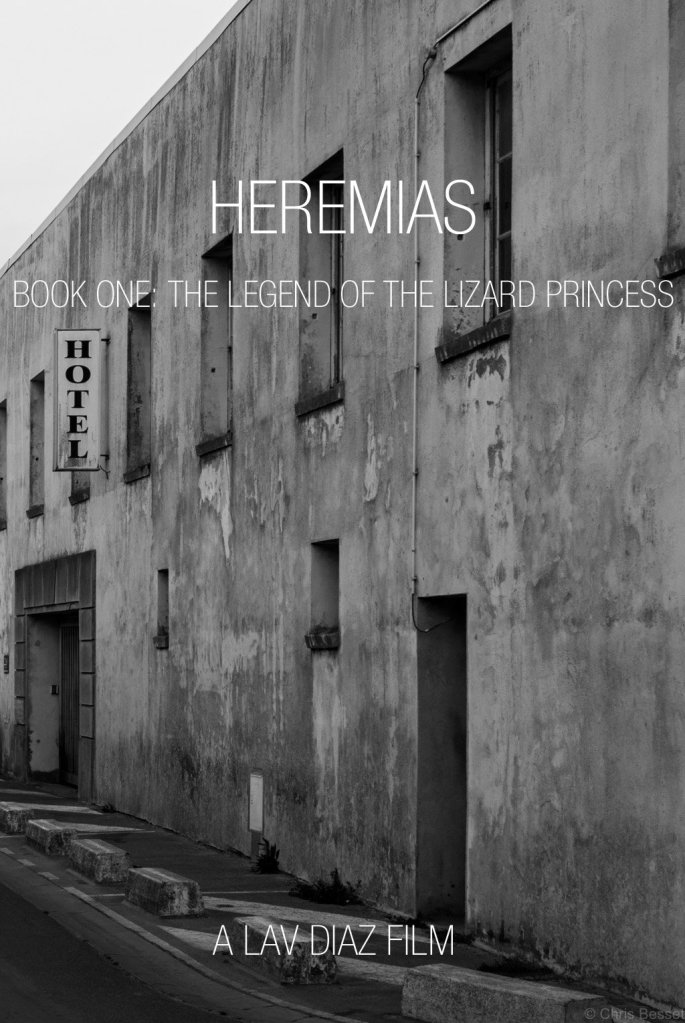 Lav Diaz has never been accused of directness, but even so his 8.5hr epic, Heremias (Book 1: The Legend of the Lizard Princess) (Unang aklat: Ang alamat ng prinsesang bayawak) is a curiously symbolic piece, casting its titular hero in the role of the prophet Jeremiah, adrift in an odyssey of faith. With long sections playing out in near real time, extreme long distance shots often static in nature, and black and white photography captured on low res digital video which makes it almost impossible to detect emotional subtlety in the performances of its cast, Heremias is a challenging prospect yet an oddly hypnotic, ultimately moving one.
 Windows on Worlds