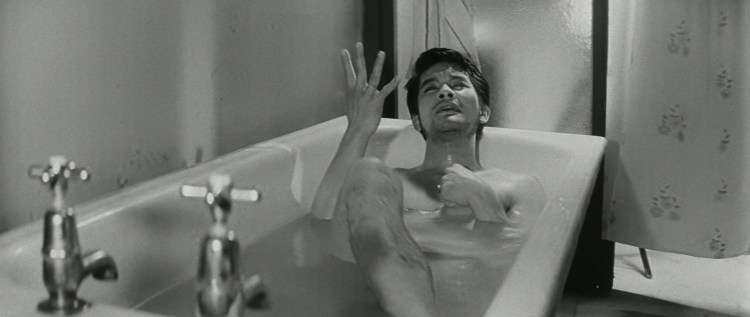
Six Suspects (六個嫌疑犯, Lin Tuan-Chiu, 1965)

“Crime doesn’t pay” is the moral of many a film, but few of them care to state as much upfront. Not perhaps since The Public Enemy has a moral message been declared so baldly on screen as it is in the title card overlying the opening of Lin Tuan-Chiu’s Six Suspects (六個嫌疑犯) which tells us in no uncertain terms not only that you reap what you sow, but also that we law abiding citizens have nothing to fear because we are “well protected” by the police. In the end, Six Suspects was never released (apparently because Lin was unhappy with it rather than any censorship issues), but is perhaps a curious example of a pro-police drama masquerading as a noirish crime thriller with a surprisingly leftist message that dares to suggest the new middle class is inherently corrupt. 

Our anti-hero is a roguish blackmailer, Tenn Kong-Hui (Wu Dongru), who has a habit of following people around and taking photos he can use as leverage against them later. His ex-girlfriend Tai-Giok (Zhang Qingqing) has moved on and attempted to go straight with a job as the secretary to the CEO of a steel firm, but is also having a “serious” affair with the man who hopes to become his son-in-law, Lap. Meanwhile, the chairman’s brother, Khe-bing, has troubles of his own. He’s already being blackmailed by a bar hostess who may have lied about conceiving a child with him before he was married to his elegant wife, who is also a target for Kong-hui after he spots her meeting with a beatnik artist. The real problem, however is that through all his various investigations, Kong-hui has stumbled on a deeply entrenched system of corruption running between the steel company and local contractors. 

It will come as no surprise that Kong-hui is eventually bumped off. Someone knocked him on the back of the head and then turned the gas on to make it look like he killed himself. His roommate, actually in love with the chairman’s daughter even though she’s still planning on marrying Lap to please her dad, freely admits Kong-hui was “scum” but thinks it’s unlikely he did himself in. The police eventually agree, but have the luxury of too many suspects. Who did it? Two yakuza-esque petty gangsters going by the names “Snake” and “Turtle” because of their tattoos, Lap, his old flame Tai-Giok, the roommate who apparently argued with him on the night in question and then passed out drunk in a park, Khe-bing and/or his wife, or someone else entirely? 

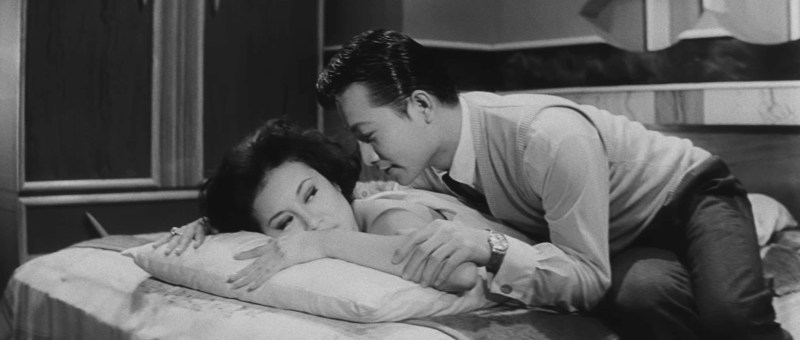
In some senses, it doesn’t really matter. The society here is so inherently corrupt that no one is really “innocent” except perhaps the pure-hearted roommate who remains shocked and disgusted by the results of his police detective friend’s investigations and innocently in love with the chairman’s unobtainable daughter. The ambition that comes from the widening wealth gap is instantly on display as the film opens with Lap in bed with Tai-Giok but brushing off her suggestions that they marry by reminding her she’ll be the most comfortable of mistresses when he marries the chairman’s daughter. In another kind of film, they would be our central couple – their pure love corrupted by post-war greed, but we later realise neither of them is very much in love at all and their “relationship” must be based on some other factor. Lap isn’t betraying Tai-Giok to marry the boss’ daughter, though there may be other casualties of his all too willing complicity in an increasingly amoral economy which sees him gleefully accepting kickbacks and wining and dining clients in restaurants where you can hire scantily clad dancers to entertain you while you eat. 

Despite his rather obvious villainy, Kong-hui wasn’t really all that bad, just a product of the world in which he lived. In fact, the film almost sides with him in his one man crusade against “immorality”. In any case, the real villain as we later see is equal parts prudery and an elitist entitlement that enables this level of corruption to prosper. Our “heroes” are of course the police, turning their collars to the cold as they work tirelessly to fight “crime” but also, it has to be said, acting on behalf of an oppressive regime which may be the biggest villain of them all. 


Six Suspects screened as part of touring retrospective Taiwan’s Lost Commercial Cinema. It will also be available to stream in the UK as part of the Taiwan Film Festival Edinburgh from 18th to 27th September.

Restoration trailer (English / Traditional Chinese subtitles)

Tarzan and the Treasure (泰山寶藏, Liang Zhefu, 1965)

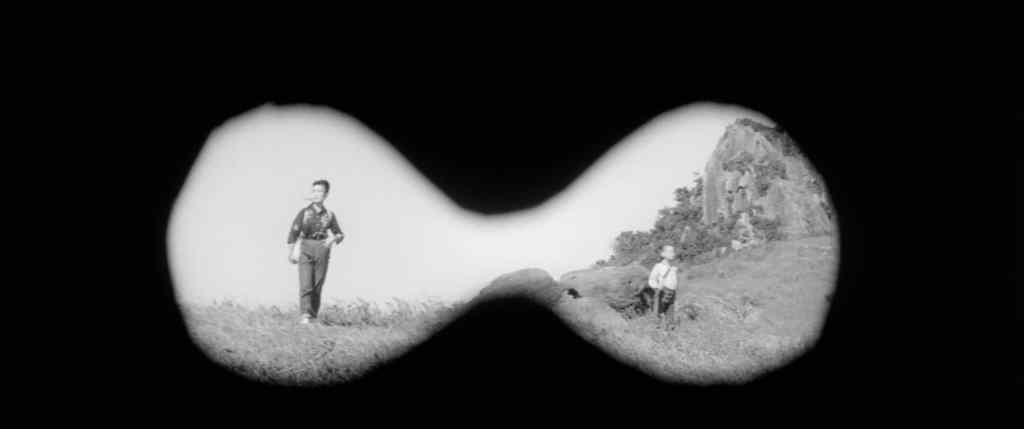
Nothing is guaranteed to turn people against each other faster than hidden loot. So it is for the children of two wartime conscripts inheriting a dubious legacy from their departed fathers in the enticingly named Tarzan and the Treasure (泰山寶藏). The world was beginning to open up in 1965, but in cinema at least there was still space for the “mysterious East” even when seen from the relative proximity of Taiwan. 

A Taiwanese businessman travels to Macao in search of the missing half of a map said to lead to treasure hidden in the Malayan mountains by the Japanese at the end of the war. The man’s brother, Zheng, and the father of the man he’s supposed to meet, Fan, served together as conscripts to the Japanese army and agreed to tear the map in two because they were afraid that their descendants may try to do each other out of their shared inheritance. That proves truer than they could ever know seeing as they both died young. The businessman is shot dead by crooks including Fan’s son (Chin Tu) who planned to steal Zheng’s half of the map and get the treasure for himself, but thankfully he didn’t have it on him, leaving it with his niece Shufen (Liu Qing) for safekeeping. Fan’s son is also killed by his gangster boss who takes his leads about Shufen and her young cousin Hong-luk (Ba Ke) heading to Malaya and runs with them. 

Shufen meanwhile has been warned by a policeman from Macao that her uncle is dead and gangsters may be on her tail. Inspector Khoo tells her to go and wander around in the jungle as bait while he is supposedly going to protect her and her cousin. Hong-luk privately dreams of finding the treasure, but Shufen reminds him they’re here for “revenge” and to smoke out the gangsters, not to get rich. While in the jungle, however, they encounter many more dangers than the alien element of invading criminality. Despite being firmly set in the modern era, Shufen and her cousin repeatedly run into members of a primitive tribe, some of whom turn out to be predatory. A hero is, however, forever on the horizon and whenever Shufen finds herself shouting for help “Tarzan” (Gao Ming) swings out of the jungle to rescue her. 

Somewhat surprisingly, “Tarzan” speaks perfect Taiwanese but wears only a leopard print loincloth and a few bangles. He is apparently, and for obvious reasons, a popular guy but only has eyes for So-bi, his increasingly jealous girlfriend with an equally jealous sister constantly outraged on So-bi’s behalf. Tarzan never falls for the the “Jane” figure of Shufen standing in for urban sophistication but remains her protector, not only from the predatory members of his own tribe but from the gangsters too even as they bring unwelcome modernity in the form of guns into this idyllic paradise. 

As they said, Shufen and her cousin haven’t come to find the treasure, only to get justice and in the hope of figuring out what happened to Shufen’s father and brother who came to Malaya some years ago after Fan’s death made getting the second half of the map impossible. The treasure itself, unearned wealth with a less than ideal genesis, is the corrupting influence which has caused so much pain and suffering. Zheng may have given his life for it, his brother and Fan’s son were shot for it, and now amoral gangsters from Macao may make sure that Shufen pays for it too even though she seems to have no interest in striking it rich. The lesson seems to be that going off to foreign countries to pull dollars out of the hillsides is a meaningless and risky business. Shufen has the right idea in that she’s gone to Malaya to restore her family and if possible bring it home while paying her respects to her late uncle. 

Greed, romantic jealousy, and the dangers of the jungle, however, threaten her mission. Wise for his years, little Hong-luk is increasingly convinced they’ve been double-crossed and that “Inspector Khoo”, if that’s his real name, must be in league with the gangsters, having tricked them into coming into the mountains all alone without the promised police “protection” even while they’re supposedly acting as bait for vicious Macao gangsters. Rest assured, however, that the authorities are eventually vindicated while Shufen remains just as innocent as the guileless Tarzan but standing up to the forces of corruption as long as she is able. The “treasure” that she discovers is family unity, preparing to leave the exoticised “Eastern paradise” for the urban sophistication of “civilisation” in Taiwan, but taking something of Malaya with her as she goes.


Screened as part of touring retrospective Taiwan’s Lost Commercial Cinema

The Rice Dumpling Vendors (燒肉粽, Hsin Chi, 1969)

What could be more wholesome and comforting than a rice dumpling? To support their desperate family, a father and daughter become, unbeknownst to each other, Rice Dumpling Vendors (燒肉粽), hoping to buy back their innocence through honest work but secretly ashamed of the depths to which they’ve fallen. Rising economic prosperity has it seemed provoked a moral decline and resulted in an arrogant entitlement that allows wealthy men to assume they can do as they please, but one ordinary businessman is about to get an unexpected humbling when confronted by the consequences of his moral transgressions. 

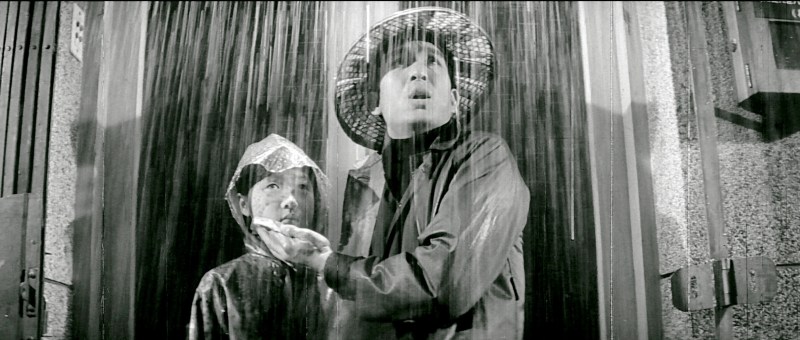
Tsibing (Yang Ming) is outwardly successful. He dresses in suits, has a large house and chauffeur driven car, can afford to employ a nanny, and comes home to an elegant middle-class wife (Jin Mei) and three adorable children. Despite all of that, however, he’s about to ruin everything. His mistress is secretly part of a criminal gang. She gets her boyfriend to pretend to rob the place, knocking out Tsibing’s wife and undressing her, leaving a pair of underpants on the bed to make it look like her lover has thrown his clothes on in a hurry and jumped out of the French doors to avoid being caught out by Tsibing’s unexpected arrival. Tsibing doesn’t stop to ask questions. He rounds on his wife, beating her violently in front of their young son whom he also kicks in the ribs for trying to defend her. Hypocritically pointing out that his taking a mistress is no justification for her to take a lover a too, he throws her out of his house, only to be thrown out himself when he realises that his mistress has stolen all his money. Ruined and penniless he moves into a shack with the three kids and tries to keep things together while meditating on his mistakes. 

The Rice Dumpling Vendors is, somewhat unusually, a melodrama of male failure in which Tsibing experiences a humbling which pulls him away from the amoral capitalism of the post-war era towards humanistic compassion. The couple next-door, a balloon seller (Chin Tu) who dresses as a clown and his feisty wife (Siu Chu), were unable to have children of their own and quickly take to the young family, feeling sorry for Tsibing and often helping him out particularly with buying formula milk for the baby. “I always thought people were selfish” he confesses while lying on a hospital bed after sustaining a serious workplace injury, finally seeing a different, less materialistic way to live. 

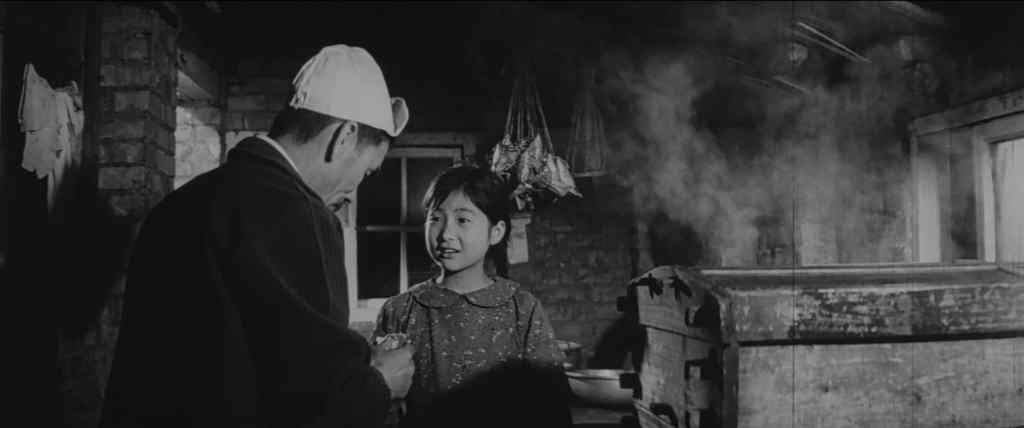
As the closing song reminds us, however, you can’t do anything without money. Attempting to walk away from failure, Tsibing finds himself in an impossible position. He can’t find work that can support a family, and even once he finds a job he gets himself injured leaving him entirely unable to provide. Oldest daughter Hsiu-chuan (Dai Peishan) tries to take the burden on herself, selling lottery tickets and heading out at all hours to hawk rice dumplings to passersby in the streets, unconvincingly telling her father that she’s going to help a classmate who is sick in the hospital with their homework. Hsiu-chuan’s earnestness stands in complete contrast to her father’s increasing desperation compounded by guilt and regret. In a low moment, he even considers abandoning the baby in front of the house of a wealthy childless couple in the hope that they will adopt her.

Strangely, Tsibing never considers asking the childless couple from next-door who already dote on his children if they’d be willing to look after the baby, but determines straight on placing himself at the mercy of the wealthy. The couple at least seem nice – they want a child and would spoil it with both love and money, but they are also arch materialists. Their first thought is that they should give Tsibing money in compensation, as if they were buying a pet. It doesn’t quite occur to them that he might change his mind, after all they can give his baby a quality of life he currently cannot in which she’ll be well fed and taken care of. Is it selfish of him to deny her that? Hsiu-chuan and her brother, however, aren’t having any of it. They’re taking their sister home where she belongs, vowing to give up on school and double down on their part time jobs to make sure they can afford milk to feed her. 

Tsibing too lowers himself once again, selling not only lottery tickets but later rice dumplings, telling Hsiu-Chuan, who is doing exactly the same thing, that he’s got a job as a nightwatchman in a warehouse which is why he’s out all night. Humbled and encouraged by the warmhearted altruism of his kindly neighbours, he’s learning to renounce the materialist life and re-embrace what’s important. The mistress, meanwhile, making an unexpected reappearance, pays a heavy price both for her amoral materialism, and for her transgressions as an “immoral” woman whose attempts to use men provoke only jealousy and violence. Meanwhile, the wife is eventually vindicated and seems to have retained both her wealth and her class status even after being unfairly thrown out by Tsibing. 

What we’re presented with is a seemingly uncomplicated family reunion, completely ignoring Tsibing’s brutal use of violence against his wife and son which is itself intended to demonstrate his “manliness” and patriarchal authority. He reminds his wife of the cultural double standard that insists that a man may take a mistress but a wife must be faithful, punishing her not for betraying their family but for making a fool of him. Little does he know however that he’s already been made a fool of by a “wicked” woman, and it’s entirely his own fault for acting irresponsibly, regarding a mistress as little more than a status symbol. Nevertheless, now humbled he has a new appreciation for what it means to be a family man, seeking not riches but simple wholesome pleasures like rice dumplings and friendship surrounded by kind and honest people always willing to lend a hand to those in need.


Screened as part of touring retrospective Taiwan’s Lost Commercial Cinema