Forget Love for Now (恋も忘れて, Hiroshi Shimizu, 1937)

vlcsnap-2016-09-21-02h01m08s449Sad stories of single mothers forced to work in the world of low entertainment are not exactly rare in pre-war Japanese cinema yet Hiroshi Shimizu’s 1937 entry, Forget Love For Now (Koi mo Wasurete) , puts his on own characteristic spin on things by looking at the situation through the eyes of the young son, Haru (Jun Yokoyama). Frustrated by both social and economic woes, little Haru’s life is blighted by loneliness and resentment culminating in tragedy for all.

Oyuki (Michiko Kuwano) is a single mother and bar hostess in a port town. Her young son Haru loves his mum even though he’s often on his own but after he makes the mistake of inviting some of the other boys back to his mother’s apartment and they end up getting doused in her rather pungent perfume, the other kids’ mothers figure out what Oyuki does for a living. Predictably they forbid their kids from associating with Haru because his mother is “a bad woman”. After repeatedly trying to keep hanging out with the other children, Haru starts skipping school to avoid the constant exclusion entirely. When Oyuki finds out about this she is very upset and has him moved to another school but the old group of kids and the new group of kids are not entirely unconnected and so Haru is unable to escape the prejudice his old group of friends hold for him.

The film never goes into how Oyuki ended up on her own with a young child or what might have happened to Haru’s father but Oyuki’s role as a single mother is not the reason the pair are excluded from the other families. Lacking other opportunities, Oyuki is forced to into work as a bar hostess even though she clearly hates it and bears it only for her son’s sake.

Her job is to entertain men in the bar to keep the drinks flowing, always smiling and flirting to keep dull men trapped in the false hope of real connection. She gets paid very little for this as we find out early on when she tries to spearhead a kind of union movement in the bar by questioning why their work costs them so much – they have to pay for their outfits, food and drink out of their own wages when the girls working at other establishments get a share of the alcohol profits which they have helped to generate but Oyuki and her friends get only their meagre salaries. Their pleas fall on hard ears with the tough as nails mama-san who isn’t going to permit any kind of mutinies in her establishment. This is made clear later on when one employee tries to quit her job at the bar and move to Kobe in search of more lucrative employment but is beaten black and blue by the bar’s goons.

Oyuki’s single ray of hope comes in the form a sinister figure lurking in the shadows outside her apartment. Eventually becoming friends with Oyuki and her son, the man represents a possible happy ending in which he beats the depression, finds a better job and takes them both away from this world of poverty of degradation. Needless to say this is not to be – the man’s attempts to find a solution to everyone’s problems take to long and he is simply too late. Not only that, his well meaning words of advice to Haru that he should make sure to win against the bullies next time have disastrous consequences.

In essence, Forget Love For Now is “hahamono” in which Oyuki bravely sacrifices everything of herself in her son’s name, committed to the idea that he will progress through his education to university and repay all of her efforts by becoming a fine man. Society, whilst praising the idea of the self sacrificing mother, does not approve of the things she has to do in that very sacrifice she’s making and refuses to allow her success in her mission. The true tragedy is that the little boy, Haru, is aware on some level of everything his mother is doing for him and loves her so much that he is willing to sacrifice himself for her – rendering her long years of suffering entirely pointless.

In the end, Oyuki has nothing. As the title of the film tells us, not even love is permitted to her as she loses both her son and the possibility of romance as her well meaning man makes a now equally pointless sacrifice of his own. Forget Love For Now is somewhat atypical in Shimizu’s output as it ends with no hope in sight, strongly condemning this rigid society which forces women to act in a way of which it disapproves and then refuses to support them when they do. Shooting mostly on stage sets rather than the naturalistic settings featured in much of his other work, Shimizu crafts an emotionally devastating tale of maternal sacrifice cruelly frustrated by a cold and unfeeling society.
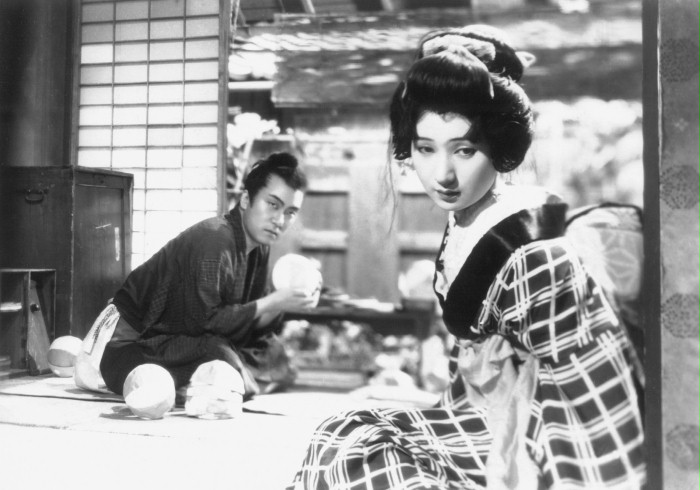


Humanity and Paper Balloons (人情紙風船, Sadao Yamanaka, 1937)

Humanity and Paper Balloons

That Humanity and Paper Balloons (人情紙風船, Ninjo Kami Fusen) would turn out to be the final film of its director is just one of its cruel ironies. Sadao Yamanaka was one of the most promising young directors of the 1930s, but his career was ultimately cut short by historical circumstance as, despite his leftist views, he found himself drafted into the army and dispatched to the Manchurian front where he later died in a field hospital at only 28 years old. The film both begins and ends with suicide – an acknowledgement of the crushing hopelessness of the feudal society in which humanity itself is as fragile, transient, and often overlooked as a paper balloon. Necessarily bleak, but not absent of humour (at least of the gallows kind) Humanity and Paper Balloons neatly reframes the Edo era not as one of a glorious lost past where honourable men presided over a carefully controlled social order but one where the elites were absent, crime was rampant, and and promises were always “a series of possibilities”.

The scene opens with panic. A down on his luck samurai is dead by his own hand. So destitute was he, that he’s hanged himself – armed only with a bamboo sword he couldn’t even die in a manner befitting his social class. People are beginning to wonder if this is an “unlucky” street – this has been the third such suicide of recent times. Meanwhile, barber and upstart Shinzo has been conducting secret gambling sessions in local kingpin Yatagoro’s territory so his guys are out for blood. Neighbouring ronin Unno, whose wife manufactures the titular paper balloons, is convinced that a low level samurai who owes his status to the support of Unno’s now deceased father will help him as soon as he reads the letter his father wrote on his deathbed. Mori, however, is in no way interested and is currently in negotiations to “adopt” the daughter of a local merchant so she can be married to a noble samurai who otherwise would lose face in marrying down. Said daughter, Omoka, is not happy about this arrangement as she is in love with her father’s clerk, Chushichi. When Shinzo decides to kidnap Omoka, getting Unno involved by hiding her at his house, a series of unfortunate consequences ensue.

The world of the jidaigeki is often an idealised one. Centring on the higher echelons, they paint a picture of noble warriors bravely standing up for honour and justice whilst displaying fearsome loyalty to their feudal lords. This is no such idyll – this is a slum where the social classes mingle freely but with invisible barriers still dividing one from the other. The samurai were already in decline and so it was not unusual for the men who grew up in rarified halls to suddenly find themselves cast down into the lower orders without the means to support themselves. The former samurai who hangs himself at the beginning has had enough, evidently, having sold even his sword he finds himself unable to go on.

Unno is in a similarly desperate situation, reliant on the pittance his wife earns making the paper balloons. He still thinks Mori will obey ancient social codes and repay his father’s kindness by supporting him, but Mori has no use for him now and no inclination to follow the ideals of honour which underpin the samurai word. Unno is experiencing a rude awakening to Edo era hypocrisy. In making a rash decision to go along with Shinzo’s scheme, he damns himself in every conceivable way – by dishonouring himself as a samurai, by indulging in illegality, and in merely being a party to someone’s else’s underhanded scheme. “Samurai are wicked these days” say some of the neighbourhood women, not noticing Unno’s wife is just returning from a few days away, unaware of what her husband has been up to in her absence.

The verdict on the samurai class is damning. Honourable men without honour, they use and misuse each other but are entirely unwilling to help out even one of their own fallen on hard times. Yet men like Unno are also victims of their class, suddenly ejected from a life of comfort but with no skills to survive in world of “normal” people. Single men can become wandering ronin, drinking, fighting and whoring their way through life but married, mild mannered men like Unno are left with nothing to live on but resentment.

Yamanaka’s final feature is once again far ahead of its time more resembling the films of twenty years later than those of the mid 1930s. Aiming for a highly detailed approach closer to naturalism than the general trend of the time, Yamanka paints a vivd picture of a claustrophobic world, alive with the struggle of those desperately clawing over each other in order to survive while the landlords enjoy a life of ease in vast mansions surrounded by peace, quiet and open air. Pointedly a comment on the present more than the past, Yamanaka is getting away with much more than you would think possible in the highly pressured world of 1937 following the previous year’s failure of a complex military coup seeking to return power to the emperor in the hopes of a return to feudal style paternalistic socialism. Humanity here is a paper balloon – cheap, fragile, and often unnoticed. That it exists at all is something to be thankful for, but like a paper balloon, humanity requires careful construction and committed maintenance. The plea to the people of 1937 was clear but it is often hard to recognise the importance of so commonplace an object let alone ensure its survival.


Unsubbed clip:

https://www.youtube.com/watch?v=N8fhHuy401o