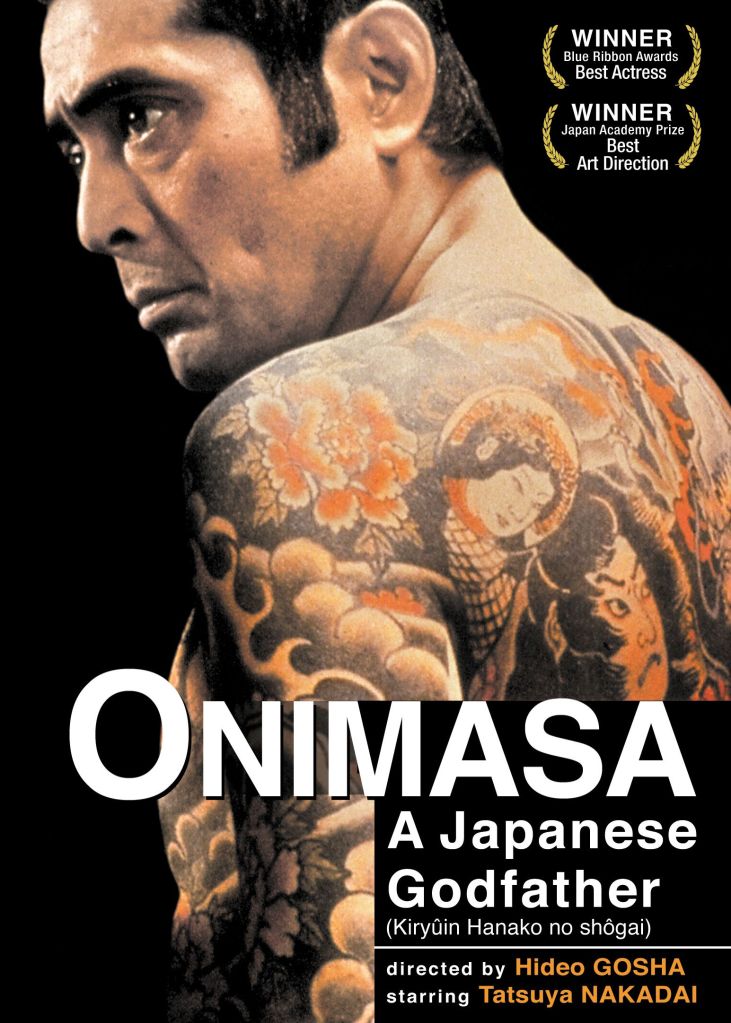
 When AnimEigo decided to release Hideo Gosha’s Taisho/Showa era yakuza epic Onimasa (鬼龍院花子の生涯, Kiryuin Hanako no Shogai), they opted to give it a marketable but ill advised tagline – A Japanese Godfather. Misleading and problematic as this is, the Japanese title Kiryuin Hanako no Shogai also has its own mysterious quality in that it means “The Life of Hanako Kiryuin” even though this, admittedly hugely important, character barely appears in the film. We follow instead her adopted older sister, Matsue (Masako Natsume), and her complicated relationship with our title character, Onimasa, a gang boss who doesn’t see himself as a yakuza but as a chivalrous man whose heart and duty often become incompatible. Reteaming with frequent star Tatsuya Nakadai, director Hideo Gosha gives up the fight a little, showing us how sad the “manly way” can be on one who finds himself outplayed by his times. Here, anticipating Gosha’s subsequent direction, it’s the women who survive – in large part because they have to, by virtue of being the only ones to see where they’re headed and act accordingly.
Beginning with its end, Onimasa’s story finishes with the discovery of the body of his only biological child, Hanako (Kaori Tagasugi ), in 1940. Found bled out and alone in the red light district of Kyoto, the suspected cause of death is a miscarriage. Tragically, our heroine, Matsue, arrives only a couple of hours too late after having spent years searching for her younger sister. We then skip back to 1918 when Matsue was adopted by Onimasa and his rather cool wife, alongside another boy who later ran away. An intelligent girl, Matsue earns her adopted father’s respect but neither he nor his wife, Uta (Shima Iwashita), are particularly interested in the emotional side of raising children. Things change when one of Onimasa’s mistresses gives birth to his biological child who awakens a sense of paternal interest in the ageing gangster beyond rule and possession.
Onimasa’s behaviour is frequently strange and contradictory. Originally intending to adopt only a boy, he and his wife come away from a poor family with two of their children, only for the son to run away home. Having picked her out like a puppy in a pet store window, Onimasa views Matsue as an inalienable possession. When a man arrives and wants to marry her, he goes crazy assuming the man must have been sleeping with her behind his back (despite the fact that this man, Tanabe (Eitaro Ozawa), has only just been released from prison where Onimasa had himself dispatched Matsue to visit him). Exclaiming that Matsue is “his”, has always been “his”, and no one else’s, he forces Tanabe to cut off his finger yakuza style to swear Matsue’s honour is still intact. However, this need for total control manifests itself in a less than fatherly way when he later tries to rape Matsue and is only brought to his senses when she threatens to cut her own throat with a broken glass. Despite this act of madness which he tries to justify with it somehow being for her own good, Matsue remains a dutiful daughter to both of her adopted parents.
Matsue’s innate refinement and reserve contrast’s strongly with Onimasa’s loose cannon nature. Commenting on the long history of “honourable” cinematic yakuza, Onimasa embraces an odd combination of traditions in believing himself to be the embodiment of chivalry – standing up for the oppressed and acting in the interests of justice, yet also subservient to his lord and walking with a swagger far beyond his true reach. All of this contributes to his ongoing problems which begin with a petty clan dispute over a dogfight which sees a rival leaving town in a hurry only to return and raise hell years later. Similarly, when his boss sends him in to “discourage” strike action, the union leader’s reasonable objections which point out the conflicts with Onimasa’s doctrine of chivalry and imply he’s little more than a lapdog, have a profound effect on his life. Severing his ties with his clan and attempting to go it alone, Onimasa does so in a more “honourable” way – no longer will he engage in harmful practices such as forced prostitution no matter how profitable they may be, but old disagreements never die easy and it’s a stupid ancient argument which threatens to bring his old fashioned world crashing down.
Despite concessions to the bold new Taisho era which saw Western fashions flooding into traditional culture from Onimasa’s trademark hat to the record players and whiskey glasses clashing with his sliding doors and tatami mat floors, Onimasa’s world is a childishly innocent one where honour and justice rule. Despite this he often excludes his own behaviour – one minute turning down the offer of his rival’s woman to pay a debt with her body, but later attempting to rape a young woman who had been his daughter in a drunken bid for a kind of droit du seigneur. The times are changing, it’s just that Onimasa’s traditionalist mind can’t see it. Tragically trying to rescue his daughter from a situation it turns out she had no desire to be rescued from he eventually spies the writing on the wall and puts down his sword, defeated and demoralised. Tragically, it seems Hanako may have needed him still though her rescue arrives too late to be of use.
The Onimasa family line ends here, as does this particular strand of history under the darkening skies of 1940. Out goes Taisho era openness and optimism for the eventual darkness of the militarist defeat. Matsue, now a widow – her left wing intellectual husband another victim of her father’s mistakes rather than political stringency, remains the sole source of light in her shining white kimono and pretty parasol even as she’s forced to identify the body of the sister she failed to save. The life of Hanako was a sad one, trapped by her father’s ideology and finally destroyed by her own attempts to escape it. Fittingly, she barely features in her own tale, a peripheral figure in someone else’s story. Slightly lurid and occasionally sleazy, Onimasa is another workmanlike effort from Gosha but makes the most of his essential themes as its accidental “hero” is forced to confront the fact that his core ideology has robbed him of true happiness, caused nothing but pain to the women in his life, and eventually brought down not only his personal legacy but that of everything that he had tried to build. The “manly way” is a trap, only Matsue with her patience backed up by a newfound steel inspired by her cool mother, Uta, is left behind but is now free to pursue life on her own terms and, presumably, make more of a success of it.
Original trailer (no subtitles, NSFW)
 Windows on Worlds