The Bullet Vanishes (消失的子弹, Law Chi-leung, 2012)

20128291720405212Review of Law Chi-leung’s The Bullet Vanishes (消失的子弹, Xiāo Shī Dè Zǐ Dàn) – first published on UK Anime Network in June 2013.


In 1930’s Shanghai there’s a bullet factory where a young girl has been accused of pilfering. The punishment, it seems, is a cruel and very public trial by Russian roulette where fate, the gods or whoever will judge her innocent or guilty with a simple click or a loud bang. Crying out her innocence to the end, the girl pulls the trigger and presumably never actually hears the outcome as her co-workers look on in horror – she must have been guilty though, right? Or she would have been spared by the immortal powers at be.

Following this horrific incident, other deaths start to occur in the factory – the strange thing is, on examining the bodies, no trace of a bullet can be found (nor any casings at the scene). Some of the munitions workers start to believe the ghost of the poor girl who died must have returned to take revenge – perhaps she was innocent after all. To solve this intriguing mystery, the police turn to two unorthodox detectives – recently transferred former prison warden Song (Lau Ching-Wan) and maverick cop “fastest gun in town” Guo (Nicholas Tse). Neither of these two are buying the “supernatural” explanation and both are determined to get to the truth even if they work in very different ways. The solution is going to be a lot more complicated than anyone could have thought, and will, ultimately, be painful to hear.

Let’s get this out of this way first – yes, the film owes a significant debt to the recent “westernisation”, if you want to put it that way, of Ritchie’s Sherlock Holmes and other Victorian set crime dramas (e.g. Ripper Street) which seek to present themselves as taking place in a totally lawless world denizened by a criminal population that is somehow both repellent and glamourous. Although The Bullet Vanishes is set in 1930s, it still has a noticeably “Victorian” sensibility presenting a world in which rapid industrialisation has brought about mass corruption and a decline in morality. Once again, setting a film in China’s past proves to be a surefire way of getting subtextual criticisms of modern China past the country’s strict censorship regulations.

The murder mystery itself is certainly very intriguing with a series of unpredictable twists and turns. The idea of disappearing bullets might not be a new one, but The Bullet Vanishes manages to find an original solution that is perfectly plausible within its own time setting. Also, the “supernatural” element exists only as an idea and is never seriously entertained as an explanation by any of the investigators – something of a break from the genre norm.

The two detectives seem much more like rivals than partners for much of the film though an awkward sort of camaraderie does eventually grow up between them. Lau and Tse both give excellent performances but Tse in particular who’s often criticised for being a pretty boy trading on family connections, really proves himself with his surprisingly complex Guo. There is, however, the familiar criticism that the female characters are severely underdeveloped and seem almost like a rushed afterthought. Yang Mi gives a lot to the barely two dimensional Little Lark but can’t disguise the fact that the character only exists as a love interest for Guo and that in turn a love interest for Guo only exists so that we can have the “obligatory” love scene. That wouldn’t be so much of a problem if the love scene itself didn’t feel quite so “obligatory” – it could easily have been excised and the film would have remained pretty much unchanged as the scene feels as if it exists purely to satisfy a perceived audience need for romance.

There really isn’t much to fault with The Bullet Vanishes. As a slightly cerebral mainstream period thriller it’s certainly very successful. It has an engaging mystery element, strong characters played excellently by the cast and extremely slick, modern direction. In Song they’ve created a very interesting character who’d be very welcome in a sequel or two. His relationship with female prison inmate, a sort of Irene Adler figure to Song’s cerebral detective, who he’d previously investigated before being transferred was quite an usual idea that would really benefit from further exploration. All in all The Bullet Vanishes is a very impressive and enjoyable period procedural that is truly a cut above its genre origins.

http://www.youtube.com/watch?v=8oZOMNeJjzQ


Like Someone in Love (UK Anime Network Review)

Like_someone_in_love_quad_v5_HRFirst published on UK Anime Network in June 2013.


Like Someone In Love is only Iranian director Abbas Kiarostami’s second international venture after 2010’s Certified Copy but this time sees his familiar preoccupations with ambiguities and poetic imagery transported to modern day Tokyo. Although in this case all the characters are quite clearly drawn and presented somewhat unambiguously, the reasoning behind the decisions they make and the way they behave, however, remains oblique. The title implies someone is acting ‘like someone in love’ if not exactly ‘in love’ themselves but who is it, who or what are they (‘almost’?) in love with, and what exactly would that mean – these are all the gentle ambiguities that Kiarostami wishes us to think about in this perfectly excised cross section of modern life.

As the film opens we are placed statically looking onto a scene which appears to be some sort of bar, a woman’s voice can be heard speaking to someone – not us, this clearly isn’t a voice over, there is obviously someone else involved in this dialogue that we cannot hear. We search the screen for the owner of the voice and even though we can see that nobody else is speaking somehow the thought that the woman is off camera hasn’t quite occurred to us. Eventually we find a young woman has been talking on the phone, presumably to her boyfriend – ‘I’m not lying’ she says, though we know she is. The boyfriend suspects her and makes her go to the bathroom to count the number of tiles so he can come there later and compare to see if she’s telling the truth.

Shortly afterwards, an older man (Denden) starts talking to her and encourages her to break up with said jealous boyfriend ‘not just for business reasons’ but as fatherly advice. He wants her to visit ‘a very important man’, she doesn’t want to because she’s tired after cramming all night for an exam and anyway her grandmother is in town and she’d like to see her. The man makes it very clear he isn’t forcing her, but he leaves her no room to refuse and she goes anyway even though she doesn’t want to. He puts her in a taxi for an hour’s drive across the city – on the way she gets a message from her grandmother that she’ll be waiting outside the station until her train so Akiko (Rin Takanashi) asks the driver to pass the station twice just so she can catch a glimpse of her.

Fast asleep in the car she arrives at a rather nondescript little address behind a ramen shop where a retired sociology professor (now sometime translator), Watanabe (Tadashi Okuno), lives. As soon as they enter the phone rings and Akiko takes the opportunity to poke around – she finds some pictures of an older and a younger woman – a wife and daughter perhaps? Strangely they look a little like her, as does the woman trying to teach a parrot to speak in the famous print on one wall.  ‘I always thought the parrot was teaching the woman’ Akiko says and the professor laughs. Still tired she makes straight for the bedroom, undresses and gets into the bed. This wasn’t what the old man had in mind though – he’s cooked a full dinner and bought wine, soft music ‘Like Someone in Love’ is playing in the background. After trying to convince her to eat and failing the professor gives up and turns the light out to let her sleep.

The next morning he drives her to school only to witness an altercation with the jealous boyfriend, Noriaki (Ryo Kase) who’s been lurking in wait after not being able to get through on Akiko’s phone. It’s clear he’s angry, he grabs at her then sulks after she goes inside before trying to talk to the professor, mistakenly thinking he’s her grandfather. He of course keeps up the pretense simply by not (directly) correcting the mistake. It’s clear though that something is coming to head and the meeting of these three people is going to produce a fundamental change in one or all of their lives.

Like Someone in Love might be one of those films where the reaction to it says much more about the viewer than it does about the film. It’s so much more about what isn’t said, the things that one infers from brief snippets of possible backstory than it is about what is actually seen on the screen. We don’t know exactly why Akiko got into this line of work or why she does it or even how she really feels about it. It’s plain in the first scene that she doesn’t want to go, at least tonight, and that she’s refused to go before but when she arrives at Watabe’s house she’s anything but coy and seems every inch the seasoned pro ready to get down to business. She’s a cipher, the clearest thing you can say about her is that she’s defined by her own passivity. She says she won’t go and then bows to pressure and goes, she obviously wants to break up with her awful boyfriend but doesn’t, she wants to see her grandmother but obeys her pimp(?) instead. She seems to spend her entire life bowing to the whims of other people rather than making any sort of decision for herself.

The two men by contrast appear as virtual mirror images of each other. The elderly scholar Watanabe, contemplative and introspective and the violent, obsessively jealous high school dropout garage owning Noriaki. What is Watanabe’s interest in Akiko? Is this something he’s done often? it seems maybe not, perhaps this is a gift from his former student now Akiko’s ‘boss’. At any rate it seems he’s after some kind of romantic evening rather than a torrid few moments in bed with a girl young enough to be his granddaughter. He’s arranged things for her comfort – cooking her local dish, lighting candles, setting the dinner table etc just as someone in love might do. Perhaps he’s just lonely (though his phone is always ringing and he never answers it) and wants to relive fondly remembered memories of his wife. Noriaki by contrast seems much more territorial – he wants to own Akiko, he’s decided she’s useless on her own and needs his protection but he’s obviously terrified someone’s going to steal her out from under him. He’s also hugely over sensitive about the phone box card which looks like Akiko (because we know it is) maybe because he’s got a Madonna-whore conception of women to begin with.

The film ends as abruptly as it started which is inevitably going to be a problem for many viewers. This is not the end, but it is an end – perhaps the beginning of something new rather than the end of something old. An internal world is penetrated – like the intrusion of falling in love into an otherwise dull life, old securities prove inadequate and perhaps it’s harder to protect the things that are precious to you than you might hope (especially if you are old and your aggressor is not). In many ways we are like the old curtain twitcher whose sole entertainment is her window onto Watanabe’s doorstep – we can’t know what happened before our one and only window was opened, nor can we know what will happen once it’s closed but still we can’t help but wonder.


Available now in the UK from New Wave Films.

The Kirishima Thing (UK-anime.net review)

thekirishimathingThis is from a million years ago but it was caught up in the queue at UK-anime.net and has only just been liberated! Also I wrote this when I was deathly ill (festival fever is a real thing!) so I’m not entirely sure it’s completely coherent. Anyway, have at it – The Kirishima Thing reviewed at Uk-anime.net


What’s up with that girl, why is everyone crying?

Must be the Kirishima thing again, right? It’s got everyone all riled up.

Hey, what exactly happened with that? Where is Kirishima?

You didn’t hear?! Kirishima quit the volleyball team! And nobody’s heard from him since, doesn’t answer calls, doesn’t answer texts – he’s in the wind….

Damn, man, that’s cold! Wonder what happened….

What happened with Kirishima, why he’s upped and quit the volleyball team quite suddenly right after having been made captain and with the team on course to win a big championship actually turns to out be almost totally irrelevant. We may speculate on why someone might just do that but we can never really know. What is important is that Kirishima’s unpredictable action causes a seismic wave to rip through the social structure of his class. With Kirishima gone, everyone else starts to question their own place in the social hierarchy – are they really where they want to be, where they ‘belong’ within the all important high school pecking order? Some threaten to move up and others down but will anything be the same ever again?

The ‘cool’ kids are in the ‘going home’ club or possibly ‘in a sports team but blowing off practice’, the next level are ‘kind of in a club because it’ll look good on my application forms (it’s not like I like it or anything)’ and then at the bottom we have the geeky guys and girls who are really into their club activities – exemplified here by the downtrodden film club. When Kirishima just quits and effectively demotes himself from the A crowd by quitting the volleyball team nobody’s really certain of anything anymore – what’s cool, what’s not, what do I care? The volleyball team feel betrayed by their captain’s absence, the cool boys are puzzled and uncertain without their leader to look to, the popular girls doubt their status now the alpha guy isn’t around and the film club….carry on as normal and try to ignore all the silly drama going around the school.

However, there are those in the higher echelons who maybe feel they don’t belong there. One of the cool girls has a secret liking for ‘geeky’ films but is frightened of becoming ‘one of them’ and losing her ‘popular’ status. Another girl, nominally one of the cool girls both hates and admires her friends for their vacuity and refusal to see whats going on around them. She is the only who really sees what’s going on everywhere, but even she too is afraid of losing her position. The most troubled and changed though is Hiroki, Kirishima’s ‘best friend’ who nevertheless didn’t know anything about his friend’s decision. Half in half out of the baseball team, he’s trapped between the cool world of the going home club and the slightly less cool one of being able to do something very well. The only people who aren’t really affected are the film club who are, to some extent, too invested in their own sense of inferiority to really notice what’s going on everywhere else.

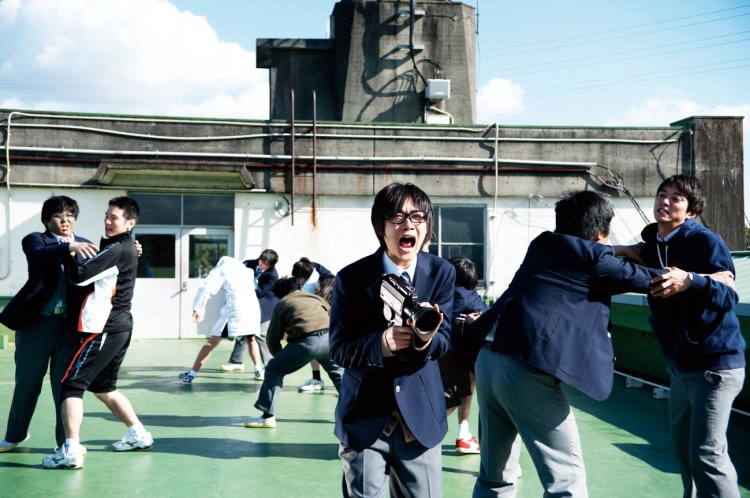
The film club  are in some ways the heart of the film as they both refuse to see and ultimately document the social fracturing that’s going on within the school. They seem to think themselves very hard done by -‘they’re always winning’ complains one boy after they find a location they want to use already occupied and later ‘I won’t cast them when I’m a director’ about the annoying popular clique who’ve just been laughing at them loud enough for them to hear before they’ve even gone past. However, they are the key to the film’s climactic roof top confrontation scene as the film club’s high school zombie invasion movie is rudely interrupted by the popular kids’ desperate search for Kirishima. This leads to a day of the dead style zombie fantasy sequence as the film club zombies devour the unwitting volleyball stars and popular girls which is the highlight of the film. The intermingling of the two groups which would never normally have anything to do with one another finally forces the ramifications of the Kirishima thing to come to a head. In some senses it clears the air; the tensions have boiled over and worked themselves out. However, for some the outcome is far from clear and they remain trapped between levels of high school cool.

The Kirishima Thing is certainly not for for those who like a lot of action, zombies aside, or something with a heavier plot element, but as an ensemble character study it excels. As an allegory for the wider problem of conformity/social norms vs individuality and self recognition in the adult world it’s certainly a very apt parable but all of the characters concerned are very well drawn and each afforded a degree of sympathy and understanding. The Kirishima thing strikes a more realistic tone than the director’s previous films (Funuke: Show some love you losers!, Perfect Nobara) which took place in a world of heightened reality but still has a strongly comic tone. An extremely nuanced and layered tale, The Kirishima Thing may require multiple viewings to completely appreciate but it’s certainly well worth the investment in time.


Also look out for fellow queue inmates Kumiko the Treasure Hunter and Tale of Iya which, I am assured, will shortly become eligible for parole.

Pluto (명왕성, Shin Su-won, 2013)

GSEOiWzAs we’ve seen lately, there are certainly no shortage of films looking at the complicated and often harsh world of high school in Korea. Pluto (명왕성, Myungwangsung) takes a sideways look at the darker side of academic excellence when the praise and prestige of being one of the top students becomes almost like a drug and makes otherwise bright young people do things even a heroin addict in serious need of a fix might at least feel bad about afterwards with an all encompassing sense of entitlement that gives them a lifetime free pass for even the worst transgression.

June (David Lee) is a bright young boy from a regular high school who’s just transferred into an elite boarding school educating the country’s next great hopes. He may have been a top student at his old school, but here he’s merely average as the school hotshots are pretty quick to point out. Here, the top ten students are treated like princelings – a special computerised teaching room, no curfew, better rooms, better resources and they can more or less do what they like so long as they keep their grades up. Occasionally someone manages to bump one of the top ten from the list but they quickly get kicked out again. The top ten operate like some kind of swatters mafia – they all stick rigidly together, swapping hot tips for the upcoming exams that they refuse to share with the others and engaging in a series of increasingly cruel “pranks” they term rabbit hunts.

The film opens with the police finding the body of the previously number one student Yu-jin (Sung Joon) in a wood with June’s phone lying next him having been used to film the entire grisly affair. June is arrested for the murder but is released after his alibi checks out. Sick of all the struggle and unfairness, June puts his particular talents to use to try and teach the world a lesson about the sort of people this system is producing.

The picture Pluto paints of the Korean schools system is a frankly frightening one in which academic success is virtually bought and paid for or guaranteed by class credentials. Yes, the top students obviously must have ability – some of their activities may come close to cheating but interestingly nobody seems to want to try actual deception to get ahead. However, that natural ability has clearly been bolstered by their parents’ wealth. Attending an elite school and spending more than some people earn on private tutors geared towards knowing how to get into the best universities undoubtedly gives them advantages which are out of reach for others no matter how smart they may be. Perhaps that’s fair enough in a capitalist society, they didn’t ask to be born to rich parents and who would turn that sort of help down if offered it? However, though they may possess the virtues of discipline, hard work and a desire to succeed what they lack is any sort of empathy or even common human decency. Engaging in a series of manipulative hazing exercises, the elite group will stop at nothing to protect their status specialising in thuggery, blackmail, rape and even murder. The sort of people this system is advancing are not the sort of people you want running your schools and hospitals, they are morally bankrupt and only care about their own standing in the eyes of others.

Perhaps it’s fitting that this elite boarding school is housed inside a former compound of the Korean secret police, including a subterranean layer of prison-like tunnels once used as a torture chamber. Aside from the obvious school as torture analogies, much of them film seems to be about what people choose to ‘unsee’. The headmaster of the high school is aware of the ‘untoward’ behaviour of some of his pupils but refuses to do anything in case it upsets their well connected parents, damages the reputation of his school or has an adverse effect on those all important test results. The ‘Pluto’ of the title is referenced in June’s university application essay on the demotion of Pluto from the accepted list of planets. He argues that this is unfair and a fallacy as it’s illogical to measure anything by its proximity to the sun which is, after all, just another star which will eventually die like all the others. Just because it’s a little different looking, you shouldn’t necessarily categorise it as being in some way ‘inferior’ based on a set of fairly flimsy criteria. June, like Pluto, hovers in uncertain orbit on the periphery – always wanting in but perpetually locked out. Naturally gifted but from an ‘ordinary’ background where his single mother sells insurance for OK money, June can’t hope to compete with these elite kids even if his capabilities may be greater. A lot of decisions have already been made as to what people choose to see, have chosen to regard as an ideal, even if the reality is painfully obvious.

Though oddly funny in places for such a hard hitting film, Pluto is a difficult watch at times and paints a depressing picture of the high pressured nature of the Korean educational system and of human nature in general. The elite group are universally awful people who run the gamut from arrogant, entitled prigs to snivelling cowards which makes it difficult to feel any sort of sympathy and you start to long for bad things to happen to them which somewhat undermines the film’s premise. Perhaps the problem is just that they were awful people who were enabled by a system rather than people who started out good and were corrupted by it. Stylishly shot and supported by well grounded performances from its young cast, Pluto is a welcome addition to this perhaps overcrowded genre which brings more than a few new thought provoking ideas to the table.


Review of first Pluto published by UK Anime Network.

2012 in Review – An Extremely Subjective Top Ten!

I kind of hate trying to come up with a top ten list for a huge variety of reasons: 1) I have an extraordinarily loose grip on time – I can never remember what I saw when or what was this year or last year or a decade ago so trying to even list ten films I definitely watched within a specific period of time is not something my brain is set up for 2) I change my mind all the time 3) I’ve almost certainly left something out due to point 1 4) I’m over sensitive and will probably burst into tears when the inevitable trolling begins OMG I CAN’T BELIEVE YOU THINK AI TO MAKOTO IS BETTER FILM THAN AMOUR, WHAT KIND OF IDIOT ARE YOU OH I SEE YOU ALSO LIKE SEVEN PSYCHOPATHS YOU EVIDENTLY HAVE NO EYES OR EARS, I PITY YOU – GOOD EVENING  5)I feel bad making a list when I didn’t see every film released this year, I don’t even think that would be possible but still it feels wrong from a scientific point of view 6)What does ‘best’ mean anyway? Closest to perfect? could we ever agree on the criteria for this? 7) as usual I’ve totally over thought the whole thing and wasted a whole 200 words on neurotic waffle. Oh well, neurotic waffle is what I do ‘best’, after all….

Ahem, all that in mind, I have come up with an extremely subjective, somewhat arbitrary, list of films I quite liked over the last year. As I say it’s a list of the films I liked the most, I’m not going to try and argue the artistic merits (or otherwise) of all the films on the list or debate the positioning – it’s a simply a list of the films that I either enjoyed the most, was most affected by, or impressed me in the most significant way. Are you all wearing your party hats? Right then, trumpets please


1 Himizu

I reviewed this over at Uk-anime back in June and was completely blown away by it – raw and tender it’s the story of two damaged children trying to find their way in world that’s all sorts of broken. Devastating yet oddly uplifting.

2 Tabu

A tale of longing, loss and the cinema Miguel Gomes’ Tabu is a beautifully made homage to silent cinema. Memory, the passage of time and the relationship between past and present come together to create one of the best European films from the last year.

3 The Master

To say The Master received a divisive reception is to understate the state of affairs. I don’t claim to have understood all of it, but on a first viewing found it utterly overwhelming.

4 Ai to Makoto

Fun, great ridiculous unrepentant FUN.

5 Holy Motors

Strange and extraordinary – the accordion scene might even make it into my top scenes in cinema history list!

6 Amour

An extremely powerful, and usually warm, film from Michael Haneke about the true nature of love. Undoubtedly difficult to watch but rewarding.

7 Berberian Sound Studio

An homage to Giallo with a strong performance from Toby Jones as the bewildered Gilderoy – an Englishman lost in the foreign world of slasher movies. Does extraordinary things with sound.

8 Dredd

A supreme effort that perfectly captures a genre and a place and time. Gritty, spare and punkish this is my favourite action movie for a very long time. Also excellent use of 3D.

9 Kotoko

A harrowing film about a woman who can no longer distinguish reality from imagined fears and her battle to protect her son. A horrifying experience in which we’re just as unsure as Kotoko is whether or not what we’re watching is actually happening. Truly impressive performance from leading actress Cocco.

10 Seven Psychopaths

Again, just a lot of entertaining meta fun as brilliantly dark and witty as the best of McDonagh’s stage work. Those expecting another In Bruges might be disappointed as this is altogether a lighter exercise but no less entertaining for it.

A Liar’s Autobiography – LFF 2012


A few years before he died, Graham Chapman recorded a a kind of audiobook detailing some of his experiences embellished with flights of pure whimsy. Now, in 2012, these recordings have enabled Chapman to become the star of a new animated feature attempting to bring some of his story to the big screen. Starting with an audio clip of Chapman asking for his thirty seconds of abuse, it then moves to a sort of framing device in which he forgets his lines on broadway, promptly collapses and hits his head provoking a surreal odyssey through his life so far. Boasting three director credits (one of whom being Bill Jones – son of Terry) and the work of fourteen different animation studios the film uses many different animation styles and techniques.

It is perhaps a matter of aesthetic taste but some of the animation styles serve their subject matter better than others. The seeming lack of motivation for the switching between styles lends the film an episodic felling which prevents it gaining any real traction and is often more of a distraction than something that brings any kind of artistic contribution. Undoubtedly, much of the animation is good, solid work but taken as a whole it fails to come together in any meaningful way.

It also doesn’t really help that it ends up being fairly light on the autobiographical detail so that anyone with even a cursory interest in all things Python or even just having been raised in the UK over the past thirty years isn’t going to hear anything they didn’t know already. Even the darker elements of Chapman’s life are glossed over in an ‘all jolly good fun, ho ho ho’ sort of way rather than engaged with any kind of insight.

Thirdly, it really just feels as if it’s trying way too hard. Unfortunately it misses the effortless silliness of Monty Python that’s the best example of English whimsy and winds up feeling by turns juvenile and laboured. Crushingly, it’s sometimes as if the animation seems superfluous where Chapman’s voice alone might have done the job better as the animation just isn’t really adding anything into the mix. Slightly gimmicky things like casting Cameron Diaz as the voice of Sigmund Freud initially scream ‘genius!’ but prove too on the nose and collapse under the weight of their own absurdity.

That’s not to say it’s a total disaster – it is moderately enjoyable and at times quite funny, just not quite as much as it seems to think it is. It felt very much like the sort of of British grown up animation that was commoner in the ’90s but forced into the biopics mode that’s really popular with BBC4. Possibly, it may have worked better on the small screen in one of the lighter documentary spots but as a big screen experience it fails as either a documentary or an entertainment film. Diverting rather than a must see.

At the European gala screening we were treated to a few actors playing various Graham Chapman roles such as King Arthur/Brian beforehand and a pop up (literarily) performance from the London Gay Men’s choir during the film’s musical interlude. Something of a curate’s egg but worth seeing.