A Swordsman in the Twilight (황혼의 검객, Jeong Chang-hwa, 1967)

Jeong Chang-hwa is better known for the films he made with Shaw Brothers in Hong Kong, including the iconic King Boxer which helped to kick start the Kung Fu craze of the 1970s, than for earlier films he made in his native Korea. Nevertheless, while he was there he also instrumental in creating a new genre of Korean swordplay films with A Wandering Swordsman And 108 Bars of Gold and 1967’s A Swordsman In The Twilight (황혼의 검객, Hwanghonui Geomgaek).

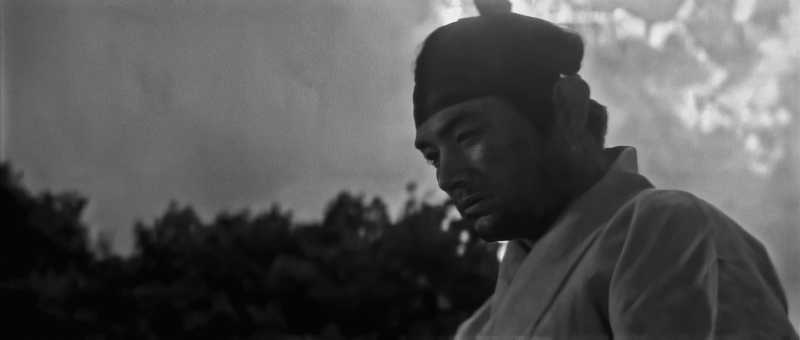
Drawing inspiration from both Japanese samurai movies and King Hu’s wuxia dramas, the film is set in 1691 and like many Korean historical dramas revolves around intrigue in the court. Our hero is however not a high ranking courtier but as he describes himself a struggling vassal who was lucky to get his job as a lowly palace guard because he has no real connections nor does he come from a prominent family and his skills and long years of study mean almost nothing in this society ruled by status. The more things change, the more they stay the same. In any case, he was not unhappy with his life, got on well with his father-in-law, a poor scholar, and had a loving wife and daughter, who like him, valued human decency over ambition. 

But it’s that gets them into trouble when the venomous Lady Jang stages a palace coup to usurp the position of rightful queen, Min. Queen Min is depicted as a shining example of traditional femininity and idealised womanhood. Though the situation she finds herself in is unfair, she bears it with good grace and refuses the small comforts others offer her saying only that she is a sinner and it’s only right she suffers this way for displeasing the king. Hyang-nyeo (Yoon Jeong-hee), wife of swordsman Tae-won (Namkoong Won), was once her servant and shares her birthday so feels an especial connection to her. Pitying Queen Min seeing her forced to walk barefoot through the mud she offers her shoes and for this crime is hounded by the Jang faction on account of her supposed treason.

Having taken the local governor and his clerk, who are also against the Jang faction but don’t know how to oppose it, hostage, Tae-won narrates his long sad story and reasons for his desire for revenge against corrupt courtier Oh Gi-ryong (Heo Jang-kang) who, it seems, is also motivated by resentment and sexual jealousy after having once proposed to Hyang-nyeo but been instantly rejected by her father who did not wish to marry his daughter off to a thug. As such, he comes to embody the evils of the feudal order in his casual cruelty and pettiness. When we’re first introduced to Tae-won he saves a young woman who was about to be dragged off by Gi-ryong’s henchmen presumably as a consort for their immediate boss, Gi-ryong’s right-hand man, but is warned by the other villagers that he should leave town quickly else the Jang gang will be after him. That is however, exactly what Tae-won wants. He fights a series of duels with Gi-ryong, the first of which ends with Gi-ryong simply running away when Tae-won breaks his sword and in their final confrontation he resorts to the cowardly use of firearms not to mention an entire squad of minions pitched solely against a wounded Tae-won and the unarmed governor.

What it comes down to is a last stand by men who know the right path and are now willing to defend it rather than turn a blind eye to injustice. Tae-won’s own brother (Park Am) had thrown his lot in with Gi-ryong in the hope of personal advancement, willingly aligning himself with the winning side and complicit in its dubious morality. This of course puts him in a difficult position, though he implies he will be prepared to sacrifice Tae-won and his family if necessary even if he also tries to find a better solution such as suggesting Tae-won kill Queen Min to prove his loyalty to the Jang faction. In an odd way, it speaks to the contemporary era as a treatise on how to live under an authoritarian regime not to mention the creeping heartlessness of an increasingly capitalistic society. 

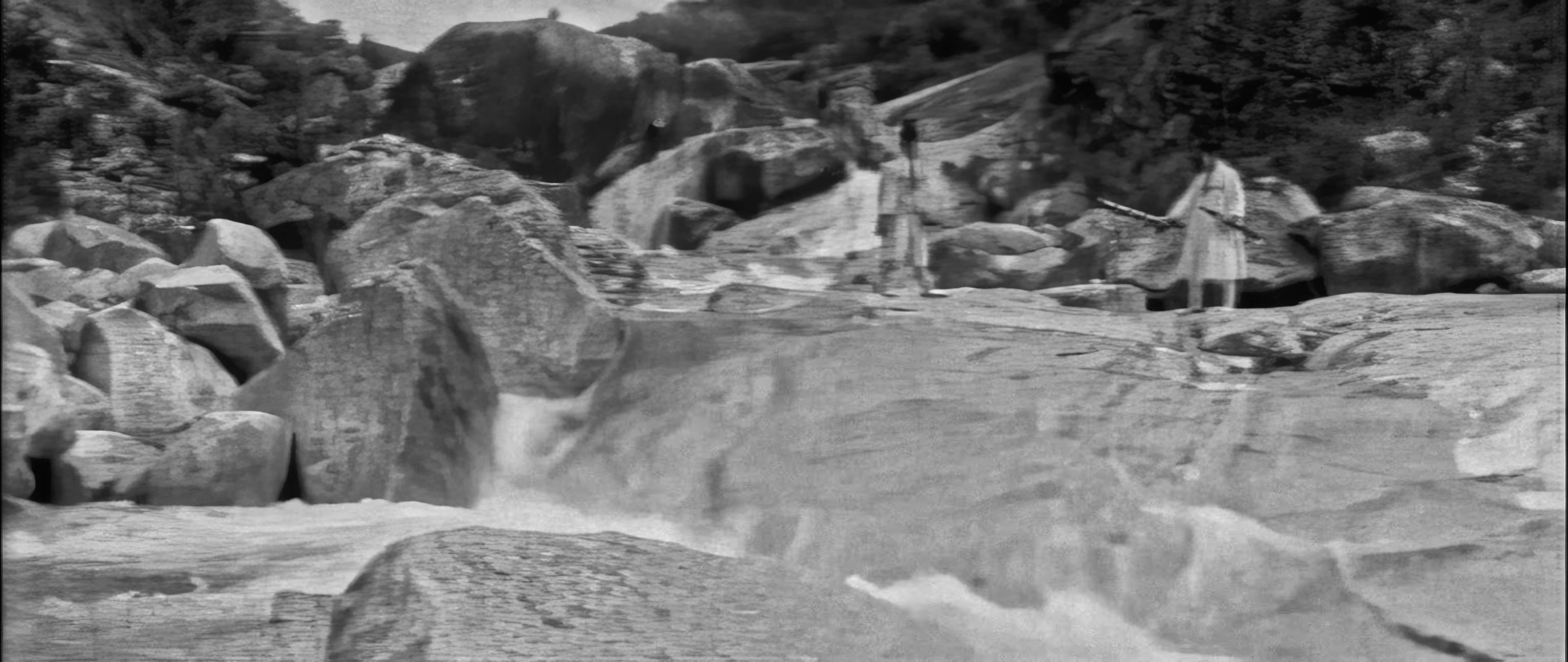
This sense personal rebellion may owe more to the jianghu sensibility found in the wuxia movies of King Hu than to the righteous nobility of the samurai film even if the ending strongly echoes chanbara epics in which the hero is displaced from his community and condemned to wander as a perpetual outlaw in a society which does not live up to his ideals. While staging beautifully framed action sequences such as fight at a rocky brook, Jeong undoubtedly draws inspiration from Hu in the use of trampolines and majestic jumps that have an almost supernatural quality. The sword fights are largely bloodless until the final confrontation but also violent and visceral. Gi-ryong’s henchman plays with a minion he feels has betrayed him by lightly scratching his throat before going in for the kill and such cruelty seems to be a hallmark of the Jang faction. But despite the seeming positivity of the ending in which a kind of solidarity has been discovered between Tae-won and the governor, the film ends on an ambivalent note with the fate of the nation still unknown as Lady Jang stoops to shamanic black magic to hold sway and darkness, the lingering shadows of authoritarianism, still hang over the swordsman even if he is in a way free as s rootless wanderer no longer quite bound by feudal constraint. 


A Swordsman in the Twilight screened as part of Echoes in Time: Korean Films of the Golden Age and New Cinema.

Burning Mountain (山불 / 산불, Kim Soo-yong, 1967)

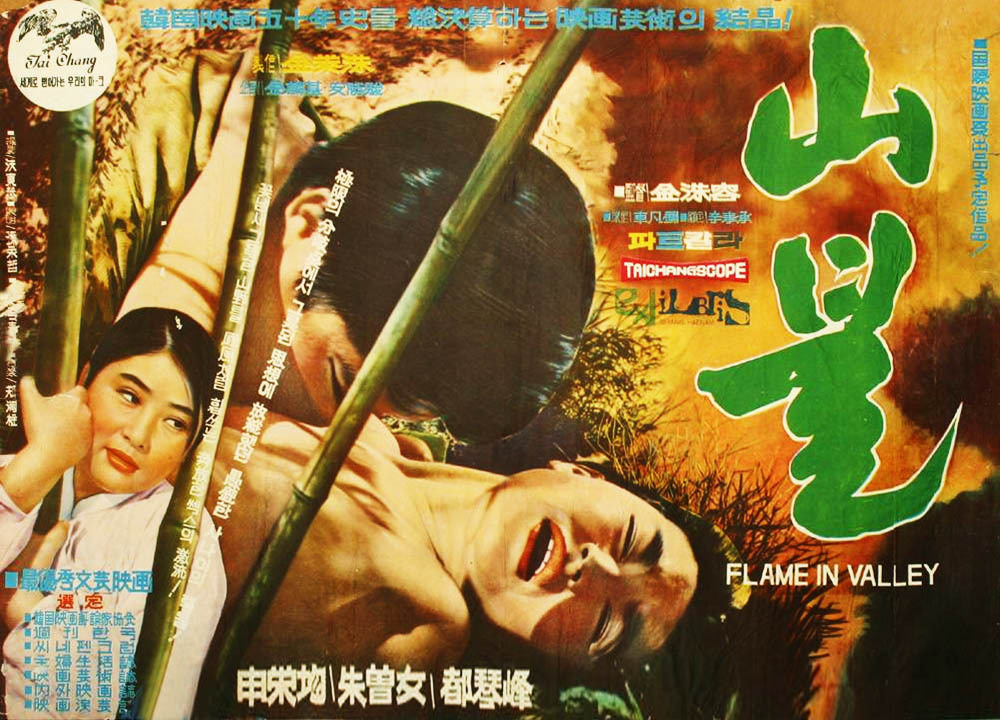
Burning Mountain still 1In his 1965 film The Seashore Village, Kim Soo-yong had presented a broadly positive vision of a community of women who had learned to survive without men by supporting each other. 1967’s Burning Mountain (山불 / 산불, Sanbul, AKA Flame in the Valley) revisits a similar theme but with much less positivity. This time around, the women have been deprived of their men not because of nature’s cruelty, but because of man-made corruption. Set during the Korean War, Burning Mountain finds a collection of wounded, lonely women condemned by patriarchal social codes and hemmed in by political strife not of their making struggling against their baser instincts as they determine to survive in an often hostile environment.

A small village near Jirisan has lost all of its men. Pressed by communist guerrillas for food, the lone women are hungry and afraid. Consequently, they are often at each other’s throats and united only in a shared futility of waiting for men they are almost certain will never return, either because the war has taken them or they have taken the opportunity to seek a better kind of life. The drama begins when Jum-rye (Ju Jeung-ryu) discovers a communist deserter, Kyu-bok (Shin Young-kyun), hiding in the bamboo grove and is seduced by him, satisfying her long repressed desire and escaping her loneliness through a transient bond with a captive man.

Unlike the fishwives of The Seashore Village, the women of Burning Mountain are a more conservative bunch though they too are largely unafraid to talk plainly of their unanswered desire in the absence of men. Rather than embracing each other as the fishwives had, the mountain women allow their sexual frustrations to make them bitter and irritable, forever at each other’s throats and unable to let go of past grievances. They dwell on the possibility of escape, but do not believe it to be real. One of the younger, unmarried women, talks of going to the city to find work as a maid but is confronted by a world of checkpoints and soldiers which restricts both her movement and her freedom in ways she is ill-equipped to understand.

The village stands as a tiny enclave, caught between North and South, part of both and neither as if lost in some eternal netherland. The bamboo grove represents the innocent natural freedoms which have been taken from the villagers by civilisation and by later by the folly of men and war. It’s in the bamboo grove that Jum-rye first encounters Kyu-bok in a meeting which begins as rape but ends in seduction as Jum-rye surrenders herself to a rough stranger in desperation and loneliness. The affair continues and relations between herself and the other women improve until Sawol (Do Kum-bong), a woman with whom she’d been on bad terms because their absent husbands had been on different sides, discovers Kyu-bok’s existence and blackmails the pair into allowing her to make sexual use of him in order to ease her own frustration.

Roles interestingly reversed, Kyu-bok takes exception to his new status as a kept man, resenting the feeling that he is nothing more than a pet, breeding stock kept to scratch an itch. Nevertheless, he stays while the women, increasingly conflicted, urge him to turn himself in to the authorities sure that if he explains himself they will not treat him harshly. Already emasculated in having been forced into the mountains against his will, Kyu-bok remains impotent in all ways other than the sexual, pleading with Jum-rye that she let him stay in the bamboo grove “until the world gets better”.

Sadly, the world shows little sign of doing that, though thanks to their shared transgression a strange kind of camaraderie arises between former enemies Jum-rye and Sawol, now disposed towards female solidarity having eased their own frustrations. They want to trap Kyu-bok and keep him for themselves, but at the same time they dwell on the idea of the unseen woman waiting somewhere for him just as they are waiting for their menfolk and know they cannot have him for long. Where the constant refrains of “we are all the same” had rung somewhat hollow, they ring true now in the two women’s commitment to a woman they don’t know who is, in some senses, their rival.

Yet, the liminal space of the bamboo grove cannot be allowed to stand in the increasingly straitened future. Already subversive in his frank depiction of female desire, Kim subtly undercuts the austerity of the times in making accidental villains of the South Korean army who arrive to burn the bamboo grove down to smoke out the guerrilla fighters, taking from these women the symbol of their freedom in the natural pleasure of the forest. The cowardly communist, while fulfilling the demands of the censors’ board, is both passive victim of his times and a representative of the frustrated masculinity which has caused them in the first place. The corruption of the war has come to the bamboo grove and set light to the last vestiges of hope in taking from these already impoverished women their very source of life. A sorry tale of despair and futility, Burning Mountain spins a tale of weak men and resilient women whose solidarity is bought through a mutual satisfaction cruelly ended by an austere and unforgiving regime.


Burning Mountain is available to stream online via the Korean Film Archive’s YouTube Channel.

The Guests of the Last Train (막차로 온 손님들 / 막車로 온 손님들, Yu Hyun-mok, 1967)

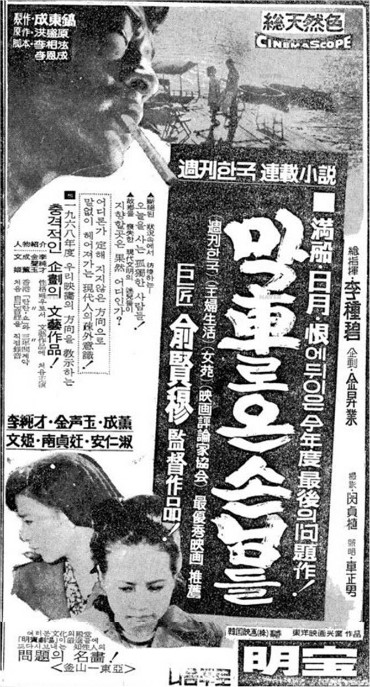
guests who came by train 2Despite ongoing social and political oppression, the Korea of the 1960s was an upwardly mobile world in which increasing economic prosperity and global ambition was beginning to offer the promise of financial stability and a life of comfort to millions of young men and women, albeit at a price. Yu Hyun-mok, often thought of as among the most intellectual of “golden age” film directors, was a relatively infrequent visitor to the “literary film” but Guests of the Last Train (막차로 온 손님들 / 막車로 온 손님들, Makcharo on Sonnimdeul, AKA Guests Who Arrived on the Last Train), adapted from a novel by Hong Seong-won, is perhaps comfortably in line with his career long concerns in its focus on those who for one reason or another have been running to catch the rapidly departing train of modernity, pulling themselves on board just it prepares to pull away. A disparate tale of three men and their respective love interests, Yu’s film once again rejects the consumerism of the modern society in its cold and lonely search for soulless acquisition and finds comfort only in the fragile connections between the lost and hopeless.

The film opens behind a train station where a young woman, Bo-yong (Bo-yong), staggers and stumbles, grasping for something to hold on to but hardly able to stand. Eventually a man, Dong-min (Lee Soon-jae), turns up and tries to hail a taxi. Noticing the distressed woman, he manages to get her into a car and when she tells him she has nowhere to go, takes her home with him. Dong-min is currently off work with an illness which turns out to be terminal lung cancer and has only a few months left to live as a second opinion from his doctor friend, Kyeong-Seok (Seong Hoon), makes clear. Kyeong-seok is also facing a problem with a female patient, Se-jeong (Nam Jeong-im), suffering a nervous complaint after losing her wealthy husband and subsequently being hounded by her relatives over the inheritance. When Se-jeong leaves the hospital the pair end up having an affair but the money continues to present a problem – neither of them want the hassle of dealing with it. Meanwhile, Dong-min and Kyeong-seok reunite with another old friend, Choong-hyeon (Kim Seong-ok), who has just returned from Japan apparently having become fabulously wealthy. Choong-hyeon has pretensions of becoming an avant-garde artist, but is unable to get over his ex-wife who has left him to become a famous actress.

Each of the three men is in someway arrested, unable to move past something towards the future rapidly rolling away from them like a train leaving the station. Dong-min’s depression and listlessness is understandable given that he’s facing a terminal illness and knows that he has already reached the end of the line. Yet his ennui began long before. Kyeong-seok, describing his friend to a colleague, disapprovingly remarks that he used to be a mild-mannered bank teller but left to become a freelance translator and journalist. Unable to put up with the stringent, high pressure world of work Dong-min removed himself from it to try and grasp his freedom only to remain dissatisfied and eventually defeated by a cruel and arbitrary illness. Even so he retains his human feeling as demonstrated by his decision to help Bo-yong rather than leave a vulnerable woman alone to suffer on the streets. Staring blankly at the calendar on his wall, avoiding tearing off the sheets which serve as an all too obvious symbol of his limited time, he falls slowly in love with the woman who remains at his side whilst knowing that his existence is futile and doomed only to tragedy.

Kyeong-seok, by contrast, is merely disaffected. Dragged into a relationship with Se-jeong originally unwillingly, what he resists is responsibility. He wants to help her, but he does not want to get involved with her complicated familial and financial problems. As so often in Yu’s films, money is the root of all evil, presenting barriers between people where there should be none. Neither Kyeong-seok or Se-jeong are very interested in the money for its own sake, they want only simple lives of adequate comfort and emotional fulfilment – something which the hassle of dealing with other people’s money hungry machinations will actively destroy.

Money has also, in a sense, destroyed Choong-hyeon’s hopes though more through his misplaced faith in its ability to buy him back what he’s lost. His relationship with his wife is clearly over, she has chosen something else which is her right and privilege, but Choong-hyeon can not accept it and continues to look for her in all he does. Attempting to become an “artist” himself, he uses his money to get himself a show featuring his avant-garde pop art creations but neither of his friends rate his work or is careful enough about his feelings to avoid criticising it. Choong-hyeon spirals out of control, becoming dangerously obsessed with a schoolgirl he somehow wants to imagine as his wife. Dong-min and Kyeong-seok suspect that he will kill himself, but by this point they aren’t sure if they should care. What would they be saving him for? There is no possible salvation – no one can save anyone else, and no one can save themselves. Each is an individual and can offer no excuses. Love and friendship are but scant comfort in a cold and lonely world.

Meanwhile, the women continue to suffer in silence. Yu chooses to focus on his trio of male misfits rather than the pair of unlucky women whose story lies at the centre of the narrative. Se-jeong married an older man for apparently legitimate reasons but the marriage was unsuccessful and also ruined her friendship with her husband’s daughter who, unsurprisingly, turns out to be Bo-yong. Looking for love and not money, Se-jeong is only holding on to her inheritance in the hope of someday reconciling with Bo-yong and handing it all to her. Meanwhile, Bo-yong has been on the run from her former life. Once an air stewardess, Bo-yong dropped off the radar when a former fiancé planted drugs in her suitcase and got her sent to prison. Like Se-jeong she is looking for support and companionship and finds it in the kind if melancholy Dong-min, vowing to stay by his side even if she knows their time it limited. The two women are eventually “reunited” at a wedding, but the crowd keeps them apart, breaking into factions fighting over the inheritance that neither Se-jeon or Bo-yong actually want.

Yu declines to tell us whether the women are eventually able to meet and repair their friendship, but he does make clear that both have rejected the superficial comforts of wealth in asking for a small and simple life with their respective partners. In this he offers both hope and despair. The couples are rejecting the new future their nation has planned for them, yearning for small comforts and an end to their loneliness and struggling to find it in an increasingly alienated world. Bo-yong, at least, steps forward to grasp her chance at happiness however small it maybe, waiting for the train and seeing red lights change to green only when her gesture of sincerity is finally accepted.


Available on DVD as part of the Korean Film Archive’s Yu Hyun-mok boxset. Not currently available to stream online.