My Best Friend’s Breakfast (我吃了那男孩一整年的早餐, Du Zheng Zhe, 2022)

Teenage romance is always complicated, but it seems wilfully so for the couple at the centre of Du Zheng Zhe’s high school rom-com, My Best Friend’s Breakfast (我吃了那男孩一整年的早餐, wǒ chī le nà nánhái yī zhěng nián de zǎocān). Du’s adaptation of the popular novel by Misa lacks the quirky post-modernism with which Taiwanese romantic comedies have come to be associated save a few fantasy sequences and the heroine’s dialogues with possible versions of her future self, opting instead for a more much more conventional tale of miscommunication and the potential costs of failing to speak one’s true feelings at the right time. 

High schooler Wei-xin (Moon Lee) is in any case sceptical of romance as her parents have recently divorced after years of arguing about money and their conflicting views on success and happiness. Her classmate Yuan-shou (Edison Song Bai-wai), who has an obvious crush on her, convinces Wei-xin to take part in the school concert in exchange for receiving a milk tea every day, while she also makes a habit of eating the breakfasts sent to her best friend, popular girl Qi-ran (Jean Ho), by her various suitors. She then runs into top swimmer You-quan (Eric Chou) who chips in when she’s sort on her pineapple bread snack and starts hanging out with him after witnessing his awkward breakup with an unfaithful girlfriend. 

A brief note of social commentary is introduced as the pair bond over their stigmatised familial circumstances, Wei-xin fearing You-quan will look down on her when she explains her parents are divorced while he reveals he feared the same because his father has passed away and his mother is working in the US while he lives in one of the school dorms. The problem is, however, the central miscommunication in their by-proxy courtship in which You-quan starts sending breakfasts to Qi-ran which are obviously intended for Wei-xin though she remains oblivious both of You-quan’s feelings and those of Yuan-shuo. Assuming that You-quan is interested in Qi-ran she keeps quiet, as does he and everyone else giving rise to a lot of totally unnnecessary emotional suffering for all involved. 

Then again Wei-xin’s romantic predicament pushes her into an intense contemplation of her future, engaging in conversation with possible versions of herself in 15 years’ time firstly as a lonely, overweight woman who lives only to eat, and then as a cool and super-confident musician, each of them helping her figure out her feelings and what to do about them. Meanwhile, her youthful romance is contrasted with her parents’ failed relationship which apparently began when they were both carefree teens with no responsibilities and eventually broke down when faced with the realities of supporting each other as a family. While Wei-xin’s musician father has continued to follow his dreams even if they never payoff, her mother has become an unhappy workaholic desperate to work herself out of debt but also perhaps resentful in having given up on love for the illusion of financial security. 

What Wei-xin learns is that it’s better to be bold and have no regrets than risk becoming the version of her future self who is embittered and resentful that she never told her teenage crush how she felt. These teens do at least seem to have a fairly mature attitude to romantic disappointment, taking rejection with good grace and resolving not to let the awkwardness of a failed romantic confession ruin a friendship. One unexpectedly compassionate teen receives a declaration of love from a same sex crush in the midst of wailing about their own romantic heartbreak and though they do not return their feelings immediately embraces them in empathising with their emotional pain while another reflects on a bad breakup and traumatic incident to work on themselves and gain inner confidence before winning back their former love. 

Given all that the idealism of the film’s conclusion may sit a little oddly if perfectly positioned to appeal to a teen audience with an archetypal romantic moment, but is to a degree earned in teen’s path towards emotional honesty and the necessity of being brave enough to accept the risk of heartbreak in chasing their romantic destiny. Perhaps free breakfast delivered to your best friend by proxy is as a good a way to say I love you as any other. 


My Best Friend’s Breakfast screened as part of this year’s New York Asian Film Festival.

Original trailer (Traditional Chinese / English subtitles)

Images: © 2022, SKY FILMS Entertainment Co., Ltd., all rights reserved.
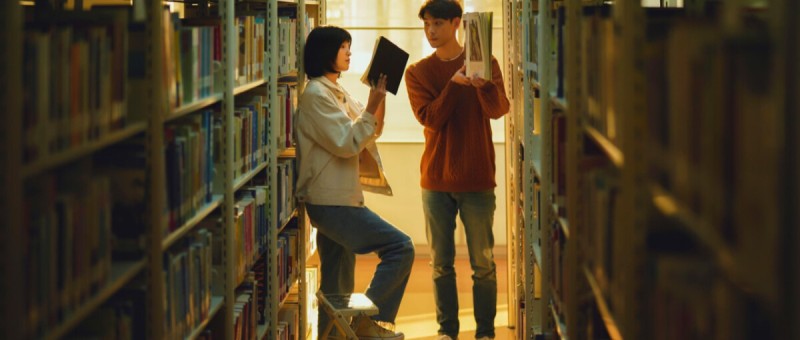
Waiting for My Cup of Tea (一杯熱奶茶的等待, Phoebe Jan Fu-hua, 2021)

How long should you wait for love? Released during the prime romance season over the Christmas holidays and adapted from her own novel, Phoebe Jan Fu-hua’s Waiting for My Cup of Tea (一杯熱奶茶的等待, yī bēi rè nǎichá de děngdài) wonders if love is something you can defer or something to which you should submit as a collection of youngsters attempt to deal with various kinds of baggage from unresolved attachments to chronic illness, career worries, and the burden of responsibility for one’s own feelings and those of others. 

Xiao-hua (Ellen Wu), for example, is a shy young art student who seems to stand at a distance from her friends while intensely irritated by a classmate/neighbour who has a sideline as a model and seems to have everything passed to her on a plate simply for being pretty. It’s Yi-chun’s love life, however, which is beginning to annoy her partly because each of her suitors, which Xiao-hua suspects may extend to at least three, constantly rings her bell mistakenly believing Yi-Chun’s is broken. After being jokingly threatened by Yi-chun’s overbearing secret boyfriend, she later runs into another young man, Zi-jie (Simon Lien Chen-hsiang), ringing her bell in vain advising him to come back later fearful of a scene should he enter and find another guy in Yi-Chun’s flat, while she’s also touched by the sight of a third man, A-wen, sitting quietly on a bench opposite her window next to a bouquet of flowers assuming he too is probably waiting for Yi-Chun. 

Feeling sorry for A-wen sitting out in the cold waiting for a girlfriend who’s probably off with someone else, Xiao-hua buys him a hot milk tea from a vending machine which will become something of a motif throughout the film, but it’s Zi-jie she eventually falls for after a series of meet cutes during which he declares himself uninterested in committed romantic relationships and indifferent to Xiao-hua’s revelation that Yi-Chun may have as many as three guys on the go at the same time. Even so, he appears much more interested in her than he ever was in the model next-door, later ending his association with Yi-Chun rather abruptly much to her surprise in order to better romance Xiao-hua if mainly through an air of mystery. 

Though all of these people are very young, in the main college students about to graduate, they each have their own barriers to romance which they’re wary to overcome, Xiao-hua’s being her previous relationship with fellow student Shao-Ping who broke up with her to take care of a childhood friend living with mental illness while selfishly asking Xiao-hua to wait for him. At one point or another, everyone asks someone else to wait or else to give them time, Xiao-hua eventually that of asking Zi-jie on figuring out why he seems to be keeping a distance from her echoing the words of the radio host she’s fond of listening to that he should give her time and learn to let her in, while he later asks the same of her, and of course A-wen is always “waiting” in one sense or another. There is something a little uncomfortable in Shao-ping’s broodiness, opposed to Xiao-hua’s new relationship not only because he unfairly believes he still has a right to a say in her romantic future but uncomfortably suggesting that he sees an ironic degree of symmetry fearing that Xiao-hua will discover that Zi-jie is a “burden” she will become responsible for an idea tacitly affirmed in the otherwise positive conclusion in suggesting that Zi-jie must wait until he’s physically fit for love before committing himself fully. 

Meanwhile Xiao-hua’s romantic naivety is challenged by relationships between her friends witnessing a couple she thought were made for each other suddenly break up while each of them prepare for their lives after college, getting jobs and moving on often in different directions. She comes to realise that it’s unfinished business that holds people back and that in the end it’s better to have an uncomfortable conversation than leave a door open that would be better closed because there’s no sense waiting for a moment that’s already passed, but then paradoxically commits herself to waiting as an act of faith in a surer love. A gentle meditation on loneliness, grief, and the internalised barriers to romance Jan’s melancholy drama is less an advocation for moving on than for taking the time to find the right direction or at least one that is your particular cup of tea. 


Waiting for My Cup of Tea screens in Chicago April 10 as part of the 14th season of Asian Pop-Up Cinema.

Original trailer (English subtitles)