Capone Cries a Lot (カポネおおいになく, Seijun Suzuki, 1985)

1040003_lNever one to be accused of clarity, Seijun Suzuki’s Capone Cries a Lot (カポネおおいになく, Capone Ooni Naku) is one of his most cheerfully bizarre movies coming fairly late in his career yet and neatly slotting itself in right after Suzuki’s first two Taisho era movies, Zigeunerweisen and Kageroza. Though not part of the so called “Taisho trilogy” (this would be completed with Yumeji in 1991), Capone Cries a Lot begins its tale in the short lived period between the ages of Meiji and Showa when the world seemed open and foreign influence flooded into this once isolated nation. Could that influence also travel upstream? Naniwa-bushi, for example, could could a Naniwa-bushi singer on the run make something of himself in the New World?

Like most of Suzuki’s movies, plot is a secondary concern. However, loosely speaking, our protagonist is Jun – a man who wanted to learn the art of Naniwa-bushi from its accepted master but ultimately ran off with another man’s wife and ended up in 1920s America. Once there he hooks up the Japanese gangster Gun-tetsu who makes use of Jun’s sake making experience to assist in his bootlegging business during prohibition. This brings them in contact with the Capones, firstly with Frank and eventually with Al (who Jun amusingly mistakes for the president of the United States). Meanwhile, Jun’s girl, Kozome, has left him (to an extent) and become a prostitute. However well things seem to be going for Jun, he’s still a foreigner in a strange, and sometimes unkind, land. Is this the sort of place where dreams can survive?

Suzuki films the whole thing in Japan at an abandoned theme park which is 100% Americana – the Old West tricked out with cowboys, saloons and guns. Now it’s strange kind of new city populated by runaway Japanese criminals gambling and whoring their way through life. Jun wants to sing Naniwa-bushi in this odd place even if no one understands him. Originally he’s annoyed by the foreigners laying a hand on his shamisen or making attempts to join in with their jazz inflected modern music, but eventually he’s singing new Naniwa-bushi songs about the plight of the Native Americans and finally joining the jazz band for a full on musical fusion number. Suzuki does not shy away from the racial politics and problems inherent in his critique of American imperialism even up to an including the KKK and the Japanese internment camps.

In contrast to the previous two Taisho set films, Capone is much lighter in tone and obviously more playful even if it includes a similar level of oblique surrealism. Chaplin references and slapstick humour mix with absurdist dialogue and cosmic silliness to create a popcorn candy world that’s still somehow sad and strange. It’s a vision of America filtered through ‘20s gangster pics and B-movie westerns, equal parts bubblegum and tommy guns. It doesn’t make a great deal of literal sense but offers plenty of Suzuki’s psychedelic eye for colour, surprising editing choices and all round idiosyncratic approach to storytelling.

There may be ample reasons why Capone Cries a Lot has never found an overseas audience, it’s a little overlong for one and its comments on race are perhaps a little uncomfortable from several different angles. Nevertheless, it’s another characteristically zany effort from Suzuki and full of colourful pop aesthetics that are much more playful than the rather heavier Zigeunerweisen and Kageroza. Well worth the long strange ride, Capone Cries a Lot is a trip to 1920s candy land that few of the directors devotees will be able to resist.


(Unsubtitled) Scene from midway through the film
http://www.youtube.com/watch?v=r_ILc3zQ7nE


Cold in July

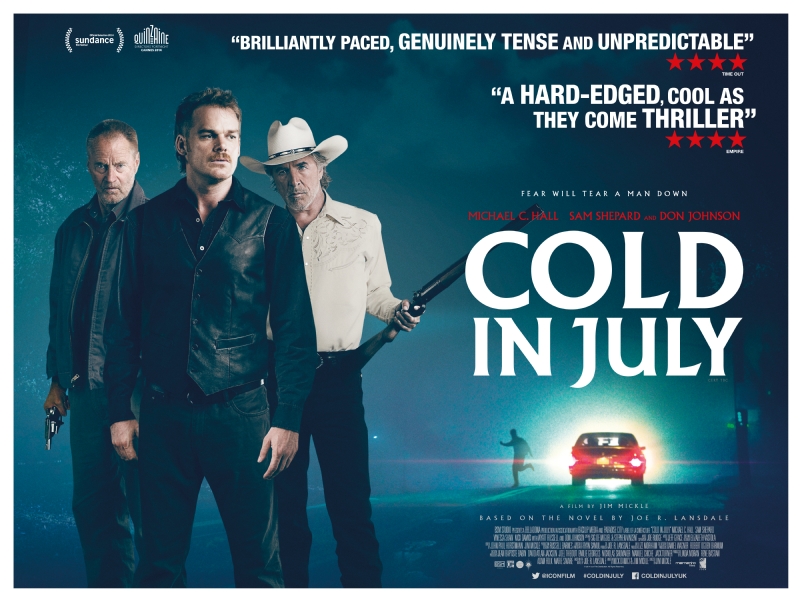
cold-in-july-quad-posterBased on Joe R Lansdale’s novel of the same name, Cold in July is an homage to classic ’80s neon tinged noir with a noticeable digression into Southern Gothic, revenge thrillers and B-movie heroics. Small town Texas picture framer Richard Dane (Michael C. Hall) is woken by his wife one night after she begins hearing strange noises from downstairs. Fearfully arming himself with his father’s old pistol hidden in a shoebox in his wardrobe, Richard tiptoes downstairs only to find a masked and hooded figure standing in his living room. In a halted moment Richard confronts the intruder with the gun and, hands shaking, uncertain what to do next locks eyes with the would-be burglar now held motionless as if in a tractor beam. As Richard holds his course, the mantlepiece clock begins to strike and whether accidentally or in panicked terror the gun goes off sending its explosive charge into the scenic landscape hanging on the wall by way of the burglar’s right-eye. The police arrive to find a traumatised Richard near catatonic in disbelief but oddly seem fairly congratulatory – “it must have been difficult, for a man like you” his Sheriff friend tells him, with heavy implications. Assured that it’s legally self defence and nothing further is likely to come of the matter Richard tries to return to his previous small town, family man life but the incident has left him jittery and with a noticeable ambivalence toward firearms. However, despite what the police may say it’s not quite over yet – the burglar had a father, and a psychotic one at that. An eye for an eye as they say, or a son for a for son – only, that’s not quite it either and before he knows it, Richard finds himself involved in a complex circle of crime and conspiracy.

Cold in July lines itself up with those late ’80s slightly sleazy, hyper violent crime thrillers in which one ordinary man must face off against some kind of larger danger which threatens the very foundations of his world. The period detail is exact with the book’s 1989 setting recreated faithfully down to every last detail from the bizarre red neck haircuts, giant portable telephones and floral furniture craze to VCRs and vintage 80s Apple Macs. The look has an appreciably 80s vibe with heavy grain despite having been filmed on digital RED cameras and the Carpenter-esque synth score give it the air of something that could have been made thirty years ago. Like all the best 80s small town crime stories there’s the melancholy and oppressive feeling of something not quite right, that there are no safe places and even in these cosy little towns there’s a great festering wound that’s rapidly turning rotten.

Like its ’80s settings, these are some old fashioned ‘heroes’ who display an unabashed adherence to ‘traditional’ ideas of masculinity. Richard is a mild mannered picture framer – work that requires skill and artistry rather than physical strength. After Richard shoots the man who threatened his home, the town’s reaction is less fear or sadness but almost joyful respect. “We didn’t think you had it in you” seems to be the general consensus from everyone from the local postman to the glowing write-up in the local paper. Before he was an emasculated husband and father, but now – having killed, he’s a man. Real men shoot first and don’t bother with questions at all. Despite Richard’s discomfort with his actions, with the reaction to his actions and even his own lingering feeling of inferiority he can’t escape the fact that something that he sees as weakness is being held up as heroism.

These old fashioned macho ideas are clearly something that continues to be passed from father to son – something that Richard begins to worry about when his own son playfully points a toy gun at him. The two older men – Don Johnson’s Jim-Bob the private-eye-cum-pig farmer and would be vengeful father Russell (Sam Shepard) are veterans of the Korean War and come from a generation steeped in conflict in which men are judged by their physical strength and survival techniques. Richard appears to have had some kind of strained relationship with his own (presumably deceased) father as though he keeps his gun in a shoebox at home, he seems pained every time the subject comes up. Russell hasn’t seen his own boy since he was a child and feels he’s failed as a father and perhaps as a man (in so far as a man is duty bound bring his son up right). What Richard learns from them is a lesson in old school masculinity – you carry the gun, you put things right. There’s an archetypal idea of chivalry there, that you stand up and protect your own and that the sins of the son are also visited on the father who must atone for failing to prevent such transgressive behaviour. There is something noble in it, but it is also dangerous – can a man who’s taken care of business, even in the name of his community, really return and live amongst other men?

Genre-busting as it is, the Cold in July mostly keeps itself together even as the action threatens to descend into the ridiculous. A thin stream of black humour helps to paint over its excesses as does its sheer joy in the larger than life elements such as the improbable Jim-Bob’s gaudy red cadillac, stetson hat and penchant for cool one-liners. There are undoubtedly a host of plot holes to the extent that it might be better to just avoid thinking about the sequence of events as a whole – the most obvious being a glaringly obvious loose end that everyone seems to have forgotten about. To be fair, no one leaves The Big Sleep shouting “yes, but who killed the chauffeur?”, a few potholes here and there don’t necessarily ruin the road and Cold in July is not a film about its plot. As an exercise in style, Cold in July excels but it also manages to pack in enough social commentary and primal melancholy to give its old fashioned morality tale some weight. Its politics maybe unpalatable and its outlook distinctly 1950s but Cold in July is among the best of recent retro exploitation B-movie throwbacks and walks its own path with considerable assuredness.