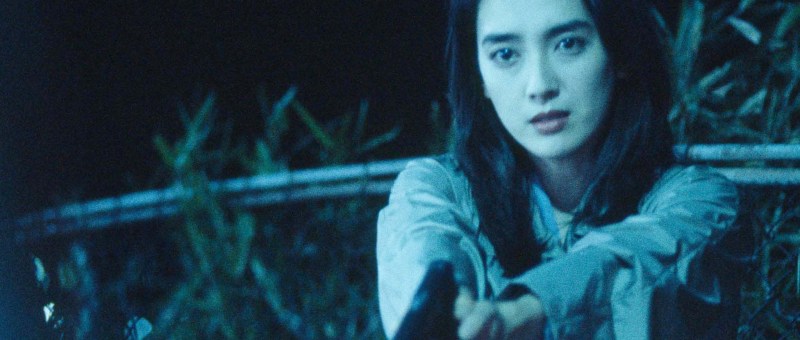
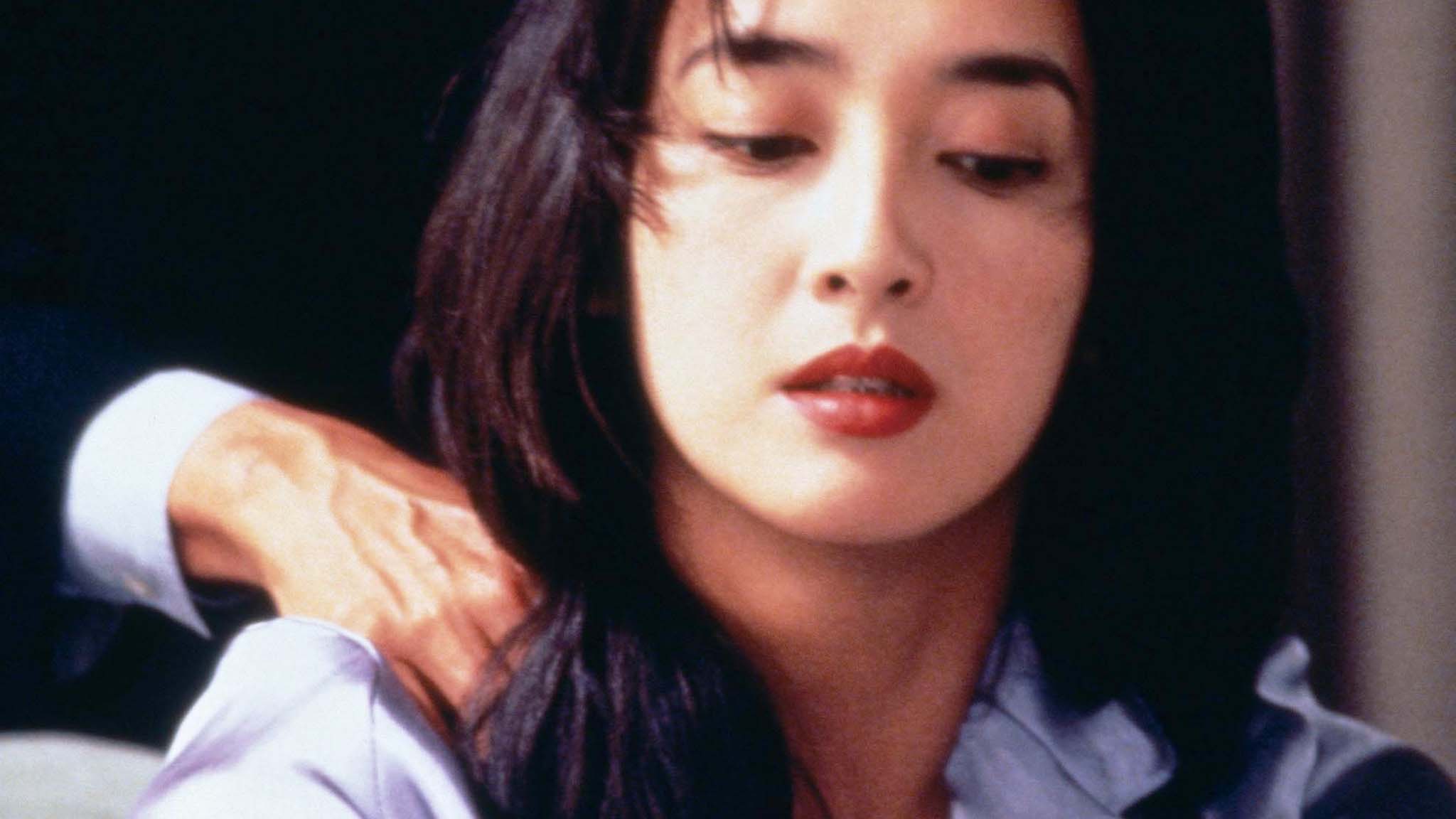
Though the title may suggest something more in line of exploitation cinema, Kazuo “Gaira” Komizu’s XX: Beautiful Weapon (XX ダブルエックス 美しき凶器, XX: Utsukushiki Kyoki) is more of a mood piece that harks back to classic noir coupled with the erotic thrillers of the 1980s. Though inspired by a short story by hard-boiled master Arimasa Osawa, the film nevertheless adds some political subtext and gives its heroine a much happier ending echoing the underlying themes of fairytale romance.
Indeed, wisecracking hitman/piano player Sakagami (Masao Kusakari) paints himself as a lovelorn prince come to awaken Sleeping Beauty from her slumber and free her from her imprisonment in a dead-end cottage in the middle of nowhere. He begins, however, as a clueless but intrigued hitman on his way out thanks to an apparent inability to keep his mouth shut or lay off the booze. Middle man Yoshizawa (Ren Osugi) drops into his bar, he says just to kill time, though perhaps changing his mind and deciding not to send Sakagami on this particular job.
A homoerotic frisson colours their interaction, as it does it with the other assassin, a man who runs a coffee shop and has apparently supplanted Sakagami as the hitman of choice. Yoshizawa, however, also has forbidden desires for his charge whom he raised like a daughter and trained in her trade. Nevertheless, he is fairly powerless as the underling of an increasingly paranoid political fixer, Kokubu (Takeshi Kato), who orders him to take care of a bank manager about to blow the whistle on his dodgy dealings and then to take out the assassin too just to be on the safe side. He’s installed the woman (Masumi Miyazaki) in the cottage for just this reason, a conveyor belt killing system in which she knocks off her targets in the middle of coitus and Yoshizawa burns the bodies to make them disappear. Now she knows too much, it’s time to get rid of her too.
Yoshizawa isn’t onboard with his plan, but find it’s difficult to defy his boss while otherwise worried about the woman’s mental state as she has evidently taken to drink to escape the emotional toll of her unusual line of work. Yet it’s her crying herself to sleep that causes Sakagami to fall in love with her as he peeks in from outside, again like a fairytale figure, observing how she kills the coffee shop guy and making mental notes for when his turn comes around. He quickly realises that she is blind, but pretends not to be, which gives her an advantage in the dark denied to her targets. Her blindness is also, in its way, a symbol of her innocence in that she does not see the darkness of the world all around her and only continues in her work because she doesn’t want anyone else to be forced to do it while, in other ways, hoping to show her love and loyalty to those who raised her.
Even when Sakagami offers to rescue her, she refuses in fear of what the outside world holds for her. She fears that the dead-end cottage is the only place where she can be “normal”, while outside it she’d be a blind woman unable to navigate the seeing world. Though Sakagami offers to be her guide dog, the surprisingly upbeat ending suggests that she only returns for him once she has achieved independence along with her revenge on those who imprisoned her in the cottage. It is indeed a dead-end place, a liminal space where people only go to die and from which there is no other escape. The woman would most likely have met her own end there, if it were not for Sakagami. The city meanwhile has its own sense of melancholy as a kind of lost paradise filled with the radiating darkness of the corruption of men like Kokubu pulling strings in the shadows. Even so, the woman and Sakagami eventually find a kind of escape in their fairytale romance guided by his gentle piano music and the vague hope of a quiet life free of death and killing having successfully bounced back from their mutual dead ends into an open-ended future.
Screened as part of the International Film Festival Rotterdam’s Focus on V-Cinema.
 Windows on Worlds