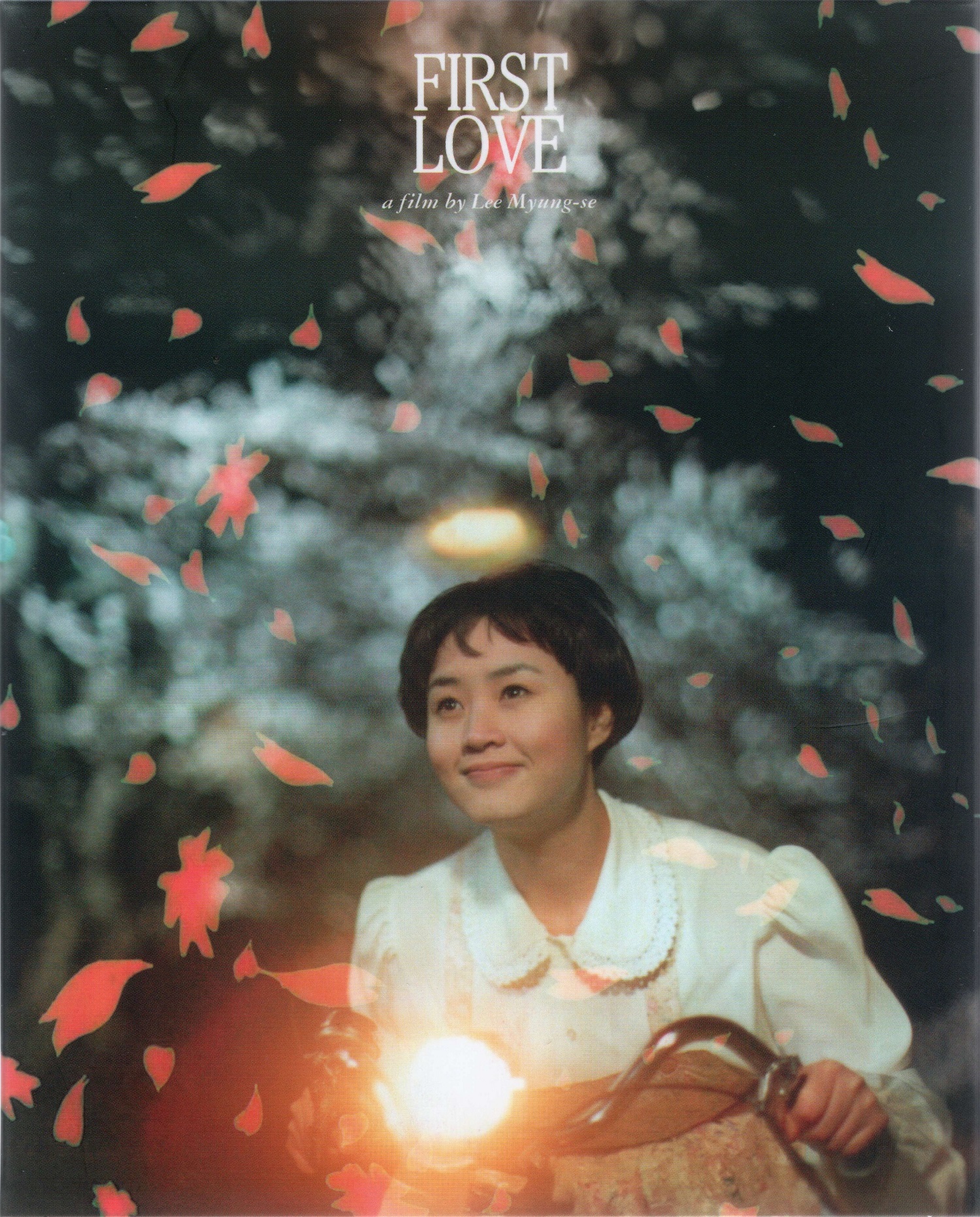
First Love (첫사랑, Lee Myung-se, 1993)

Expectations were high for Lee Myung-Se’s third film, First Love (첫사랑, Cheot Sarang), given that My Love, My Bride had been a runaway success. First Love proved to be, however, one of the worst box office disasters in Korean cinema history, selling fewer than 6000 tickets in Seoul during the Lunar New Year holiday. The film was however well received by the industry with star Kim Hye-soo picking up best actress at that year’s Blue Dragon Awards. Lee had originally intended to cast Choi Jin-sil, the female lead of My Love, My Bride, who had even turned down a TV drama series to do the film, but she apparently didn’t take to the personality of the character after reading the script and withdrew. Casting former child star Kim Hye-soo was seen as a left-field choice, but paid off in spades as Kim perfectly embodies the innocence and heartbreak of first love in charming fashion.

In some respects, the film is structured in a similar way to Thornton Wilder’s Our Town which first-year university student Young-shin’s (Kim Hye-soo) theatre club is performing. As the Stage Manager explains in the play, the first act will deal with everyday life, the second with first love, and the third with something else he assumes the audience will be able to guess, in case of the play, death. The film, however, ends with something more like continuity as the street where Young-shin lives turns from summer into autumn, winter, and then comes full circle into spring as one of the poems that pepper the screen pops up to remind us that everything begins and ends with nothing, or in other words, life goes on.

Set in the 1970s, the film opens with Young-shin taking a trip to Seoul from her rural hometown where she is a student in order to recruit a director for their play. She is immediately disappointed by Kang Chang-Wook (Song Young-chang), reflecting that she was expecting someone much more literary and poetic who in contrast to the local men wouldn’t smoke and drink excessively. Chang-wook even has an off-putting habit of rubbing his hair to shake the dandruff out which suggests poor hygiene. Nevertheless, her initial aversion to him soon transitions into attraction and an all-consuming, obsessive love, though she is only 19 and he 32. 

Much of the film takes place within her romantic fantasy and flights of fancy in which she develops superpowers such as invisibility or telekinesis while pursuing Chang-wook, her bicycle seemingly moving on its own under the vibrant cherry blossoms. She frequently addresses the camera directly to explain aspects of her life, particularly how boring it is in this rural town where the height of excitement is sending her younger sister out on an illicit late night mandu run. This thrill of romance is also, in that sense, a way of passing the time, though it’s often difficult to see what she sees in Chang-wook who is often patronising and has a bad drinking habit. When the pair go on a kind of date to a historical temple, he drinks so much that they miss the last train and Young-shin has to take him to a hotel, booking into a rent by the hour type place without realising and having to lie about her age on the register. 

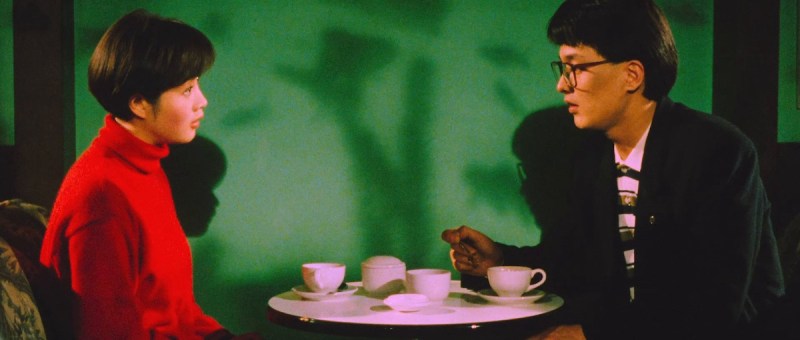
But while she is experiencing her first love, so are others. Her childhood friend Moon-su (Jo Min-ki) is clearly in love with her, trying to declare his feelings by giving her a copy of Tugenev’s First Love, though this proves too obscure a clue for Young-shin who is still wrapped up in her own romantic drama. The deliberately artificial set design, mostly taking place on a studio set, evokes a strong sense of nostalgia for an idealised youth. Young-shin and her friend fancy Gregory Peck and Jean-Paul Belmondo, while there are posters for South Pacific in the background, echoing the ways in which Young-shin has also turned her life into a romantic melodrama. The saturated colour scheme also echoes the Technicolor past, golden light pouring in through the studio windows as Young-shin ponders her romantic dilemma. Only once are we reminded of the less cosy side of the ‘70s as the sirens blast to mark the start of the curfew, trapping Young-shin in the motel room with a passed-out Chang-wook waiting for the first train. Young-shin’s story may be tinged with melancholia as her romantic illusions are smashed by an unexpected discovery, but she still holds on to the memories of this magical time while knowing that there are other loves to still to come as time marches on.


Trailer (no subtitles)
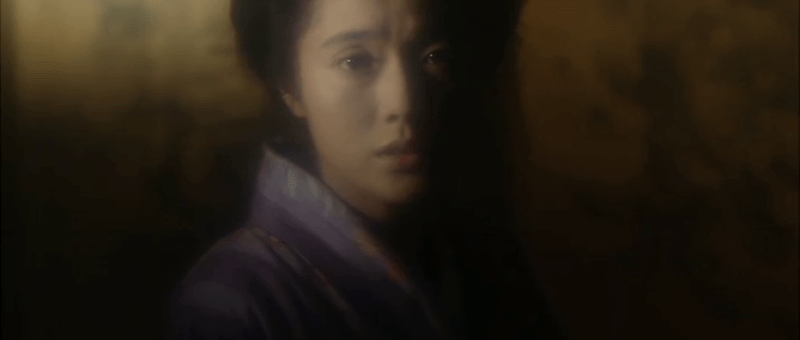
Fusa (その木戸を通って, Kon Ichikawa, 1993)

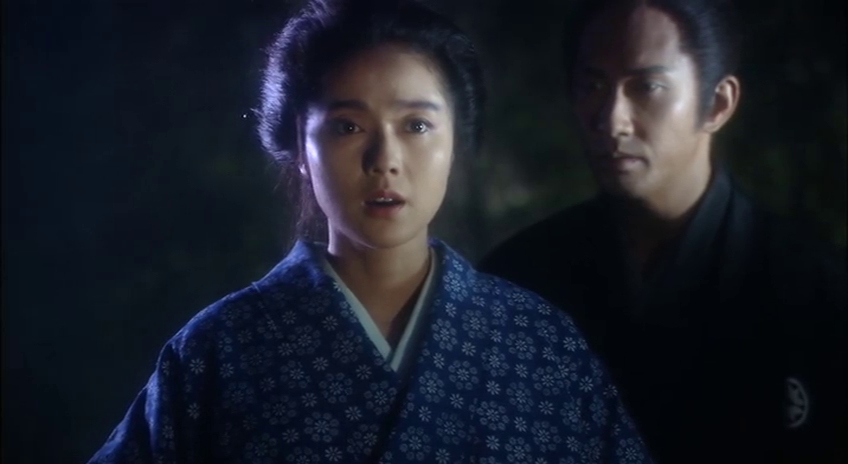
Kon Ichikawa’s Fusa (その木戸を通って, Sono Kido wo Totte) opens on a note of artifice. Misty rain and the verdant green of the forest give way to total darkness in which leaves appear, followed by the hero, Seishiro (Kiichi Nakai) tending a bonsai tree. As light brightens the scene, we see that he is seated beyond the veranda of his home which has taken on the appearance of a proscenium arch framed by the open shoji. It’s almost as if this space, in which Seishiro will enter his own reverie, is one of unreality as distinct from the interior which is busy with the preparations for the marriage of Seishiro’s only daughter, Yuka.

17 years previously, however, it was his own marriage he was preoccupied with when a mysterious woman arrived at his home claiming to have lost her memory and knowing only his name while he was away doing the annual audit. This is a little ironic, because “Seishiro Hiramatsu” hadn’t  been his name for very long and, in fact, he struggled to remember it or answer when called. The second son of an Edo lord, Seishiro had been adopted into the Hiramatsu clan and has made an advantageous match with the daughter of a lord, Tomoe. The presence of the mysterious woman threatens Seishiro’s position and path to advancement when Tomoe happens to catch sight of her, assuming she’s an old flame from Edo trying to rekindle things with Seishiro.

He, meanwhile, assumes the woman’s arrival is part of a plot to discredit him and ruin his engagement, presumably perpetrated by a jealous rival. For those reasons, he instructs his retainer Yoshizuka to have the girl sent away, but he and his wife (Kyoko Kishida) feel sorry for her and wish to take her into the household. Seishiro comes up with the ingenious plan of throwing her out and following her to see if she meets up with whoever sent her, but becomes protective when she is nearly assaulted by a pair of local louts. Despite himself, he becomes absorbed in the mystery, but at the same time both he and the woman, whom they name “Fusa” (Yuko Asano), become worried that if she did in fact regain her memory, she would have to leave.

Fusa sometimes enters a kind of trance state, staring at the mystical forest behind the house in way that gives her a supernatural air. That she arrives so suddenly aligns her with a tradition of ghost story and folklore, suggesting that she may be some kind of forest spirit that like the Snow Woman would have to leave once the spell was broken. She describes herself as feeling as if he had been possessed or were trapped within a dream. As Seishiro learns later, she may not have known his name at all, but only taken it from one of his servants, while her past remains opaque. Nevertheless, they are blissfully happy and conceive a daughter together before Fusa suddenly disappears with the same suddenness as she arrived. She had often had visions of a bamboo path and a wooden door beyond which seem to lurk the secrets of her past, but it may not be possible to return after passing through.

Seishiro continues to believe she will one day remember them and return, but at the same time knows to treasure the small bubble of happiness they once had no matter how long it lasted. The truth is only that she was here and then gone, which isn’t so much of an unusual story and requires little explanation, though Seishiro never really solves the mystery as he had vowed to do. Perhaps like Fusa, he didn’t really want to risk breaking the spell. Based on a story by Shugoro Yamamoto, the film was produced by Fuji TV as a test feature for NHK’s “Hi-Vision” high-definition television channel with the consequence that it was shot on hi-def video tape and later transferred to 35mm for international festival screenings. For those reasons, it’s not a particularly handsome film and obviously low budget, but even so Ichikawa makes the most of the medium, leaning into its soft focus to create an ethereal and mysterious atmosphere. Playing with colour and light, he often frames Fusa as the only one in colour in an otherwise monochrome scene as if perhaps suggesting that it’s Seishiro’s world that lacks reality rather than hers. An ominous violet light seems to emanate from the misty forest, but in truth perhaps all here are ghosts looking for a way to go beyond the wooden door but, at the same time, hoping they won’t find it.


XX: Beautiful Weapon (XX ダブルエックス 美しき凶器, Kazuo Komizu, 1993)

Though the title may suggest something more in line of exploitation cinema, Kazuo “Gaira” Komizu’s XX: Beautiful Weapon (XX ダブルエックス 美しき凶器, XX: Utsukushiki Kyoki) is more of a mood piece that harks back to classic noir coupled with the erotic thrillers of the 1980s. Though inspired by a short story by hard-boiled master Arimasa Osawa, the film nevertheless adds some political subtext and gives its heroine a much happier ending echoing the underlying themes of fairytale romance.

Indeed, wisecracking hitman/piano player Sakagami (Masao Kusakari) paints himself as a lovelorn prince come to awaken Sleeping Beauty from her slumber and free her from her imprisonment in a dead-end cottage in the middle of nowhere. He begins, however, as a clueless but intrigued hitman on his way out thanks to an apparent inability to keep his mouth shut or lay off the booze. Middle man Yoshizawa (Ren Osugi) drops into his bar, he says just to kill time, though perhaps changing his mind and deciding not to send Sakagami on this particular job. 

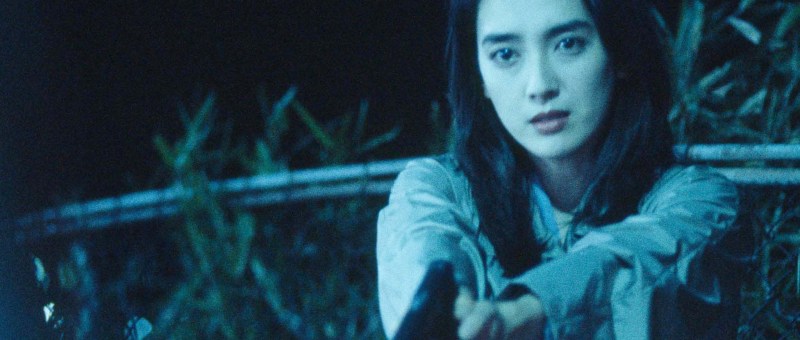
A homoerotic frisson colours their interaction, as it does it with the other assassin, a man who runs a coffee shop and has apparently supplanted Sakagami as the hitman of choice. Yoshizawa, however, also has forbidden desires for his charge whom he raised like a daughter and trained in her trade. Nevertheless, he is fairly powerless as the underling of an increasingly paranoid political fixer, Kokubu (Takeshi Kato), who orders him to take care of a bank manager about to blow the whistle on his dodgy dealings and then to take out the assassin too just to be on the safe side. He’s installed the woman (Masumi Miyazaki) in the cottage for just this reason, a conveyor belt killing system in which she knocks off her targets in the middle of coitus and Yoshizawa burns the bodies to make them disappear. Now she knows too much, it’s time to get rid of her too. 

Yoshizawa isn’t onboard with his plan, but find it’s difficult to defy his boss while otherwise worried about the woman’s mental state as she has evidently taken to drink to escape the emotional toll of her unusual line of work. Yet it’s her crying herself to sleep that causes Sakagami to fall in love with her as he peeks in from outside, again like a fairytale figure, observing how she kills the coffee shop guy and making mental notes for when his turn comes around. He quickly realises that she is blind, but pretends not to be, which gives her an advantage in the dark denied to her targets. Her blindness is also, in its way, a symbol of her innocence in that she does not see the darkness of the world all around her and only continues in her work because she doesn’t want anyone else to be forced to do it while, in other ways, hoping to show her love and loyalty to those who raised her. 

Even when Sakagami offers to rescue her, she refuses in fear of what the outside world holds for her. She fears that the dead-end cottage is the only place where she can be “normal”, while outside it she’d be a blind woman unable to navigate the seeing world. Though Sakagami offers to be her guide dog, the surprisingly upbeat ending suggests that she only returns for him once she has achieved independence along with her revenge on those who imprisoned her in the cottage. It is indeed a dead-end place, a liminal space where people only go to die and from which there is no other escape. The woman would most likely have met her own end there, if it were not for Sakagami. The city meanwhile has its own sense of melancholy as a kind of lost paradise filled with the radiating darkness of the corruption of men like Kokubu pulling strings in the shadows. Even so, the woman and Sakagami eventually find a kind of escape in their fairytale romance guided by his gentle piano music and the vague hope of a quiet life free of death and killing having successfully bounced back from their mutual dead ends into an open-ended future.


Screened as part of the International Film Festival Rotterdam’s Focus on V-Cinema.

Many Happy Returns (教祖誕生, Toshihiro Tenma, 1993)

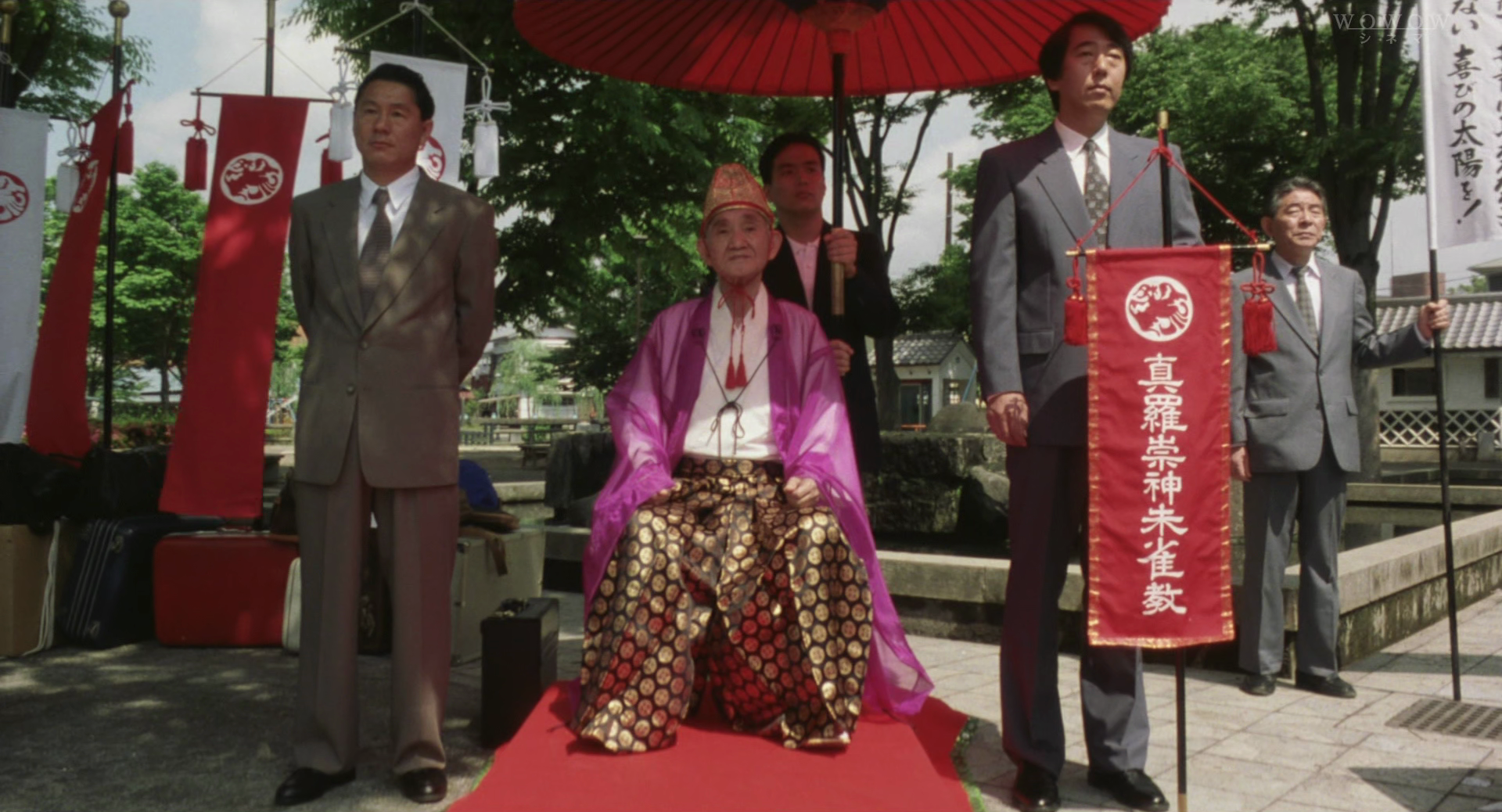
Cults, or “new religion” organisations as they’re euphemistically known, proliferated in Japan after the war. Though people may have joined them out of loneliness in search of new families or communities, the numbers only seemed to increase in the era of high prosperity as a sense of spiritual emptiness countered the age of consumerism. Coming in 1993 and based on Takeshi Kitano’s own novel, Many Happy Returns Toshihiro Tenma’s (教祖誕生, Kyoso Tanjo) approaches the issue with a genial humour that likely became impossible two years later with the involvement of Aum in the Tokyo subway attack.

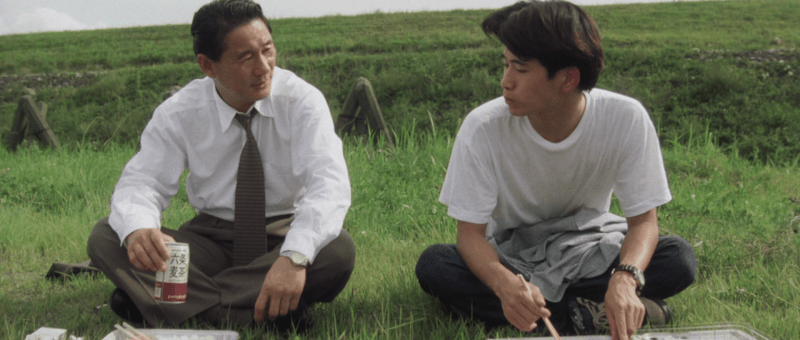
Kazuo (Masato Hagiwara), a wandering young man, asks himself why people join join cults while insisting that all looks so fake but later becomes fascinated with them himself. He can tell that the elderly woman who can suddenly walk again after an encounter with the leader (Masami Shimojo) is probably a plant, but is intrigued rather than outraged. Shiba (Takeshi Kitano), the actual “leader” of the group, tells him that it doesn’t matter. The leader healed the lady before at some point in the past, and they’re just reenacting it to show the power of god, which doesn’t really make sense, but it seems to satisfy Kazuo for the moment. 

Of course, Shiba and Go (Ittoku Kishibe) are just a pair of yakuza types running a religious cult as a business to fleece money out of vulnerable people in the countryside by making them think their leader can make all their problems better. The only thing is, Shiba and Go seem to be the only ones who know it’s all fake while current leader has started to believe that he actually has real healing powers despite using an electricity generator to create the sparks of energy flying from his hands during his healing sessions. Though the old lady in a wheelchair is a plant, the leader sometimes agrees to heal other people who request it, which could end up backfiring if Shiba can’t find a way to fake the miracle.

After becoming alarmed that the Leader is too into his religious speeches and has fallen victim to his own patter despite obviously knowing that it’s all made up, Shiba and Go pay him to leave the cult but are then left with a dilemma over how to appoint a successor. Komamura (Koji Tamaki), who’d tried to undermine Shiba’s leadership, is a religious zealot who joined the cult to be closer to god. He objects to Shiba’s godless ways, and while Shiba briefly considers making him the leader to keep him quiet, ends up appointing Kazuo who only recently started tagging along with the cult.

Though Kazuo was originally only interested in the cult precisely because it was fake, once he becomes the leader he starts to think it’s real too. He takes his responsibilities seriously, which means of course that he threatens Shiba’s position and is torn between the real nature of cult which he knows to be a cynical way of making money by exploiting vulnerable people, and the genuine religiosity of Komamura. To look the part and boost his confidence, he starts undertaking ascetic practices such as bathing in waterfalls and going on long, isolated retreats during which he also fasts. Shiba and Go, meanwhile, stuff their faces at a local Chinese restaurant in an orgy of consumerism.

Kazuo asks Shiba if the believes in god, but Shiba counters him by asking what his idea of “god” is. Kazuo believes that “god” heals the sick and helps those in trouble, but Shiba points out that that’s never actually happened, while at least their made-up religion helped some people, so in a way it’s more godlike than actual god. In any case, Shiba’s god is probably consumerism, but unlike Go it seems he has a degree of uncertainty and entertains the possibility that some kind of god really exists and will punish him for his wrongdoing and lack of faith. When he is attacked and ends up killing someone, Kazuo tells him that it’s his punishment for denying god and chasing after money which Shiba eventually concedes to be true. Nevertheless, the closing scenes find him starting again by reuniting with the previous leader, now dressed as a catholic priest, to offer the same patter about healing miracles while warning about false cults and fake religions. Kazuo, meanwhile, has fully accepted the role of an emissary of god by kicking out Go for not taking the religion seriously while preparing to meet his own apotheosis in a sold out show attended by people who, like he once was, are spiritually lost and ironically looking for something that means more than money in this increasingly empty society.


Trailer (no subtitles)
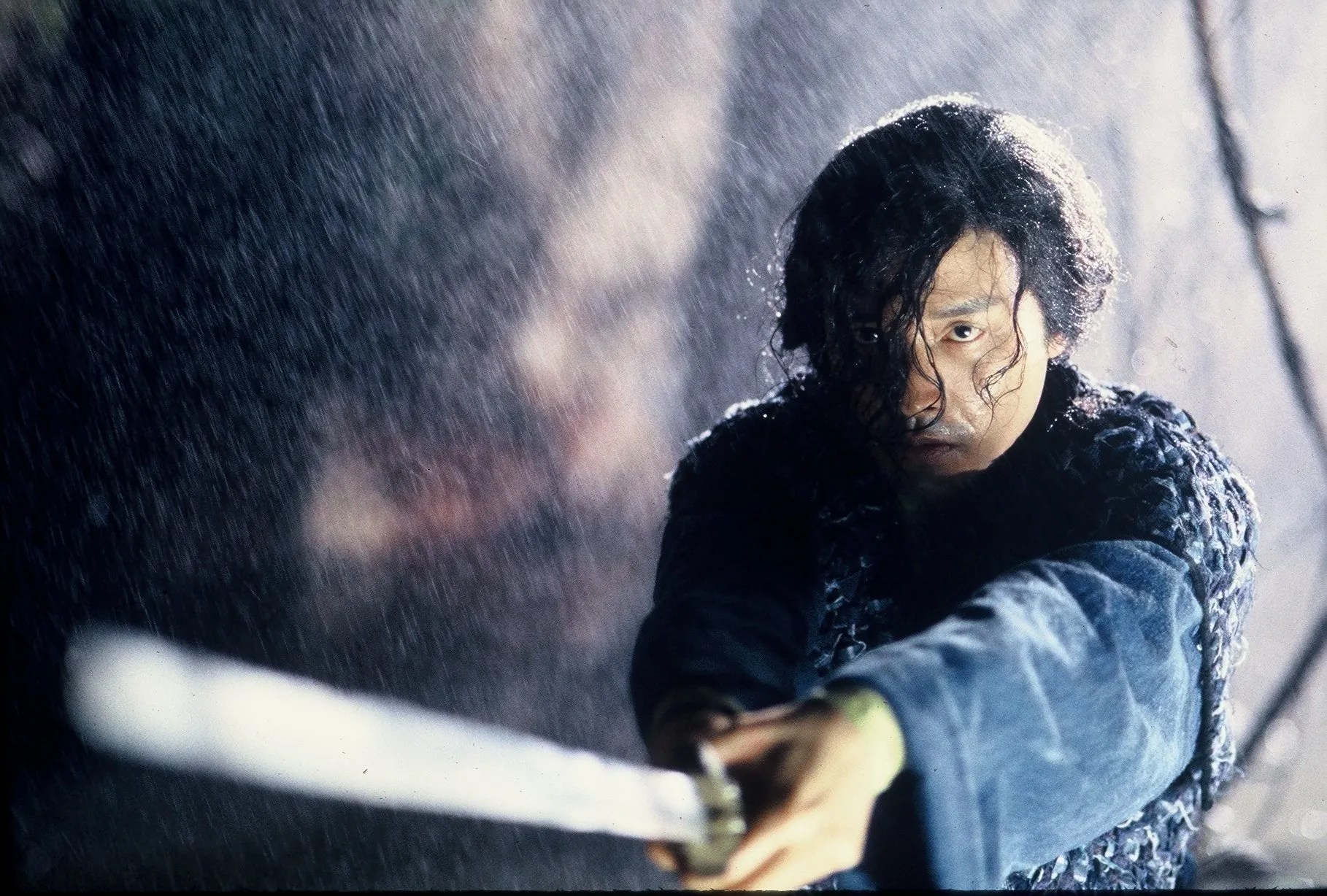
Madadayo (まあだだよ, Akira Kurosawa, 1993)

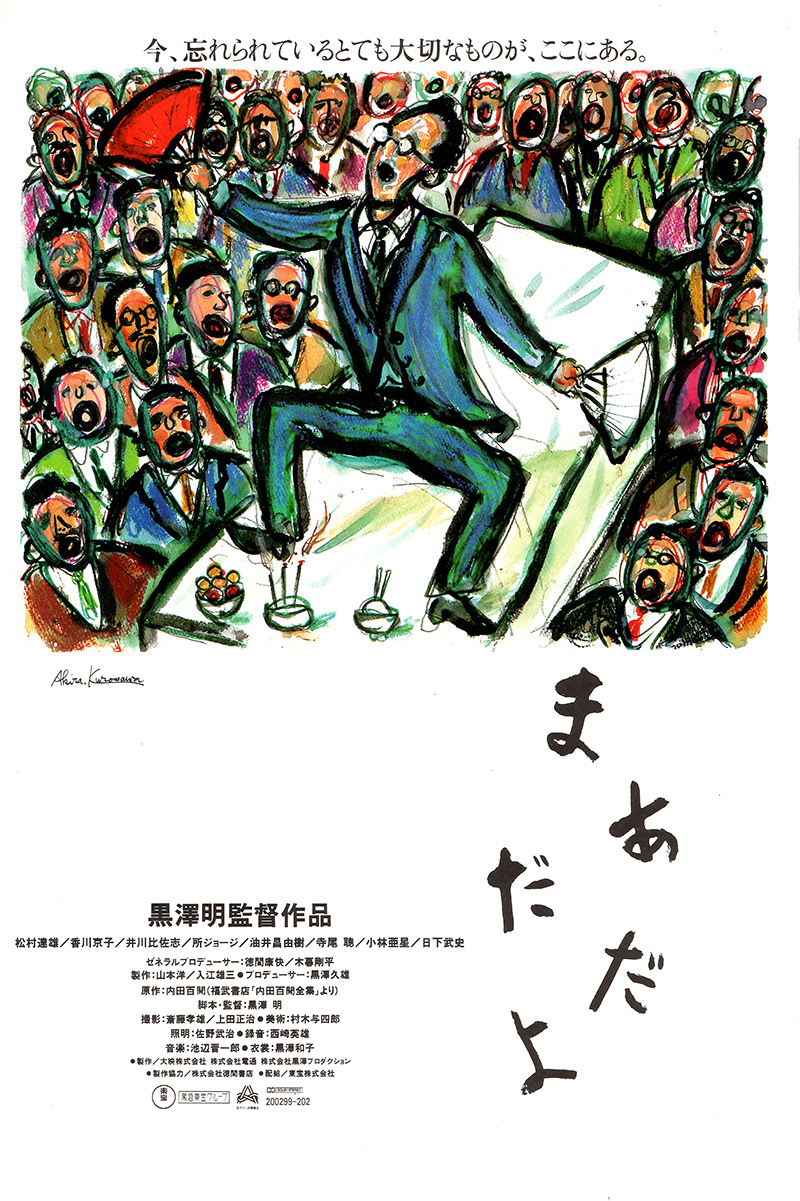
It’s tempting to read Akira Kurosawa’s final film Madadayo (まあだだよ) as a kind of valediction, though he may not have thought of it as a “final” film and if he had, it would have been ironically for film’s title means “not yet” and thematically hints at a desire on hold to a life that is admittedly fleeting. Much of the film is indeed bound up with transience and the difficulties of accepting it, but it’s also a humorous tale of a man who was “pure gold” and managed to maintain his childish heart even into his 77th year. 

Inspired by the life of the writer Hyakka Uchida (Tatsuo Matsumura), the film rather curiously opens with his retirement as he abandons his teaching position to pursue writing full-time much to the disappointment of his doting students. The relationship between Uchida and the boys he taught is at the heart of the film, for much like Mr Chips he had no children of his own and is cared for in his old age by a collection of old boys who almost venerate him as if he were something precious which cannot be allowed to slip from the world. Soon after his retirement, Uchida achieves his Kanreki, that is his 60th birthday or the completion of one cycle of the Chinese zodiac which is also the beginning of a second never to be completed round, which some consider as a second childhood or the beginning of old age.

Uchida is indeed childishly innocent and generally lighthearted forever making incredibly silly puns and approaching even potentially serious situations with good humour. When his wife remarks that the rent may be reasonable on their new home because it is unlucky and prone to being burgled, Uchida simply puts up a series of signs directing thieves to the “burglars entrance” through the “burglars corridor” to the “burglars lounge” and “burglars exit” reasoning any potential robber would find the situation so odd as to want to leave as soon as possible. The house does turn out to be unlucky in a sense as it is burned down during the fire bombing of Tokyo leaving the Uchida and his wife to move into a tiny shack on the grounds of a ruined mansion. 

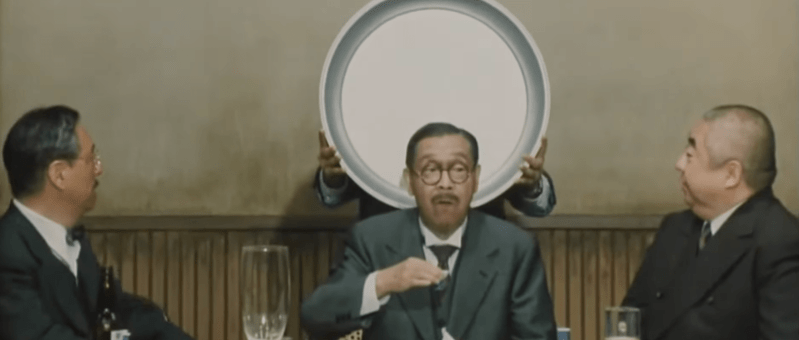
Signs of a sense of irony and an underlying darkness are, however, present in his improvised version of a march he would have taught the students during the years of militarism on which he comments on the disillusioning realities of new era of “democracy” under the Occupation ruled by bribery and corruption. The students decide to hold a birthday party for the professor they christen the “Not Yet Fest”, taking the lines from a child’s game of hide and seek to ironically ask if he’s ready to throw in the towel first, actually featuring a performance of his funeral which might seem insensitive but Uchida can be relied upon to see the funny side. During the party the former students give various speeches, one announcing he will recite the names of all the stations from one end of the country to the other, but no one really pays very much attention to them. The students even track on a large white dinner plate during a children’s song about the moon to hold behind Uchida’s head as if he were a buddha achieving enlightenment. 

Yet the crisis comes when, shortly after the students buy Uchida and his wife a new house to live in, their beloved cat Alley disappears, plunging the professor into a well of existential despair that leaves him unable to sleep or eat. The depths of his sorrow perhaps hint at his childish sincerity, though there is an undeniable poignancy in the attachment of the childless couple to this cat that chose them as its family. Despite the best efforts of the students along with the local community, Alley never returns though the professor and his wife learn to love a new cat who like Alley wandered into their garden and found a home. As in the poem that inspires Uchida in his “ascetic” life in the hut, life is an ever-flowing river. The waves of students that flowed through his classroom, the homes that were destroyed and rebuilt, the cats who stayed as long as they could and then made way for the new visitor all of them small circles of life that will continue long after he is gone. 

But as Uchida says, “Not Yet”. Like Kurosawa himself who feels the light dimming he asks for more time as if playing hide and seek with death whose presence he must eventually acknowledge even if he’s not quite ready to welcome him in. At the last Not Yet Fest that we see times have clearly changed. Uchida’s wife is now present along with the daughters and granddaughters of the students, one of whom points out they’ll soon be genuine old geezers themselves. For a moment we think we see the boy from 1943. Uchida tells the children to find their passion and give their lives to it, imparting one final not quite lesson while gifting them the cake they’ve just brought him in order of his 77th birthday. A 77th birthday is supposed to be lucky, though seven sevens are also 49 which is the length of a Buddhist mourning period and the time it takes to be reborn. The cycle begins again, as Uchida may know as he dreams of childhood hide and seek only to be distracted by a surrealist sky in its pinks and blues, a vista apparently painted by Kurosawa himself who lets the clouds roll into the credits an endless stream of dream and memory on which our lives are mere bubbles that disappear and form anew. But perhaps, not yet. 


The Last Dance (大病人, Juzo Itami, 1993)

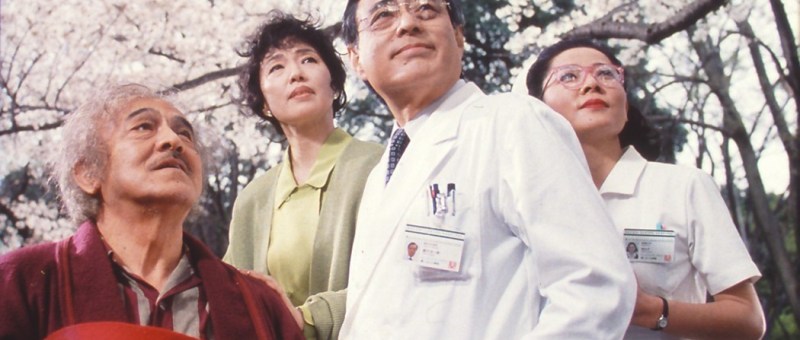
A self-involved film director gets a lesson in what it is to live when he discovers that he has terminal cancer in a lighthearted melodrama from Juzo Itami, The Last Dance (大病人, Daibyonin). Itami was apparently inspired by his own stay in hospital after being attacked by yakuza offended by his previous film Minbo and like his debut The Funeral the film has a few questions to ask about the nature of death along with the functioning of the medical system. 

That’s partly because film director Buhei Mukai (Rentaro Mikuni) is not initially told of his diagnosis. His well-meaning doctor, Ogata (Masahiko Tsugawa) a old university friend of his wife, elects to tell him only that he has a stomach ulcer in keeping with an old-fashioned policy that worries patients may lose hope and give up too easily on discovering the extent of their illness. Buhei meanwhile continues to obsess about his condition, convinced it must be cancer and that his wife, Mariko (Nobuko Miyamoto), and the medical staff are lying to him, at one point pretending to be his own uncle in order to tease the truth out of Ogata over the phone and attempting suicide when he accidentally implies that Buhei may not have long left. 

His distress is compounded by the irony that in the film he was working on when he became ill he was starring as a composer with advanced cancer whose wife has also been diagnosed with a more aggressive form of the disease. Whatever we might think about Buhei, it’s fair to say that the film’s sexual politics have not aged well. Not only was he having an affair with the actress playing his wife, but continues to flirt inappropriately with the medical staff and at one point even tries to force himself on his wife who was in the process of leaving him when he was first diagnosed. His lechery seems primed to appeal to men of a similar age while hinting at his virility and desire for life, but is nevertheless crass and often uncomfortable. Nevertheless, as Mariko says he’s like a child inside cheekily joking with the doctors about his drinking and smoking habits while running away from anything unpleasant and trying to get out of having to undergo treatment. 

Itami had often remarked on the weaknesses of Japanese men who “can’t stand loneliness, can’t make decisions alone, can’t face anyone who disagrees with them and can’t accept responsibility for their mistakes,” Buhei seemingly possessing all four. In part regretting her decision to keep the seriousness of his illness from him, Mariko reflects that in the end all they did was leave Buhei alone in his fear and anxiety as the only one who didn’t know the truth, engineering a kind of conspiracy as they cheerfully told him to “soldier on” knowing there was no hope. Yet during his time in the hospital, Buhei is also confronted by the ethical dilemmas of medical treatment on witnessing doctors desperately try to resuscitate a man who was miserable, in pain, bedridden, and unable to communicate, just waiting for the end. As even his grieving wife calls out to the doctors to let him go, Buhei wonders if it’s right to preserve life at all costs especially when the patient has not been given a choice in his treatment and may not have been informed that they have no possibility of recovery. 

Coming to a new realisation he challenges Ogata’s conviction that death is his enemy, telling him that he should see it less as defeat than acceptance reflecting on the irony that he never felt so alive as when dying. Whimsical if occasionally maudlin, Itami throws in a surrealist dream sequence in which Buhei approaches the other side and comes to realise that death might not be so frightening after all even as he watches himself from above in an out of body experience witnessing the accidental violence inflicted on his body by those trying to save it. In some senses, Buhei is fairly unredeemed, winking at his indifferent mistress even on his death bed, but is in others humbled as he looks back on his life with its regrets and unfulfilled promises, repairing his relationship with his long suffering wife while admitting that under different circumstances he and Ogata might have become good friends. Offering a sometimes critical view of medical practice and ethics, Itami’s poetic meditation on what it is to die loses none of his ironic humour even in its unfolding tragedy. 


Three Days of a Blind Girl (盲女72小時, Chan Wing-Chiu, 1993)

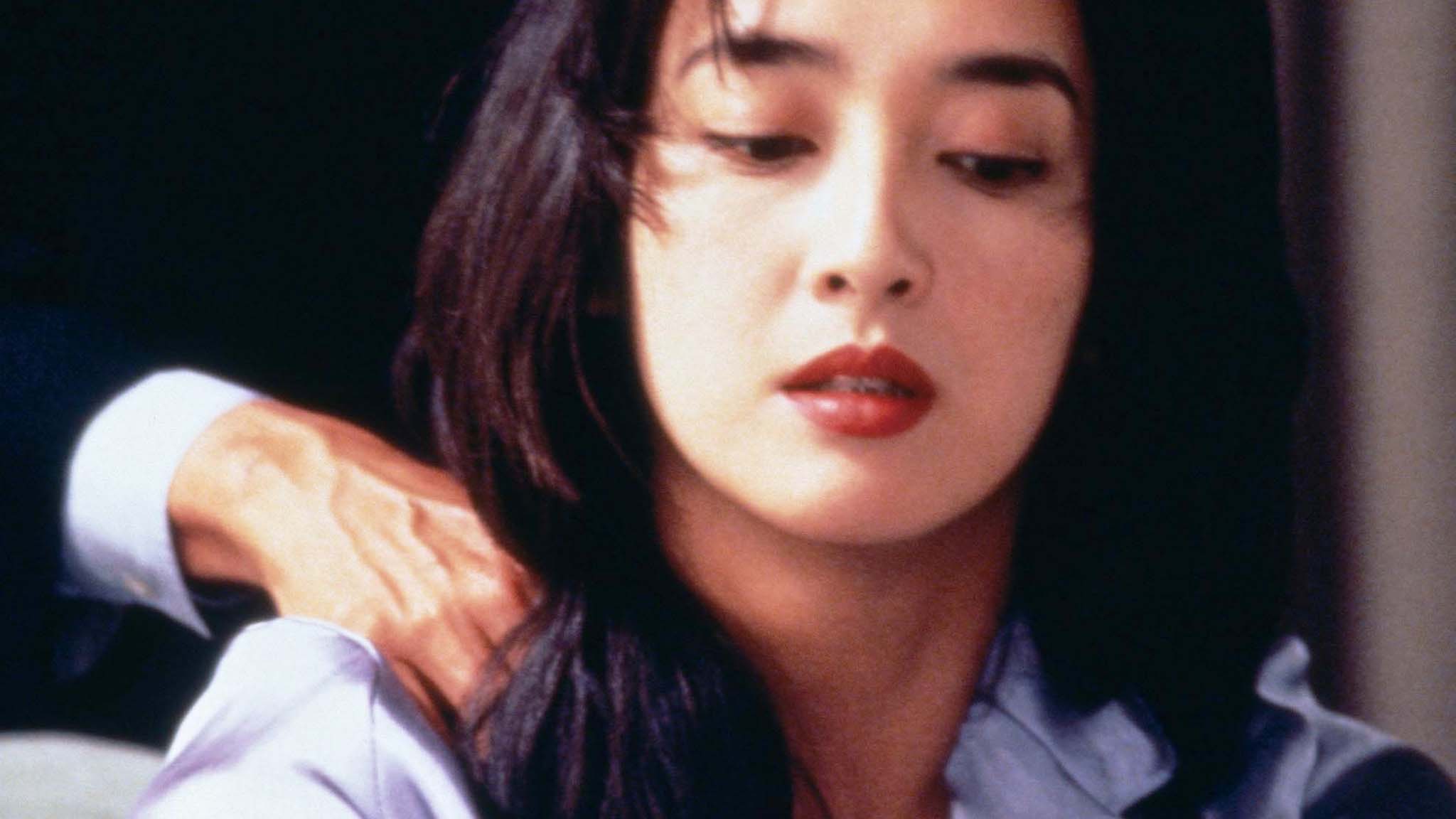
An oblivious housewife undergoes a kind of awakening while confronted with her husband’s transgressions by a vengeful intruder in Chan Wing-Chiu’s home invasion horror, Three Days of a Blind Girl (盲女72小時). Rendered temporarily sightless after an operation designed to save her sight, the implication is that the heroine, referred to only as Mrs Ng (Veronica Yip Yuk Hing), has been living in a fantasy of aspirational domestic success largely dependent on her heart surgeon husband Jack (Anthony Chan Yau) and devoid of her own identity while blind to the patriarchal forces which oppress her. 

Having returned from surgery in the US, Mrs Ng is assured her sight will gradually return in around 72 hours though until then she will be entirely blind. The doctors give her no special instructions, and she and her husband return to their country home where they are cared for by a maid, May (Chan Yuet-Yue). Somewhat insensitively, Jack has to leave for an important heart attack conference in Macao leaving Mrs Ng solely in the custody of May only May has other plans. Her policeman boyfriend has got them concert tickets while she also needs to go out to refill her asthma medication meaning that Ms Ng will be entirely alone at home while attempting to adjust to her sightless existence. 

Mrs Ng is rendered vulnerable in what should be a safe space. The sanctity of the domestic is disrupted firstly by Jack’s absence and then by an uncanny lack of familiarity introduced by her blindness. Though she has a stick, she soon finds herself bumping into things or encountering unexpected obstacles while the design of the home’s staircase appears dangerous even to the sighted and a definite health hazard to anyone else. In a moment of foreshadowing, Jack warns the maid that there’s a problem with the phone while the mobile he left is also low on battery meaning that Mrs Ng could not even call for help if she needed it. 

Unsolicited help is however something she’s offered by an unexpected visitor, Sam (Anthony Wong Chau-sang), who claims to be an old school friend of Jack’s who also treated his wife for her heart condition. Mrs Ng can’t see it, but Sam is dressed in a rather unique outfit of lederhosen and a check shirt appearing something like malicious garden gnome. In an odd moment of comedy, Sam, who soon begins stalking Mrs Ng around the house, pretends to chase off an intruder by running up and down the stairs swapping characters as he goes but otherwise skews increasingly sinister while discussing his relationship with his wife who he claims has rejected him on the grounds of the printer’s ink that stains his hands. 

Sam is Jack’s inversion, an overly solicitous husband now hellbent on avenging his masculinity by raping Mrs Ng to get back at Jack whom he blames for his wife’s death claiming he treated her heart condition with vitamins while abusing his position to take advantage of her sexually. At first, Mrs Ng doesn’t believe him and trusts her husband but her literal awakening occurs in line with the return of her sight. She begins to see the light and the reality of her life with Jack, ironically thanking him for this experience because it’s taught her how to fight back and protect herself in the face of his male failure. “Don’t think women are easily bullied” she claps back after finally taking charge of her life and knocking the forces of patriarchy firmly on the head.

Nevertheless, she begins to resist with regular household items such as using the serrated edge on a box of clingfilm to try and saw through the ropes binding her hands. Despite her blindness, she uses her knowledge of the domestic space against the intruder Sam and tries to frustrate his plans for her through strategy and forward thinking even while beginning to discern the danger which has always surrounded her as evidenced by the unexpected appearance of an entirely different assailant wandering in by chance in the temporary absence of Sam. “Never fight with women,” a much more confident, fully sighted, Mrs Ng later exclaims finally awakened to the realities of the world around her and unafraid to confront its ever present dangers now armed with the stylish briefcase of an independent woman. Surprisingly feminist in its overtones, Chan turns the home invasion thriller inside out as Mrs Ng mounts a successful jailbreak from the confines of a stereotypical housewife life.


Three Days of a Blind Girl screens at the Prince Charles Cinema, London on 19th October as part of Silk and Bullets: The Sisterhoods of Revenge where it will feature a video introduction by producer Alfred Cheung and pre-recorded Q&A with Director Chan Wing-Chiu.

Original trailer (no subtitles)

All Under the Moon (月はどっちに出ている, Yoichi Sai, 1993)

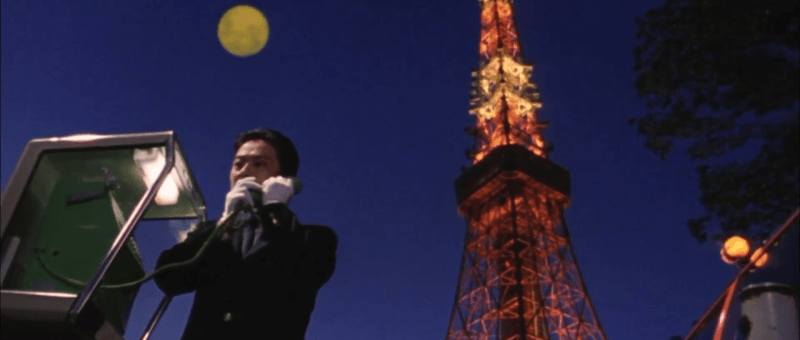
Throughout Yoichi Sai’s All Under the Moon (月はどっちに出ている, Tsuki wa Dotchi ni Dete iru), an earnest taxi driver, Anbo (Akio Kaneda), repeatedly calls in to despatch to inform them that he’s become lost and has no idea where he is despite rocking up next to such prominent landmarks as Tokyo Tower and Mount Fuji. His confusion reflects that of the changing post-Bubble society in which those like him struggle to reorient themselves and find new direction just as the nation appears slow to recognise itself and adjust to a new reality. 

It does seem that many of the drivers at Kaneda Taxi have themselves lost direction in their lives and are living very much on their margins while their rather deluded boss Sell is behaving like it’s still the Bubble dreaming of building a golf course and then a hotel to accommodate 2000 people. The Korean loan shark working with him alternately tells fellow Zainichi taxi driver Chun (Goro Kishitani) that he’s acquiring wealth to use for the reunification of Korea, and Sell that they are all children of capitalism, “Damn Reunification!”. At the wedding Chun attends, the guests take phone calls to deal with business and each remark on the precarious economic situation while one suggests that the North Korean association he represents is probably on the brink of failure joking that he fears they may sell their school and pocket the money. 

Yet despite the economic turbulence, the country has been slow to accept the presence of workers from outside Japan and many, including those at the taxi firm, still face discrimination as does Chun himself by virtue of his Korean heritage. One Japanese employee also seems to face a good deal of stigmatisation simply because he has a speech impediment, while an older mechanic with a limp insists on calling an Iranian colleague by a similar sounding Japanese name while baselessly accusing him of theft. Hoso (Yoshiki Arizono), a man with mental health issues provoked by his previous career as a professional boxer in which he accidentally killed an opponent during a bout, is fond of saying “I hate Koreans, but I like you” while otherwise fixating on Chun as a dependable big brother figure and resentful enough when he starts dating a Filipina hostess, Connie (Ruby Moreno), who works at his mother’s bar to pound down the door of her flat and demand to be let in. 

Chun himself is at least problematic and especially by the standards of today as he tries a series of crass pickup lines on Korean women at the wedding and then eventually forces a kiss on Connie not to mention physically striking her during a heated argument. He also insensitively tells her about his family’s tragic history in the war emphasising that citizens of Korea were abused for slave labour while seemingly unaware of the history of the Japanese occupation of the Philippines. Meanwhile, he also lies that his father was killed by the Japanese and that all his brothers died of malnutrition whereas they are (presumably) alive if possibly not so well in North Korea. His hard as nails mother (Moeko Ezawa) points out that she came to Japan at 10, while Connie counters that she came at 15, though their experiences have perhaps been very different leaving them somewhat at odds rather than sharing a kind of solidarity as otherwise echoed in the marginal status of each of the migrants who are similarly othered as merely not Japanese yet largely left to fend for themselves while facing possible exploitation and deportation. 

Divisions exist even within the Korean population with guests at the wedding complaining that there have been too many long and boring speeches along with North Korean propaganda songs, claiming that it is discriminatory against South Koreans and finally being allowed to sing a South Korean folksong instead which is at least a good deal more lively. The gangsters leverage the idea of reuinifaction to carry out their scams while later claiming that they have been scammed by their Japanese backer who turned out to be more racist than they had first assumed. Yet as Chun says during one of his cheesy pickup attempts, what really has reunification got to do with them, the younger post-war generation who know no other homeland than Japan? He too flounders, caught between a series of names from “Tadao Kanda” to “Chun”, to the name which appears on his taxi license “Kang” the Korean pronunciation of character read “ga” Japanese which is only otherwise used in the word for ginger as pointed out by a slightly racist fare who goes on to remark that he doesn’t see the point of the “comfort women issue”. Chun has to grin and bear it while technically powerless despite being in the driver’s seat. Predictably, the prejudiced passenger also attempted to make a run for it rather than actually pay Chun his money. “I was born after the war too” Chun reminds him, “but we say after the liberation.”

Sai introduces us to the world of Kanda Taxis through a roving long shot around the carpark travelling from one employee to another before drifting up to management on the second floor. He returns to a similar scene near the film’s conclusion as the remaining workers playfully hose each other with water while literally watching their world burn. Yet for some at least it may be liberating experience, Chun finally gaining the courage to choose his own destination and go after something that he wants, even if it he does it in a characteristically problematic way, seemingly no longer worrying about where it might be taking him but content to simply drive in the direction of the moon. 


Original trailer (no subtitles)

The Bride with White Hair (白髮魔女傳, Ronny Yu, 1993)

“This is the so-called underworld rule. You have no choice.” the hero of Ronny Yu’s gothic fairytale The Bride White Hair (白髮魔女傳) is told, only to reflect “Yes, I do.” though the world will eventually prove him wrong. Tinged with handover anxiety, the film finds its star-crossed lovers longing to exercise their choice of exile, to be allowed to live quietly outside of the political turbulence that surrounds them. But in the end their love is not strong enough to overcome their difference and doubt becomes the ultimate act of emotional betrayal. 

This is a tale that signals its tragedy from its inception. The Ching emperor is deathly ill and only a flower growing on a distant mountain that blossoms only once every 20 years can save him. “This flower is not for you” the emissaries are told by man who appears to be frozen in more ways than one, relating that he has waited 10 years for a woman who may have forgotten him. As a young man, Yi-hang (Leslie Cheung) was the roguish heir to the Wu Tang clan whose recklessness sometimes caused him to behave in unorthodox ways in the name of justice. The eight clans of Chung Yuan are beset on both sides, caught between the conflict of Ching and Ming while fearful of an “Evil Cult” that otherwise destabilises their icy grip over the local area. 

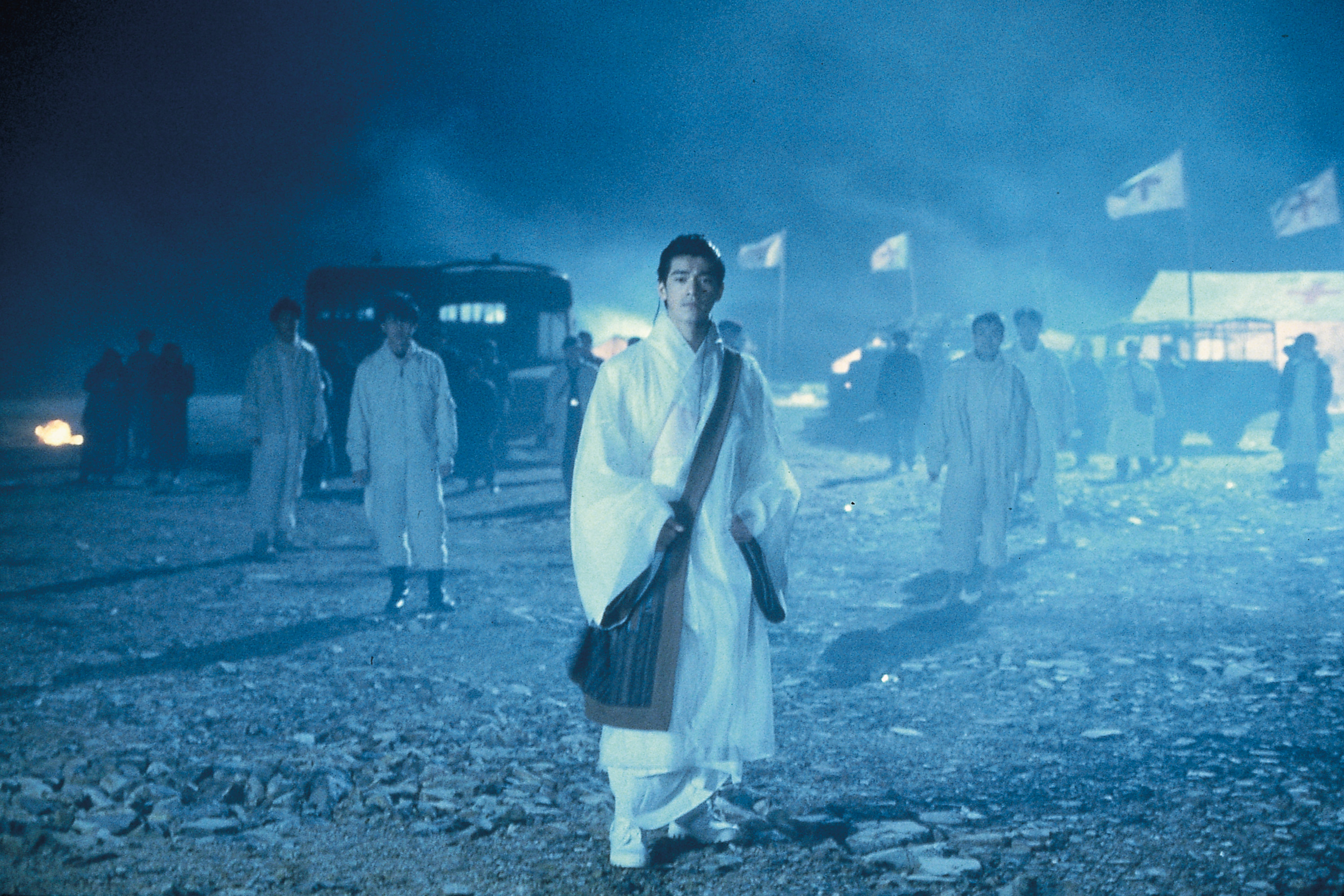
It’s becoming clear to Yi-hang that he may not be on the right side. The people are oppressed and starving but their attempt to procure a little sustenance for themselves leads to a bloody raid with clan soldiers cutting down peasants until a mysterious woman in white (Brigitte Lin) arrives wielding a whip that can cut people in half. Interrupted by a tragic scene while napping in the forest, Yi-hang is immediately smitten with the female assassin whom he later realises is the same girl he saw as a child who saved him from wolves with the song of her flute. 

The woman is an orphan taken in by the cult and trained up as an assassin. She has only a surname, Lien, and is then symbolically “reborn” when Yi-hang gives her her name, Ni-chang. Having fallen in love, the pair vow to leave the underworld together and live in the pastoral paradise of the watering hole where they first made love. “This underworld doesn’t belong to us, let them fight for it” Yi-hang insists, attempting to exercise his choice to escape a system he sees as corrupt before it strains his integrity but as he’ll discover he’s not as much choice as he thought. 

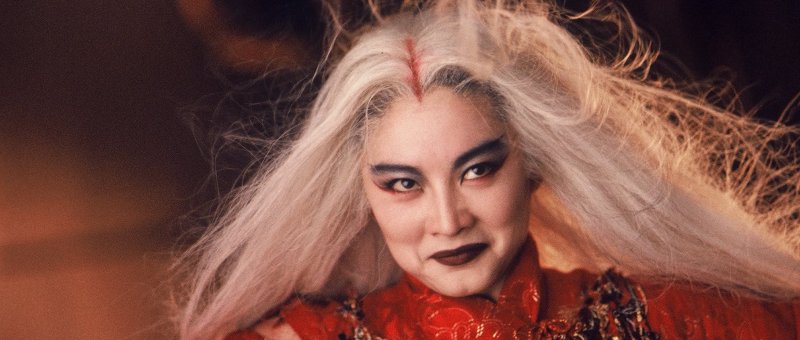
In the shadow of the Handover, it might be tempting to read Lien and Yi-hang as ordinary people who just want to live quietly and resent the intrusion of politics into their lives, though they remain caught between two opposing powers with no neutral space for them to occupy. The same could be said of the cult’s leaders, a pair of crazed conjoined twins, one male one female, who are fused at the back in a potent symbol of duality. The twins were once members of the Wu Tang clan but were betrayed and exiled, driven mad by their banishment. At the film’s conclusion, Yi-hang symbolically frees the twins by splitting them apart but their separation leads only to their deaths. In the end, Yi-hang betrays his love because the underworld does not permit it to exist. He doubts Lien’s word and his rejection of her sparks her metamorphosis into the title’s Bride with White Hair, a vengeful spirit of hurt and rage now condemned to eternal wandering just as Yi-hang is condemned to life a waiting only to watch a flower wither and die knowing that he has damned himself. 

Yu’s world of melancholy romanticism is typical of that of early ‘90s wuxia though carries a touch of the gothic not least in the Bride’s cobweb-like hair which eventually becomes her finest weapon. The pervading sense of longing seems to hint at a future act of imperfect union, tinged with volatile ambivalence but perhaps finally suggesting that this romance is doomed to failure because the corruption of the world into which Yi-hang, the authority, was born is simply too great to be conquered by the innocence of his love. 


The Bride with White Hair screens screens at UltraStar Cinemas Mission Valley April 23 as part of this year’s San Diego Asian Film Festival Spring Showcase.

Trailer (English subtitles)

Executioners (現代豪俠傳, Johnnie To & Tony Ching Siu-Tung, 1993)

At the end of The Heroic Trio, the shadowy rise of authoritarianism seemed to have been beaten back. The three superwomen at the film’s centre had discovered joy and liberation in female solidarity and were committed to fighting injustice in a flawed but improving world. If Heroic Trio had been a defiant reaction to Handover anxiety, then sequel Executioners (現代豪俠傳) is its flip side shifting from the retro 40s Hong Kong as Gotham aesthetic to a post-apocalyptic nightmare world where nuclear disaster has normalised corporate fascist rule. 

As Ching (Michelle Yeoh) explains in her opening voiceover, a nuclear attack has ruined the city contaminating its water and leaving ordinary citizens dependent on the Clear Water Corporation for safe drinking supplies and basic sanitation. The trio have been scattered, pushed back into the roles from which they escaped at the first film’s conclusion save perhaps for Ching who continues to serve a duplicitous authority but does so with clearer eyes and a humanitarian spirit driving a medicine truck to ensure those in need have access to healthcare. Chat (Maggie Cheung Man-Yuk) meanwhile has reverted to her cynical bandit lifestyle, hijacking water trucks mostly for her own gain but also ensuring the water gets to the needy. Tung (Anita Mui Yim-Fong) has abandoned her Wonder Woman persona on the insistence of her husband who is now a high ranking policeman with the military authority devoting herself to the role of the traditional housewife and mother to her daughter Cindy. 

Though the women seem to have maintained their bond, Ching and Chat turning up for a Christmas celebration with Cindy, the political realities soon disrupt their friendship as they find themselves at odds with each other given their shifting allegiances. As in the first film, Chat has continued to accept work from dubious authority in the form of the Colonel including tracking down a man who embarrassed the police by firing a gun at a rally for a cult-like protest leader, Chung Hon (Takeshi Kaneshiro), only the gunman later turns out to be a patsy and Chat has unwittingly helped them bump off the voice of the people as an overture for a military coup. Ching is secretly working for responsible government trying to safeguard the President to prevent his assassination by the Colonel, but obviously cannot say very much about her mission arousing Tung’s suspicions that she may have been part of a plot to have her husband killed. 

In any case, the true villain turns out to be a kind of Wonder Woman mirror image in that the mysterious Mr. Kim (Anthony Wong Chau-Sang), CEO of Clear Water Corporation, is a man who wears a mask to hide his scarred face and dresses like an 18th century aristocrat as if engaged in some kind of Man in the Iron Mask cosplay. Kim and the Colonel have been collaborating to engineer a military coup by deliberately restricting water supplies. The oblivious Chung Hon had unwittingly been Kim’s stooge, stoking up public resentment about the water situation to give the government an excuse for a crackdown and the Colonel to move. Chat’s path to redemption amounts to vindicating the faint hope that the water contamination was a hoax, which she eventually does by taking Cindy with her to smash the corporate dam and return the water to its rightful flow and the people of the city. But like the Evil Master, Kim does not die so easily turning up for a surprisingly hands on fight squaring off against the barely unified trio who are only just beginning to repair their friendships on coming to a fuller understanding of the reality of their circumstances. 

They are all in a sense liberated, though less joyfully than in the first film and largely through violent loss. The good guys don’t always win and a fair few die while all the women can do is keep moving, fighting off one threat after another with few guarantees of success and not even each other to rely on. Where the first film had embraced a hopeful sense of comic camp, Executioners skews towards the nihilistic in its dystopian world of corporate overreach and increasing militarism in which the trio no longer trust each other and are each re-imprisoned inside their original cages from patriarchal social norms to capitalistic inhumanity and questionable loyalties with the only hopeful resolution resting on “the sincerity of our friendship” in a world which may be healing but is far from happy. 


Executioners screened as part of this year’s San Diego Asian Film Festival.