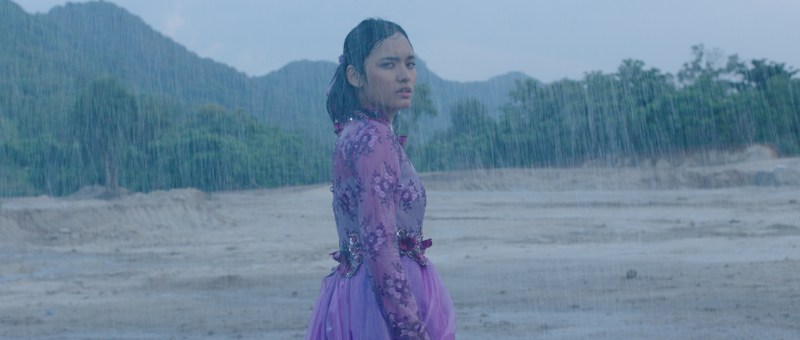
Yuni (Kamila Andini, 2021)

“Marriage is a blessing”, according to a wise old grandma, “we shouldn’t refuse a blessing, no?” expressing a commonly held belief in the traditional small town where the titular Yuni (Arawinda Kirana) resides in Kamila Andini’s melancholy social drama. Yuni meanwhile isn’t so sure, if marriage is a blessing then why does it feel like a trap and how can you call something a blessing if as it seems to have been for some of her friends it only results in violence and misery? 

At 17 Yuni is a talented student, her progressive female teacher urging her to consider going to college while offering various pamphlets about applying for scholarships which Yuni feels might make it easier for her parents to accept. Yet in addition to the academic criteria, the rules are clear that married women are not eligible which is a problem because Yuni has just received her first marriage proposal from a man recently relocated to the village who is handsome enough and thought a catch because he has a good job in a local factory. 

While everything in Yuni screams no, she finds it difficult to articulate her resistance constantly second guessing herself wondering if she’s doing the right thing or if as some of the other girls suggest she is lucky to have received such a generous offer and ought to accept it. Her obsession with the colour purple, the colour both of a wedding dress and according to another girl widow’s weeds, which causes her to steal any purple item she sees is an expression of her alienation yearning for colour and vibrancy in a culture which seems to deny her both. Dressing in purple under her green school uniform, she rejects the idea of marriage and wants to continue her education, spending time with an older woman who takes her to clubs to dance enjoying the illicit freedom of a modern society which has otherwise been kept from her. 

Even at school, her freedom begins to shrink. The Islamic Club seems to dominate everything, planning to introduce virginity tests for the female students to prevent the inconvenience and shame of teenage pregnancy though it does not seem as if the boys are given the same talk. The girls are all convinced that one of their classmates is pregnant because she wears a baggy jacket and has become withdrawn, but later wonder if she may have been raped no one seemingly very interested in helping her. Later after embarking on an escapist romance with diffident and sensitive classmate Yoga (Kevin Ardillova), Yuni is also asked if was raped when confessing that she is no longer a virgin in order to escape a second marriage proposal to become the second wife of a wealthy old man who not so subtly tries to buy her from her grandmother while implying that she might be considered damaged goods as a woman who’s already rejected a suitor. 

Yuni is warned that turning down a second proposal is bad luck and struggles with herself in her decision, her internal confusion ironically interfering with her studying making it harder for her to escape through education. Meanwhile she hears of a woman who married young but experienced domestic violence after her husband blamed her for a series of miscarriages only to be disowned by her family following a divorce they again telling her she ought to have counted herself lucky that her husband still put up with her despite her “condition”. Another friend’s husband has abandoned her with a young son and she isn’t sure if she should divorce him and look for someone else, while one of Yuni’s classmates ends up having to marry a teenage boyfriend when a gang of blackmailers threatens to ruin their reputations after discovering them taking photos at a well known hookup spot. 

With most of the other women largely complicit, Yuni feels she has no one to talk to or turn to for advice eventually pouring her heart out to the sensitive Yoga who offers to run away with her knowing that nothing will change as long as she stays in the conservative environment of their hometown. Even the teacher whom she’d once admired, Mr. Damar (Dimas Aditya), proves no ally attempting to use her to escape his own sense of impossibility after she catches him trying on women’s clothes at a local department store. Mr. Damar’s own desperation causes him to act in the most insidious of ways, in effect barring Yuni’s path out of her repressive life in inappropriately wielding his power as a teacher against her. Having lost all confidence, Yuni no longer knows what she wants out of life and is growing weary of fighting the same battles in attempting to struggle free of the constraints of traditional patriarchy but is left with little choice once all her dreams are shattered. A tragedy of modern day Indonesia, Yuni sees its heroine’s spirit gradually crushed by the world in which she lives in which she has only the choice of lonely exile or resigned misery. 


Yuni screened as part of this year’s Glasgow Film Festival and is available to stream in the UK until 8th March.

International trailer (English subtitles)

Gundala (Joko Anwar, 2019)

“If we see injustice before our eyes and do nothing then we’re no longer humans” the idealistic father of a future superhero instructs his young son, trying to impart a sense of humanitarianism as a basic moral good. It’s a lesson the boy will find himself unlearning and resuming later, his innocence well and truly destroyed by an often cruel and cynical society only to be reawakened to the idea that it doesn’t need to stay that way. Among the most recognisable names of Indonesian cinema, Joko Anwar turns his hand to the creation of a local comic book cinematic universe, adapting the 1969 comic Gundala by Harya “Hasmi” Suraminata for the present day filtering contemporary Jakarta through classic Gotham. 

Operating as an origin story for the titular hero, Gundala opens with the young hero Sancaka (Muzakki Ramdhan) unable to prevent his father’s (Rio Dewanto) death due to his fear of electrical storms when he is first set up by a duplicitous factory boss and then assassinated while leading a protest for fair pay and conditions. Soon after, Sancaka loses his mother (Marissa Anita) too after she is forced to go to the city for work and never returns. Ending up a ragged street kid, he’s saved from an attack by a rival gang by an older boy (Faris Fadjar Munggaran) who teaches him how to protect himself physically and mentally by convincing him that the only way to survive on the street is keep his head down and walk on by even if it looks like others are in trouble. 20 years later the adult Sancaka (Abimana Aryasatya) is an aloof young man working as a security guard at a print house where his sympathetic mentor Agung (Pritt Timothy) begins to remind him of his father in his conviction that “living is no use if you stop caring and only think about yourself”, while he also finds himself defending the woman next-door, Wulan (Tara Basro), and her young brother Teddy (Bimasena Prisai Susilo), from hired thugs sent to intimidate them because of their involvement in a protest against the forced redevelopment of a local marketplace.  

Events seem echo around him. The major villain Pengkor (Bront Palarae) is also an orphan but on the opposing side as the son of a cruel plantation owner murdered by his not altogether ideologically pure workers whose desire for fair pay and conditions he had resolutely ignored. According to cynical politician Ridwan (Lukman Sardi), Pengkor became a union organiser of his own, leading an uprising at the abusive orphanage he was placed into by a cruel uncle hoping he’d die and free up the inheritance, thereafter becoming a kind of godfather to the fatherless with a thousands strong army of eternally grateful orphans he saved acting as sleeper agents for a coming revolution. 

Pengkor’s nefarious plan involves fostering a conspiracy surrounding contaminated rice said to make the unborn children of the women who eat it turn out “immoral”, a generation of psychopaths unable to tell right from wrong. Fairly unscientific, it has to be said, but playing directly into the central questions of the nature of “morality” in a “immoral” society. Can it really be “moral” for bosses to exploit their workers and get away with it, for politicians to cosy up to gangsters and remain complicit with corruption, and for a man like Pengkor to be the only hope for orphaned street kids otherwise abandoned and ignored by a wilfully indifferent society? Pengkor decries that hope is the opiate of the masses, but that’s exactly what Gundala eventually becomes for them in his “electric” ability to resist, eventually rediscovering his humanity as he designates himself as the embodiment of “the people” pushing back against the forces of oppression and seeming at least to win if only momentarily.  

Young Sancaka’s fear of lightning is, in essence, a fear of his power and his social responsibility something he is quite literally shocked into accepting. In a world of quite striking social inequality, he finds himself the lone defender of the oppressed whose very existence spurs others, including previously cynical politician Ridwan, into rediscovering their own humanity in the resurgent hope of a better future. As someone puts it, peace never lasts long but you keep fighting for it because every moment is precious. Not so much a battle of good versus evil as a battle for the meaning of good, Anwar’s Gundala recalibrates the anxieties of the late ‘60s for the modern era and creates an everyman hero not only to resist them but to foster a spirit of resistance and humanity in the face of heartless cynicism. 


Gundala streams in Poland until 6th December as part of the 14th Five Flavours Film Festival.

Original trailer (English subtitles)

Satan’s Slaves (Pengabdi Setan, Joko Anwar, 2017)

Satan's Slaves posterBad things happen in houses where they don’t pray. So says a kindly Imam in Joko Anwar’s chilling horror remake Satan’s Slaves (Pengabdi Setan). Taking inspiration from a 1982 classic, Anwar updates the tale of supernatural dread and familial breakdown for the new century while maintaining the early ‘80s setting and pushing back still further into the superstitious, gothic past. The family, threatened by financial, social, and spiritual pressures is stretched to breaking point by supernatural unease. Advised that the cure for their ills is religion, they begin to conform but, unlike the original, godliness cannot save them from a greater evil and if the family chooses to save itself, it will be through acts of selfless love rather than brutal adherence to a set of outdated social codes.

As the film begins, eldest daughter Rini (Tara Basro) – a 22-year-old former college student, has given up her studies and become the defacto maternal figure to her small family while her mother, Mawarni (Ayu Laksmi ), remains bedridden after a long illness. Mawarni was once a famous singer and the family’s breadwinner, but having been out of the spotlight so long her music has begun to go out of fashion. Royalties have dried up and there is little prospect of any further income. Lacking the funds to pay for ongoing hospital care, the family have brought Mawarni home to care for her themselves though the father (Bront Palarae), worrying about feeding his children, secretly urges his wife to be on her way to a better place, as a disturbed Rini hears him say from outside the door. Soon enough, Mawarni is gone, but not forgotten. Strange noises fill the old mansion as Mawarni’s bell continues to tinkle in the night, her records play without warning, and radios reset themselves to play her song. When dad leaves the siblings – 16-year-old Tony (Endy Arfian), 10-year-old Bondi (Nasar Annus), and 7-year-old Ian (M. Adhiyat) who is deaf and mute, in Rini’s care to head into the city in search of money, the kids are left to deal with the legacy of his moral cowardice all alone.

Adopting the trappings of the classic European gothic chiller, Satan’s Slaves sets itself in an old fashioned villa located in a forest some distance outside of the city. If the house were not creepy enough on its own, it is also conveniently located next to the local graveyard where Mawarni has now been laid to rest (in theory, at least). Moving in “next door”, a kindly Imam and his spiritually open minded son Hendra (Dimas Aditya) promise to provide pastoral care to the bereaved children but find themselves engulfed by the house’s increasing power to isolate and terrorise.

Tipped off by Hendra, Rini discovers a dark and disturbing secret regarding her mother’s former life and her own origins. Devolving into a vast conspiracy involving satanic fertility cults and their apparently omnipresent spy networks, Satan’s Slaves revels in its oppressive atmosphere of supernatural dread and human impotence as the children find themselves surrounded on all sides by faceless, umbrella wielding zombies lying in wait to tear their home apart.

Rini is told, by an old friend (Egy Fedly) of their grandmother’s (Elly D. Luthan), that the fertility cult requires child sacrifice but that the cult cannot take the child unless the family gives it up. She is being asked, quite literally, to put her life (and those of her siblings) on the line in order to save “the family”, yet “the family” or more particularly hers already has its problematic elements. Rini’s grandmother, recently deceased in mysterious circumstances, was not originally accepting of her daughter-in-law because of a class difference and also because of her occupation as an “entertainer” which was not considered respectable at the time. She only warmed to Mawarni once the children were born which was already some years into the marriage as Mawarni, finding it difficult to conceive, became desperate for a child and for her mother-in-law’s acceptance.

Rather than the lack of spiritual rigour which the Imam blames for the increasing demonic presence, it is these social taboos which seem to have opened the door to evil. The kids try the religious solution, but unsurprisingly it doesn’t help them. Literally haunted by their late mother who feels herself “abandoned” by her family, her loving husband hastening her death now that she is no longer economically useful and has become an unbearable burden, the only way to defeat this curse is to reverse it through unconditional familial love and solidarity even given what Rini now knows about her history. Oppressive in atmosphere yet filled with an eerie beauty as shadowy figures slowly colonise the misty Indonesian forest, Satan’s Slaves challenges the idea of “the family” in the face of strict patriarchal social codes and finds that in order to survive it must salvage itself through acts of defiance and self identification.


Screened at the 20th Udine Far East Film Festival.

Original trailer (English subtitles)

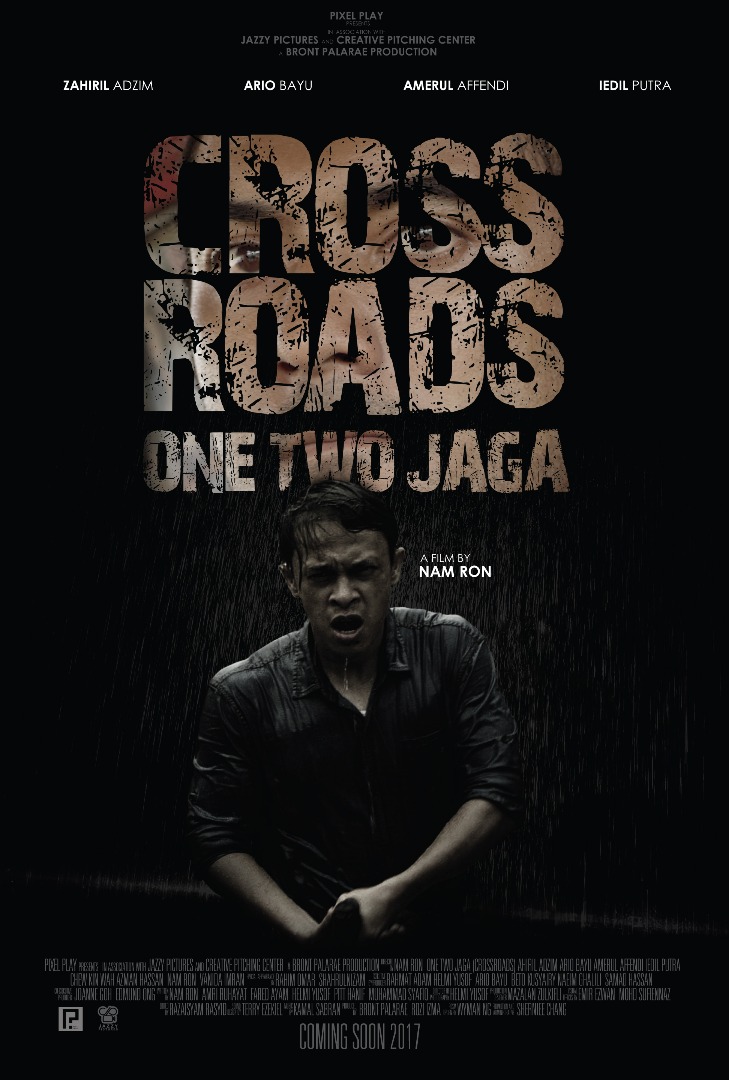
Crossroads: One Two Jaga (十字路口, Nam Ron, 2018)

crossroads one two jaga posterThe world is increasingly interconnected but far from greater freedom and increased possibilities, exploitation is often all that awaits those seeking opportunities overseas. Crossroads: One Two Jaga (十字路口) places the undocumented migrant worker at its centre and uncovers a deeply entrenched system of corruption and hypocrisy in which the line between the forces of order and chaos is so thin as to be barely discernible. The migrant worker is exploited twice over – once by the employers and again by the police who blackmail and extort, pulling in anyone who seems “suspicious” whenever they find themselves short of a few pennies. With no recourse to the “law” and no route “home”, there is little hope for a brighter future for any but those who seek to profit from other people’s misery.

Beginning at the end, we open on the bruised face of a young man who has prominent stitches on his cheek. Something tells us he is a police officer, but he is in questioning over the death of a young boy, killed by a bullet from his weapon. The officer looks stunned and claims to know nothing. As it turns out he may be telling the truth, but he alone is responsible for a child’s death, on the one hand, and exposing a corrupt police chief, on the other.

Flashing back, Joko (Izuan Fitri) – the son of Indonesian migrant worker Iman (Ario Bayu), wants to go for a ride with Adi (Amerul Affendi) – the adult son of Mr. Sarip (Azman Hassan) who runs a small construction firm (among other enterprises). Iman doesn’t really want his son to go, but he ignores him and goes anyway. Iman has another problem on his hands – his sister, Sumiyati (Asmara Abigail), who has left the family she was working for as a maid and wants to go home to Indonesia. Mr. Sarip says he can help with that (for a price) but Sumiyati is stopped by Hassan (Rosdeen Suboh) and his rookie partner Hussein (Zahiril Adzim). Hassan really just wants a bribe because his wife really needs money to avoid family embarrassment, but things goes south when Iman ropes in Adi to try and help him out only to escalate the situation into a declaration of war on the “rogue” policemen.

Undocumented workers exist in a kind of grey area which makes it possible for the unscrupulous to misuse them for their own ends. Sumiyati, like many young women, has gone abroad to work as a maid but found herself kept a virtual prisoner by her employer who holds her passport as a guarantee. With job parameters unclear, she finds herself not only maid but cook, babysitter, and office assistant and all for almost no pay. Fed up she upped and left, but lost her passport in the process leaving her with no legal way back to Indonesia which is where she’s decided she’d rather go. The only way “home” is through the back door channels operated by men like Mr. Sarip who have fingers in many pies and friends in all the right places.

Ordinarily speaking, a righteous rookie cop would be our hero, but we already know Hussein is our villain. Though he wants to enforce the letter of the law and resents the casual corruption of other officers, it’s his hotheadedness and refusal to play the long game which eventually cause so much trouble. Accidentally or otherwise, he does manage to unmask the kingpin responsible for holding together a system of corruption running from the top of the force down, collaborating with the criminals and turning a blind eye to real “crime”, but it comes at a heavy price and one to which Hussein seems worryingly indifferent.

Stylishly shot, Crossroads weaves a complex picture of interconnected exploitations in which the innocent are made to pay the price for the world in which they live. Realist in essence but expressionist in intent, gritty images of children disposing of bodies mingle with a father’s nightmare as blood colours the rain soaked ground and a young woman disappears in its miasmic haze. Malaysia maybe the crossroads of Asia, but it also finds itself at something of a junction unsure in which direction to turn, unwilling to confront the darkness that lies at the heart of the modern society.   


Screened at the 20th Udine Far East Film Festival.

Official trailer (English subtitles)