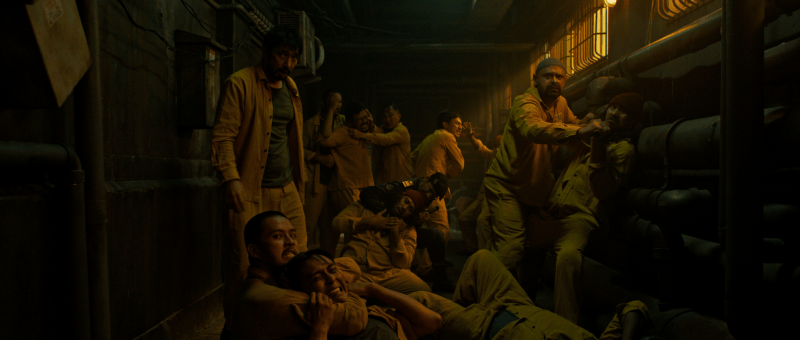

Ghost in the Cell (Joko Anwar, 2026)

“This is Indonesia, not Norway,” the protagonists of Joko Anwar’s horror comedy Ghost in the Cell keep reminding each other as a means of explaining their dismal circumstances. The prison they’re confined within isn’t so different from the wider society, and even while inside they’re subject to the same hypocrisies, hierarchies, injustices and inequalities as they were outside. Ghosts, however, cannot be bound by prison walls and will seek bloody vengeance down to the last angry man.

Indeed, one of the ghost’s characteristics is that it seems to feed on negative energy, targeting the angriest man it can find to sustain itself. It generally manifests as a kind of doppelgänger in which the victim is essentially confronted by themselves, their own rage and frustration turned back on them. To that extent, the message seems to be that in the end your anger will consume you if you don’t do something to mitigate it, forcing the men to take advantage of the tools they’ve been given to calm themselves such as prayer and dancing. Every so often during a fight, one of the men will call out that their friend’s aura is turning red which places them at risk of being targeted by the ghost, so they should immediately bust out some dance moves to improve their mood.

But at the same time, their anger can be a powerful weapon if turned in the right direction as de facto leader of the prisoners Anggoro (Abimana Aryasatya) later says. Many of them are in here because of some kind political manipulation. He was cheated out of his house by land sharks who wanted to build a luxury resort, so he tried to rob them but got caught and ended up in prison. One of the other men is a university professor who tried to expose corruption in his institution but was framed for theft and incarcerated. “It’s easier to survive in this country if people think you’re dumb,” he later reflects on reassuming his intellectual persona during the mini revolution provoked by the arrival of the ghost.

Dimas (Endy Arfian) ought to understand this better than anyone after being framed for the brutal murder and dismemberment of his boss. He’d just finished an article on the illegal clearing of a protected forest to build a nickel mine with investment from people in the government. His editor did not, however, want the hassle of publishing it especially as the paper is on its last legs. He objects to Dimas’ focus on the series of mysterious deaths that have taken place there, something he describes as better suited to a trashy clickbait outlet whereas their last remaining readership has stuck around for their rigorous reporting. The implication being that rigorous reporting is not sustainable in Indonesia, though another prisoner suggests that Indonesians care more about celebrities than their own lives and journalists have simply followed the money to give them what they want with a constant flow of salacious stories to distract them from the bigger issues such as the inherent corruption in their society.

This corruption exists within the prison too as one wing is dedicated to hosting corrupt politicians who live in luxurious cells with fridges and air conditioning. They can even leave whenever they want and treat prison like some kind of retreat where they can deflect press interest while basically carrying on doing the same things while inside. The irony is that both the prison warden and the corrupt politician behind the nickel mine were both once former activists who wanted Indonesia to be a better place. The warden joined a political party because he thought he could change it from inside before coming to the conclusion that nothing was going to change, and if you can’t beat them, join them. “In Indonesia it’s the survival of the fittest,” he explains, “they call it corruption, I call it reward for the smarts.”

In a way, perhaps that’s the real ghost in the cell, the imprisoned spectre of their youthful idealism. “We just need to save ourselves,” the warden tells his underling, an argument immediately countered by Anggoro who points out that they could all continue to prioritise their own survival, but the ghost will come for them in the end unless they work together to try to stop it. The message seems to be that they could save Indonesia too, if only they stopped allowing themselves to be distracted and remained united. Reminiscent of Silence of the Lambs, the ghost likes to create gruesome and ironic tableaux of its victims while itself perhaps distracted, sating its lust for vengeance while searching for the real source of injustice, but only finally finding it when the people work together for a common cause.


Ghost in the Cell is on digital platforms 26 October 2026 from Blue Finch Film Releasing.

Trailer

Satan’s Slaves (Pengabdi Setan, Joko Anwar, 2017)

Satan's Slaves posterBad things happen in houses where they don’t pray. So says a kindly Imam in Joko Anwar’s chilling horror remake Satan’s Slaves (Pengabdi Setan). Taking inspiration from a 1982 classic, Anwar updates the tale of supernatural dread and familial breakdown for the new century while maintaining the early ‘80s setting and pushing back still further into the superstitious, gothic past. The family, threatened by financial, social, and spiritual pressures is stretched to breaking point by supernatural unease. Advised that the cure for their ills is religion, they begin to conform but, unlike the original, godliness cannot save them from a greater evil and if the family chooses to save itself, it will be through acts of selfless love rather than brutal adherence to a set of outdated social codes.

As the film begins, eldest daughter Rini (Tara Basro) – a 22-year-old former college student, has given up her studies and become the defacto maternal figure to her small family while her mother, Mawarni (Ayu Laksmi ), remains bedridden after a long illness. Mawarni was once a famous singer and the family’s breadwinner, but having been out of the spotlight so long her music has begun to go out of fashion. Royalties have dried up and there is little prospect of any further income. Lacking the funds to pay for ongoing hospital care, the family have brought Mawarni home to care for her themselves though the father (Bront Palarae), worrying about feeding his children, secretly urges his wife to be on her way to a better place, as a disturbed Rini hears him say from outside the door. Soon enough, Mawarni is gone, but not forgotten. Strange noises fill the old mansion as Mawarni’s bell continues to tinkle in the night, her records play without warning, and radios reset themselves to play her song. When dad leaves the siblings – 16-year-old Tony (Endy Arfian), 10-year-old Bondi (Nasar Annus), and 7-year-old Ian (M. Adhiyat) who is deaf and mute, in Rini’s care to head into the city in search of money, the kids are left to deal with the legacy of his moral cowardice all alone.

Adopting the trappings of the classic European gothic chiller, Satan’s Slaves sets itself in an old fashioned villa located in a forest some distance outside of the city. If the house were not creepy enough on its own, it is also conveniently located next to the local graveyard where Mawarni has now been laid to rest (in theory, at least). Moving in “next door”, a kindly Imam and his spiritually open minded son Hendra (Dimas Aditya) promise to provide pastoral care to the bereaved children but find themselves engulfed by the house’s increasing power to isolate and terrorise.

Tipped off by Hendra, Rini discovers a dark and disturbing secret regarding her mother’s former life and her own origins. Devolving into a vast conspiracy involving satanic fertility cults and their apparently omnipresent spy networks, Satan’s Slaves revels in its oppressive atmosphere of supernatural dread and human impotence as the children find themselves surrounded on all sides by faceless, umbrella wielding zombies lying in wait to tear their home apart.

Rini is told, by an old friend (Egy Fedly) of their grandmother’s (Elly D. Luthan), that the fertility cult requires child sacrifice but that the cult cannot take the child unless the family gives it up. She is being asked, quite literally, to put her life (and those of her siblings) on the line in order to save “the family”, yet “the family” or more particularly hers already has its problematic elements. Rini’s grandmother, recently deceased in mysterious circumstances, was not originally accepting of her daughter-in-law because of a class difference and also because of her occupation as an “entertainer” which was not considered respectable at the time. She only warmed to Mawarni once the children were born which was already some years into the marriage as Mawarni, finding it difficult to conceive, became desperate for a child and for her mother-in-law’s acceptance.

Rather than the lack of spiritual rigour which the Imam blames for the increasing demonic presence, it is these social taboos which seem to have opened the door to evil. The kids try the religious solution, but unsurprisingly it doesn’t help them. Literally haunted by their late mother who feels herself “abandoned” by her family, her loving husband hastening her death now that she is no longer economically useful and has become an unbearable burden, the only way to defeat this curse is to reverse it through unconditional familial love and solidarity even given what Rini now knows about her history. Oppressive in atmosphere yet filled with an eerie beauty as shadowy figures slowly colonise the misty Indonesian forest, Satan’s Slaves challenges the idea of “the family” in the face of strict patriarchal social codes and finds that in order to survive it must salvage itself through acts of defiance and self identification.


Screened at the 20th Udine Far East Film Festival.

Original trailer (English subtitles)