
Lumberjack the Monster (怪物の木こり, Takashi Miike, 2023)

Could being a psychopath actually be better? It might be an attractive thought for some, the absolute freedom of living without emotional or moral constraint. Emotion is after all a difficult thing to bear, though life without it might also be lonely and unfulfilling leaving a void often filled by other desires such as a lust for wealth, status, power, or proof of superiority. Based on a novel by Mayusuke Kurai, Takashi Miike’s Lumberjack the Monster (怪物の木こり, Kaibutsu no Mikori) finds its hero at a point of existential crisis no longer certain of his true nature or identity.

The film takes its title from a fairytale featured in a picture book being read by a small boy who has been abducted and illegally experimented on. A monster begins living as a lumberjack in a small town where he begins killing and eating the residents, only no one notices. Eventually it realises that he spends more time being the lumberjack than the monster and is confused about his identity. With no friends left to talk to (because it ate them all), the monster decides to move to another town to make more friends but ends up sneaking into the house of a lumberjack, stealing a baby, and fashioning after itself to create another monstrous lumberjack.

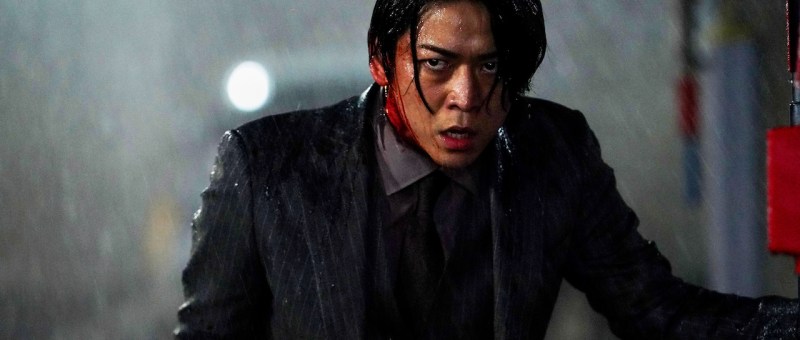
This is in a sense what’s happened to Akira (Kazuya Kamenashi), now a lawyer who discovers he has a “neuro-chip” in his brain that suppresses his emotions after he’s attacked by a masked figure and it breaks re-introducing him to an unwelcome humanity. This is quite inconvenient for him in that he’s done quite a lot to feel guilty about, firstly participating in a scheme with his “friend” Sugitani (Shota Sometani), a natural-born psychopaths, to facilitate his experimentation on live humans, and secondly that he murdered his boss who is also his fiancée’s father to take over his law firm. Though the fiancée, Emi (Riho Yoshioka), seems to be afraid of him, it’s also true that simple proximity to her warmth and kindness may have begun to reopen his heart.

Of course, it could be true that the mad scientists who abducted the children accidentally picked up a few who were already psychopaths but in this case it seems like the chip did its job on each of the victims of the axe-wielding assassin. Meanwhile, we also see “psychopathic” traits in lead investigator Toshiro (Nanao) who admits that she will do whatever it takes to get to the truth even if it includes throwing out the police rulebook. Akira asks her if her desire to solve the case isn’t also a roundabout means of vengeance for the death of her brother, leaving her not so different from the assassin who is also extracting vicarious revenge on man-made psychopaths, but she replies that that’s exactly how a psychopath might see it while also deflecting a similar question from embittered cop Inui (Kiyohiko Shibukawa) who remarks that if the killer’s only taking out psychopaths then why bother stop them?

In some ways, Akira is like the lumberjack. He was simply being what he was and knew no different, but gradually beginning to rediscover his humanity is burdened with guilt and remorse now acutely aware not just of the feelings of others rather than their consequences but of his own feelings too. The couple who abducted the children claimed they were doing it to save their son, trying to reverse engineer psychopathy so they could cure him though their actions were themselves psychopathic and like the lumberjack they created only more monstrous children like themselves. Akira has it seems rediscovered the person he may have been if he had been raised in the loving family from which he was abducted and is determined to search for the meaning of life, but he is also responsible for the decisions he made as a man who knew no guilt or remorse and may in fact have to pay for the moral transgressions he was not fully aware he was making. Miike conjures a sense of the gothic in the creepy, candlelit mansion where the children were kept and otherwise sticks to standard procedural for the “real” world, but finally lands back in the realms of fairytale as his hero finds himself part of neither one world nor another while faced with a choice that may earn him redemption but also loneliness and futility.


Trailer (English subtitles)

Spring In Between (はざまに生きる、春, Rika Katsu, 2023)

A struggling editor at a magazine gains a new perspective while falling in love with an autistic artist in Rika Katsu’s romantic drama Spring In Between (はざまに生きる、春, Hazama ni ikiru, haru). Spring is coming in the lives of artist and reporter alike, yet as Haru’s (Sakurako Konishi) professional life begins to come into focus she finds herself romantically confused and ever more obsessed with the mysterious painter while largely unable to ascertain what the extent of his feelings for her may be assuming that he has any at all. 

Haru’s obsession begins when she becomes immersed in one of Tohru’s (Hio Miyazawa) paintings which like much of his work depicts a vast blue sea. Three years on the job, she’s still making rookie mistakes and is constantly berated by her boss who offers little in the way guidance. Nevertheless, she catches a break when he brings her on to assist with an interview of a top artist who is known to be “eccentric”. Never having much exposure to neurodiversity, Haru finds herself captivated but also somehow on the same wavelength while drawn to what she sees as Tohru’s profundity and poeticism. 

The film does at times fall into the trap of fetishising Tohru’s “unique” way of seeing of the world while otherwise keen to lay bare the extent to which neurodiversity continues to be stigmatised. Haru’s partner on the magazine article repeatedly describes Tohru as “odd” in a slightly mocking way, while the journalists assigned to interview him have little patience and do not even bother to hide their exasperation when he flies off on tangents about plastic bottles or tree bark. The magazine is interested in him precisely because of his neurodiversity and learning disability hoping to sell an inspirational story of someone overcoming the odds to find success but in private continue to laugh at him.

Even Haru struggles to comprehend some of the unhelpful information she looks up while researching Asperger’s Syndrome which talks of an inability to empathise leaving her wondering if Tohru has the capacity for romance despite his directly telling her that he has fallen in love before because he is after all human though he never said anything because he did not want to get hurt. A more experienced colleague noticing Haru’s increasingly erratic behaviour tries to give her some advice, but it isn’t to the effect that it might be unethical and irresponsible to fall in love with your subject for a piece but only that she’ll wind up getting hurt because Tohru is autistic and therefore unable to return her feelings, implying that in any case she views a relationship between them as as inappropriate given what she sees as Tohru’s disability. 

In revealing Haru’s own potentially autistic traits, such as her preference to have someone stand on her left and never her right, the film strays into a potentially uncomfortable implication that everyone is a little bit autistic while otherwise trying to eliminate the line has that been placed between Tohru and everyone else. Introducing a romantic rival in the form of an equally eccentric, larger than life photographer who also does not fit into “conventional” society, also implies that neurodiverse people can only date each other while Haru struggles to define her feelings both for Tohru and for uni boyfriend Nao who appears to be both possessive and disinterested telling her that she should get over her left side only thing in the same way some talk about a “cure” for Tohru’s neurodiversity. 

Haru can’t state her feelings any more directly than Tohru can while simultaneously unable to find a way through to him to find out if he likes her at all or is just being friendly and considerate, unlike Nao making a map to figure out the acceptable dimensions of her personal space and promising to always stay at a comfortable angle. Yet in the end it’s curiosity that builds connection, the simple desire to know more about another person and to see the world from another perspective. Promises are kept, and a message delivered if in a roundabout way. As they say, spring will always get there in the end even if summer is right around the corner. A sweet and innocent romance, Spring in Between is as much about self-revelation as it is about mutual understanding and the still currents of a deep blue sea.


Spring in Between screened as part of this year’s Nippon Connection

Original trailer (no subtitles)

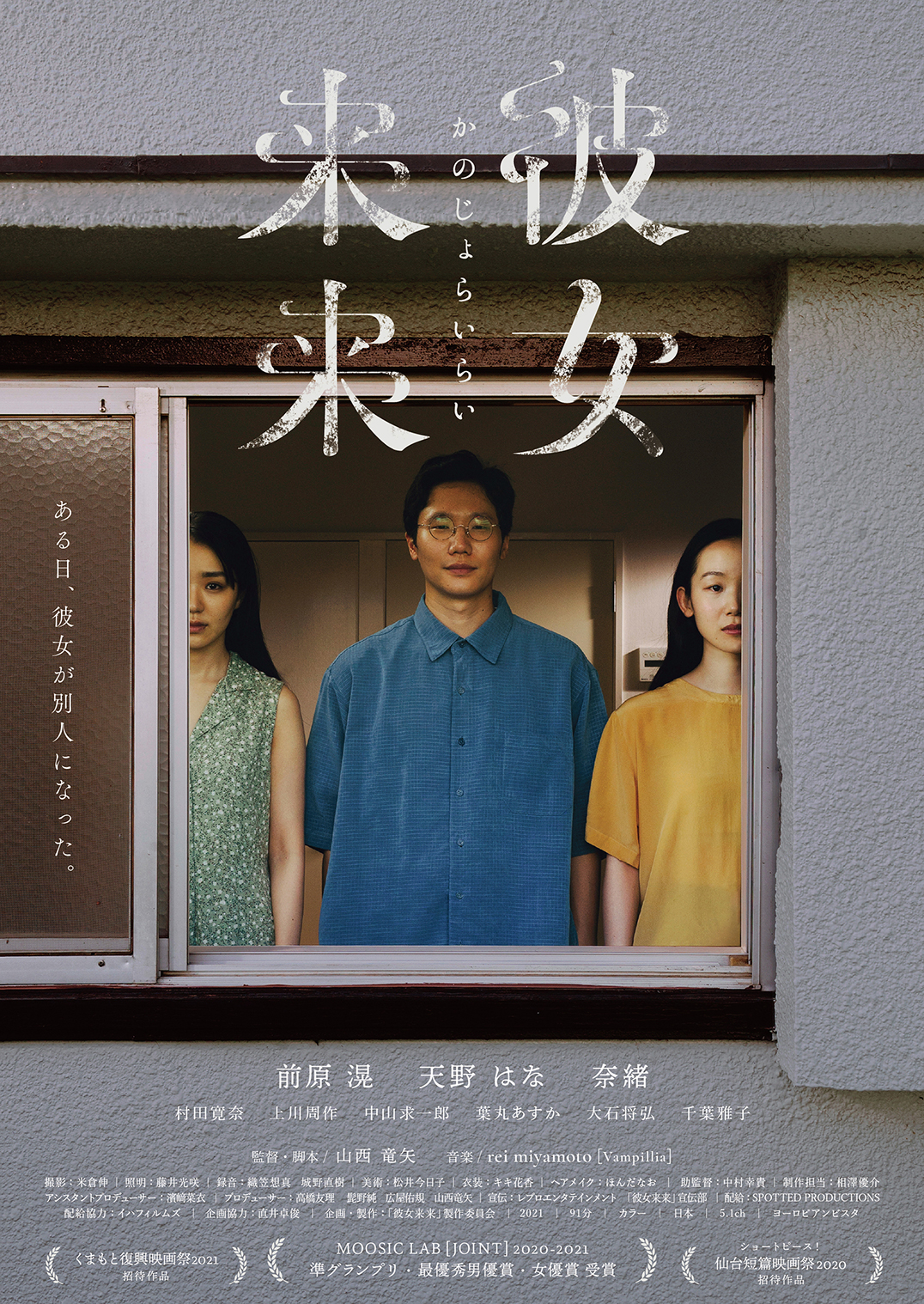
Mari and Mari (彼女来来, Tatsuya Yamanishi, 2021)

How well do you really know your significant other, and is it possible that even you can be lulled into a false sense of security by the performative qualities of your relationship? The befuddled hero of Tatsuya Yamanishi’s Mari and Mari (彼女来来, Kanojo Rairai) is forced to reckon with the superficialities of his romantic life when he arrives home one day to discover that his girlfriend is nowhere to be found and in her place is another woman with the same name who seems intent on occupying the space she has just vacated. 

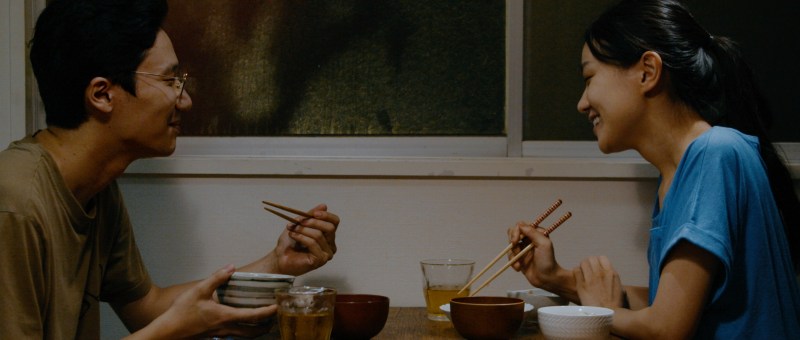
Casting agent Norio (Kou Maehara) is in a longterm, actually rather nauseating in its sweetness, romantic relationship with girlfriend Mari (Nao). Despite being a well established, not yet married but might as well be cohabiting couple, they have their own little song they like to sing about how great their lives are with each other while taking romantic walking dates along the river where they look lovingly into each other’s eyes. “You’ve been together for ages, but you act like it’s a first date” one of Norio’s colleagues unironically remarks, seemingly a little envious. After moaning about a workplace setback, Norio suggests taking a trip while Mari points out that he’s always too busy for holidays but seems pleased just with the thought. 

For all these reasons, Norio is especially confused when he arrives home after a tough day and finds Mari gone, understandably mistaking the figure of a woman sleeping on their sofa for his girlfriend only to realise his error when she gets up and turns around, the low evening light finally hitting her face. The woman, who is apparently also named “Mari” (Hana Amano) claims to have no memory of her life before waking up on the sofa, and declaring herself homeless announces that she’s moving in. Extremely confused, Norio embarks on a quest to try and out what’s happened to Mari but discovers few leads. Even her sister seems relatively unconcerned, certain that she’s just blowing off steam bringing up a childhood incident in which she “ran away” to stay with a friend whose family ran a sweetshop because she had a sweet tooth and they weren’t allowed sweets at home. 

This relatively innocent story perhaps highlights the possibility of cracks in Norio’s “perfect” relationship, that “Mari 1” might have been feeling the lack of something and has gone off to find it. Though we’re told that Norio and Mari had been happily coupled for some years, a surprise visit from Norio’s parents reveals they’d never met his longterm girlfriend which does indeed seem odd if the relationship is as serious and loved up as it seemed to be. The plot thickens further when he visits the bookstore where Mari was working and is told she quit her job a few days previously having said nothing to him. You have to wonder if Mari 2 is actually real or a merely a manifestation of his inability to accept the fact that his relationship has failed and his girlfriend has moved on. 

Could Norio be guilty of treating his romantic life like one of his auditions, simply slotting in a woman who looks the part to play the role of “girlfriend”? Maybe Mari 1 was so wrapped up in her relationship that she didn’t have any friends, but Norio doesn’t contact any outside of her sister and appears not to know very much about her interior life. He also appears oblivious to a sweet intern at the office, his work life beginning to suffer while he remains preoccupied with Mari 1’s disappearance, who seems to have a crush on him until becoming unexpectedly jealous on spotting her in a clinch with another coworker in the darkened break room. Missing Mari 1 he repeatedly rebuffs Mari 2, attempting to throw her out of his apartment and rejecting each of her attempts to get close to him but eventually warms to her presence and finally allows her to take Mari 1’s place as his live-in girlfriend. 

Are Mari 1 and Mari 2 interchangeable to him? His brief comment that Mari 1 looked like another person under different light hints at a slight fluidity in the nature of her identity, as does the repeated motif of the sunlight climbing towards her face in their darkened bedroom. Then again, could the memory of Mari 1 merely be the intrusive ghost of failed love that disrupts his subsequent relationships, suggesting that his relationship with Mari 2 is doomed to failure because of his obsession with the one who literally got away. Or are Mari 1 & Mari 2 actually the same and a reflection of the way people can sometimes change or you learn something new about them and they seem like a completely different person? Perhaps “Mari” is just a signifier for romantic partner, otherwise devoid of an individual identity. What seems clear at least is that Norio does not “see” the woman in his life because he only sees “Mari”, as the slightly melancholy, intensely lonely look on the face of the woman next to him at the film’s conclusion may seem to suggest. 


Mari and Mari streams in the US until Sept. 2 as part of this year’s Japan Cuts.

International trailer (English subtitles)