
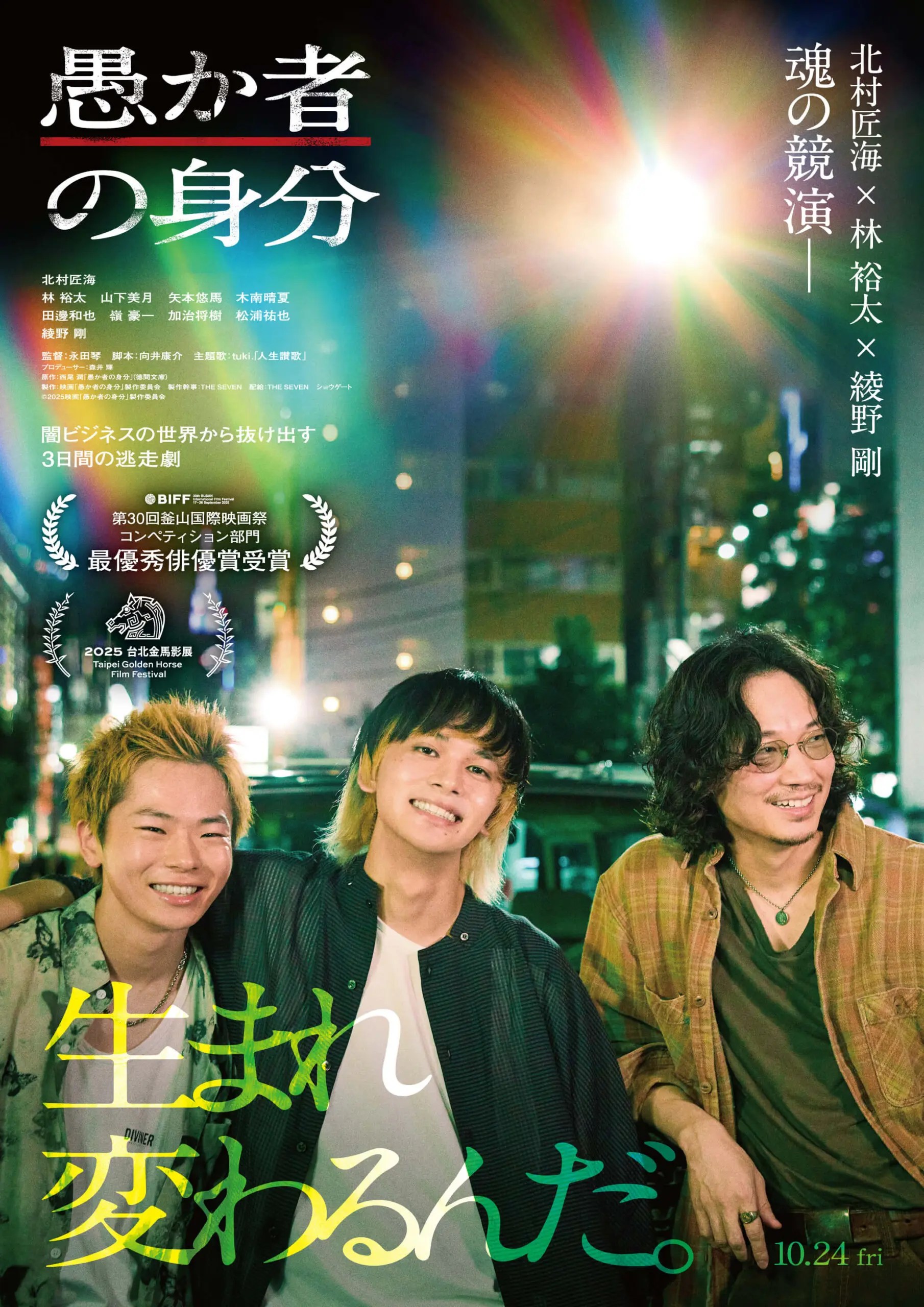
What does a name really mean? Can you really start over just by swapping your current identity for a new one, and what would that actually mean for the rest of your new life? Two young men who’ve been failed by adults and authority figures become involved with yahoo boy-style cyber crime, only in this case the aim of their romance fraud is to trap men they already know are poor and desperate and convince them they can turn their lives around by lending their identities to “someone in trouble”.
It’ll only be for two years, they say. Just lie low, try not attract attention from the authorities. Though the targets also get a new identity in the form of a driving license with another name, they’re told not to use it for driving because the police will run checks on it if they have an accident. But the truth is that despite the widespread believe that it’s easy to disappear in Japan, it’s actually quite hard to live without a formal proof of identity through the family register system. You can’t rent an apartment or get a regular job, because on paper you don’t exist. The fake ID they’ve been given is only good enough to pass as proof of age. It’s not going to stand up if someone actually does more than glance at it.
But even if the idea of being able to wipe everything clean and start again might be attractive, the reality it not quite so easy. You can’t just wipe away your existing fears and traumas, and they’ll follow you even into your new life. Takuya (Takumi Kitamura), who’s been doing this sort of thing longer, is conflicted on realising their latest mark, Egawa (Yuma Yamoto), is a broken man who can’t get over the death of his daughter at the hands of his wife. Though Takuya, and the young woman they have assisting them with the scam, don’t want to do something like this to someone who’s already suffered so much, this world is pretty brutal and in reality they no longer have much choice.
Kisara (Mizuki Yamashita) is only involved in the scam because her mother stole her scholarship fund and she needed money for university, but she’s since dropped out and seems to be doing this kind of thing full-time. Takuya too seemingly had no parental support and sold his own identity to pay for medical treatment he hoped would save his brother, but he died anyway. That might be why he feels so protective of Mamoru (Yuta Hayashi), a young man he met in a homeless shelter run by the yakuza for the purpose of getting them to apply for benefits and then stealing them all. Mamoru was also abandoned by his mother and suffered physical abuse in his familial environment. Takuya brings Mamoru in on the scam and his life in the criminal underworld thinking it would help him, only to later feel guilty when events spiral out of control.
Takuya may look to his boss, Sato (Goichi Mine), as a kind of big brother figure, but also knows that he most likely plans to throw him under the bus while plotting to rob gangland kingpin Joji (Kazuya Tanabe) of a windfall gained through gold smuggling. Various people warn Takuya that it’s best to get out now, because if you go too deep you never will, but Takuya knows his bid for escape is likely to fail even when he turns to former mentor Kajitani who convinced him to sell his identity in the first place. The irony is that Takuya sold his name without a second thought and doesn’t really think his identity’s worth anything, which might be why he thought it was worth rolling the dice just to see if he could change his situation. The film’s Japanese title might ask us who we thought was being “fooled,” the men whom Takuya scammed who convinced to give up their identities for what seemed to them at the time a lot of money, or Takuya and Mamoru deluded both by the opportunities of a life of crime and by the allure of escape. In the all end, all any of them really have is each other and the unexpectedly genuine connections that arise between them in opposition to a society that has already discarded them and a hellish underworld in which an identity is just another commodity to be bought, sold, or sacrificed at will.
Trailer (no subtitles)








 Post-golden age, Japanese cinema has arguably had a preoccupation with the angry young man. From the ever present tension of the seishun eiga to the frustrations of ‘70s art films and the punk nihilism of the 1980s which only seemed to deepen after the bubble burst, the young men of Japanese cinema have most often gone to war with themselves in violent intensity, prepared to burn the world which they feel holds no place for them. Tetsuya Mariko’s Destruction Babies (ディストラクション・ベイビーズ) is a fine addition to this tradition but also an urgent one. Stepping somehow beyond nihilism, Mariko’s vision of his country’s future is a bleak one in which young, fatherless men inherit the traditions of their ancestors all the while desperately trying to destroy them. Devoid of hope, of purpose, and of human connection the youth of the day get their kicks vicariously, so busy sharing their experiences online that reality has become an obsolete concept and the physical sensation of violence the only remaining truth.
