
Vengeance Is Mine, All Others Pay Cash (Seperti Dendam, Rindu Harus Dibayar Tuntas, Edwin, 2021)

The innocent love of a pair of traumatised youngsters is crushed by the society in which they live in Edwin’s ‘80s-set pulp adventure, Vengeance is Mine, All Others Pay Cash (Seperti Dendam, Rindu Harus Dibayar Tuntas). An absurdist parable about the corrosive effects of toxic masculinity and its links to oppressive authoritarianism, Edwin’s outlandish drama sees a young man contend with literal and societal impotence through the medium of violence while falling in love with a woman equally in desire of revenge against her misuses at the hands of a misogynistic society. 

Rendered sexually impotent after childhood trauma, 20-something Ajo (Marthino Lio) gets his release through violence well known for always being up for a fight whether there’s money involved or not. Yet as we see he seems to enjoy being on the receiving end, almost giggling when he’s set upon by a small mob in a bar. During the course of one particular job with a social justice angle roughing up an overreaching local businessman who apparently pressed a man into debt in order to extract the payment from his wife, Ajo ends up running into Iteung (Ladya Cheryl), his target’s bodyguard and a lover of violence like himself. The pair fall in love, but Ajo is afraid to pursue a relationship because of his impotence eventually provoked into a rain-soaked confession only to realise that just like everyone else in town Iteung already knows and doesn’t care. She marries him anyway but is continually stalked by a resentful ex, Budi (Reza Rahadian), while Ajo is preoccupied with a job he unwisely took on to knock off a gangster rival of former general Uncle Gembul (Piet Pagau).

The pair are in a sense pursued by their pasts each of which stems back to an instance of sexual abuse, the young Ajo forced to participate in a rape after being kidnapped by a pair of corrupt soldiers and thereafter rendered impotent. In an ironic touch, the assault takes place on the day of an eclipse which president Suharto had issued advice not to look at owing to the possibility of damaging one’s sight though in essence Ajo gets in trouble for looking directly at something he should not have seen and is rendered impotent by corrupt state power. Years later, Iteung decides she wants revenge, that if she could track down and enact justice on these two former soldiers she might be able to lift Ajo’s curse and ironically enough restore his manhood so that they might have a full marriage. 

She meanwhile is also carrying her own trauma having been subject to male sexualised violence from a young age. Given Ajo’s condition, the pair consummate their relationship through pugilism, a fight scene standing in for sex but the disruptive presence of the brooding Budi continues to linger on the horizon Iteung coming to regret a bargain she made with him in the hope of tracking down the soldiers. Having quelled his lust for violence, discovering that Iteung has betrayed him sends Ajo into a murderous rage finally completing the job he had been afraid of doing in fear that it would pollute his otherwise blissful relationship with his new wife. In an ironic touch, Budi’s big business plan is selling a snake oil male virility tonic, his insecure yet superficially powerful vision of masculinity held up as an ideal while Ajo once again attempts to validate his manhood through violence. After a period of wandering and an encounter with a mysterious figure he begins to rediscover a sense of security in masculinity that is not linked with sexuality realising that all he wants is to be with Iteung and he no longer cares whether or not his impotence is ever cured. 

A retro homage to the action exploitation movies of the 1980s, Edwin’s absurdist world building is a direct attack on a macho culture that manifests itself in oppressive authoritarianism along with the concurrent misogyny that leaves women vulnerable to male violence. At heart a romance in which love ultimately triumphs over the corrosive effects of toxic masculinity and entrenched patriarchy, Edwin’s absurdist tale later takes a turn for the metaphysical in the form of the arrival of a ghostly avenger come to enact justice on those who presumed themselves above the law but nevertheless ends on a note of cosmic irony in which the wages of vengeance must indeed be paid in full.


Vengeance Is Mine, All Others Pay Cash screens in New York March 19 with lead actress Ladya Cheryl appearing in person as part of Museum of the Moving Image’s First Look 2022. Due to popular demand, a second screening without guest appearance has now been added on March 26.

International trailer (English subtitles)
Yuni (Kamila Andini, 2021)

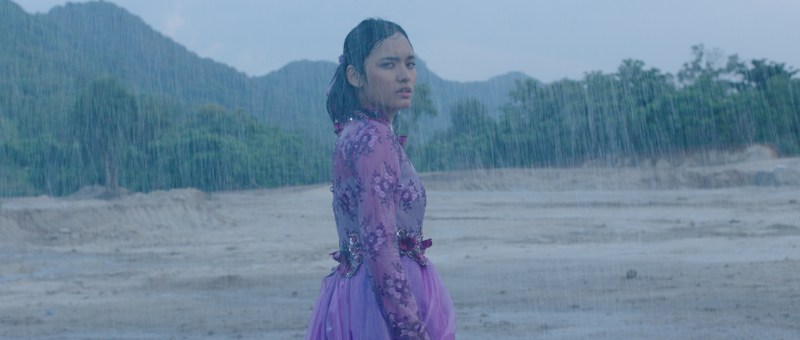
“Marriage is a blessing”, according to a wise old grandma, “we shouldn’t refuse a blessing, no?” expressing a commonly held belief in the traditional small town where the titular Yuni (Arawinda Kirana) resides in Kamila Andini’s melancholy social drama. Yuni meanwhile isn’t so sure, if marriage is a blessing then why does it feel like a trap and how can you call something a blessing if as it seems to have been for some of her friends it only results in violence and misery? 

At 17 Yuni is a talented student, her progressive female teacher urging her to consider going to college while offering various pamphlets about applying for scholarships which Yuni feels might make it easier for her parents to accept. Yet in addition to the academic criteria, the rules are clear that married women are not eligible which is a problem because Yuni has just received her first marriage proposal from a man recently relocated to the village who is handsome enough and thought a catch because he has a good job in a local factory. 

While everything in Yuni screams no, she finds it difficult to articulate her resistance constantly second guessing herself wondering if she’s doing the right thing or if as some of the other girls suggest she is lucky to have received such a generous offer and ought to accept it. Her obsession with the colour purple, the colour both of a wedding dress and according to another girl widow’s weeds, which causes her to steal any purple item she sees is an expression of her alienation yearning for colour and vibrancy in a culture which seems to deny her both. Dressing in purple under her green school uniform, she rejects the idea of marriage and wants to continue her education, spending time with an older woman who takes her to clubs to dance enjoying the illicit freedom of a modern society which has otherwise been kept from her. 

Even at school, her freedom begins to shrink. The Islamic Club seems to dominate everything, planning to introduce virginity tests for the female students to prevent the inconvenience and shame of teenage pregnancy though it does not seem as if the boys are given the same talk. The girls are all convinced that one of their classmates is pregnant because she wears a baggy jacket and has become withdrawn, but later wonder if she may have been raped no one seemingly very interested in helping her. Later after embarking on an escapist romance with diffident and sensitive classmate Yoga (Kevin Ardillova), Yuni is also asked if was raped when confessing that she is no longer a virgin in order to escape a second marriage proposal to become the second wife of a wealthy old man who not so subtly tries to buy her from her grandmother while implying that she might be considered damaged goods as a woman who’s already rejected a suitor. 

Yuni is warned that turning down a second proposal is bad luck and struggles with herself in her decision, her internal confusion ironically interfering with her studying making it harder for her to escape through education. Meanwhile she hears of a woman who married young but experienced domestic violence after her husband blamed her for a series of miscarriages only to be disowned by her family following a divorce they again telling her she ought to have counted herself lucky that her husband still put up with her despite her “condition”. Another friend’s husband has abandoned her with a young son and she isn’t sure if she should divorce him and look for someone else, while one of Yuni’s classmates ends up having to marry a teenage boyfriend when a gang of blackmailers threatens to ruin their reputations after discovering them taking photos at a well known hookup spot. 

With most of the other women largely complicit, Yuni feels she has no one to talk to or turn to for advice eventually pouring her heart out to the sensitive Yoga who offers to run away with her knowing that nothing will change as long as she stays in the conservative environment of their hometown. Even the teacher whom she’d once admired, Mr. Damar (Dimas Aditya), proves no ally attempting to use her to escape his own sense of impossibility after she catches him trying on women’s clothes at a local department store. Mr. Damar’s own desperation causes him to act in the most insidious of ways, in effect barring Yuni’s path out of her repressive life in inappropriately wielding his power as a teacher against her. Having lost all confidence, Yuni no longer knows what she wants out of life and is growing weary of fighting the same battles in attempting to struggle free of the constraints of traditional patriarchy but is left with little choice once all her dreams are shattered. A tragedy of modern day Indonesia, Yuni sees its heroine’s spirit gradually crushed by the world in which she lives in which she has only the choice of lonely exile or resigned misery. 


Yuni screened as part of this year’s Glasgow Film Festival and is available to stream in the UK until 8th March.

International trailer (English subtitles)

Satan’s Slaves (Pengabdi Setan, Joko Anwar, 2017)

Satan's Slaves posterBad things happen in houses where they don’t pray. So says a kindly Imam in Joko Anwar’s chilling horror remake Satan’s Slaves (Pengabdi Setan). Taking inspiration from a 1982 classic, Anwar updates the tale of supernatural dread and familial breakdown for the new century while maintaining the early ‘80s setting and pushing back still further into the superstitious, gothic past. The family, threatened by financial, social, and spiritual pressures is stretched to breaking point by supernatural unease. Advised that the cure for their ills is religion, they begin to conform but, unlike the original, godliness cannot save them from a greater evil and if the family chooses to save itself, it will be through acts of selfless love rather than brutal adherence to a set of outdated social codes.

As the film begins, eldest daughter Rini (Tara Basro) – a 22-year-old former college student, has given up her studies and become the defacto maternal figure to her small family while her mother, Mawarni (Ayu Laksmi ), remains bedridden after a long illness. Mawarni was once a famous singer and the family’s breadwinner, but having been out of the spotlight so long her music has begun to go out of fashion. Royalties have dried up and there is little prospect of any further income. Lacking the funds to pay for ongoing hospital care, the family have brought Mawarni home to care for her themselves though the father (Bront Palarae), worrying about feeding his children, secretly urges his wife to be on her way to a better place, as a disturbed Rini hears him say from outside the door. Soon enough, Mawarni is gone, but not forgotten. Strange noises fill the old mansion as Mawarni’s bell continues to tinkle in the night, her records play without warning, and radios reset themselves to play her song. When dad leaves the siblings – 16-year-old Tony (Endy Arfian), 10-year-old Bondi (Nasar Annus), and 7-year-old Ian (M. Adhiyat) who is deaf and mute, in Rini’s care to head into the city in search of money, the kids are left to deal with the legacy of his moral cowardice all alone.

Adopting the trappings of the classic European gothic chiller, Satan’s Slaves sets itself in an old fashioned villa located in a forest some distance outside of the city. If the house were not creepy enough on its own, it is also conveniently located next to the local graveyard where Mawarni has now been laid to rest (in theory, at least). Moving in “next door”, a kindly Imam and his spiritually open minded son Hendra (Dimas Aditya) promise to provide pastoral care to the bereaved children but find themselves engulfed by the house’s increasing power to isolate and terrorise.

Tipped off by Hendra, Rini discovers a dark and disturbing secret regarding her mother’s former life and her own origins. Devolving into a vast conspiracy involving satanic fertility cults and their apparently omnipresent spy networks, Satan’s Slaves revels in its oppressive atmosphere of supernatural dread and human impotence as the children find themselves surrounded on all sides by faceless, umbrella wielding zombies lying in wait to tear their home apart.

Rini is told, by an old friend (Egy Fedly) of their grandmother’s (Elly D. Luthan), that the fertility cult requires child sacrifice but that the cult cannot take the child unless the family gives it up. She is being asked, quite literally, to put her life (and those of her siblings) on the line in order to save “the family”, yet “the family” or more particularly hers already has its problematic elements. Rini’s grandmother, recently deceased in mysterious circumstances, was not originally accepting of her daughter-in-law because of a class difference and also because of her occupation as an “entertainer” which was not considered respectable at the time. She only warmed to Mawarni once the children were born which was already some years into the marriage as Mawarni, finding it difficult to conceive, became desperate for a child and for her mother-in-law’s acceptance.

Rather than the lack of spiritual rigour which the Imam blames for the increasing demonic presence, it is these social taboos which seem to have opened the door to evil. The kids try the religious solution, but unsurprisingly it doesn’t help them. Literally haunted by their late mother who feels herself “abandoned” by her family, her loving husband hastening her death now that she is no longer economically useful and has become an unbearable burden, the only way to defeat this curse is to reverse it through unconditional familial love and solidarity even given what Rini now knows about her history. Oppressive in atmosphere yet filled with an eerie beauty as shadowy figures slowly colonise the misty Indonesian forest, Satan’s Slaves challenges the idea of “the family” in the face of strict patriarchal social codes and finds that in order to survive it must salvage itself through acts of defiance and self identification.


Screened at the 20th Udine Far East Film Festival.

Original trailer (English subtitles)