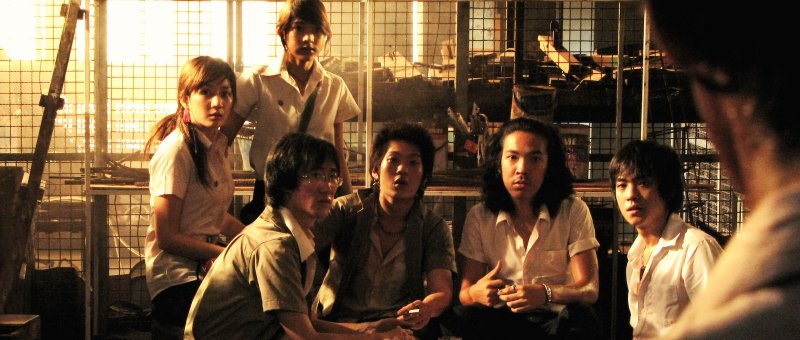
Pee Mak (พี่มาก..พระโขนง, Banjong Pisanthanakun, 2013)

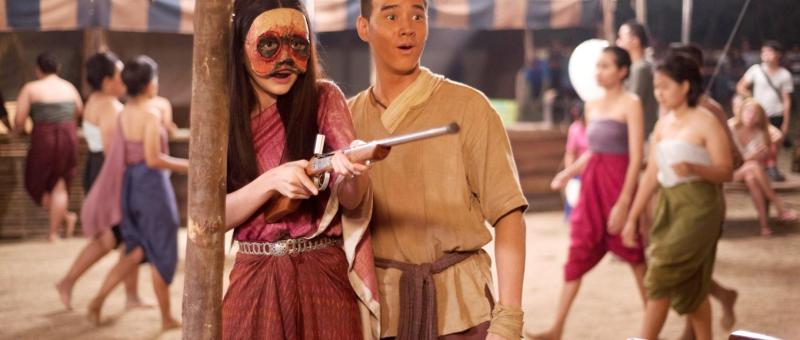
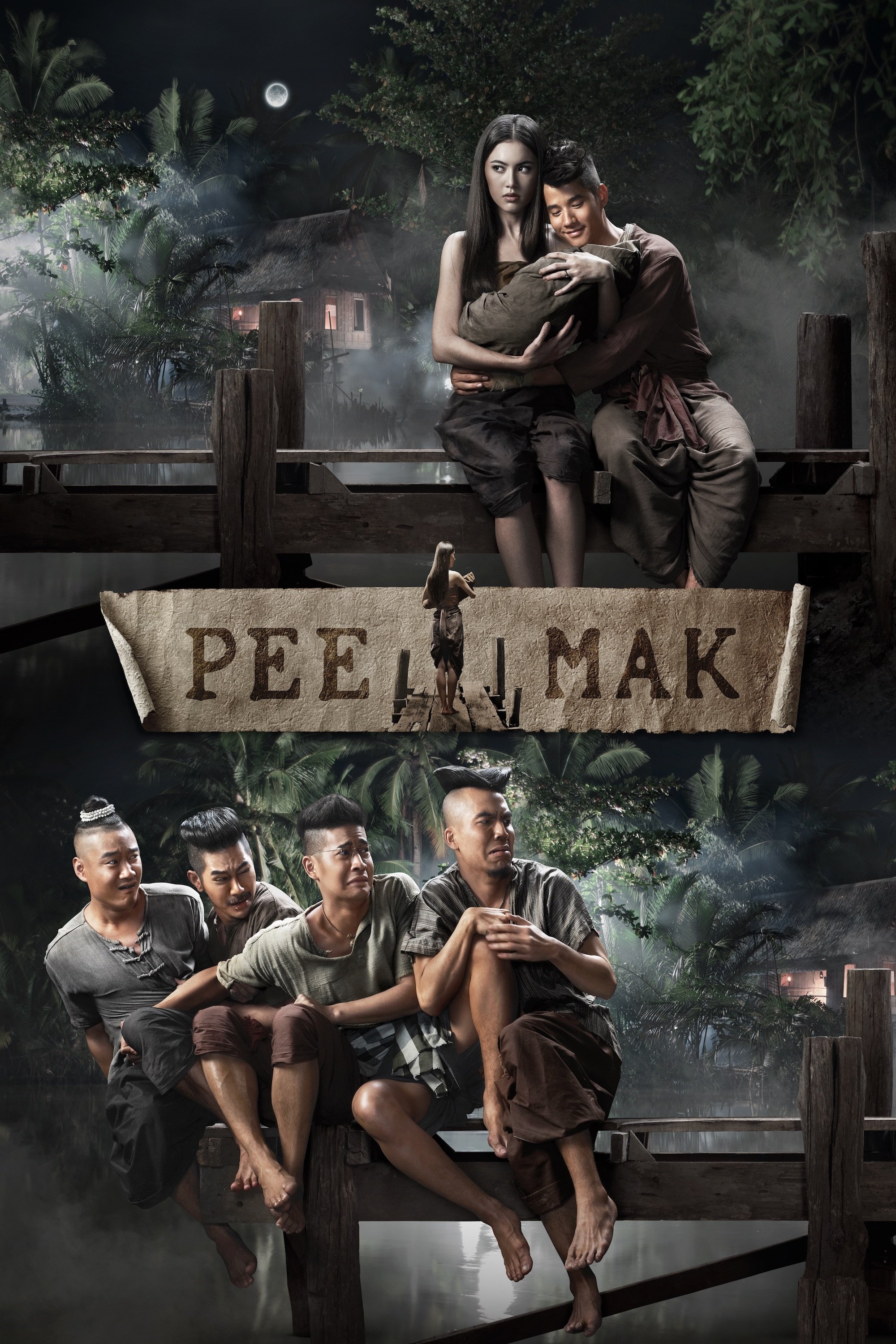
If you suddenly discover your spouse is a member of the undead, do you really have to break up with them or is it alright to go on living with a ghost? The conventional wisdom in Banjong Pisanthanakun’s horror comedy take on the classic folktale Mae Nak Phra Khanong, Pee Mak (พี่มาก..พระโขนง), is that the dead cannot live with the living, but perhaps love really is strong enough to overcome death itself and living without the person who means most to you really might be more frightening than living with an all-powerful supernatural entity.

In any case, much of the comedy revolves around the desperate attempts of Pee Mak’s friendship group to make him realise that wife, Nak (Davika Hoorne), is a ghost. The men had all been away at the war and have now returned but the village seems different and the villagers are all avoiding Pee Mak. Gradually, it dawns on them that Nak actually died due to complications from a miscarriage after going into labour alone at home given Pee Mak’s absence. But Pee Mak himself remains unaware of this fact, or so it seems, and refuses to listen to his friend’s attempts to convince him which are also frustrated by their fear of Nak and the worry that she might curse them if they reveal her secret.

The four friends are each played by the same actors and have the same character names as those in the shorts Banjong Pisanthanakun directed for 4Bia and Phobia 2, and as in those two films there is a degree of confusion about who is and isn’t a ghost. On their return, the men are passed by a ferryman who is returning the bodies of dead soldiers to their families explaining that the graveyards are all full. This of course hints at the destructive costs of the war and haunted quality of the depleted village to which not all men have returned, but also leaves the door open to wondering if the five of them are not already dead themselves and have returned home only in spirit without realising. Pee Mak, after all, sustains a serious injury from which he miraculously recovers driven only love and the intense desire to return home to his wife and the baby he’s never met who must by now have been born. 

Meanwhile, Nak tells Pee Mak that the rumours of her death are greatly exaggerated and mostly put about by a local man, Ping, who had been harassing her while Pee Mak was away at the war and was upset by her rejection. Ping then later also accuses Nak of killing his mother after she drunkenly told Pee Mak about Nak being a ghost, but in general the villagers only avoid Nak until one rather late intervention rather than try to exorcise her spirit. Nevertheless ghost or not, it does not actually appear that Nak is particularly dangerous. She does not drain Pee Mak’s life force nor randomly attack other people and at most only seems to glare intensely at his friends who might just be annoying in far more ordinary ways especially as one of them seems have developed a crush her.

Which is all to say, is it really so wrong for Pee Mak to enjoy a happy family life with his ghost wife who may have developed a set of really useful skills such as super-stretchy arms and the ability to hang upside down? Banjong Pisanthanakun constantly wrong-foots us, suggesting that perhaps everyone’s already dead, or maybe no one is, while eventually coming down on the side of the power of love to overcome death itself. Despite the film’s setting in the distant past, he throws in a constant stream of anachronistic pop culture references that might suggest this is all taking place in some kind of universal time bubble but also lends to the sense of absurdity in what is really a kind of existential farce as the gang attempt to figure out who’s alive and who’s a ghost before eventually realising that it might not really matter. Dead or alive, it seems like life is about just being silly with your friends free from the folly of war, which is surely a message many can firmly get behind.


Trailer (English subtitles)
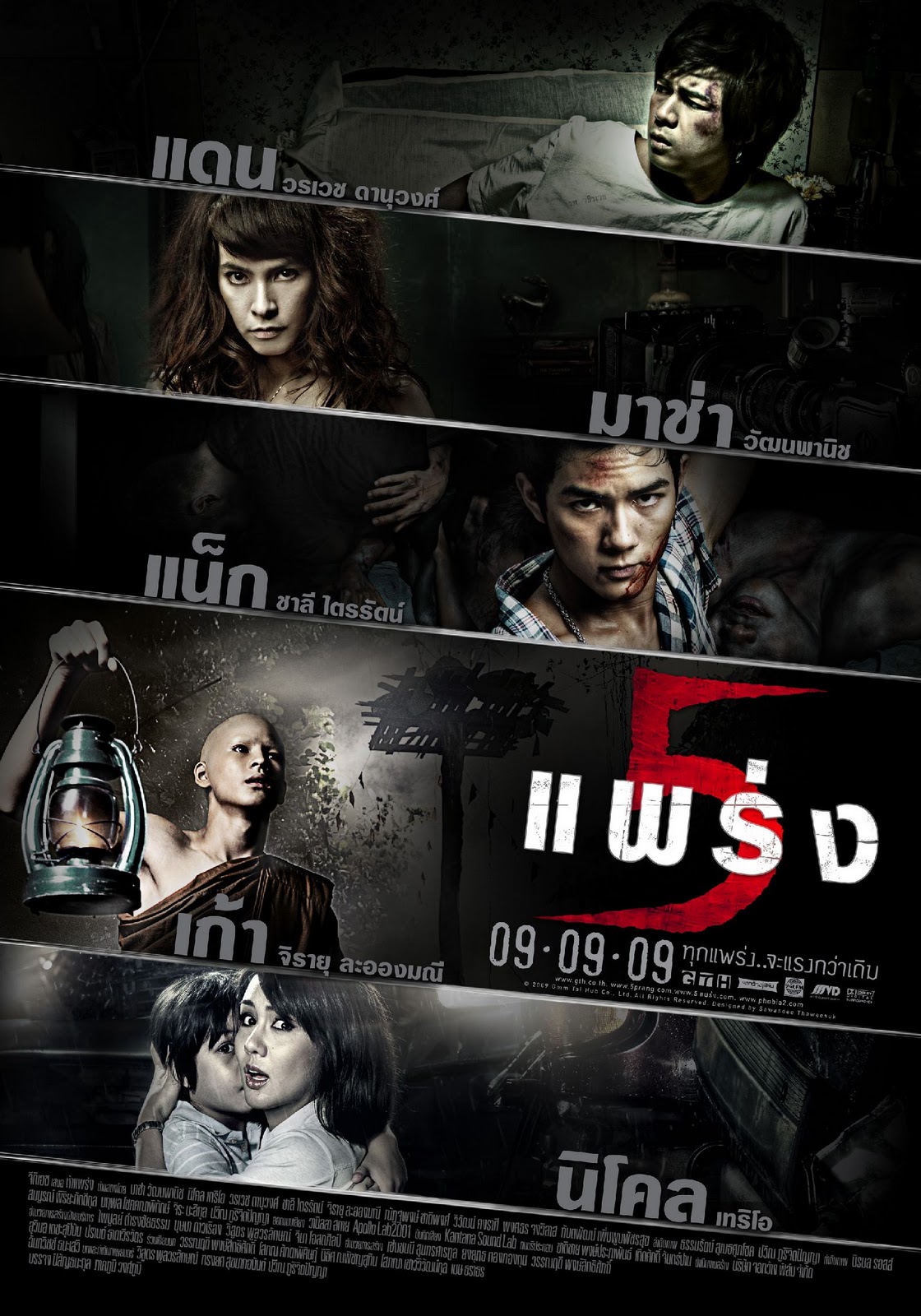
Phobia 2 (5 แพร่ง, Paween Purijitpanya, Visute Poolvoralaks, Songyos Sugmakanan, Parkpoom Wongpoom, Banjong Pisanthanakun, 2009)

Aptly termed “5bia” but retitled in English as Phobia 2, this sequel to the original four-part anthology adds an additional director for five tales of Thai horror. Unlike the first film, there aren’t any particular linking details though they each someway turn on an anxiety towards cars and other forms of transportation along with exploring the effects of unresolved guilt and natural justice in the form of karma.

Thus in the first sequence, Novice, a young man, Pey (Jirayu Laongmanee), is sent to a temple to hide out after being involved with a crime. He evidently did not want to become a monk and is resentful towards his mother and stepfather for bringing him here. But what he soon becomes involved with is a haunting, a hangover from the hungry ghosts festival that confronts him with his unresolved feelings towards his mother and lingering guilt over the crime he committed. Elegantly lensed, the film has a creeping sense of dread and eerieness as Pey begins to accept responsibility for his actions even if as it seems he must also pay for his lack of respect towards traditional custom.

Continuing the theme, in the second part, Ward, a young man, Arthit (Worrawech Danuwong), with casts on both of his legs is intrigued by the patient in the next bed, a former priest who it seems is not quite ready to move on. Rendered vulnerable by his incapacitation, Arthit can only watch as a weird ritual seems to unfold while the hospital staff do not seem to take his distress seriously. Despite its grim strangeness, there is a dark humour underpinning the action along with a kind of absurdity in the oddness of this weird black magic.

There’s nothing quite so supernatural in the third instalment, however, as a pair of Japanese hitchhikers are unwittingly picked uo by a people trafficker whose entire cargo turns out to be dead because his son tried to use them as drug mules. The film might have something small to say about exploration and the devaluing of the human life, but soon slips into zombie drama as the truckers try to outrun the consequences of their actions while the tourists pay a heavy price for their naivety. 

Just as in the earlier sequences, Salvage too finds a source of fear in the car but this time its largely because it’s haunted, both literally and by the spectre of amoral capitalism embodied by the boss’ attempts at corning cutting. Nuch (Nicole Theriault) has largely been making her money by buying wrecks and selling them as second-hand without telling the new owner they were involved in a fatal accident. After being taken to task by a mother who complains her son was nearly killed, she can’t find her son Toey anywhere and while looking at him is confronted by the ghosts of the various people who’ve been killed by her cars. It’s a neat indictment of the various ways capitalism is killing us even if ending on a note of improbable cruelty.

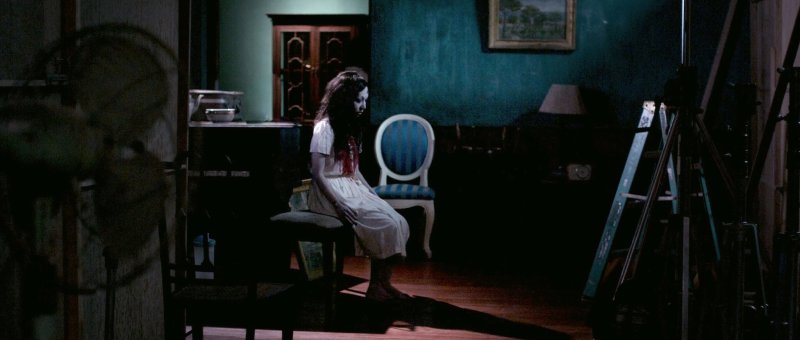
The fifth, final, and best instalment meanwhile takes on a meta quality. Directed by Shutter’s Banjong Pisanthanakun, it follows the action on the set of a sequel to his film Alone and stars the same actors as his segment in 4bia which Banjong Pisanthanakun humorously references while inverting its structure. After the supporting actress is taken ill, a rumour begins that she has in fact died only for her to turn up on the set provoking terror from the boys who become convinced she’s s vengeful ghost.In any case, it turns out it wasn’t the supernatural they really needed to look out for but a sleepy, overworked driver. Like Man in the Middle, the gentle camaraderie between the guys and zany humour help carry the witty tale alone as the gang start suspecting each other and acting irrationally in an attempt to escape “the ghost.” All in all, it’s a fitting way to end the series, concluding on a note of cosmic irony as the real threat turns out to be all too human and an exmplifcation of an exploitative employment culture rather than a vengeful spirit seeking revenge from beyond the grave.


Trailer (English subtitles)

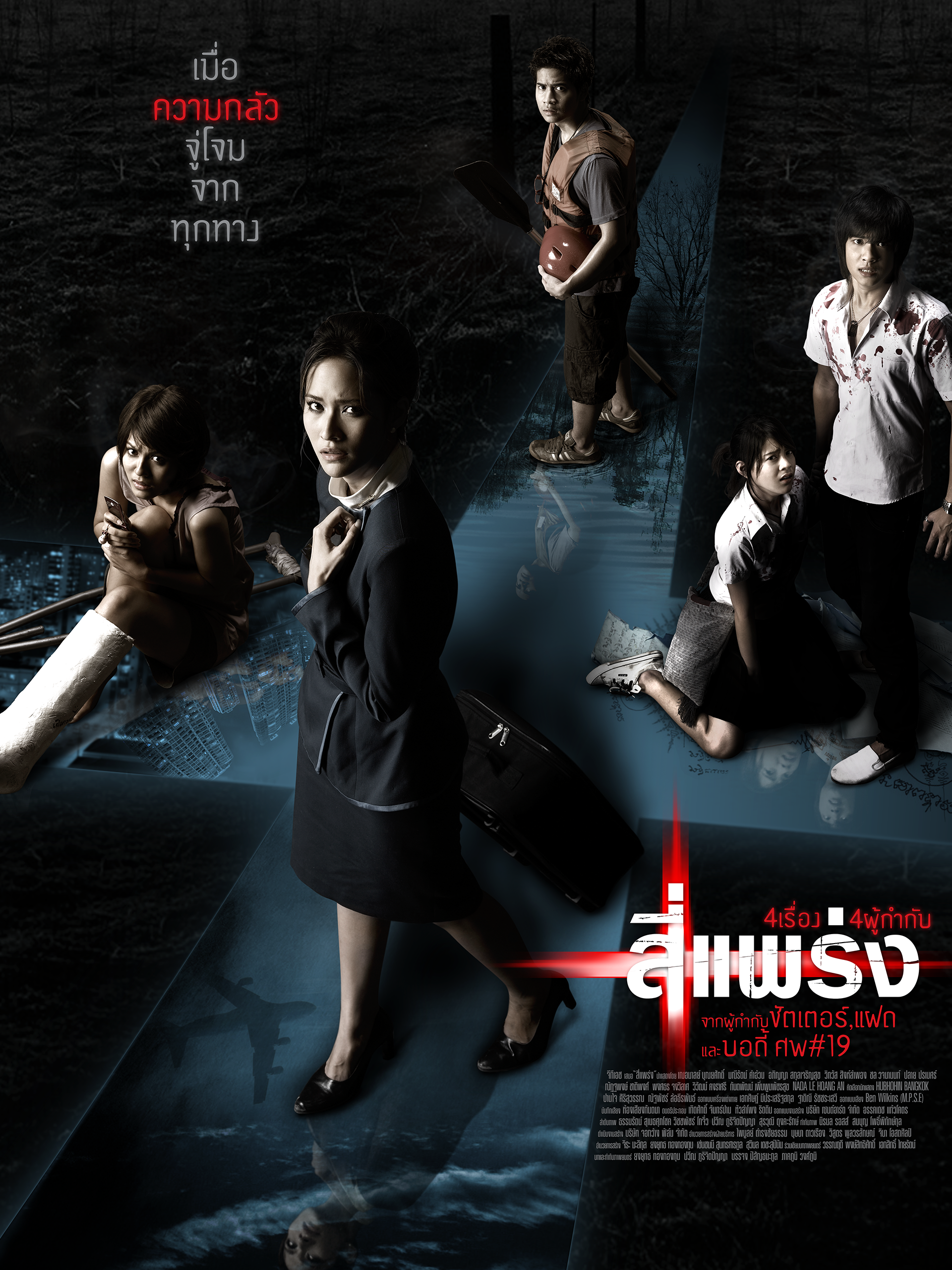
4bia (สี่แพร่ง, Youngyooth Thongkonthun, Banjong Pisanthanakun, Parkpoom Wongpoom, Paween Purijitpanya, 2008)

A quartet of Thai directors come together for four tales of horror in the appropriately titled 4bia (สี่แพร่ง). Though the stories are largely unconnected save for a few common details that locate them in the same universe, they each deal with a particular kind of anxiety and different sorts of ghosts who for various reasons are haunting the protagonists. What’s certain is that if you’re targeted by an otherworldly spirit, finding escape will not be easy.

That’s something quite obvious even in the first episode in which a young woman trapped alone in her apartment after breaking her leg in a horrific car crash begins chatting with a total stranger who sends her a random text message. Of course, replying to a message like that is not very sensible and even perhaps dangerous, as Pin (Maneerat Kham-uan) herself may release when she asks the (presumably) male messenger to send a photo only to be sent back the one she just sent of herself with the reply that he’s in it next to her. In any case, the real malevolent force here seems to be loneliness itself which is what motivates Pim to message back having already spent 100 days without interacting with another human being. The messenger has also spent the same amount of time alone in what he calls a “cramped space,” which is why he wants company. It’s gradually revealed that the pair share a kind of destiny which is an inversion of the kinds of meet-cutes you might find in a romantic comedy that makes Pim’s 100 days a purgatorial space of borrowed time in which she might as well have been a ghost herself.

But in the second chapter, Tit for Tat, it’s almost the opposite of loneliness that’s the problem as bunch of delinquent high school students and recreational drug users bully a bookish boy, Ngid (Nattapol Pohphay) and end up killing him. The boy then becomes a vengeful spirit and uses black magic to take them all out. Though one of them quips that they need to start smoking less weed, there’s no real question that the ghost is real or that the gang pretty much deserve what’s coming to them for having been so obnoxious in real life. The later part of the drama focuses on Pink (Apinya Sakuljaroensuk), a peripheral member of the gang who did try to tell the others to stop but otherwise did nothing to help Ngid and is punished for her sin of omission, though she does eventually think of a way to break the curse if only ironically in poetic justice for simply standing by and watching in the face of injustice. 

The third sequence, Banjong Pisanthanakun’s Man in the Middle is, however, a meta textual-delight that asks why ghosts in films always have long hair and pale faces. Four boys go on a rafting trip and swap campfire stories about how you should never sleep on the end when you’re close to the jungle in case a succubus comes to get you. When they get into an accident on the water and are separated, it leads to a sense of suspicion as some wonder if their friend actually died and is a ghost come to haunt them who, like in the Sixth Sense, may not know he’s dead. Though the twist maybe somewhat predictable, the tale is told with good humour and a sense of narrative cohesiveness that is lacking in some of the other chapters. 

Similarly, the final instalment Last Fright, is a chamber piece focusing on a stewardess who is unexpectedly charged with escorting a princess (Nada Lesongan) who’s fallen out of favour on her trip to Thailand where she spent her honeymoon. Pim’s (Laila Boonyasak) secret is that she’s been having an affair with the princess’ husband whom she met on their honeymoon flight which is why the incredibly imperious woman tortures her all the way through the flight before dying in a hotel room on arrival. Pim must, for reasons that don’t really make sense, escort the body back only to begin going out of her mind while haunted by the princess’ spirit. This is the only sequence which flirts with the idea of the ghost not actually being real but a manifestation of Pim’s guilt, or else a vengeful spirit come to punish her not for her secondary crime but for the transgression of adultery. Despite its potentially moralising overtones it’s a pretty chilling moment on which to end the film suggesting that in the end there is no real escape either from a vengeful ghost or your own questionable decisions.


4bia is available as part of Umbrella Entertainment’s Thai Horror Boxset.

International trailer (English subtitles)

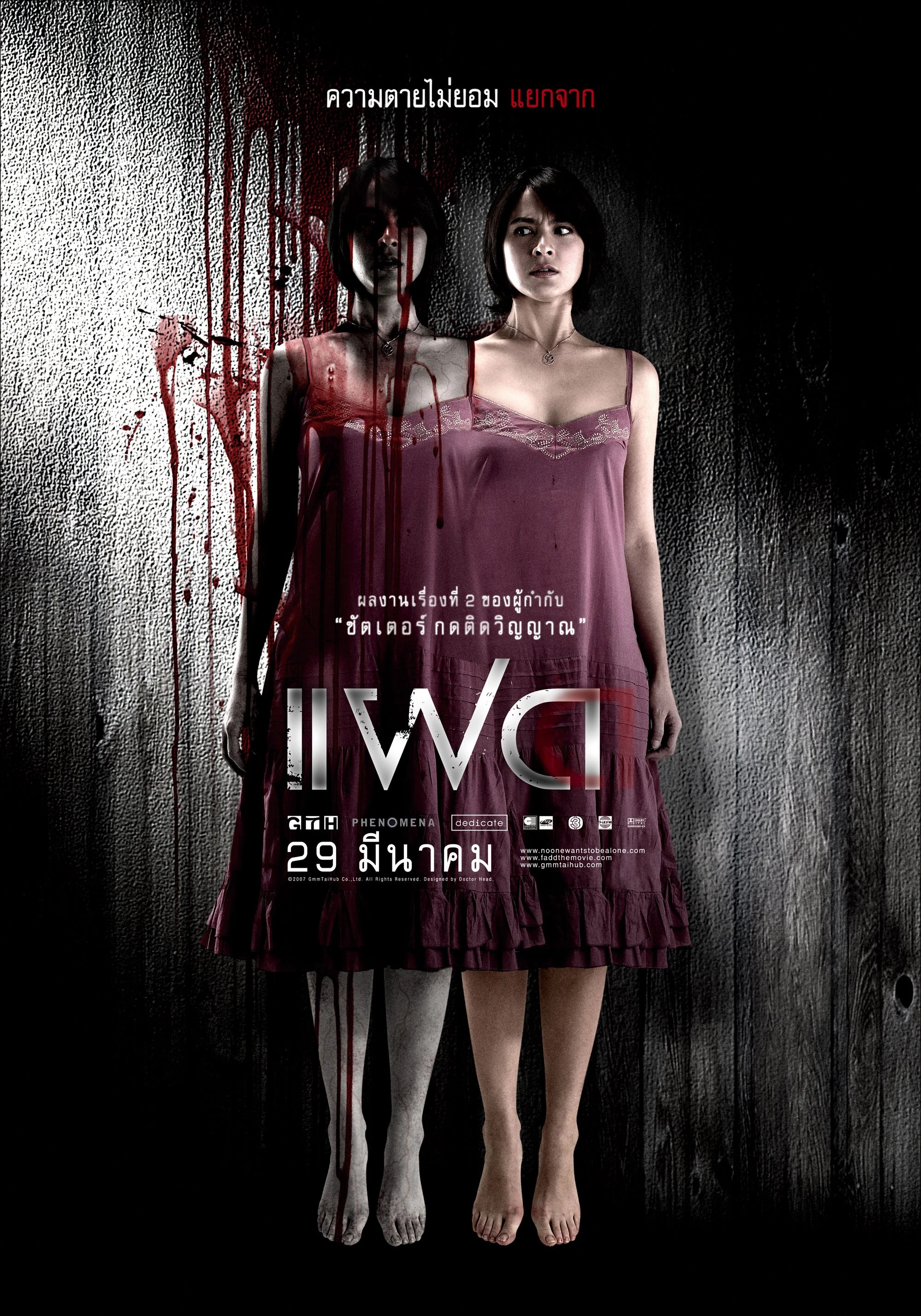
Alone (แฝด, Banjong Pisanthanakun & Parkpoom Wongpoom, 2007)

A young woman returns to her apartment in Seoul to find the lights don’t work. She begins to feel uneasy, as if there’s a presence around her she can’t see or hear. Slowly, she moves towards the source of her discomfort, but the lights soon come back on. This isn’t a haunting, it’s a party. Her devoted boyfriend Wee (Vittaya Wasukraipaisan) has organised a surprise birthday celebration, though Pim (Marsha Wattanapanich) is indeed a haunted woman attempting to outrun her ghosts in a new country a world away from the nexus of her trauma.

This is just one of many ways in which Banjong Pisanthanakun and Parkpoom Wongpoom attempt to misdirect us while foreshadowing Pim’s eventual confrontation with ghosts of her past on returning to Thailand after her mother suffers a stroke and is hospitalised. A brief prologue sequence had seen her mother sewing a dress that’s oddly shaped, we later realise intended for her daughters who are conjoined twins. A guest reading the tarot at Pim’s party had hinted that something she’s lost would soon return, or else someone to whom she’d broken a promise would come back seeking recompense. This soon proves to be true, Pim haunted by the spectre of her sister Ploy (also played by Marsha Wattanapanich) who passed away unable to adjust after Pim’s apparently unilateral decision to separate.

It’s for this reason that Pim feels intense guilt, convinced that she killed her sister in breaking their promise to always stay together because she desired individual fulfilment. To that extent, some might wonder if the ghost Pim sees is “real” or merely a manifestation of her unresolved trauma. Wee eventually convinces her to see a psychiatrist, who is also a good friend of his, who tells him that Pim is suffering from a delusion while advising her to try to make peace with herself over her sister’s death if she wants to stop seeing the ghost. But perhaps there really is something dark and malevolent, a resentful spirit haunting her family home which is otherwise full of childhood memories. Pim flips through old photos all featuring her and her sister living their shared life of enforced closeness that is at first blissfully happy in its isolation but then suffocating and constrained. 

Nevertheless, though it’s Pim who’s left “alone” in being the one left behind, it’s also true that Pim’s actions have left Ploy “alone” too, only on the other side. The film plays into their nature as twins who represent two halves of one whole rather than two separate beings and locates the source of trauma in their separation as if they must in some sense be reunited in order to exorcise its taboo. In many ways, the psychological drama revolves around a quest for identity as Pim tries to reassert herself in the face of Ploy’s reflection, to become the whole rather than an orphaned part of it, while in other ways affecting a persona that is not quite her own. One cannot take the place of the other, just the new dog the pair get after moving to Thailand cannot replace their old one even if as Pim says they are otherwise identical. 

Yet Pim wonders if it was alright to desire an individual future, choosing herself over Ploy and thereby condemning her to a life of loneliness. To that extent, her dilemma is that of a contemporary woman torn between familial devotion and personal fulfilment, though of course, her words turn out to have a hidden implication suggesting that all is not quite as it seems even if she begins to confront her trauma by finally explaining the circumstances of her separation to an ever supportive but increasingly worried Wee. As the tarot reader had implied, perhaps all promises must in the end be fulfilled as the grim conclusion suggests, literally burning down the house as if to purify this space and restore order in uniting the sisters in an eternal embrace, alone together. Banjong Pisanthanakun and Parkpoom Wongpoom engineer a slowly creeping sense of dread in the gothic eeriness of Pim’s family mansion while edging towards the fatalistic conclusion in which a kind of balance is finally restored, the sisters are both separated and united once again two halves one perfect whole.


Alone is available as part of Umbrella Entertainment’s Thai Horror Boxset.

International trailer (English subtitles)

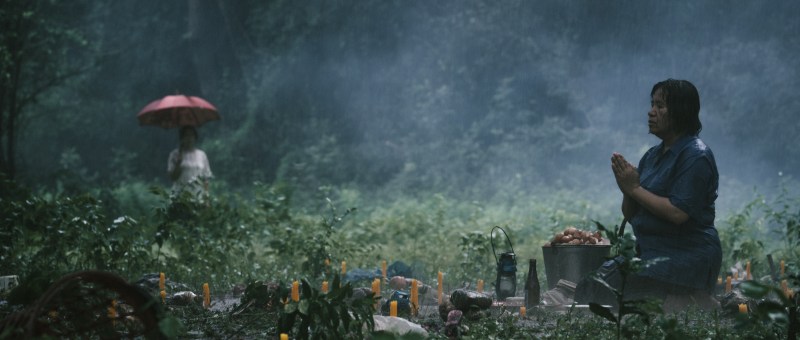
The Medium (ร่างทรง, Banjong Pisanthanakun, 2021)

A young woman finds herself caught between the contradictions of the modern Thailand in Banjong Pisanthanakun’s eerie forest-bound supernatural folk horror, The Medium (ร่างทรง). Produced by The Wailing’s Na Hong-jin and based on his original story, Banjong Pisanthanakun’s shamanistic drama is in many ways an exploration of the vagaries of faith but also of the price to be paid for abandoning the traditions of your nation and the slowly mounting karmic debt that visits itself solely on the young. 

A documentary film crew exploring indigenous religious practice has settled on shamaness Nim (Sawanee Utoomma) as a subject, getting her to provide a brief explanation of the area’s animist beliefs. According to her, there are good spirits and bad, those who protect and those intent on causing harm. As a conduit of the goddess Ba Yan, the local protective deity, she is able to intervene when the villagers need her help though only, she is keen to point out, where the problem stems from something “unseen”. She takes no money for her services, though sometimes people bring gifts, and is clear that she cannot treat conventional illnesses such as cancer only those a direct result of supernatural manipulation. 

Nim had not originally wanted to become a shamaness and at one point attempted to take her own life in order to escape it, but claims that after deciding to accept Ba Yan everything changed for the better and she’s since grown to like it because it allows her to help people as well as affording her a special status in the village. A maternal deity, Ba Yan only seeks female hosts and the original target had been Nim’s older sister Noi (Sirani Yankittikan) who went so far as to convert to Christianity in order to reject her. According to older brother Manit (Yasaka Chaisorn), the sisters have never got on, a degree of animosity between them obvious on attending the funeral of Noi’s husband Wiroj (Prapruttam Khumchat). Wiroj, however, a had traumatic family history of his own, his ancestors apparently having committed a terrible crime, while his grandfather was stoned to death by his employees, and his father burned his factory down for the insurance money later taking his own life. The couple’s son Mac (Poon Mitpakdee) was also tragically killed in a motorcycle accident some time previously.  

All of this might explain why Nim’s 20-something niece Mink (Narilya Gulmongkolpech) seems to be behaving strangely at the funeral, having too much to drink and kicking off at an uncle for supposedly insulting her. Witnessing other strange events, Nim starts to suspect that Mink is beginning to awaken as a shamaness and that Ba Yan is looking to move on, but whatever it is that’s troubling Mink may not be as benevolent as the protective deity. The clash between the sisters comes to represent a clash between tradition and modernity, ritualistic animist religion and Western Christianity, as mediated through the body of Mink a young urbanised woman working at a recruitment centre who thinks all this shaman stuff is backward and superstitious. Interviewed by the documentary crew she rolls her eyes and recalls a story of a so-called Doraemon Shaman who is compelled to sing the theme tune to the famous children’s cartoon about a blue robot cat from the future on entering a trance. 

As the film progresses, a series of questions arises in relation to the dubious ethics of the documentary film crew particularly in their decision to continue following Mink as her mental health deteriorates. Later events imply they did not edit this footage themselves, but the decision to film the aftermath of a suicide attempt seems unjustifiable as does the inclusion of CCTV footage featuring clearly recognisable people engaging in acts of intimacy even if admittedly in public places. 

In any case, the central question is how much faith you can have in things you can’t see, Noi ironically asking Nim how she knows Ba Yan is with her if they’ve never “met” while simultaneously refusing to ask herself the same question in regards to her Christian faith. Then again, we can’t be sure if Noi’s faith is “genuine” or solely a way of rejecting her traditional beliefs in order to shrug off the burden of shamanism. Even Nim finally admits that she no longer feels certain that she really is possessed by Ba Yan and not the victim of localised hysteria. Her final conclusion is that Mink’s illness is a result of Noi’s rejection of shamanism and only by convincing her to finally accept the goddess can they gain her assistance in freeing Mink from the ancestral curse and bad karma that have apparently made her a magnet for evil spirits. 

Having originally believed the spiritual pollution lay firmly in the present generation with the suggestion of an uncomfortable taboo, Nim later realises she’s been tricked and the problems lie far in the distant past if exacerbated by the karmic debts accrued by Wiroj’s immediate forbears. Noi’s reluctance to listen to her guidance, however, eventually leads to a series of escalating consequences, further bearing out the message that it was her own betrayal of her traditional beliefs that laid a spiritual trap for her daughter. Capturing a sense of eeriness in the Thai forests,  Banjong Pisanthanakun leans heavily into a sense of spiritual confusion and existential dread asking some key questions about the nature of faith, the costs of sophistication, and effects of failing to deal with the legacies of historical trauma while raising a sense of palpable evil in its demonic trickery. 


The Medium screened as part of this year’s BFI London Film Festival and will stream exclusively on Shudder in the US, Canada, UK, Ireland, Australia, and New Zealand from Oct. 14.

Teaser trailer (English subtitles)