A Princess’ One-Sided Love (公主님의 짝사랑 / 공주님의 짝사랑, Choi Eun-hee, 1967)

“Those are the rules of the palace for a princess” the rebellious heroine of Choi Eun-hee’s second directorial feature A Princess’ One-Sided Love (公主님의 짝사랑 / 공주님의 짝사랑, Gongjunimui Jjaksarang) is told, though the “palace” is really the society and the “rules” those which all women are expected to “endure”. Quietly and perhaps subversively feminist, Choi’s humorous tale draws inspiration from Roman Holiday but unexpectedly engineers a happier ending for its lovelorn heroine who is permitted to transcend the constraints of her nobility if not quite of her womanhood. 

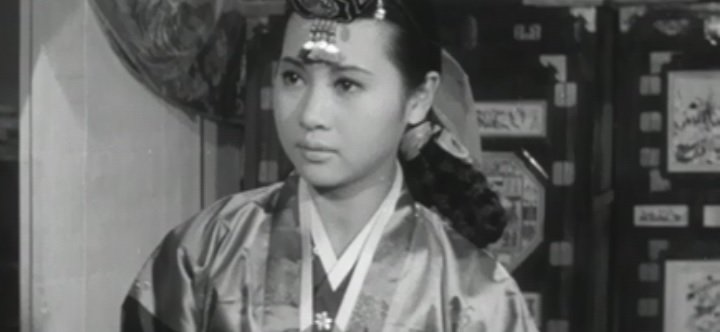
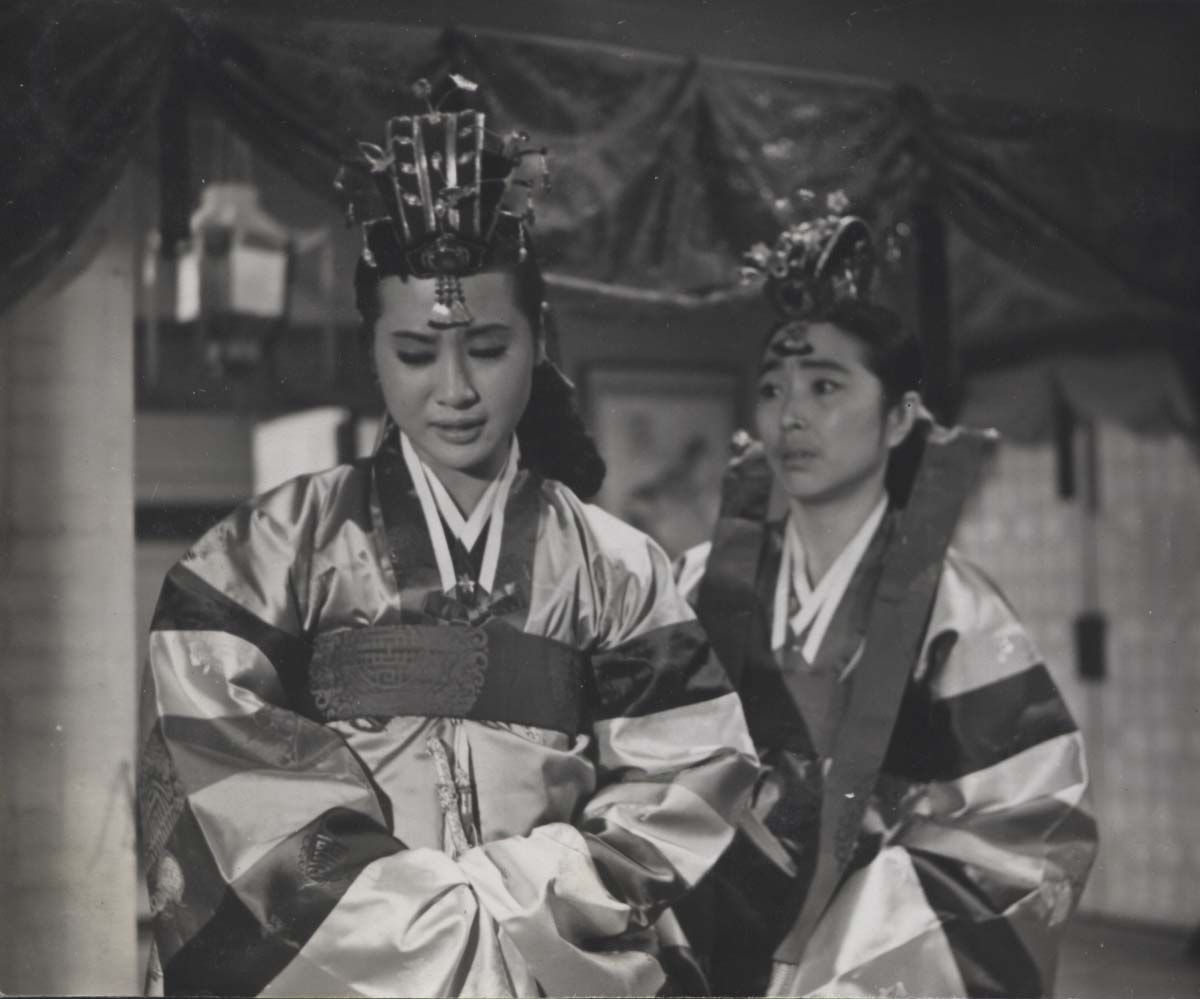
Tomboyish princess Suk-gyeong (Nam Jeong-im) is the youngest of six princesses and the last to remain at home in the palace yet to be married. Consequently, she is infinitely bored all the time and continually up to mischief in part because as a princess she is not permitted to leave the estate and has a natural curiosity about the outside world. That curiosity is further sparked when she lays eyes on handsome scholar Kim Seon-do (Kim Gwang-su) who picks up a shoe she had dropped while inappropriately running on the day of her mother’s birthday celebrations. Possibly the first young and handsome man she has even seen, Suk-gyeong cannot help but be captivated by him and manages to convince her sisters to help her escape the palace to venture in search of her probably impossible love under the pretext of visiting her grandparents whom she has apparently never visited before.  

Like Audrey Hepburn in Roman Holiday, what Suk-gyeong wants is a break from the “tedious and pathetic” life of a princess, but soon discovers herself to be entirely naive as to how the “real world” works. Her sisters agreed to help her in part because they acknowledge how difficult it was for them when they married and had to leave the palace with no understanding of how to live outside it. Having left in the clothes of a servant, the first thing that Suk-gyeong realises is that the outside world is governed by a different set of hierarchies and even if she’s a princess she is still a woman and therefore presumed to be “inferior” to men to whom she is expected to remain subservient. Her grandfather, who has never met her before, wastes no time exerting his patriarchal authority in his own, comparatively humble, home. “A woman, once married, must abide by the rules of her new family, the confucian ethics, and respect your father and husband and become a wise and obedient wife” he explains, striking her across the calves with a cane to teach her a lesson for her imperious tone in failing to pay him the proper respect. 

Failing to use appropriately polite language with those around her, forgetting that she should now be deferent both to men and to those who exceed her in age, gets her into constant trouble. Nevertheless, a trip to the marketplace gains her a further understanding of the extremes in her society firstly when she misunderstands a rice cake seller’s patter and assumes he intended to gift her some of his produce as he might to a princess, and secondly when she bumps into a woman with a baby on her back and breaks the pots she was hoping to sell to pay for her husband’s medical care. Introduced to such desperate poverty, the undercover princess knows not what to do but later gifts her a jade pin hoping perhaps to at least cure the husband’s malady, only to wander into another dangerous situation when she is mistaken for a sex worker by a trio of drunken noblemen who pull her into a drinking establishment which is in fact a brothel. Naively drinking with the men she mocks them for their attempts to play on their names each boasting of their famous fathers and personal connections to men she knows to be elderly cranks and obsequious fools. Shocked to discover what goes in establishments like these she tries to make her escape but is almost assaulted by one of the men, Shim, who is later posited as an ideal match by her unsuspecting mother laying bare another patriarchal double standard as Shim plays the part of the gentleman in order to effect his advancement. Luckily, she is saved by Seon-do who happens to be passing but mistakes her for a boy because of the disguise she is currently wearing. 

Selfish in her naivety, Suk-gyeong is warned that her impossible crush might end up harming Seon-do’s hopes of making it into the elite through success in the state exam while he, once made aware of the truth, immediately does the right thing by kindly rebuffing the princess’ inappropriate interest leaving her with a poetic love letter claiming he’s gone off to a temple for a spell of intensive study. Perhaps improbably it’s the love letter that eventually saves them, touching the king’s heart and convincing him to acquiesce to his sister’s wishes of escaping the gilded cage of nobility. Suk-gyeon’s pleas to renounce her royal title might also stand in for a desire to renounce womanhood in that it “stops us from doing anything we want. We are matched up with an unknown husband and we spend our youths in misery for our lives are tedious and pathetic”, reminding her brother that as a king but in truth as a man he cannot understand even while he reminds her that these are the “rules” endured by countless ancestors. The king is moved, he breaks with tradition and frees his sister yet he does so to allow her to become a wife even if he has also granted her the freedom to choose her husband and live in the outside world unconstrained by the strictures of nobility but nevertheless bound by oppressive patriarchal social codes. Nevertheless, it’s an unexpectedly progressive conclusion advocating for change and personal happiness over the primacy of duty and tradition. 


A Princess’ One-Sided Love streamed as part of the Korean Cultural Centre UK’s Korean Film NightsFilming Against the Odds 

The Body Confession (肉体의 告白 / 육체의 고백, Jo Keung-ha, 1964)

Body Confession posterThe Korea of 1964 was one beginning to look forwards towards a new global future rather than back towards the turbulent colonial past, but the rapid leap forward into a new society had perhaps left an entire generation behind as they prepared to watch their children reject everything they’d strived for in search of “modernity”. 1964’s The Body Confession (肉体의 告白 / 육체의 고백, Yukche-ui Gobak) is the story of one such woman. Widowed young, she turned to sex work in order to support her three daughters in the hope that sending them to university would win them wealthy husbands only for her daughters to encounter the very problems she worked so hard for them to avoid.

The heroine, a veteran sex worker known as The President (Hwang Jung-seun), has become a kind of community leader in the red light district largely catering to American servicemen in the post-war era. While she labours away in the brothels of Busan, her three daughters are living happily in Seoul believing that she runs a successful fashion store which is how she manages to send them their tuition money every month. The President goes to great lengths to protect them from the truth, even enlisting a fashion store owning friend when the girls visit unexpectedly. Nevertheless, she is becoming aware that her position is becoming ever more precarious – as an older woman with a prominent limp she can no longer command the same kind of custom as in her youth and is increasingly dependent on the support of her fellow sex workers who have immense respect for her and, ironically, view her as a maternal figure in the often dangerous underworld environment.

This central idea of female solidarity is the one which has underpinned The President’s life and allowed her to continue living despite the constant hardship she has faced. Yet she is terrified that her daughters may one day find out about her “shameful” occupation and blame her for it, or worse that it could frustrate her hopes for them that they marry well and avoid suffering a similar fate. Despite having, in a sense, achieved a successful career in the red light district, The President wants her daughters to become respectable wives and mothers rather than achieve success in their own rights or be independent. Thus her goal of sending them to university was not for their education but only to make them more attractive to professional grade husbands.

The daughters, however, are modern women and beginning to develop differing ideas to their mother’s vision of success. Oldest daughter Song-hui (Lee Kyoung-hee) has fallen in love with a lowly intellectual truck driver (Kim Jin-kyu) who has placed all his hopes on winning a literary competition. He is a war orphan and has no money or family connections. Meanwhile, second daughter Dong-hui (Kim Hye-jeong) has failed her exams twice and developed a reputation as a wild girl. Toying with a poor boy, she eventually drifts into a relationship with the wealthy son of a magnate (Lee Sang-sa) but fails to realise that he too is only toying with her and intends to honour his family’s wishes by going through with an arranged marriage. Only youngest daughter Yang-hui (Tae Hyun-sil) is living the dream by becoming a successful concert musician and planning to marry a diplomat’s son.

The three daughters have, in a sense, suffered because of their mother’s ideology which encourages them to place practical concerns above the emotional. Song-hui is conflicted in knowing that she will break her mother’s heart by marrying a man with no money or family but also knows that she will choose him all the same. Dong-hui, by contrast, enthusiastically chases Man-gyu for his money but naively fails to realise that he is selfish and duplicitous. In another evocation of the female solidarity that informs the film, Man-gyu’s fiancée Mi-ri eventually dumps him on witnessing the way he treats Dong-hui, roundly rejecting the idea of being shackled to a chauvinistic man who assumes it is his right to have his way with whomever he chooses and face no consequences. Like Song-hui, Mi-ri breaks with tradition in breaking off her engagement against her parents’ wishes and reserving her own right to determine her future.

Yang-hui, whose future eventually works out precisely because of the sacrifices made on her behalf by her mother, turns out to be her harshest critic, rejecting The President on learning the truth and attempting to sever their connection by repaying all the “ill-gotten” investment. Her wealthy husband, however, turns out to be unexpectedly sympathetic in pointing out that her mother has suffered all these long years only to buy her future happiness and that now is the time they both should be thanking her. Meanwhile, The President has become despondent in realising she is out of road. There is no longer much of a place for her in the red light district, and she has nowhere left to turn. Only the kindly Maggie, another sex worker who has been a daughter to her all this time, is prepared to stand by her and take care of her in her old age.

The gulf between the two generations is neatly symbolised by the surprising inclusion of stock footage from the April 19 rising against the corrupt regime of Rhee Syngman which led to a brief period of political freedom before the dictatorship of Park Chung-hee took power in 1961. The poor intellectual author whom The President dismissed, eventually becomes an internationally renowned literary figure after being published abroad while the wealthy magnate’s son turns out to be a louse. The President staked her life on the old feudal ways of ingratiating oneself with privilege by playing by its rules, but the world has moved on and it’s up to the young to forge their own destinies rather than blindly allowing those in power to do as they please. Sadly for The President, her sacrifices will be appreciated only when it’s too late and her desire for her daughters to escape the hardship she had faced misunderstood as greed and snobbishness. There is no longer any place for her old fashioned ideas in the modern era and her daughters will need to learn to get by on their own while accepting that their future was built on maternal sacrifice.


The Body Confession was screened as part of the 2019 Udine Far East Film Festival. It is also available to stream online via the Korean Film Archive’s YouTube Channel.