Tea Friends (茶飲友達, Bunji Sotoyama, 2023)

Japan’s rapidly ageing society has provoked an epidemic of loneliness but also perhaps new business opportunities in Bunji Sotoyama’s empathetic social drama Tea Friends (茶飲友達, Chanomi Tomodachi). The phrase may sound innocuous enough, but given some potentially outdated cultural connotations the men who spot the advert cunningly placed in a newspaper to catch the eyes of older readers may have reason to assume that it’s more than just tea and chat on offer. Though as it turns out, it’s not just the old who are lonely as a younger generation in turn often in conflict with their parents also attempt to seek security and comfort in found family.

That said, there’s something a little cult-like about the way that Mana (Rei Okamoto), a former sex worker, talks about her organisation which aims to cure late life loneliness through what others might describe as an elderly sex ring. Employing a collection of older women, she accompanies them to meet new clients where they silently slide viagra over the table. The gentleman caller subscribes to a plan to purchase “tea” and anything that happens inside the hotel room they subsequently go to is just “free love” rather than “prostitution”. Mana sees herself as running a “community safety net” and helping elderly people who might otherwise have become isolated and depressed keep active as part of one big happy family along with the other members of staff who have, like her, become estranged from their parents and relatives. 

For Yoshiki, one of the men who escorts the ladies around, it’s that he views his father as a failure for leaving a well-paid corporate job to open a bakery which subsequently went bankrupt and has led to him living in his car. He thinks that in the end it’s better not to try at all than be left with the humiliation of things not working out. But then for Mana herself it’s more a sense of parental rejection. After a difficult childhood, her now terminally ill mother continues to reject her on the grounds of her history of sex work while she continues to crave the unconditional love of a family. Like a mother hen, she nestles those around her into the Tea Friends organisation which operates out of her own home and strives to create a place where everyone can feel they belong. 

Which is all to say she’s the loneliest one of all, but as someone else later cautions her you can’t cure your own loneliness with the loneliness of others. What she sees as a social enterprise others may see as a deliberate attempt to take advantage of vulnerable people who have admittedly been let down by an indifferent society and are in need of the money even more so than comfort or validation. At the other end of the spectrum, a young woman working at Tea Friends discovers that she is pregnant but her boyfriend immediately rejects her, insisting that he refuses to take responsibility and revealing that he is already married. Chika wants to have her baby, but everyone seems to be telling her that she shouldn’t. The doctors seem to look down on her after realising she isn’t married and the father most likely not in the picture, while an attempt to inquire about benefits at the town hall leads only to judgement as the clerk pithily tells her that they’re there for when you need them but she shouldn’t “depend” on them too much virtually calling her a scrounger and implying she’s been irresponsible in becoming a single mother. 

As another of the older women admits, being used was better than being ignored and at least being part of Tea Friends gave her a sense of purpose and acceptance if only for a time. In any case, Mana’s attempt to find unconditional love from her new “family” largely flounders as even those she’d come to believe herself close to desert her when the threat of legal proceedings enters the picture leaving her to face the music alone while she continues to protect them insisting that they’ve done nothing wrong even if it it was technically against the law. An old man’s devastation on picking up the phone and getting no answer suggests that Mana might have had a point when she said it was a social service seeing as no one else seems keen to tackle the problem of late life loneliness even if she did go about it in a problematic way. As Mana often says, righteousness does not equal happiness and it is often outdated social brainwashing that keeps people unhappy and not least herself as she struggles to find the unconditional love lacking in her life that would enable her to cure her own loneliness even in the prime of her youth.


Tea Friends screened as part of this year’s Camera Japan.

Original trailer (English subtitles)
Soirée (ソワレ, Bunji Sotoyama, 2020)

“You can run but not from yourself” a gruff but sympathetic farmer explains to a fugitive young couple, astutely perhaps understanding the quality of their flight. Less a lovers on the run romantic fantasy than a gentle character study in trauma and insecurity, Bunji Sotoyama’s Soirée (ソワレ) finds its two wounded youngsters struggling to find safety and security in an increasingly indifferent society in which they are perhaps expected to care for an older generation they may feel has long since abandoned them. 

Aspiring actor Shota (Nijiro Murakami) for instance has been participating in a spate of “It’s Me!” scams targeting the older generation in which they are convinced that their grandson has been involved in some sort of trouble and is in desperate need of money. We can see by the ambivalent look on his face that he hates himself for his “role” in this sordid piece of modern day drama but also that it plays into his self-destructive conviction that he is no good and cannot achieve conventional success. His need for slapdash, quick fix solutions is further driven home by the coach at his acting class who gives him a very public dressing down for coming in unprepared, insisting that he’ll never move anyone until he gets some real life experience and engages with the text. 

While Shota takes an envelope from an anxious grey-haired old lady, Takara (Haruka Imou), a withdrawn young woman working at a nursing home, gently brushes another’s hair only for her to suddenly disappear while Takara hums a comforting lullaby. We witness her nervousness at the unexpected ring of the doorbell and the panic attacks when some of the older gentlemen mistakenly grab at her, later realising they are each responses to a deep-seated trauma as revealed by a letter telling her that her estranged father who had been in prison for long term abuse is about to be released. 

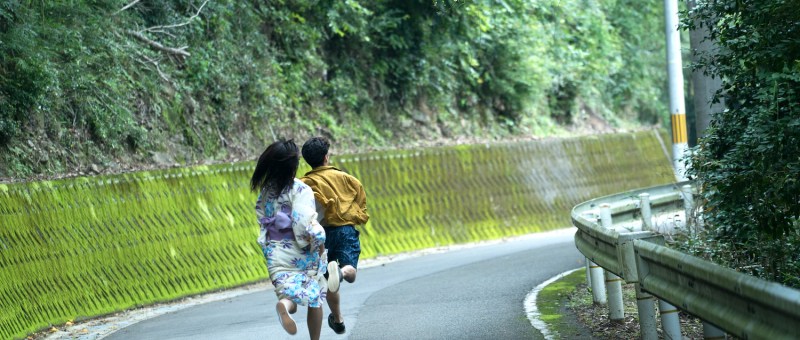
The pair eventually meet when Shota returns to his hometown with an acting troupe hired to put on a play at the home though things get off to an ominous start when one of the old ladies suddenly collapses while working with the actors, the head of the troupe rather cynically musing on DNR orders and the desires of some absentee children to keep their parents alive in order to continue receiving their pension. These contradictory impulses, Takara’s warmth and compassion towards the elderly people in her care and Shota’s wilful exploitation of their weakness, is brought home when Takara’s father suddenly returns, barges his way into her home asking for a fresh start claiming to have paid his debt, and then proceeds to rape her all over again. Discovered mid-act by Shota who had come to collect her for the local festival, Takara eventually stabs her father with a pair of dressmaking scissors in order to protect him, the pair thereafter finding themselves on the run. 

Coming to her senses, Takara intends to hand herself in but is convinced by Shota to make a run for it. “Why do the ones who struggle most get hit worst, why do the weakest always lose?” he ironically asks her, “We weren’t born to be hurt”. Yet their contradictory qualities are only further highlighted as they try to chart a new course for themselves. The pair find temporary refuge with a pair of plum farmers who take pity on them thinking they are a young couple eloping as apparently they once were, only Shota later makes a half-hearted attempt to rob them which he quickly gives up on being challenged by the sympathetic husband. In the next town, Takara determines to look for work while Shota tries to make money through bicycle races and pachinko, chastened by her admonishment on finding employment that it’s possible to support oneself without cheating others. 

Somewhat tritely, Shota tries to tell her that God never burdens you with more than you can bear, while the older woman at the plum farm also offers that plums are all the sweeter for their suffering during a harsh winter dangerously playing into a notion of internalised shame that told Takara she would blossom into the kindest soul who ever lived once her suffering was over only to leave her feeling empty and despoiled as if she somehow deserved everything that happened to her. Shota’s troubles are by comparison small, his conservative brother irritatedly telling him he should accept he has no talent and get a real job, while he too perhaps thinks he is empty inside and therefore incapable of moving anyone just as his director told him. Finding salvation in mutual acceptance they begin to see the “way out” only for their essential connection to be threatened by its very existence. 

A melancholy character study through the legacy of trauma and toxicity of internalised shame, Sotoyama’s occasionally ethereal drama takes on the qualities of a fable through the repeated allusions to princess Kiyohime and her doomed love for the wandering monk Anchin yet he is careful enough to hold out a ray of hope for each of the wounded lovers in their apparently fated connection even as they struggle to find refuge in an often hostile society.


Soirée streamed as part of the 2021 Japan Foundation Touring Film Programme.

Original trailer (English subtitles)