Fish Memories ((真)新的一天, Chen Hung-i, 2023)

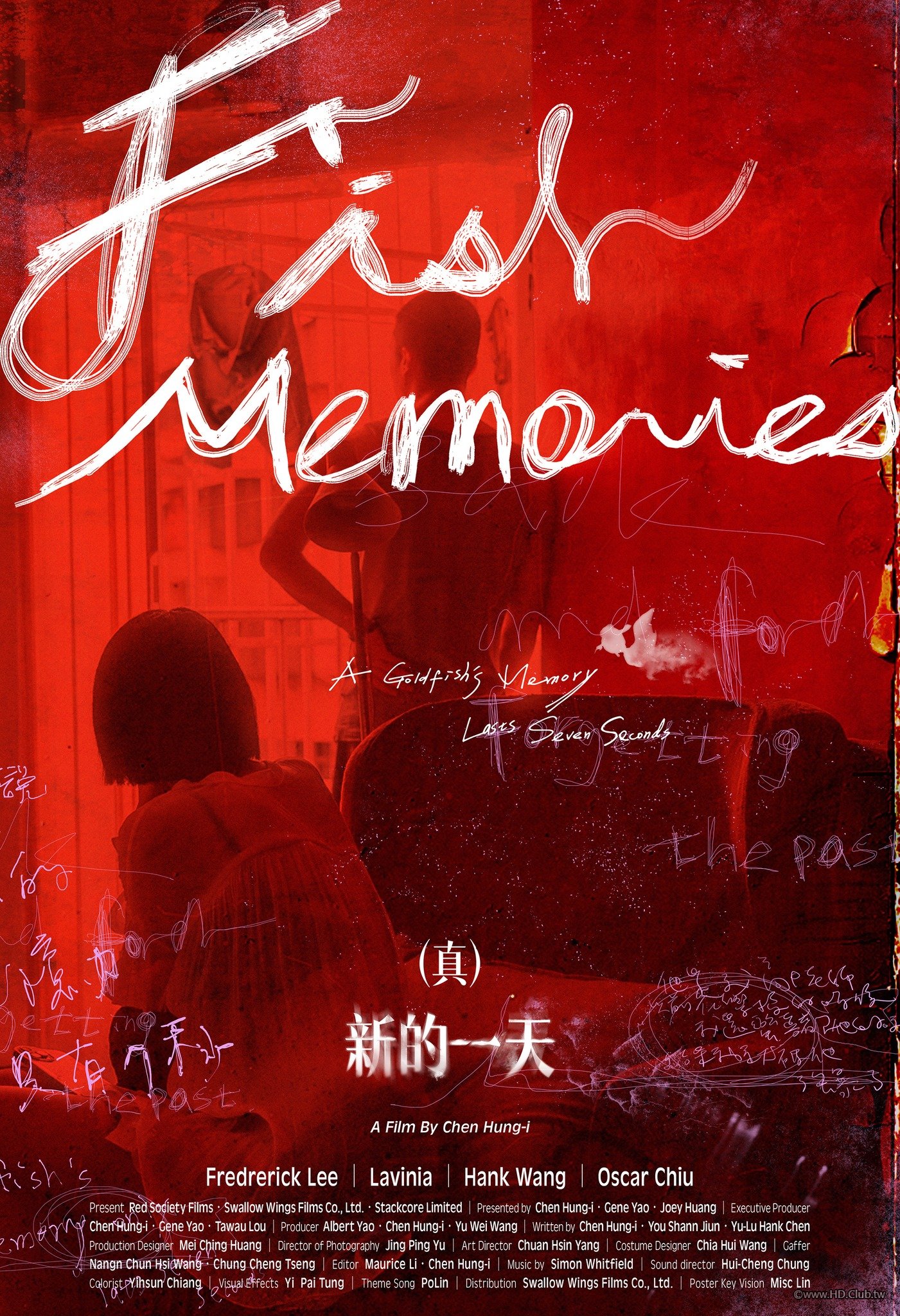
The sometime narrator at the heart of Fish Memories ((真)新的一天, (zhēn) Xīn de tiān) says that she wishes her memory were like that of a fish, no longer than seven seconds, and that she were able to be free of her traumatic past by forgetting it. But of course, she is unable to forget and like her boyfriend, Shang, and the middle-aged man with whom the pair eventually form a twisted relationship, a kind of orphan drifting in the wake of parental failure.

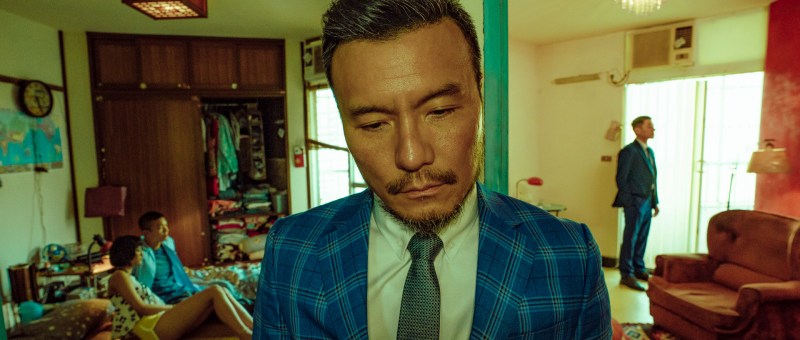
Businessman Zi Jie (Frederick Lee) also seems to drifting, seemingly dissatisfied with his financially comfortable but emotionally empty existence. He later says that his own parents only cared about about money and sent him away to Singapore when he was a teenager only for their business to then fail. He feels as if he’s done better than them, at least, but when asked how to avoid loneliness he answers only “earning money, spending money, earning money”. He has a girlfriend of around his own age, but bristles when she expresses a desire for greater intimacy and ends up pushing her away while beginning to bond with Shang (Hank Wang), a teenager he meets in a convenience store while picking up a parcel. He runs into the boy a few more times and ends up developing a friendship with him and also his same age girlfriend Zhen Zhen (Lavinia) who is still in high school and claims to have been sexually assaulted by one of her teachers who’s apparently done the same thing to several other girls with no apparent consequences.

Zi Jie’s relationship with the teens straddles an awkward divide, partly parental and partly friendly. He seems to partially regresses in their company, drinking incredibly expensive wine but also sitting around playing video games and agreeing to childish dares such as the one in which he ends up swapping places with Shang, waking up in his walkup apartment and dressing in his clothes. Shang’s living environment is not ideal, Zi Jie balks at the stairs while the place is cramped and filled with junk and Shang evidently rarely does no laundry but to Zi Jie it represents a kind of freedom. Of course, he can always return to his luxury apartment which still has power even during an outage which is an option not open to Shang who nevertheless seems to increase in confidence while wearing Zi Jie’s fancy tailored suit. Several times he approaches his rundown apartment block and looks to the sky as if echoing his sense of aspiration though that turns out not to be the reason he’s interested in Zi Jie. 

When he first gave him a car ride, Shang blunts told Zi Jie he wouldn’t sleep with him because he liked girls, remarking that Zi Jie looked “a bit gay”, but a sexual relationship does eventually evolve between the trio even as they also form an unconventional family unit. When they sit down to breakfast together with the doors onto the courtyard open and the sun drifting in with idyllic view behind, Zhen Zhen remarks that it’s the kind of moment she’s been waiting for all her life despite the awkwardness of this quasi-incestous and definitely inappropriate relationship given that the teens are underage and Zi Jie is a wealthy middle-aged man keeping them in his apartment.

But it’s perhaps when the streams start to cross that things begin to go wrong, Zi Jie making a huge miscalcutation while in the teens’ world that provokes a tragic event biding each of them together though only in the darkest of ways. The three of them are each in their way trapped in a tank, no more free than the fish they place inside it and in the end able to find freedom, of one kind or another, by remembering and acknowledging the truth. Repressing his sexuality and chasing only empty financial success has evidently left Zi Jie a hollow, broken man seeking to reconnect with his younger self through his relationship with Shang which in its way also prevents him from acknowledging the vast gulf that exists between them in their differing circumstances but also unites them in a shared feeling of irresolvable loneliness and the legacy of parental abandonment in a sometimes indifferent society defined by economic success.


Fish Memories screens 8th September in Melbourne as part of this year’s Taiwan Film Festival in Australia.

Original trailer (Traditional Chinese / English subtitles)

The Bold, the Corrupt, and the Beautiful (血觀音, Yang Ya-che, 2017)

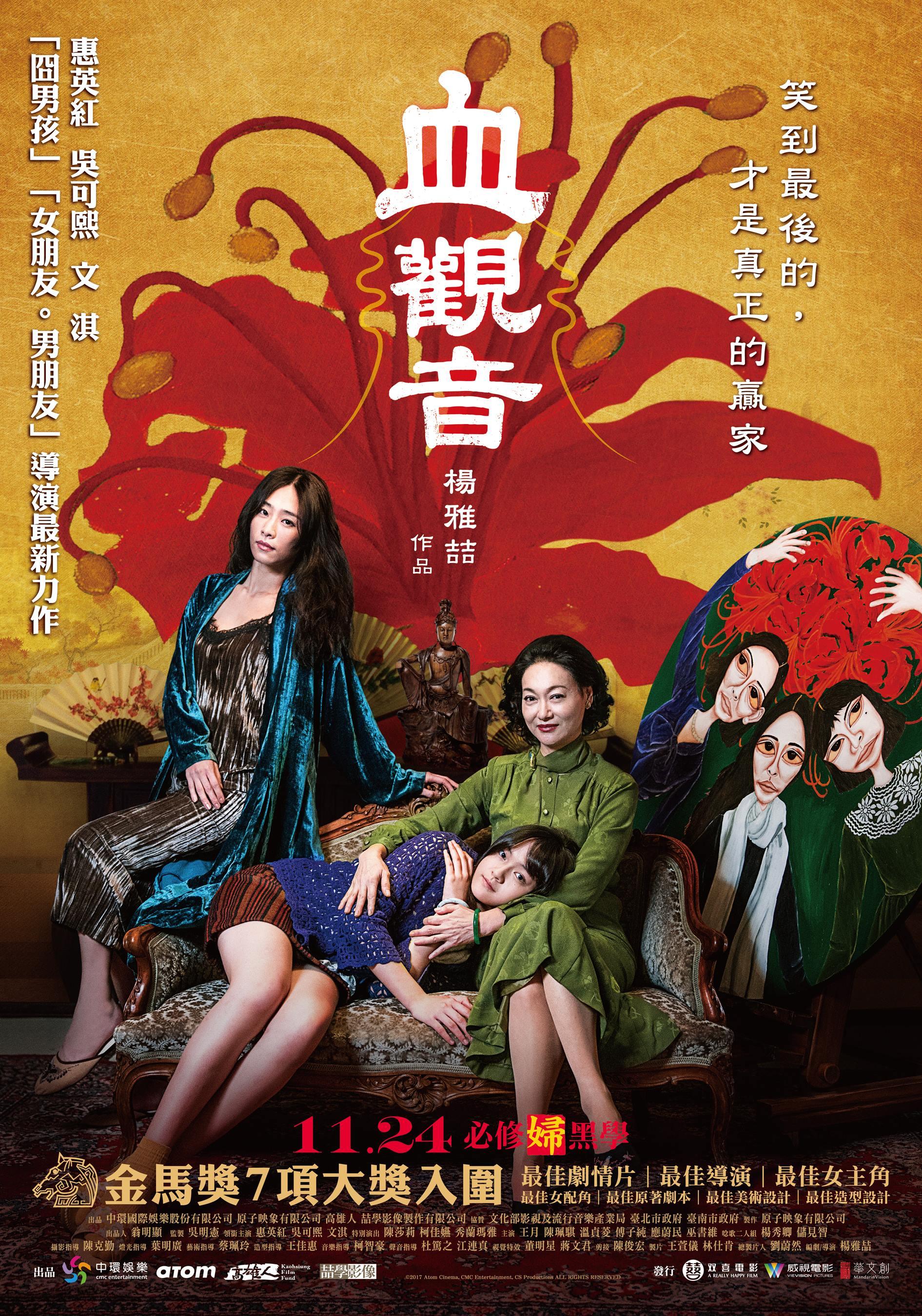
The Bold the corrupt and the beautiful posterAre you playing the game or is the game playing you? The Bold, the Corrupt, and the Beautiful (血觀音, Xuè Guānyīn) is, as its name suggests, somewhere between trashy soap opera and spaghetti western as its entirely amoral matriarch prepares to sacrifice everything in order to get ahead. The family becomes a metaphor for the state – corrupt, prejudicial, hypocritical, and often heartless in its ruthlessness but like a family a state perhaps reaps what it sows and the lessons Madame Tang has taught her daughters may come back to haunt her.

In the Taiwan of the 1980s – the dying days of the old regime but firmly within the pre-democratic past, Madame Tang (Kara Hui) is the widow of a general and, on the surface of things, an antiques dealer. Her real worth however lies in making herself the society face of genial corruption as the conveyor of the ancient treasures that often stand in for monetary bribes in the complex system of reciprocal politics. Designed to manoeuvre herself and her family into a position of power and perhaps safety, Madame Tang’s machinations amount to a mess of intrigue, manipulating the social interactions of her “friends” in order to convince them to destroy each other and clear a path for her ascendance. Part of her grand plan has involved extensive use of her daughter, Ning Ning (Wu Ke-xi) – now approaching middle-age and thoroughly sick of being her mother’s prize pony, while Chen-Chen (Vicky Chen), still a teenager, has usurped her place as the latest cute little thing to be trotted out and fussed over.

Everything starts to go wrong when a powerful neighbouring family, the Lins, is murdered in a suspicious looking home invasion leaving the daughter, Pien-Pien (Wen Chen-ling), who was the closest thing Chen-Chen had to a real human friend, in a coma. Pien-Pien had been carrying on with Marco (Wu Shuwei) the stable boy which obviously had not gone down well with her parents though she had backed out of a plan to elope with him. The police’s theory is that Marco had come back to the family home and taken his revenge, but there is an awful lot more going here than just a jealous proletarian boyfriend hitting back at the bourgeoisie.

Piling layer upon layer Yang’s script is dense and sometimes impenetrable to those not well versed in Taiwanese history and culture. Madame Tang seems to have something of an interesting hidden backstory, swapping easily between standard Taiwanese Mandarin, Cantonese, and Japanese which she, and Chen-Chen, use to get close to Mrs. Lin whose grasp of Taiwanese remains poor despite having lived on the island for many years and being heavily involved in politics. The house the family inhabits is also distinctly Japanese in layout, a colonial era home now inhabited by post-war migrants from other areas of China. The Lins look down on their stable boy not only because of the obvious class difference, or because of their daughter’s relative youth and tarnished reputation, but because he is from a persecuted minority of native peoples.

Marco does however become a kind of key. Chen-Chen, curious and privy to more knowledge than a child of her age ought to have thanks to her mother’s scheming, has developed a fondness for the strapping stable boy and mildly resents being made fun of by the oddly amused Pien-Pien. The rot sets in as Chen-Chen is sent to fetch Ning-Ning only to find her engaging in some kind of orgy in a forest, over which Chen-Chen lingers a little to long only to catch Ning-Ning’s eye and find herself suddenly caught out while her “sister” apparently finds extra spice in her discomfort. Ning-Ning, after years of emotional abuse at the hands of her mother, has begun to rebel by embarrassing her, losing herself in drink, drugs, and promiscuous sex with unsuitable men while Madame Tang still harps on about possible dynastic marriages if now to a distinctly third class tier of potential husbands.

Yang adds a post-modern dimension to the story by framing it as a cautionary tale recounted by a pair of traditional musicians in the manner of Gezi Opera which begins closer to the now before flashing back to show us how we got here. Even if the political metaphors do not hit home without some kind of primer in Taiwanese history, the familial allegory is obvious enough – corruption breeds corruption and the hollow family will eventually swallow its young. The closing coda, presented via intertitles, reminds us that the scariest prospect is not imminent punishment, but a loveless future. The Tangs’ tragedy is not that there was no love between them, but that in their cynicism and insecurity they destroy themselves through a selfish need for control and possession. Madame Tang’s lessons have indeed been learned too well, and in this she damns herself as well as her daughters, condemning all to a loveless future fuelled by greed and fear from which it is impossible to escape.


The Bold, the Corrupt, and the Beautiful was screened as part of the New York Asian Film Festival 2018.

Original trailer (traditional Chinese subtitles only)

Interview with director Yang Ya-che from the 2017 Busan Film Festival (English subtitles)