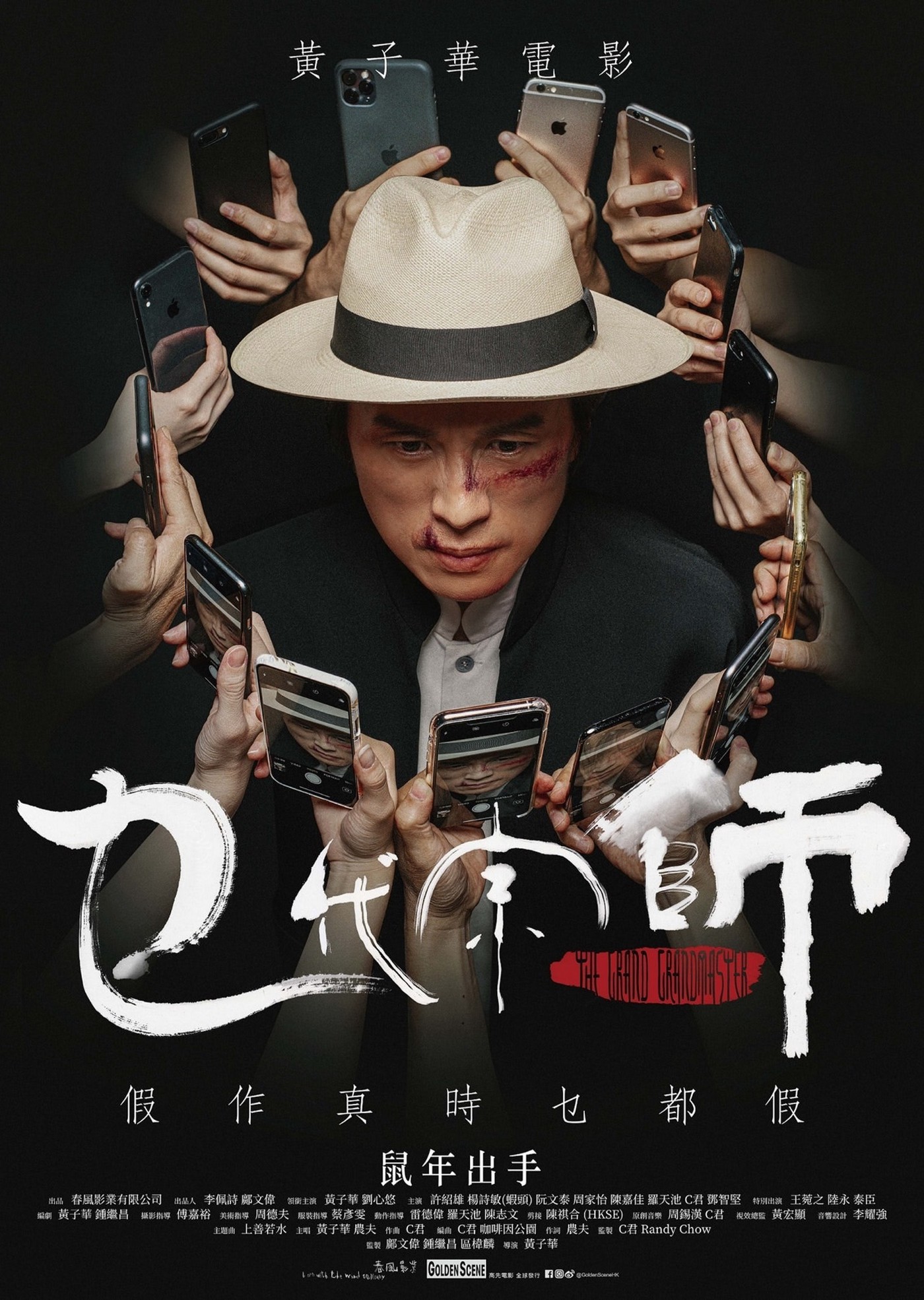
The Grand Grandmaster (乜代宗師, Dayo Wong, 2020)

Are you actually “the grandmaster” or just a bit “grand”, the hero of The Grand Grandmaster (乜代宗師) is eventually forced to ask himself after being confronted with the various levels of his self-delusion. Legend has it that comedian Dayo Wong sold an apartment to finance his second directorial feature in order to produce a purely local film without having to submit himself to the strictures of the Mainland censors’ board or accept funding from the greater PRC, a move which endeared him to the young protestors then still out in the streets campaigning for democracy. The Grand Grandmaster was one of the few New Year films to make into cinemas before they shut down because of the pandemic but aside from Wong’s grand gesture is perhaps light on political content, save for a mild satire on the commercialisation of kung fu. 

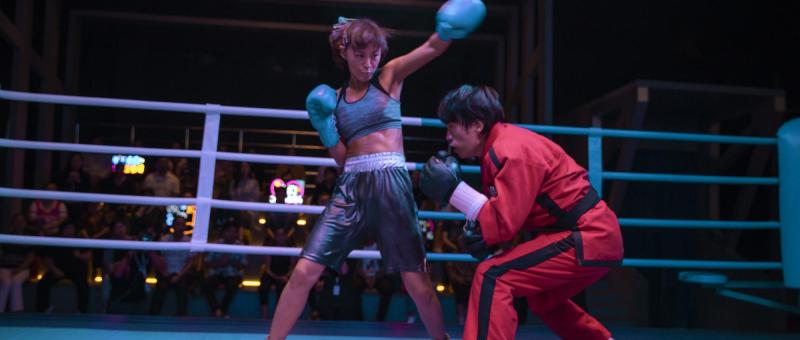
The Grand Grandmaster, Ma Fe-lung (Dayo Wong Chi-Wah), is the latest guardian of the Ma Ka Thunder Style martial art apparently carried by one of his ancestors to Hong Kong from the Mainland during the Song dynasty. Ma Ka Thunder has since become something of a brand with its own dedicated merchandising line and video ads playing on giant billboards featuring Fei-lung himself as the face of the organisation. His hopes for US expansion along with his general business plan are disrupted when he gets into a public altercation with an old man who tries to steal his taxi and then makes a scene claiming that Fei-lung hit him leading Chan Tsang (Annie Liu Xin-You), the “boxing goddess”, to emerge from the shadows and give Fei-lung a public beating. Filmed by everyone in the surrounding area, the event becomes a viral phenomenon that leaves Fei-lung humiliated but while his minions urge him towards a public rematch to regain his reputation, Fei-lung is consumed with despair on realising there is no way he could ever hope to defeat the feisty young woman. 

Wong has fun satirising the lore of kung fu as Fei-lung outlines the strange tenets of the Ma Ka Thunder Style which turns out to make more sense that it first seems only generations of practitioners have it seems forgotten something quite fundamental. Fei-lung and his associates have to ask themselves if the art of Ma Ka is really just “fake fighting”, something suggested to Fei-lung by his loyal assistant who makes a point of overdoing his defeat and admits he only stays with the school because living outside is hard and here he gets room and board. Urged to show his full strength, he effortlessly defeats his master but only by abandoning Thunder Style for a selection of moves from other martial arts. 

The remainder of the film sees Fei-lung trying to “dodge” Tsang, firstly by trying to bribe her to throw the fight for him and then by convincing her to get more “comfortable” with the idea of losing. Events take a rather strange turn when Tsang’s dad gets involved and starts training Fei-lung for real in an effort to get back at his daughter for quitting boxing after a single defeat apparently humiliating him in another nod to the film’s strangely sexist worldview. Tsang bizarrely falls for Fei-lung after witnessing the depths of his self-delusion in his complex relationship with his ex-wife, building to a crisis which accidentally makes a case for domestic violence in insisting that Tsang will only believe that Fei-lung really loves her if he defeats her in the ring. 

Nevertheless, the conclusion is an oddly egalitarian one in which there is no win, no lose, no draw. Fei-lung realises the various ways in which he’s been deluding himself and presumably emerges with a little more clarity, awakened to the true meaning of the “virtue like water” motto of Ma Ka Thunder Style which apparently lies in generosity of spirit, giving without expecting in return and like water trickling down. Which is to say, Fei-lung learns to stop dodging life’s blows, to give up on tricks and fakery, and to be a little more authentic, which is perhaps how he wins Tsang’s heart and respect. A committed performance from Liu helps to mitigate some otherwise flat comedy though the saga of the kung fu con man rediscovering his sense of social responsibility through a true appreciation of martial arts never quite hits home, while a strange mid-credits diversion perhaps proves one move too far.


Trailer (Traditional Chinese / English subtitles)
Legally Declared Dead (死因無可疑, Steve Yuen Kim-Wai, 2019) [Fantasia 2020]

“The road to hell is paved with good intentions” a well-meaning insurance agent is advised in Steve Yuen Kim-Wai’s Legally Declared Dead (死因無可疑), though he struggles to fully understand its meaning and in the end you have to wonder how good his intentions really were. Yusuke Kishi’s novel The Black House has been adapted twice before, firstly in an idiosyncratically absurdist take by Yoshimitsu Morita, and then in Korea by Shin Terra who remained firmly within the realms of contemporary K-horror. Yuen lands somewhere between the two, adopting a stylish veneer of neo noir as the traumatised hero has his worldview upended by heinous immorality. 

Yet as Wing-shun (Carlos Chan Ka-Lok) tells Ching (Stephen Au Kam-tong), the office investigator, he’s just a broker and it doesn’t do to be suspicious of all his clients. A nice, well mannered young man, Wing-shun is all poised customer service charm, but he also firmly believes that the business of insurance is a noble good, that he’s helping people by being there for them when disaster strikes. As such, he doesn’t like to think that people are abusing the system, and is reluctant to reject a claim. On the other hand, he calms a pair of panicked gangsters who are most definitely on the fiddle by explaining that neither he nor his colleague can help them because being a broker is like being a dealer at the casino, they can only push the paperwork to the floor manager who alone has the authority to decide whether or not to pay out and wait for their instructions. 

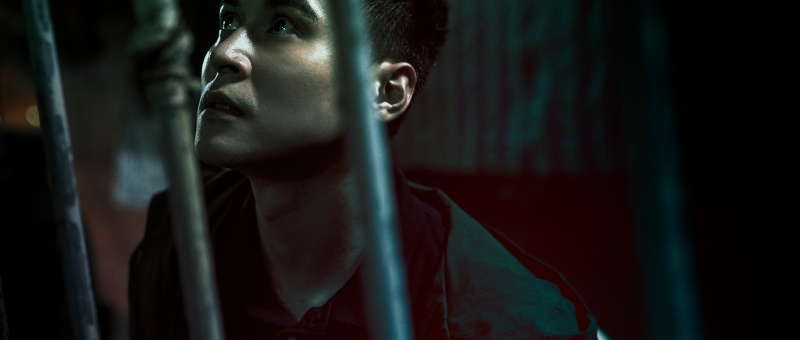
Wing-shun’s casino metaphor is more true than he intends it, what else is insurance after all than a kind of gambling? Wing-shun can tell himself he’s there to provide relief and support in times of need, but really he’s betting against misery which might be better than betting in its favour but it’s still wagering people’s lives. That fact’s brought home to him when he takes a call late one evening from a man who asks him if they pay out on suicide. Cheerful as ever, Wing-shun asks for his policy number to check the paperwork before realising the darkness inherent in the question and telling the person on the other end of the phone not to do anything rash, “money doesn’t solve everything”. The man simply asks for his name and then abruptly hangs up. Wing-shun chalks it up to just another weird thing that sometimes happens and forgets about it but the next day he’s told that a client has personally requested him to talk over their policy and wants a home visit to a rural location outside the city. A little bemused, Wing-shun does as he’s told and encounters Chu Chun-tak (Anthony Wong Chau-Sang), not realising he’s the man from the phone only noticing he’s behaving quite strangely. Suddenly Chun-tak starts shouting for his son Kafu and gesturing to another room inside which Wing-shun discovers the boy hanging. 

The boy’s death triggers painful memories for Wing-shun who is burdened with a sense of guilt over the death of his older brother in childhood. Unable to escape the idea he’s been set up and Chun-tak only invited him out here to “find” the body, Wing-shun is convinced that he killed Kafu in order to claim his life insurance payout. Kafu was Chun-tak’s stepson and also had learning difficulties, while Chun-tak’s wife Shum Chi-ling (Karena Lam Ka-Yan) is partially sighted and walks with a pronounced limp. Wing-shun is particularly worried because Chun-tak also has a policy on her and it’s reasonable to assume she’ll be next in the firing line. He struggles, however, to convince others of his suspicions. The policeman investigating closes the case when the autopsy comes back with suicide as the cause of death, attributing the motive to exam stress, while the insurance company fails to find evidence to deny the claim.  

Unlike the other adaptations, Legally Declared Dead keeps the suicide option on the table while Wing-shun begins to go quietly out of his mind. Meanwhile, his psychology student girlfriend (Kathy Yuen Ka-Yee) hooks him up with her dubious professor (Liu Kai-chi) who is studying the “criminal personality” and claims that while some people commit crime because of trauma and desire a few so because they’re simply born bad and can never be saved. These people, he says, are manipulative narcissists who often exploit the vulnerable, making them a kind of “slave”. Professor Kam becomes overly invested in Wing-shun’s case, convinced on meeting him that Chun-tak is a clear case of “criminal personality”, murdered his son, and is almost certainly going to murder his wife. But is it really fair to decide someone’s killed their child just because they’re a bit odd and admittedly desperate for money, aren’t they just being judgemental and prejudiced? Come to that, is it sexist and ablest to assume that Chi-ling is naive and powerless, that she is a potential victim and could not have been involved in her son’s death or conversely maybe planning to off her husband?

Wing-shun lives with a collection of rare insects including a few praying mantises, which he states cannot be caged in pairs because the female will devour the male, but he continues to think of Chi-ling as sweet and harmless seeing her tenderly calm her husband down after starting to accompany him on their daily visits to the insurance office to ask about the money. On the other hand, with her limp and milky eye Chi-ling is also uncomfortably coded as villainous in an unpleasant alignment of physical deformity and “evil”, while Chun-tak is also assumed to be abusive largely because he struggles to communicate in the “normal” way. 

Nevertheless, the idea that some people are deliberately maiming themselves to claim on “workers’ insurance” either at their own behest or forced into it by loansharking gangsters pursuing gambling debts is presented as no real surprise just another element of a cynical and duplicitous society. Wing-shun knew this, but perhaps didn’t really believe it. The Chu case exposes to him the ugliness of the world in which he lives, raising with it old memories of his childhood trauma, the very kind of trauma which professor Kam insists causes some to commit crimes. Becoming fixated on the idea of Chun-tak as a murder, Wing-shun descends into nervous paranoia but is perhaps less interested in getting justice for Kafu and protecting Chi-ling than vindicating himself and defending the “nobility” of insurance as a concept for social good while avoiding dealing with his own childhood trauma in refusing his responsibility towards his brother. 

Shooting the pulpy material with a stylish, B-movie sheen, Yuen closes with a Silence of the Lambs-inspired climax which sees Wing-shun venture alone into the nest of a killer, repeatedly blinded by ultraviolet light and denied the ability to fully asses his reality. He thinks he finally understands Ching’s caution that the “road to hell is paved with good intentions” which he perhaps had in his desire to get justice for Kafu and protect Chi-ling, but in the end he might have to admit that the killer had a point when they said he  was “just like me”, a “criminal personality” consumed by latent violence caused by unresolved childhood trauma. “You do what you need to to survive, you scam people and they scam you” Wing-shun’s friend shrugs, but it’s a lesson Wing-shun learns all too well, once again refusing his responsibility as a secondary victim looks to him for help but discovers only cold and cynical resentment.


Legally Declared Dead streamed as part of this year’s online edition of Fantasia International Film Festival. It will also be available to stream in New York State on Sept. 5 only as part of this year’s New York Asian Film Festival.

Original trailer (English subtitles)