Where Is the Lie? (Marupok AF, Quark Henares, 2023)

What is it that motivates acts of seemingly pointless cruelty, why do people obsessively waste their own lives trying to make those of others miserable? Quark Henares’ inspired by real events (depending on who you ask) catfishing drama Where is the Lie? (Marupok AF) sees a trans woman fall victim to homophobic love fraud amid a climate of intense transphobia and subsequently make the decision to take a stand not as a petty act of revenge but to reclaim her dignity and protect her community while generously wishing her tormentor well. 

The catfisher, Beanie (Maris Racal), is given the right to reply through a series of confessional videos which slowly gain prominence towards the film’s conclusion. She admits that she knows what she did but does not really understand why she did it save justifying herself that she’s been “bullied” by members of the LGBTQ+ community in the past. She deliberately mangles the acronym and makes a point of using male pronouns to refer to the trans woman she’s currently targeting, Janzen (EJ Jallorina), but later starts to slip up instinctively using “she” after spending months talking to her normally over a dating app posing as buff model Theo (Royce Cabrera). Asked what the point of all this is, Beanie doesn’t have much of an answer beyond the cruelty itself explaining that the end goal is simply to ghost the target once they’ve made an emotional connection to cause them to feel hurt or humiliated. Perhaps these seem like low level consequences to Beanie who regards the catfishing as something like a weird hobby though one she expends an immense amount of time on seeing as she doesn’t appear to have anything else going on in her life aside from her actual job as a video director working in the fashion industry. 

The strange thing is though is Beanie describes Janzen as fun to talk to and they even seem to strike up a genuine connection over their shared interest in design. Beanie then finds herself in dilemma, simultaneously accelerating the plan to avoid having to deal with her complicated feelings but then restarting it after its natural end point by inserting herself into the conversation posing as Theo’s cousin and apologising on his behalf for his treatment of her in a moment of panic. The implication is that Beanie’s behaviour is motivated by an internalised homophobia in which she cannot bear to admit her desire for other women keeping her connection with Janzen because she is attracted to her but simultaneously denying it through a deliberate attempt to cause her pain and humiliation in returning her feelings vicariously through the fake Theo persona.

Some may feel that the film to too sympathetic towards outward transphobe Beanie or that once again implying the villain is closeted is unhelpful, but there may be something in her claims to be a kind of victim too in that her internalised homophobia is caused by societal conservatism in a largely Catholic, patriarchal culture. The film is clear on the dangers and discrimination Janzen faces daily both online and off as her friends remark on the case of a trans woman being arrested for using the ladies’ bathroom and later TV news footage shows president Duterte pardoning a US soldier who had been convicted of murdering a transgender sex worker. As the film begins, Janzen’s boyfriend breaks up with her over his discomfort about publicly dating a trans woman, implying that he is ashamed or embarrassed in his inability to explain the relationship to his older conservative parents. An online date then goes south when he realises she is trans. As her friends tell her Theo seems too good to be true especially as his social media only contains professionally taken photos and no personal posts or connections but Janzen is blinded by love and deeply wants to believe that the relationship is “real”.

That might go someway to explaining why she puts up with so much nonsense from Theo and continues to interact with him even after he calls her a series of slur words, leaves her waiting at the airport for a fake meeting, and then dumps her in a Jollibee after convincing her to travel all the way to Manila knowing she has no return ticket or place to stay. Playing out almost like an incredibly perverse Cyrano de Bergerac, the film at times pushes Janzen into the background in favour of exploring Beanie’s motivations for her seemingly senseless, sadistic cruelty, but subsequently allows her to reclaim centrestage in owning her own story by taking a stand against transphobic bullying on behalf of the other victims and her wider community while very much claiming the moral high ground by wishing Beanie nothing but peace though whether she’ll ever find it is anybody’s guess. 


Where Is the Lie? screened as part of this year’s New York Asian Film Festival

Original trailer (English subtitles)

Images: © Anima Studios, Kroma Entertainment, December 2022.© 2022 Kroma Entertainment. All Rights Reserved

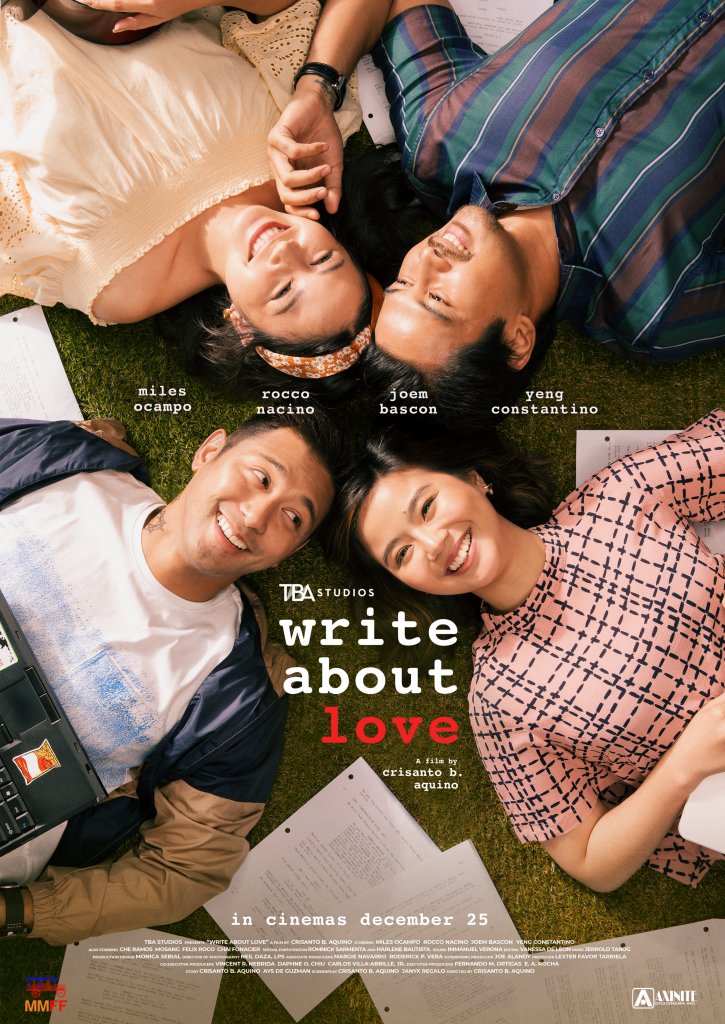
Write About Love (Crisanto Aquino, 2019)

Write what you know, the old adage goes, but can you really write about love if you’ve never been in it? The debut feature from Crisanto Aquino, Write About Love concerns itself not only with romance but with love in a wider sense as mediated through the act of creativity. Two writers are forced into an awkward collaboration working in some senses at cross purposes but eventually find common ground as their shared endeavour pushes them towards acts of self interrogation as they attempt to write a sincere romance with an ending that satisfies all. 

Credited only as “female writer” (Miles Ocampo), a young woman obsessed with rom-coms successfully pitches one of her own titled “Just Us” to a major studio. Though they like her ideas, the suits call her back in a few days later and express concern that her scenario is too similar to an upcoming movie from a rival studio. Rather than a traditional meet-cute rom-com, they want her to focus on what came next, not the story of how they got together but a serious relationship drama about all the boring bits of being in love. To help her out, they’ve decided to team her up with an experienced “indie” screenwriter (Rocco Nacino), and have given the pair one month to thrash out a first draft. 

Of course, things get off to a bumpy start. She’s very “mainstream”, He’s quite cynical, which might make for an interesting dynamic if they weren’t constantly clashing on a personal level. He pushes his experience, She pushes her earnestness. Still, they begin to become closer writing the story of Joyce (Yeng Constantino) and Marco (Joem Bascon), an aspiring musician and a company man who meet and fall in love but find that life gets in the way of their grand romance. The pair decide to structure their drama around various anniversaries – 100 days, 200 days, a year etc, during which Joyce and Marco grow apart, discover that they have different priorities, and eventually break up after an intense argument that lays bare Marco’s insecurity and ongoing abandonment issues which lead him to put his foot down over Joyce’s career ambitions in Korea. 

Meanwhile, the real lives of the writers begin to influence the drama as they hover on the sidelines observing their fictional romantics and plotting out where they might go next. Despite their intention not to write a “mainstream” romance, they are perfectly happy to play with standard melodrama plot devices like job offers from overseas and terminal illnesses as they try to tell the story of Joyce and Marco, but, it seems, those “plot devices” also come from their lives. He had a longterm relationship end because his lover went abroad and met someone else, while she is romantically naive and still hung up on the failure of her parents’ relationship. In fact, her parents’ meet cute inspired the one in Just Us though she hoped to rewrite their story with a happier ending where her dad didn’t eventually leave them to go back to an old girlfriend. 

He asks her if she’s never been in love because she’s afraid of getting hurt, She tells him she’s just not interested, but is eventually forced to deal with her sense of insecurity through accepting the fact that her family is never getting back together. He actually doesn’t tell her much of anything, but is later forced to accept that love is a choice he may have failed to make. We expect that the writers will eventually fall in love while writing the saga of Joyce and Marco, but first they have to discover a few things about themselves, about love, and about suffering. Questioning her mother, She finds out that love is great motivator, prompting you to make decisions good and bad, while He realises that just as in real life you can’t manipulate your characters to force them to do what you want because feelings must be earned to be sincere. Love and pain are inextricable, but love is also an energy which cannot be created or destroyed and endures even after death, according to Her, coming to the conclusion that you need two for a love story and creation is a collaborative effort. Maybe you can’t write yourself out of heartbreak, or give yourself a better ending than life saw fit to give you, but if you’re going to write about love you have to be honest and honest is never easy. 


 Write About Love was screened as part of this year’s Osaka Asian Film Festival.

Original trailer (English subtitles)

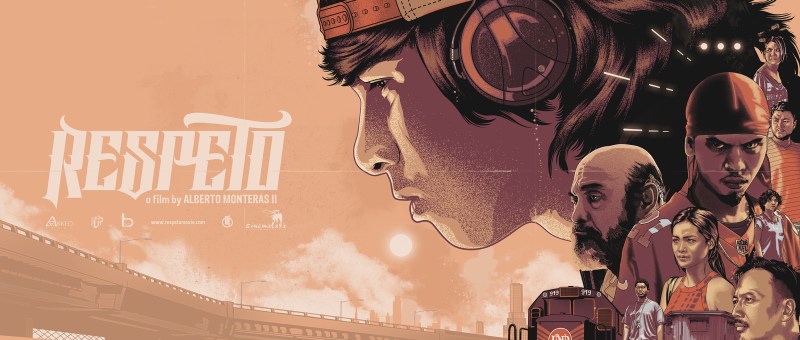
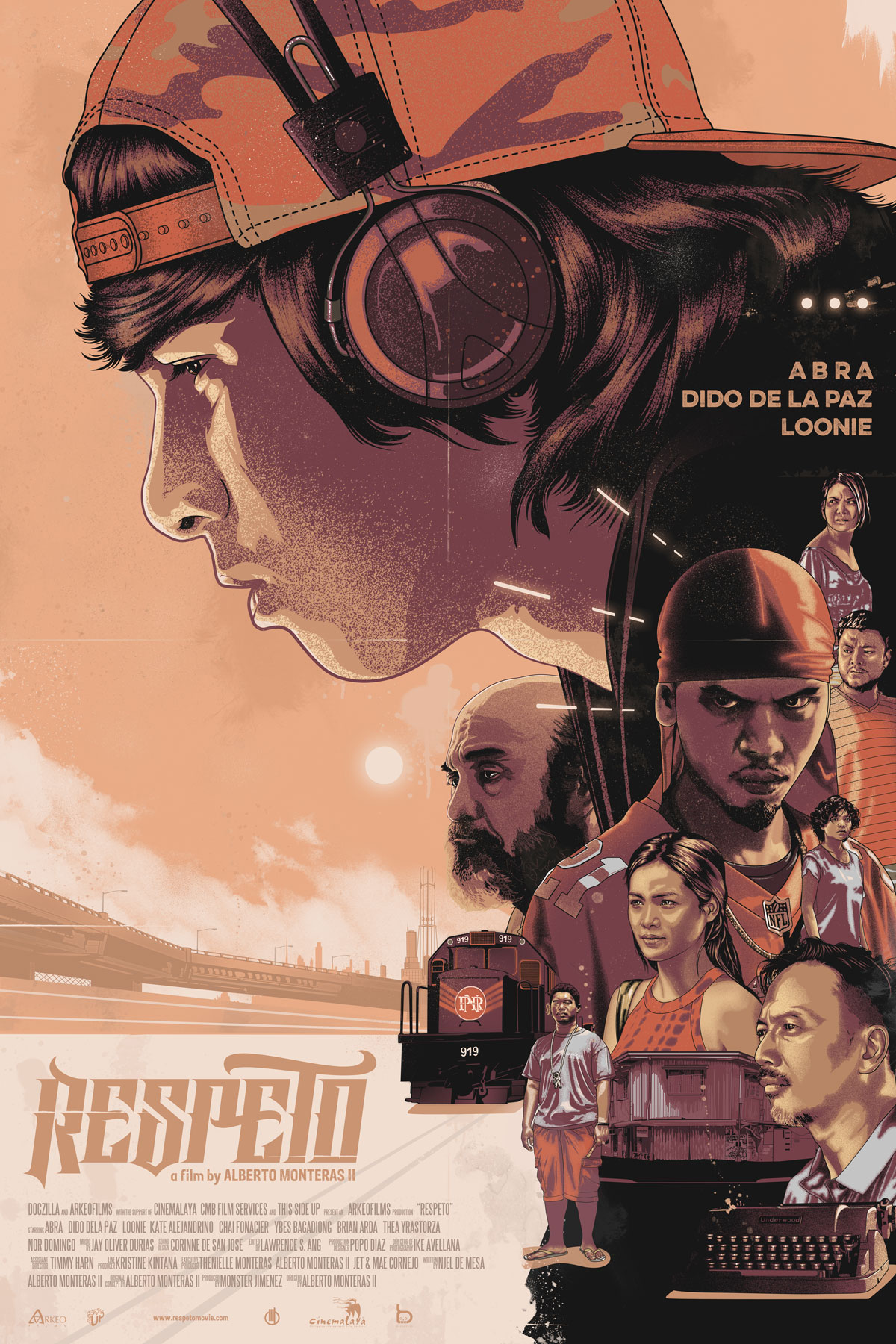
Respeto (Alberto Monteras II, 2017)

https://www.respetomovie.com/

https://www.respetomovie.com/“Respect” is a thorny issue, is it something which is conferred from a position of inferiority, an acceptance of equality, or taken by force? Should the older generation be “entitled” to the respect of the young simply for having been born earlier, lived longer, and have less time left, and should the state also be “entitled” to the respect of its citizens even if it abuses that respect? Respeto is the debut feature from Alberto (Treb) Monteras II but like much Philippine cinema it comes with heavy baggage as its scrappy youngster attempts to come of age in the hip hop dens of the Pandacan slums where all around him the increasingly oppressive Duterte regime brings back terrible memories for a generation only once removed from his own which paid a heavy price to rid themselves of a tyranny they now see returning.

Hendrix (Abra), a scrappy teen living with his older sister and her boyfriend who prides himself for his magnanimity in supporting his lover’s annoying kid brother, says he has the “mind of a gangster” and longs to prove himself in the underground rap battling world which represents a kind of escape from the harshness of his everyday existence. Hip hop maybe the music of the oppressed, but there’s little politicking in arcane world of petty gangsters and drugged up thugs. This is a world of humiliation – the rappers rap about rapping, about how their rhymes are sweeter than their opponent’s, how their opponent is weak and they are strong. Despite an often careful honing of a craft, this rap is vacuous – a misuse of words that could serve real purpose to do little more than replace the act of physical violence with macho male posturing.

This is certainly a very male, macho world. Inducted into the rap battle scene, Hendrix is tricked into battling an old veteran, Jambalaya – a larger lady with an intimidating presence, but all he can come up with is a steady stream of misogynistic fat jokes, badly delivered, before he wets himself live on stage. Jambalaya quite rightly destroys him with an elegantly delivered takedown which subtly suggests everything he’s just said is completely beneath him and is therefore doubly insulting. Hendrix is humiliated, as the loser of the battles is intended to be, but he’s slow to realise that the game itself is already a betrayal of its own power.

Having stolen the money to participate in the rap battle from Mondo (Brian Arda), his sister’s dodgy boyfriend, Hendrix hits on an extreme solution to pay him back – robbing the secondhand bookshop run by an old man, Doc (Dido De La Paz), seemingly suffering with the early stages of dementia. The plan fails because Hendrix and his buddies aren’t exactly master criminals, but as a result they find themselves tasked with having to repair the damage while Doc, mildly outraged by the youth of the day, begins to see enough potential in the obviously bright yet stubborn young man to want to try to save him.

What occurs between them is somewhere between a war of words and a war for words. Doc, now an old man, was an activist poet during the Marcos regime who lost a wife and child to its brutality. In the end, his words were not enough but unlike those of the rap battlers of Pandacan, they were both beautiful and filled with purpose. Doc’s verses were, in a sense, intended to humiliate a regime – in this they are not so different from Hendrix’s rhymes, but they failed to take the place of violence. A man of words faced with the possibility of revenge, Doc was not strong enough to resist but bought himself only more anguish in a single act of primal rage that soon forged another link in a chain stretching out in both directions across an eternity.

Peppered throughout, radio broadcasts make frequent reference to a debate surrounding the long delayed burial of former dictator Ferdinand Marcos who died in exile in 1989. The older generation fought an oppressive regime and thought they’d won only for their children to betray the revolution they gave birth to – literally in Doc’s case as his son became a corrupt policeman who abuses his power to humiliate those whose should “respect” he ought to earn through continued service. Rendered powerless by their oppressive environments, both Doc and Hendrix sought to reclaim their self respect by asserting their voice, but in the end their words find only empty air. Somehow awed by ancient technology, the kids find an old record of a Marcos era protest song in Doc’s bookshop and realise they already know the words. The singer, seemingly a young person, begs to be left out the political storm, not to be dragged into a war he sees as nothing to do with him, but an escape from this unending cycle of violence seems unlikely while words remain weightless.


Available to stream online via Festival Scope until 20th February 2018 as part of its International Film Festival Rotterdam tie-up.

Original trailer (English subtitles)