
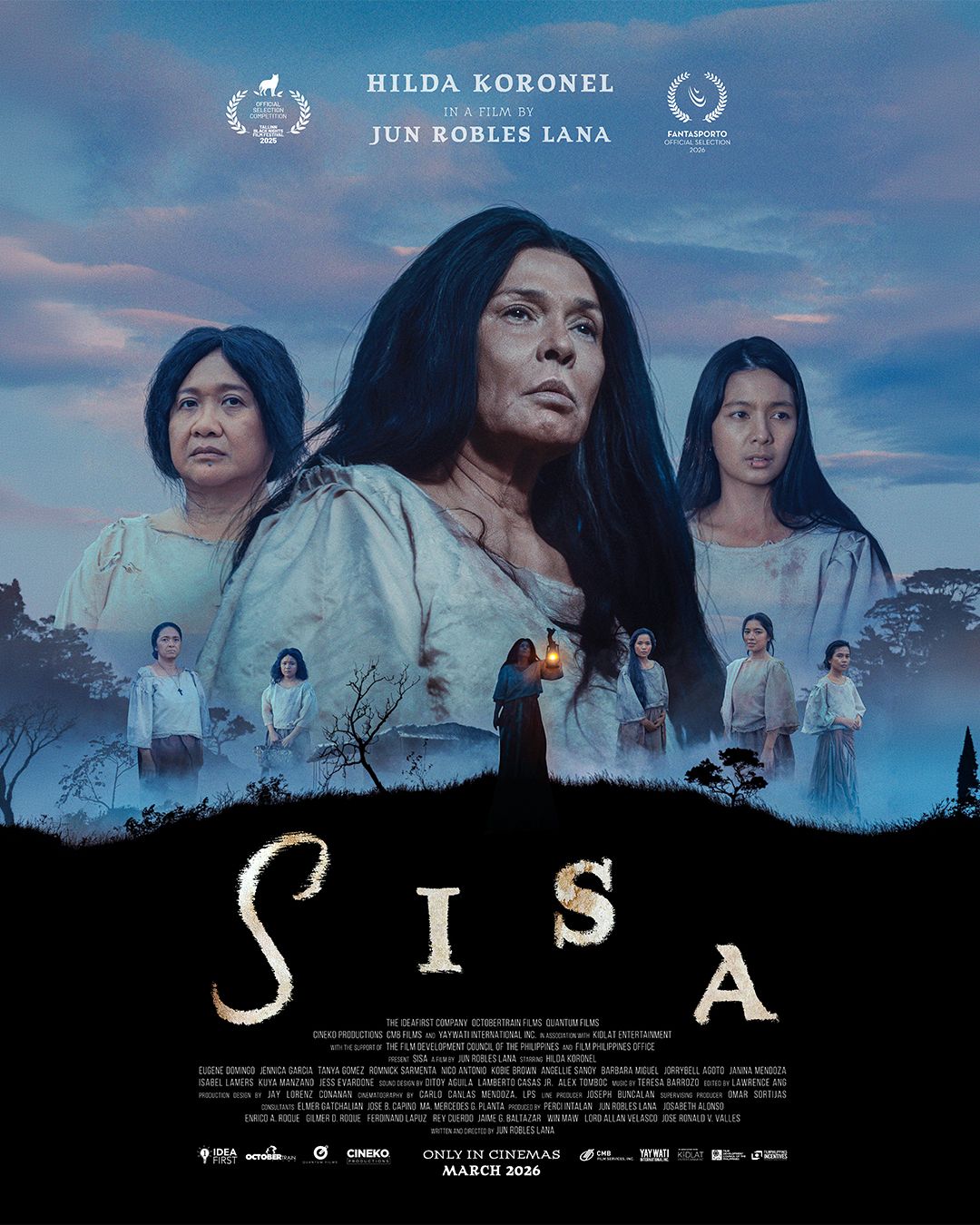
Sisa (Jun Robles Lana, 2025)

The woman who will come to be known as Sisa (Hilda Koronel) enters the frame like a wandering spirit, a ghost of a ruined land come to haunt those who would now attempt to “rebuild” it. She looks at the young soldier atop a guard tower with witchlike intensity, cursing him with her eyes though smiling beatifically before urinating on the ground. This land that you have scorched, I shall water, she seems to say, even as her actions are intended to make her seem “mad” and in that way essentially harmless, or at least harmful only to herself.

Set in 1902, Jun Robles Lana’s steely drama explores the traumatic legacy of colonialism through the experiences of a collection of women living a concentration camp during the Philippine–American War. America had annexed the Philippines after the Spanish American War, denying the nation’s attempt to assert its own independence after the collapse of the Spanish Empire. According to the title cards opening the film, America pursued a scorched earth policy when faced with resistance resulting in the genocide of thousands of Filipinos. The community of women at the film’s centre who have been forced into a concentration camp have each lost husbands and children as a result of the war and are then both dependent on and brutalised by the American military.

In fact the camp’s commander, Harrison (Kuya Manzano), describes Sisa as “another lunatic thanks to this war.” Her “madness” is understandable, yet her “inability” to remember her name is also an expression of the ways in which her culture has been taken from her. Harrison assumes her to be an insensible fool, though it seems that Sisa is able to understand his incredibly ham-fisted attempts at speaking Spanish along with his English, yet makes no reply because for now silence is her weapon. It is useful for her to appear “mad” as it gives her an excuse to go wandering and no one much expects that she could secretly be plotting against them.

On the other hand, this “madness” is also a rejection of the forced assimilation the Americans seem to be intent on. When none of the women respond to Harrison’s Spanish, he complains that if no one can speak it after 300 years of colonisation, what hope does English have. He does not appear to consider that perhaps they just don’t want to talk to him. In any case, the Americans have made it compulsory for the children to learn English with 13-year-old Nena (Angellie Sanoy) a perfect model of what they hope to achieve. Proud of her accomplishments and enamoured with this new culture, she comes to sympathise with the Americans while the older women remain wary and much more aware of the wilful erase of their culture. Mrs Warren (Isabel Lamers) speaks condescendingly of their lack of the “civilisation” which she is bestowing on them as a gift. She encourages Nena to use cutlery, which, her mother points out, is a rather moot point when all you ever get to eat is baked sweet potato.

Mrs Warren rather insensitively organises a ball to cheer everyone up, forcing the women to wear American-style ballgowns she actually picked up cheap from a disbanded theatre troupe. Just like Sisa’s madness, these are costumes they are forced to wear to survive, but the women are all but ignored at the party and completely bored by this offensive celebration of the legitimisation of their enslavement. Most of them leave early with only Leonor (Jennica Garcia), who has become Harrison’s mistress, staying behind. Leonor has convinced herself that Harrison is actually a “good man who cares about out country” hamstrung by the wider politics of the situation. This is perhaps also a costume she wears to survive, enjoying the perks of being close to Harrison such as receiving fresh bread from Manila while believing that the other soldiers see her as his “wife”. But at the same time, Harrison forces her to turn on her fellow countrymen, publicly slapping a woman who had criticised her as a traitor and a whore.

This theme of sexual exploitation and humiliation is later extended to the nation as a whole which is left with little option but to accept its subjugation. Sisa looks on in silence in rage along with buried maternal compassion such as her sympathy for Nena who has become pregnant by a young American soldier she believes loves her. Like many of the other women, Sisa has nothing left to lose. Her family, name, and identity have all already been taken from her, and in the end she too will have no option but to turn on her fellow countrymen in order to exact her revenge. “Our grief is endless,” she tells one of the other women, bearing out the weight of all she’s lost which only “madness” can assuage.


Sisa screened as part of this year’s San Diego Asian Film Festival.

Trailer (English subtitles)

Where Is the Lie? (Marupok AF, Quark Henares, 2023)

What is it that motivates acts of seemingly pointless cruelty, why do people obsessively waste their own lives trying to make those of others miserable? Quark Henares’ inspired by real events (depending on who you ask) catfishing drama Where is the Lie? (Marupok AF) sees a trans woman fall victim to homophobic love fraud amid a climate of intense transphobia and subsequently make the decision to take a stand not as a petty act of revenge but to reclaim her dignity and protect her community while generously wishing her tormentor well. 

The catfisher, Beanie (Maris Racal), is given the right to reply through a series of confessional videos which slowly gain prominence towards the film’s conclusion. She admits that she knows what she did but does not really understand why she did it save justifying herself that she’s been “bullied” by members of the LGBTQ+ community in the past. She deliberately mangles the acronym and makes a point of using male pronouns to refer to the trans woman she’s currently targeting, Janzen (EJ Jallorina), but later starts to slip up instinctively using “she” after spending months talking to her normally over a dating app posing as buff model Theo (Royce Cabrera). Asked what the point of all this is, Beanie doesn’t have much of an answer beyond the cruelty itself explaining that the end goal is simply to ghost the target once they’ve made an emotional connection to cause them to feel hurt or humiliated. Perhaps these seem like low level consequences to Beanie who regards the catfishing as something like a weird hobby though one she expends an immense amount of time on seeing as she doesn’t appear to have anything else going on in her life aside from her actual job as a video director working in the fashion industry. 

The strange thing is though is Beanie describes Janzen as fun to talk to and they even seem to strike up a genuine connection over their shared interest in design. Beanie then finds herself in dilemma, simultaneously accelerating the plan to avoid having to deal with her complicated feelings but then restarting it after its natural end point by inserting herself into the conversation posing as Theo’s cousin and apologising on his behalf for his treatment of her in a moment of panic. The implication is that Beanie’s behaviour is motivated by an internalised homophobia in which she cannot bear to admit her desire for other women keeping her connection with Janzen because she is attracted to her but simultaneously denying it through a deliberate attempt to cause her pain and humiliation in returning her feelings vicariously through the fake Theo persona.

Some may feel that the film to too sympathetic towards outward transphobe Beanie or that once again implying the villain is closeted is unhelpful, but there may be something in her claims to be a kind of victim too in that her internalised homophobia is caused by societal conservatism in a largely Catholic, patriarchal culture. The film is clear on the dangers and discrimination Janzen faces daily both online and off as her friends remark on the case of a trans woman being arrested for using the ladies’ bathroom and later TV news footage shows president Duterte pardoning a US soldier who had been convicted of murdering a transgender sex worker. As the film begins, Janzen’s boyfriend breaks up with her over his discomfort about publicly dating a trans woman, implying that he is ashamed or embarrassed in his inability to explain the relationship to his older conservative parents. An online date then goes south when he realises she is trans. As her friends tell her Theo seems too good to be true especially as his social media only contains professionally taken photos and no personal posts or connections but Janzen is blinded by love and deeply wants to believe that the relationship is “real”.

That might go someway to explaining why she puts up with so much nonsense from Theo and continues to interact with him even after he calls her a series of slur words, leaves her waiting at the airport for a fake meeting, and then dumps her in a Jollibee after convincing her to travel all the way to Manila knowing she has no return ticket or place to stay. Playing out almost like an incredibly perverse Cyrano de Bergerac, the film at times pushes Janzen into the background in favour of exploring Beanie’s motivations for her seemingly senseless, sadistic cruelty, but subsequently allows her to reclaim centrestage in owning her own story by taking a stand against transphobic bullying on behalf of the other victims and her wider community while very much claiming the moral high ground by wishing Beanie nothing but peace though whether she’ll ever find it is anybody’s guess. 


Where Is the Lie? screened as part of this year’s New York Asian Film Festival. 

Original trailer (English subtitles)

Images: © Anima Studios, Kroma Entertainment, December 2022.© 2022 Kroma Entertainment. All Rights Reserved