Four Moods (喜怒哀樂, Pai Ching-Jui, King Hu, Li Hsing, Li Han-Hsiang, 1970)

A key figure in the history of Sinophone cinema, Li Han-Hsiang migrated to Hong Kong from the Mainland in 1948, studying originally as an actor at the Yong Hwa Film Company under the director Zhu Shilun before performing various roles in the industry working as a set painter and graphic artist as well as in voice acting. After his directorial debut Red Bloom in the Snow proved a critical hit, he joined Shaw Brothers in the mid-1950s where he became instrumental in the success of the studio’s hugely popular period musicals inspired by Huangmei opera including the classics The Kingdom And the Beauty (1959) and The Love Eterne (1963). In 1963 he left Shaw Brothers to found Grand Motion Picture Company in Taiwan, helping to further the burgeoning Taiwanese film industry where the Huangmei musicals had proved so popular. Unfortunately, however, the Grand Motion Picture Company ran into financial trouble in the late 1960s and Four Moods (喜怒哀樂, Xǐnù’āilè), a four-part historical portmanteau piece featuring instalments from the most prominent directors of the day including Li himself, was in part intended to improve its flagging fortunes. Unfortunately it was not in that regard successful and Li eventually returned to Hong Kong, founding another production house before rejoining Shaw Brothers in 1972. 

The first of the Four Moods, Joy, is directed by Pai Ching-Jui who studied filmmaking in Italy in the early ‘60s and was heavily influenced by Italian neo-realism but perhaps counterintuitively his contribution is an entirely wordless piece of expressionist psychedelica in which a man trying to stay awake (Yueh Yang) receives a visitation from a beautiful female spirit (Chen Chen) who seems to be the incarnation of a woman whose resting place he repaired after frightening off a disfigured grave robber, planting a pretty flower he found into the earth. The man eventually beds the demure young woman but is disappointed to find her disappeared the next morning, running out into the forest and trying the same thing again, scouring headstones looking for a woman’s name and then planting his flower only to be much less enthused with his next visitor. A visually arresting fever dream of sex and death playing out in a gothic dilapidated cottage in the middle of a foggy forest and set to a primal beat of traditional instrumentation, Pai’s eerie ghost story is feast for the senses. 

King Hu’s Anger, meanwhile, sees the legendary director return to Dragon Inn territory as the destabilising forces of the age meet in a nihilistic battle for survival at remote outpost. The main thrust of the drama follows retainer Tang-hui (Chang Fu-Geng) who is despatched by General Yang to follow one of their men, Tsun, who has been sent into exile after killing the son-in-law of rival general Wang in a fight, but it’s believed that Wang has bribed his guards to kill him before they reach the border. They do indeed try to assassinate Tsun but he seems to fend them off and no longer thinks of them as dangerous when they arrive the inn which turns out to be staffed by duplicitous innkeepers who make a habit of robbing and murdering their guests. Tang-hui, when he turns up, is next on their list because they believe he’s a wealthy businessman weighed down with silver. Soon enough all hell breaks loose as Tang-hui takes on the innkeepers while the mercenary guards debate which side it’s best to be on, culminating in an extraordinarily well choreographed battle set to the rhythms of Peking opera. 

Anger then gives way to Sadness, directed by “godfather of Taiwanese cinema” Li Hsing who migrated from the Mainland in 1949 and began his career in Taiyupian Taiwanese language cinema in 1958 with Brother Liu and Brother Wang on the Road in Taiwan. One again a ghost story, Sadness meditates on the fallacy of vengeance as a man (Ou Wei) returns home after 10 years in prison on a trumped up charge looking for revenge against the men who murdered his family but inconviently discovers that they were all murdered themselves some years previously so there’s no one left to take revenge against. Retaking his family home, he finds a beautiful young woman (Chang Mei-yao) living there who claims to be a refugee making use of the empty house. She tries to talk him out of his revenge fantasies which involve pointlessly desecrating the graves of the Lan family so they’ll never rest in peace, but he doesn’t listen. Thrashing around angrily with his sword, the man eventually softens as he falls for the woman, but ruins his chance of happiness in his inability to let go of his grief and rage. 

The final segment, Happiness, is directed by Li Han-Hsiang himself and is a comparatively subdued tale revolving around a cheerful miller (Ko Hsiang-Ting) who enjoys a drink while fishing in the river by the millhouse. It’s there that he encounters a strange young man (Peter Yang Kwan) who charms the fish into his basket through the beautiful music of his flute. The miller learns that the mysterious man, Liu Lon, is the ghost of one who fell into the river drunk sometime previously and is looking for his replacement so he can move on. Problematically for the miller that involves the death of a young local woman (Chiang Ching) he knows well who considers drowning herself because her father doesn’t approve of her marriage to a man she loves. He saves her, offering to intercede with her father to make him see sense, which means he gets to spend more time with his ghost friend but also that Liu Lon will be in purgatory for another few years. Liu Lon later gets another chance but takes pity on a lost soul and is rewarded for his selfless act of kindness, as he tells the miller will he be for all his earthly goodness. If we haven’t learned already from all the terrible tales of fruitless human greed and violence presented in the other three segments, the path to happiness lies in temperate kindness which is sure to receive at least celestial reward in its proper time. 


Four Moods streams in the UK until 27th September as part of the Taiwan Film Festival Edinburgh.

Original trailer (English subtitles)
The Husband’s Secret (丈夫的秘密, Lin Tuan-Chiu, 1960)

Emotional pain flows out of wronged love, according to the gently judgemental voiceover cutting in at random moments throughout Lin Tuan-Chiu’s familial melodrama The Husband’s Secret (丈夫的秘密). A tale of changing gender roles and a conservative society, Lin’s film finds a frustrated female solidarity but also insists on the repair of the traditional family even when that family may not take the form one expects or in fact be entirely healthy while romantic love which destabilises the social order must be suppressed in order to preserve the maternal which only reinforces it. 

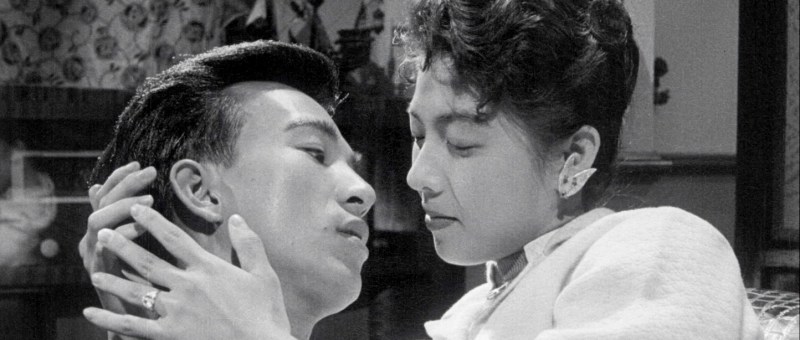
The film opens with Tshiu-Bi (Wu Li-Fen) meeting some of her old friends from college at a reunion only to be accidentally shamed by another woman boasting about her already large family. Despite being apparently happily married to rising executive Siu-Gi (Chang Pan-Yang) and living a financially comfortable life in a large Western-style home with a live-in maid, there is discord in the marriage because the couple have no children. A moment of crisis presents itself when Tshiu-Bi runs into her old friend Le-Hun (Chang Mei-Yao) who had been missing from the reunion and learns that the reason for her absence was shame. Seduced and betrayed, Le-Hun is now a single mother living in desperate poverty, forced to pawn her coat in the middle of winter and pound the streets amid the falling snow looking for work. She is always turned away, prospective employers complaining that she looks like a drug addict because of her shivering in the cold, sunken cheeks, and hollow expression. When her young song Ah-Siong is ill and she needs money for hospital treatment, she is forced to swallow her pride and ask Tshiu-Bi for help. Tshiu-Bi gives her a diamond ring to pawn, bringing her into conflict with her husband who is stunned to hear the name and realise that Le-Hun maybe the girlfriend he broke up with to agree to an arranged marriage with Tshiu-Bi to further his business prospects. 

Tshiu-Bi of course knows nothing of this, bringing Le-Hun to stay with them after she is found passed out in the street and hurt when she abruptly leaves after realising that Siu-Gi and her old friend are now a married couple. As Siu-Gi later acknowledges, much of this is all his fault in the moral cowardice that saw him abandon a woman he loved to make an advantageous match. He may have tried to be a good husband and is not a bad man, but he has perhaps behaved badly and the consequences of his bad behaviour are visited on the women in his life alone. Siu-Gi wants to make amends, but is also overwhelmed by old emotions. Perhaps he envisages a solution in which he could have it all, protect Le-Hun and the son he suspects may be his while maintaining his married life and his wife none the wiser. 

Unlike Tshiu-Bi, Le-Hun has certainly been unlucky, ruined by an early failed affair with a bad man who turned out to be a petty criminal and forced her to become a bar hostess to support him. She left Sing-Liat after discovering him with another woman, but he continues to pursue her, damaging her earlier relationship with Siu-Gi and disrupting every opportunity she takes to make a life for herself, seemingly never allowed to forget that she is a “fallen woman” as if haunted by her transgression. Le-Hun is even evicted from her flat when the landlady’s drunken husband tries it on while she is half-conscious with fever, the landlady choosing to blame her rather than the husband in a theme which will be repeated when the prior relationship between Le-Hun and Siu-Gi eventually comes to light. Tshiu-Bi’s uncle, who had arranged the marriage, reminds her that boys will be boys and having a mistress is perfectly normal, keen that she not cause further scandal with a divorce over something as trivial as a husband’s infidelity. Running into Le-Hun by chance after she had fled to another town, Siu-Gi gives in to his passion and spends the night with her, justifying himself that what they have done is perfectly natural while the judgemental voiceover cuts in to ask how educated people could behave in such an uncivilised manner. 

As a result of their night of passion, Le-Hun becomes pregnant and finds refuge with a close friend and fellow bar girl who helps her to raise Ah-Siong, but once the pregnancy is discovered the uncle reassumes control and lays claim to the baby. He orders Le-Hun never to see Siu-Gi again, to which she agrees already overcome with guilt in having betrayed her friend by sleeping with her husband, but also makes the completely unreasonable demand that he will take the baby away after it’s born, apparently intending to put it out for adoption. Tshiu-Bi, meanwhile, sees he obvious solution and wants to keep the child as her own which angers the fiercely patriarchal uncle because it would mean that the mistress’ son inherits the estate (Siu-Gi had married into their family which is why he has a different surname to the one he used when he was with Le-Hun, perhaps explaining his feelings of resentment and emasculation in the reversed power balance of his marriage). 

Yet the illicit affair provides a point both of fracture and of healing which turns the single point of crisis into two definitively separate yet viable branches. While the relationship between Le-Hun and her friend seems perhaps transgressively close and hints at an alternative family born of female solidarity of the kind that Tshiu-Bi tried to offer to Le-Hun but was frustrated by romantic crisis, Le-Hun is eventually forced to reunite with her no-good gangster boyfriend who has apparently reformed after a spot in jail and now bitterly regrets his treatment of her. Wayward men are brought back into superficial conformity in being forced to assume a degree of responsibility as husbands and fathers, while women are expected to suppress their emotions and stoically endure the consequences of male failure. Nevertheless, even while Le-Hun’s friend is seemingly left out in the cold, the social order is preserved in the repair of two “happy” families cauterising the wound of transgression through the reinforcement of the conservative.


The Husband’s Secret streams in the UK 18th to 27th September as part of the Taiwan Film Festival Edinburgh.

Clip (English / Traditional Chinese subtitles)

Restoration trailer (English / Traditional Chinese subtitles)