Hovering Blade (彷徨之刃, Chen Zhuo, 2024)

The funny thing about Hovering Blade (彷徨之刃, pánghuáng zhī rèn) is that it gets away with suggesting that the police won’t investigate properly and is quite unexpectedly sympathetic towards the hero’s desire for first hand retribution, albeit with the caveat that the police are seen to be investigating but possibly hamstrung by otherwise sensible legislation about the age of criminal responsibility. The Keigo Higashino novel on which the film is based had also been rooted in a moral panic that children were deliberately committing heinous crimes in the knowledge they couldn’t legally be punished for them.

The perpetrators in this case are a little older, though the argument is that if they had been properly charged for an offence committed in childhood they wouldn’t have gone on to commit further crimes in the belief that they are above the law. One of the men feels that in fact he is because it’s clear his wealthy and influential father often clears up his messes for him. A secondary issue hints at an anxiety about the nature of justice given that minors who commit serious crimes such as rape or murder receive much lighter sentences meaning they could be free to live a relatively normal life in just a few short years when their victims will obviously have no such opportunity.

Of course, that’s the point. The implication is that these young people were not fully capable of understanding their actions and could still be rehabilitated to become upstanding members of society. But that might not seem right to the families of their victims such as Li Chanfeng (Wang Qianyuan), a doting single father whose only daughter was raped an murdered by a pair of young hooligans with the assistance of their bullied friend. With judicial progress slow, he receives a tip off from the instigators’ underling and pays a visit to one of the other men who assumes he’s a burglar and attacks him leading Chengfeng to beat him to death with a baseball bat while a video of his daughter’s rape plays on the computer screen. 

The film presumably gets away with its hints towards vigilanteism by the fact the police are right behind him despite having received no tip off. The lead officer is however himself conflicted in beginning to doubt he can provide real justice because of the way the law responds to children who commit crimes and appears to sympathise with Changfeng to the extend he appears reluctant to catch him. The TV news and the people watching it also seem to understand and approve of his quest and desire for vengeance with a woman even helping him hide from the police if also urging him to turn himself in.

But the kind of justice Changfeng wants is incredibly direct. He doesn’t want these men off the streets because he fears for other people’s daughters, but wants to ensure they can’t live the share of life his daughter has been denied. The fact that, if legal justice is served, they’d get out and still be young men pains him without end and only death will answer it. Chased by the police, he begs them to kill him too to release him from his torment. 

Chen Zhuo keeps the tension high with a series of exciting action sequences including one though a disused water park near a moribund hotel the bad guys have been using as hideout. The reasons for their crimes are never explained aside from the ringleader’s dependence on his father, though they are assumed to be mere devilment and rebellion, an attempt to circumvent the system knowing they can’t be held legally responsible for their actions.

The familiar series of title cards at the film’s conclusion explain that the police caught all the wrongdoers while they have also lowered the age of responsibility though it wouldn’t have made any difference in this case. A flashback to another trio of teens suggests that they are emboldened by the fact the law can’t touch them, but the bigger issue is likely to be the way the system is corrupted by money and unequal access to justice. Changfeng is after all a lowly construction worker and is largely left on his own with nothing left to live for but vengeance. His quest to kill the killer is also a quest to kill himself and end his suffering. Zhuo follows him through the grimness of this everyday life, the squalid rooms and his general sense of emptiness but finally returns to the world of state justice and apparently compassionate police only sorry that they couldn’t do more to protect their fellow citizens from the “bad kids” of a changing society.


Original trailer (English subtitles)
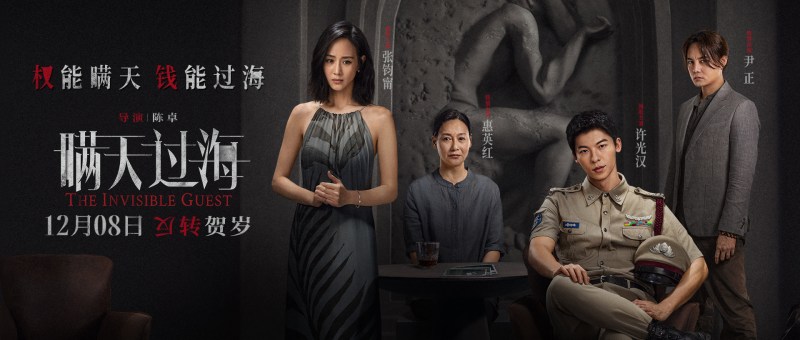
The Invisible Guest (瞒天过海, Chen Zhuo, 2023)

Prestige mystery thrillers are definitely having a moment at the Chinese box office and like last summer’s Lost in the Stars, The Invisible Guest (瞒天过海, mántiānguòhǎi) takes place in a fictional South East Asian nation among a largely Chinese community where the policemen mainly speak English and almost everyone else Mandarin. Like many similarly themed films that might partly be because there is a strong suggestion of normalised judicial corruption which would otherwise be a difficult sell for the Mainland censorship board even if very much on message in its anti-elitist themes in which it is repeatedly stated that money cannot in fact solve everything. 

Adapted from a Spanish film which was a huge hit on its Chinese release and recently remade in Korea under the title Confession, the film opens as a locked room mystery. A well-known architect, Minghao (Yin Zhung), who is also the adopted son of the nation’s only Chinese lawmaker, has been brutally murdered in a luxury hotel. Joanna (Chang Chun-ning), the wife of a filthy rich real estate magnate, has been arrested but maintains her innocence. She claims that they were attacked soon after entering the room and that she was temporarily knocked out waking up to find Minghao with his throat cut, the attacker vanished, and police kicking down the door.  

The twist is that she’s then approached by Zheng (Greg Hsu), a local cop, who offers to “help” her for a small fee promising to sort out all the problematic evidence against her if only she’s honest with him about what really happened in the room. Obviously, the depiction of such an openly corrupt law enforcement officer would not be possible on the Mainland which explains the international setting but it soon becomes clear that Joanna may not be a very reliable narrator and Zheng obviously knows a little more about what’s really going on than he pretends.

Joanna had only recently married her superwealthy husband whose business interests have been very badly affected by the scandal, suggesting at least that she may be a patsy at the centre of a corporate conspiracy with her husband’s firm possibly hoping to get rid of her or someone else’s using her to get to him. But the most essential message is that the rich and powerful shouldn’t have a right to assume that everything can be solved with money and they can get away with anything so long as they have financial means to pay for it. In a flashback which we can’t be sure is completely reliable, someone suggests that the victim’s life was meaningless and killing them no different from crushing an ant, a view somewhat validated by Zheng when he tells Joanna that he isn’t interested in people like that only people like her, wealthy. 

Conversely, a tangenital victim of the case later insists that you shouldn’t underestimate what poor people will do for their families because in the end that’s all they have. The film is sympathetic to those like them who do not have the means to face off against someone like Joanna who probably could, if she is not actually innocent as she claims, evade justice thanks to her vast wealth and social standing assuming her husband’s company don’t decide to drop her in it. There is also, however, the implication that Joanna was once herself poor and downtrodden and has been corrupted by her desire for the illusionary freedom of wealth, abandoning her integrity while carrying the innocent dream of buying an idyllic orchard where she could live in peace and comfort. 

Playing out in near realtime, Chen keeps the chamber drama tension high with frequent on-screen graphics reminding us that Joanna only has a couple of hours left to clear her name before the dossier of evidence against her will be presented to the prosecution and she’ll be charged with murder. Zheng says he can help but keeps pressing her not only for more money but more information, the “real” truth, rather than a favourable narrative though arguably the flow of hypotheses made more sense in the context of a lawyer prepping a client than a policeman probing for evidence in order to neutralise it as did the accused’s willingness to trust the person poking holes in their story. A kind of justice, at least, is done and not least poetic as the truth begins to emerge though the guilty parties or invisible guests of latent classism and social inequality are very much here to stay. 


The Invisible Guest is in UK cinemas now courtesy of CMC.

International trailer (English subtitles)

Cloudy Mountain (峰爆, Li Jun, 2021)

In recent years, Chinese big budget disaster extravaganzas have dedicated themselves to celebrating the selfless heroism of the undersung branches of the emergency services, firemen for example in Tony Chan’s The Bravest or the coast guard in Dante Lam’s The Rescue. Li Jun’s Cloudy Mountain (峰爆, Fēng Bào) features its fair share of fearless rescue teams, but is nevertheless dedicated to the rather unlikely source of pride, the Rail Soldiers whose lives, at least according to the closing credits, were sacrificed in large numbers to complete the infrastructure necessary for the expansion of the Chinese state yet in 1984 they were renamed “China Railway Construction Corporation” a development the film at least seems to regard with a surprising degree of ambivalence. 

This becomes most obvious in the conflict between the two heroes, an estranged father and son burdened by personal trauma, one a former Rail Soldier and the other a high tech engineer working for a commercial enterprise on the building of a high speed railway network through terrain known to be geologically volatile. Grandpa Hong (Huang Zhizhong) is set to visit his son Yizhou (Zhu Yilong) for New Year, though he doesn’t really want to see him knowing that his father will only criticise his work on the tunnel leading to another intergenerational argument. Meanwhile, Yizhou also finds himself unpopular at work for requesting additional safety checks many seem to regard as a pointless waste of time, and oddly they might have a point seeing as Yizhou’s monitoring fails to detect a shift in the rock formation which causes water to flood the almost complete tunnel during routine blasting. 

The fact is Hong was a Rail Soldier and is also one of those old men who think they know best about everything. He kicks off at a bored young lady at service station because she doesn’t want to accept payment in cash and has no change to offer confused as to why Hong can’t just pay with Alipay or WeChat like everyone else. Despite his years of hands-on experience, he no longer understands the modern high tech engineering industry and thinks his son is somehow unmanly with his scientific data and use of drones, believing that if you want to solve a problem you just get in there and do it. This causes a minor problem when a manmade earthquake strikes just after his arrival as he pushes rescue crews out of the way to set about rescuing everyone trapped underground on his own only to end up trapped himself. 

The film is almost on his side, definitely ambivalent about the state of modern Chinese infrastructure. Mrs. Ding (Chen Shu), the female manager of the tunnel project, is initially positioned as a villain, insisting that the tunnel must be completed on schedule and they can’t be wasting money on things like safety checks, hinting at the nation’s notoriously lax approach to public safety and widespread corruption in the construction industry. One might even ask if it was a good idea to build this tunnel at all given the geological volatility of the local area, yet Mrs. Ding later becomes something of a hero in finally agreeing to sacrifice 10 years of her own work when it becomes clear a nearby town cannot be evacuated before disaster strikes. Stepping into propaganda mode she advances that while Westerners may pin their hopes on Noah’s Ark, Chinese men move mountains convincing the workmen to blow up the tunnel they’ve been spent the last decade working on by reminding them that they can simply build it again. 

Meanwhile, Yizhou and Hong begin to sort out their father/son problems underground most of which go back to the death of Yizhou’s mother for which he blames himself but also his father for failing to return home when his wife was ill because he had important nation building work to do. This minor barb might hint at a conflict between selfless dedication to the State and familial responsibility, which would seem to run against the secondary message that unchecked capitalism is doing the same thing while also endangering public safety. One reason the crews didn’t want to fall behind through “needless” safety checks was because they’d already agreed to sacrifice New Year with their families to get the tunnel done on time. Nevertheless the only way to save both the tunnel and the town depends on father and son working together, a mix of Yizhou’s high tech data analysis and Hong’s hands-on experience as they perilously climb up the slide of a sheer rock face in torrential rain to blow up an entirely different mountain to create a protective shield. 

The major villain, if there is one, is personal greed born of irresponsible capitalism, and its only cure is, paradoxically, a recommittal to the State as Mrs Ding offers inspirational messages about the legacy of the Rail Soldiers while self-sacrifice for the public good is held up as the only moral responsibility. In any case, Li piles on the tension with a series of possible negative outcomes from the tunnel disaster not only swamping the town and killing off the local population but also endangering an adjacent chemical plant, never quite making the case for why the tunnel is so necessary in the first place even as it swaps its literality for the metaphorical in allowing the reconnection of father and son overcoming a generational divide to find an ambivalent accommodation with the demands of the modern China. 


Cloudy Mountain screens at ChiTown Movies Drive-in Chicago on Nov. 13 courtesy of Asian Pop-Up Cinema.

Original trailer (English subtitles)