
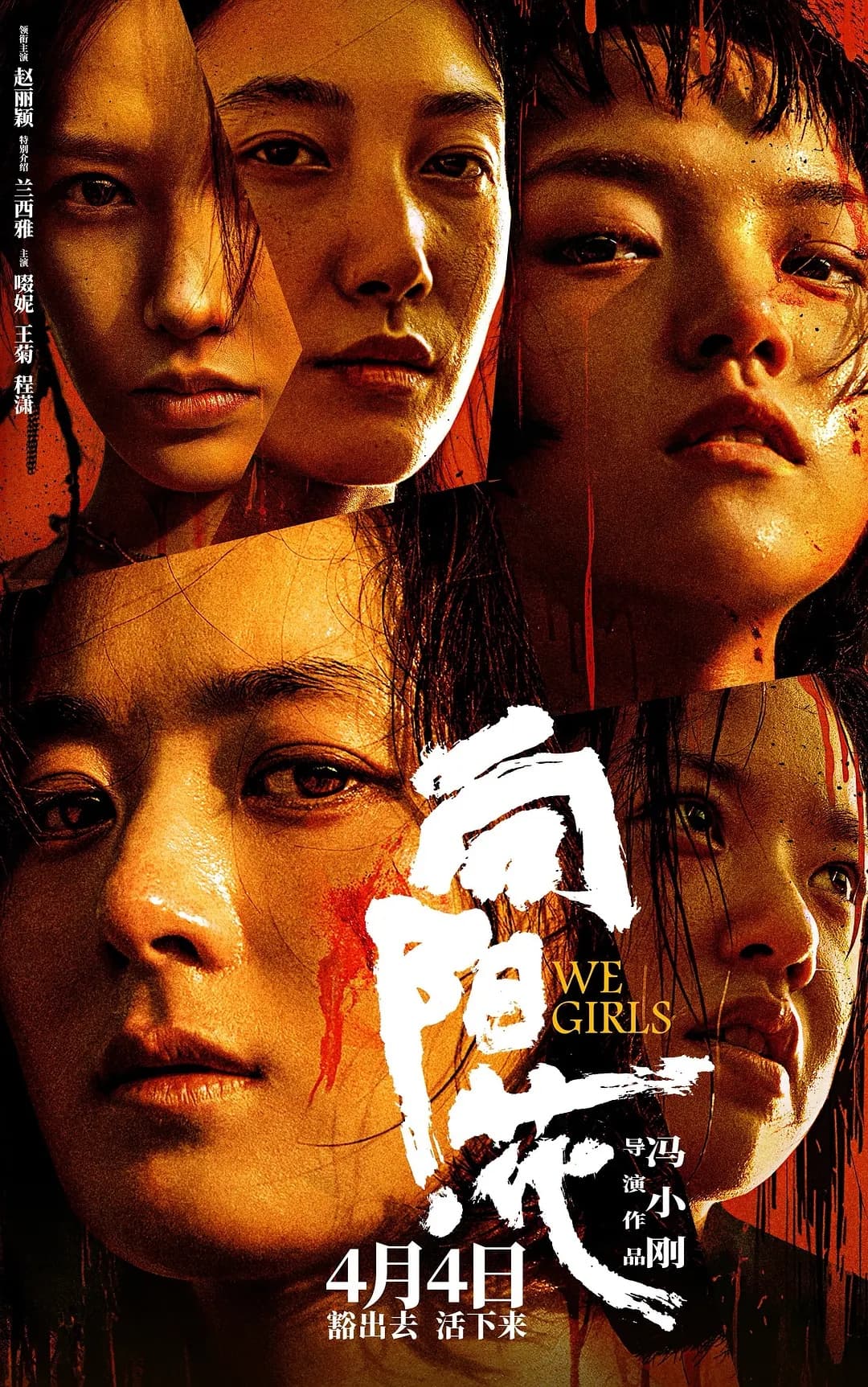
We Girls (向阳·花, Feng Xiaogang, 2025)

Feng Xiaogang’s films often straddle and awkward line in which it’s not entirely clear whether he’s deliberately being subversive or only unwittingly. The surprising thing about We Girls (向阳·花, Xiàngyáng·huā) is, however, its contradictory attitudes towards the modern China of which one would not otherwise assume the censors would approve. Nevertheless, the true goal appears to be paying tribute to the prison and probation service which is thoughtful and compassionate, geared towards helping these unfortunate young women who’ve made “poor choices” to reform and become responsible members of society. 

But like many films of this nature, the problem is that the society the prison authorities want these women to “reform” into doesn’t exist. The onus is all on the women to change, while no attempts have been made to address the circumstances that led to them being sent to prison which are also the same circumstances they will be returning to. The women don’t appear to receive any additional education or learn any new skills while inside, and when they get out it’s impossible to find a mainstream job that will hire a woman with a criminal record. Consequently, they are forced into short-term, casual labour which is often exploitative while male employers withhold pay to extract sexual favours. 

Aside from praise for the police force, the film is also a celebration of female solidarity and it’s clear that their biggest enemy is entrenched misogyny and the patriarchal society. Yuexing (Zhao Liying) is forced into a marriage with a man who couldn’t work because of a physical disability. As he resented their daughter and gave her no help with childcare, Yuexing felt responsible when the baby experienced hearing loss after contracting meningitis and was determined to save for a cochlear implant. To earn more money, she became a cam girl but was caught and sent to prison for two years for obscenity. Mao Amei (Cheng Xiao), meanwhile, is an 18-year-old deaf-mute orphan exploited by criminal gang who are sort of like her “family” but force her to steal for them. 

Having learned a little sign language for her daughter, Yuxing becomes Mao Amei’s interpreter in prison, but the pair find things on the outside much more difficult than in. Apparently illiterate and unable to speak, Mao Amei cannot rent a place to stay and is caught breaking into an abandoned car. The police take pity and let her go, but also take most of the money she was given on her release. Yuexing, meanwhile, discovers her husband abandoned their daughter who is now in an orphanage but is unable to reclaim her without a stable income and permanent address. She finds a job as a hotel maid, but is falsely accused of thievery by a wealthy businessman on a power trip and subsequently fired for concealing her previous conviction. Realistically, the women have little option but to fall into criminality because there really are no other options. 

Still, they’re supported by a network of female solidarity from sympathetic corrections officer Deng Hong (Chuai Ni), herself a foundling raised by a policeman, to another young girl sent to prison for reselling exotic animals off the internet. Orphanhood is a persistent theme with China’s longtime child trafficking problem ticking away in the background. The gang of thieves is eventually exposed as running a baby farm to make up for the decline in their traditional line of work thanks to digitalisation. Yuexing is faced with an impossible decision when she discovers that a wealthy couple are keen to adopt her daughter and are prepared to buy her a cochlear implant right away, knowing that it would be wrong to deny her this “better life” but also that her child has been taken away from her because of her socio-economic marginalisation and husband’s indifference. 

It’s only thanks to the found family that emerges between the women because of their shared experiences that they are able to find a way through, while small acts of “foolish” kindness are later repaid in kind. To that extent, the resolution falls into the realms of fantasy as the women are saved by a deus ex machina rather than through finding a place for themselves within the contemporary society and “reforming” themselves in the way the prison service insists. In the end, they are only able to free themselves through an act of violence that comes with additional, though bearable, costs and grants them the possibility of making a new life for themselves if one spiritually and geographically still on the margins of the contemporary society.


Trailer (Simplified Chinese / English subtitles)

Detective Chinatown 3 (唐人街探案3, Chen Sicheng, 2021)

Cerebral sleuth Qin Feng (Liu Haoran) and his larger than life uncle Tang Ren (Wang Baoqiang) are back on the case in the third instalment in the Detective Chinatown franchise (唐人街探案3, Tángrénjiē tàn àn 3) picking up as promised in Tokyo as the duo take on another locked room mystery on the invitation of dandyish local investigator Hiroshi Noda (Satoshi Tsumabuki). This time around, the mystery is only tangentially connected to a Chinatown though the solution in itself does indeed lead back towards the Mainland and the complicated relations between China and Japan, while Qin in particular finds himself confronting the idea that oligarchy is in fact the “perfect crime”. 

Hired by a yakuza boss, Watanabe (Tomokazu Miura), accused of offing a Thai rival, Su Chaiwit, following a dispute over development rights in the local Chinatown, Qin and Tang Ren quickly find themselves hamstrung by their own discovery of evidence which further implicates their client and brings them to the attention of top cop Tanaka (Tadanobu Asano) who wastes no time telling them to mind their own business. Meanwhile they are also being pursued by muscly Thai detective Jaa (Tony Jaa) working for the other side. In a new high tech motif, the guys are each handed a simultaneous translation earbud which allows the Japanese and Chinese guys to converse with each other in their own languages though Hiroshi often chooses to speak directly in Mandarin instead while the Thai contingent exclusively use English. Unlike previous instalments the duo do not venture into the local Chinese community and Chinatown itself is merely territory contested by Japanese yakuza and South East Asian gangsters. 

Even so Qin and Tang Ren find themselves at a nexus of cross-cultural conflict caught between the cops, yakuza, and Thai gangsters each looking not so much for the truth but some kind of advantage for their side all of which culminates in a hilarious series of mixups at a morgue. Once again, Tang Ren falls in love with a local woman, in this case Su Chaiwit’s secretary Anna Kobayashi (Masami Nagasawa) who is certain Watanabe is guilty and later apparently kidnapped by a crazed serial killer (Shota Sometani) just by coincidence. Of course, all this cycles back towards the franchise’s growing mythology, Qin pursued and manipulated by the mysterious entity known only as “Q” which, as we learn, is as obsessed with the idea of the perfect crime as Qin largely in that they think they’ve perfected it in the stranglehold placed over civilisation by a shady elite. 

In this, the film may be taking aim at hidden oligarchy and the immorality of growing social inequality, but in its Japanese setting Chen is also freer to take potshots at contemporary Chinese society such as in Tang Ren’s confusion that they can’t simply bribe the police to get Qin out of jail when he is wrongfully arrested. “Justice and equality require sacrifices” Qin explains after solving a grim riddle only to be asked some difficult questions about the nature of justice and his own role within it by a manipulative villain, but in a classically censor-friendly move ends the movie with a brief monologue declaring that “justice always prevails and light overcomes darkness”, he and his team recommitting themselves to fighting “vices”, and presumably the shady elitism fostered by Q, wherever they arise. 

Like Detective Chinatown 2’s New York setting, the vision of Japan on display is deliberately stereotypical from an Akihabara cosplay carnival to tasks involving masked kendo fighters and a sumo wrestler, not to mention bumbling comedy yakuza forever threatening to cut off their fingers, the Shibuya Scramble set piece, or a playful homage to Phoenix Wright: Ace Attorney. Meanwhile, Chen continues his taste for huge ensemble action such as the complex slapstick routine that opens the film and now traditional end credits sequence featuring the cast dancing to theme tune “Welcome to Tokyo” dressed in the classic green detective mac worn by Qin. Truth be told, the solution to the central mystery is heavily signposted and slightly unsatisfying though Chen’s visualisations of Qin’s deductions are expertly rendered even as the hero’s growing confidence as a crimefighter unbalances his relationship with the increasingly silly if goodhearted Tang Ren. Boasting a host of A-list Japanese acting talent, the film also makes space for an unexpected cameo from one of the most recognisable faces in Sinophone cinema before teasing a further instalment to take place in London, home to the greatest consulting detective of them all. 


Detective Chinatown 3 is available to stream in the UK via iTunes, Google Play, Amazon Prime, Microsoft, Sky, and Virgin Media courtesy of Cine Asia.

Original trailer (English / Simplified Chinese subtitles)