Unborn Soul (渡, Zhou Zhou, 2024)

When a woman receives the news that her unborn child has a 70% chance of being born with a disability she finds herself confronted by a series of uncomfortable social attitudes and prejudices while trying to decide what is best both for herself and her child in Zhou Zhou’s empathetic drama, Unborn Soul (渡, dù). Touching on issues such as the demands of caring for someone with a profound disability and patriarchal notions of needing to continue the family line, the film sees its heroine more or less isolated in her refusal to be pressured into an abortion she isn’t convinced is the right decision. 

Though now relaxed, the legacy of the One Child Policy may in part be influencing the way people think about raising children and the ageing society with Qing’s father-in-law insisting on a “perfect child” to inherit their family name. Qing has been the sole carer for her 60-year-old uncle who has cerebral palsy and an intellectual disability since her grandmother died and it seems to be in the back of her mind to wonder who might be around to care for her child when she is no longer able to if they were indeed to be born with a disability that prevented them from living an independent life. Because of her closeness with her uncle, she has also has a more empathetic view of living with a disability than those around her and believes it is wrong to think that the baby is better off not being born having heard from him that he is glad to be alive.

Her husband however leans towards an abortion admitting that he is not really prepared to care for a disabled child for the rest of his life while his father outright objects to the idea of having someone with a disability in their family. Laying bare the patriarchal attitudes that surround her, Qing is essentially silenced by her husband and father-in-law who at one point says he’s sick of women like her who “can’t communicate” and won’t do what they’re told. Her husband is also in a sense trapped by this patriarchal system in that his father heavily pressures him to force his wife to have an abortion until she finally files for divorce. He has a clause put into the agreement that if Qing insists on going ahead with the pregnancy the child will have no connection to his family regardless of whether or not it is born with a disability. 

While all of this is going on, the baby seems to narrate its thoughts on the present drama while lamenting the suffering he feels himself to be causing to his mother. The question arises of whether or not the baby would wish to be born which is not a question anyone could answer and in any case perhaps he would end up feeling it would have been better to not to have been even if he were born able-bodied and with no intellectual disabilities. In an attempt to reassure herself, Qing visits a home for disabled adults and encounters a man with cerebral palsy who has got a job as a masseur and is living a fulfilling and independent life but is also confronted by the fact that many of these people have been abandoned by families who feared the stigma of disability. 

The implications of the film’s ending maybe slightly uncomfortable even if they reflect Qing’s nature as a true mother who thought only of her child even while the film is otherwise critical of an overly efficient medical system which tries to usher Qing towards an abortion without really considering that her choice to give birth to the child might be valid which also displays a lack of respect for the lives of disabled people. Shot in a classic 4:3 the film flits between theatricality and detachment while shifting into a strangely dreamlike aesthetic with its commentary from the unborn baby who certainly seems quite a sophisticated thinker for one so young. In any case, the decision is in a sense taken out of Qing’s hands leaving her with little choice other than to accept the hand that fate has dealt her while otherwise isolated from a cold and rational society.


Unborn Soul screened as part of this year’s Osaka Asian Film Festival.

Original trailer (English subtitles)

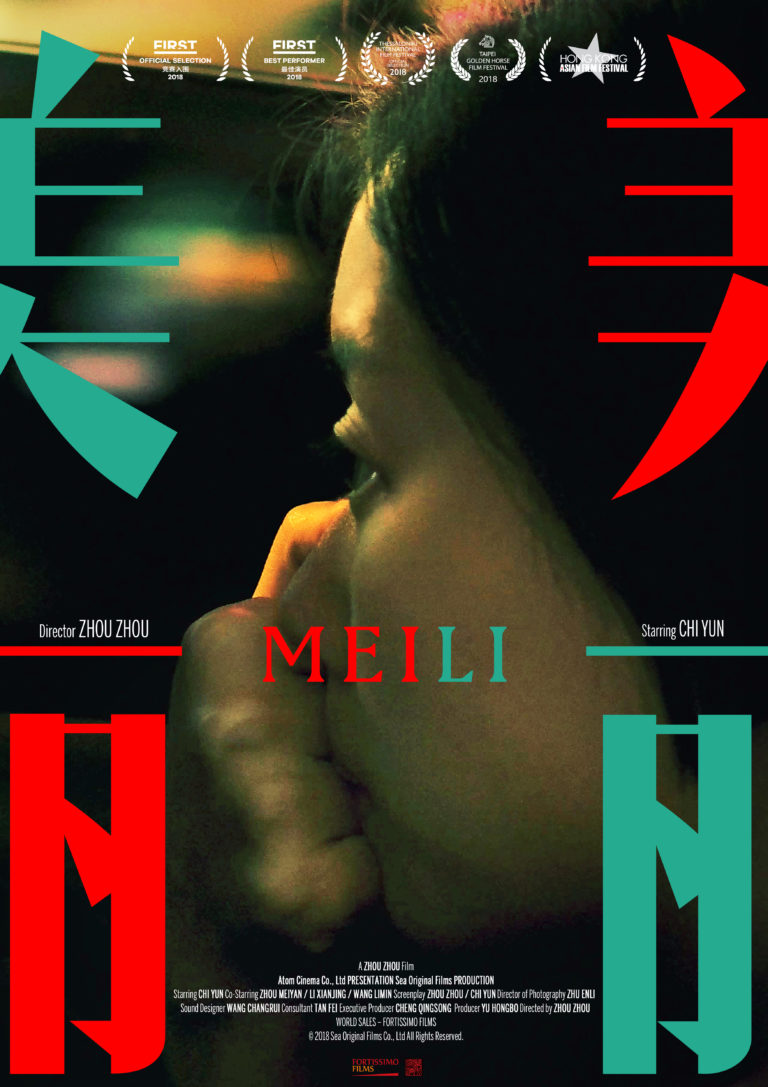
Meili (美麗, Zhou Zhou, 2018)

Meili poser 2Though Mainland cinema has a famous aversion to the representation of LGBT lives on-screen, there does seem to have been a notable shift towards the positive in recent years with even big budget blockbuster comedies and family films offering subversive, if subtle, messages of tacit support. Nevertheless, lesbian life continues to be underserved with Fish and Elephant, often regarded as the “first” explicitly lesbian film from Mainland China, released only in 2001. Zhou Zhou’s Meili (美麗) is not an issue film nor does it make much of its protagonist’s sexuality but it does attempt to address the many difficulties she experiences in her life as a gay woman from a humble background.

Meili (Chi Yun) has a casual job in a laundry and lives with her high flying career woman girlfriend Li Wen (Zhou Meiyan) who is often forced to stay out late drinking to excess with colleagues in an attempt to climb the ladder. Li Wen receives the opportunity of an extended business trip to Shanghai and asks Meili to go with her only to change her mind abruptly at the last minute, fearing her colleagues will find out that she’s in a relationship with another woman and it will damage her prospects or perhaps even cost her her job. Though Meili was ambivalent about going anyway, the sudden reversal proves a huge shock, especially as she’s also been let go from her laundry job for having the temerity to ask about the annual leave policy.

Meanwhile, Meili is constantly pestered for money by her hard-pressed older sister (Li Shuangyu) who is married to a man (Wang Limin) so vile Meili can hardly bear to look at him. The reasons for her disdain will become apparent, but adding to the confusing family situation is a little girl being brought up by the couple which is apparently Meili’s. Meili is a lesbian with no interest in men which may hint at the reasons she intensely hates the child and resents the entire situation. Despite all that, however, Meili does not seem to be able to cut her sister off and finds herself going out of her way to help her even though she is herself in extreme difficulty.

Toughness and tenderness do seem to go together as we witness Meili set up an IV for her hung-over girlfriend, berating her for drinking too much yet again but caring for her anyway. Meili blows up at her brother-in-law’s, overturning their dinner table when he insults her in front of his friends, but shuts down when wounded by Li Wen, seemingly unwilling to engage in a probably destructive argument but dragged into one anyway. The relationship between the two women appears settled and positive despite the disparity of their socioeconomic statuses, but there are cracks and when Meili begins to suspect that Li Wen may be seeing a male colleague behind her back, perhaps as a cover or to improve her career prospects, she begins to wonder what they really are to each other.

For Meili who could not rely on her family, and had no future plans or real place to belong, Li Wen had become everything. “Shanghai” is a dream to the youngsters of Changchun who assume the gleaming city must be full of opportunity and excitement but it may well be one beyond their reach even if they manage to escape industrial town casual labour hell. Meili bears her difficult circumstances with fortitude. Obliged to live quietly and under the radar, she works hard and saves her money but is betrayed at every turn – by unscrupulous employers, by her toxic family, by her ambitious girlfriend, and even by her supportive and well meaning friends who reluctantly decide that they will have to leave her behind alone in order to chase their own dreams in the city. Having lost everything and all hope for the future, violent revenge seems an unavoidable consequence of her almost total oppression.

A popular name for baby girls, “Meili” means beautiful but there’s precious little beauty in Meili’s increasingly grey and hopeless world. Human selfishness, capitalistic avarice, and conservative patriarchal values conspire to rob her of all possibility for life or forward motion. There is no path out of poverty and little possibility of happiness in being able to live openly and equally with a woman by whom she is fully loved. Painting a bleak picture of life in post-reform provincial China, Zhou’s debut presents a refreshingly normalised depiction of a same sex relationship while making plain each of the various ways its heroine is backed into a corner by the oppressive and increasingly unequal society in which she lives.


Meili was screened as part of the 2019 Chinese Visual Festival.

International trailer (English subtitles)