Pistol (手枪, Lv Huizhou, 2020)

The contradictions of the modern China drive one young man clear out of his mind in Lv Huizhou’s elliptical street punk noir, Pistol (手枪, Shǒuqiāng). Shot in a washed out monochrome and seemingly set some time after the Beijing Olympics, Lv’s anarchic drama sees its hero develop unexpected superpowers as if to combat his sense of impotence and impossibility while constantly uncertain whether his newfound abilities are “real” or merely a figment of his declining mental state as he chases lost love through the rundown backstreets of a Beijing slum.  

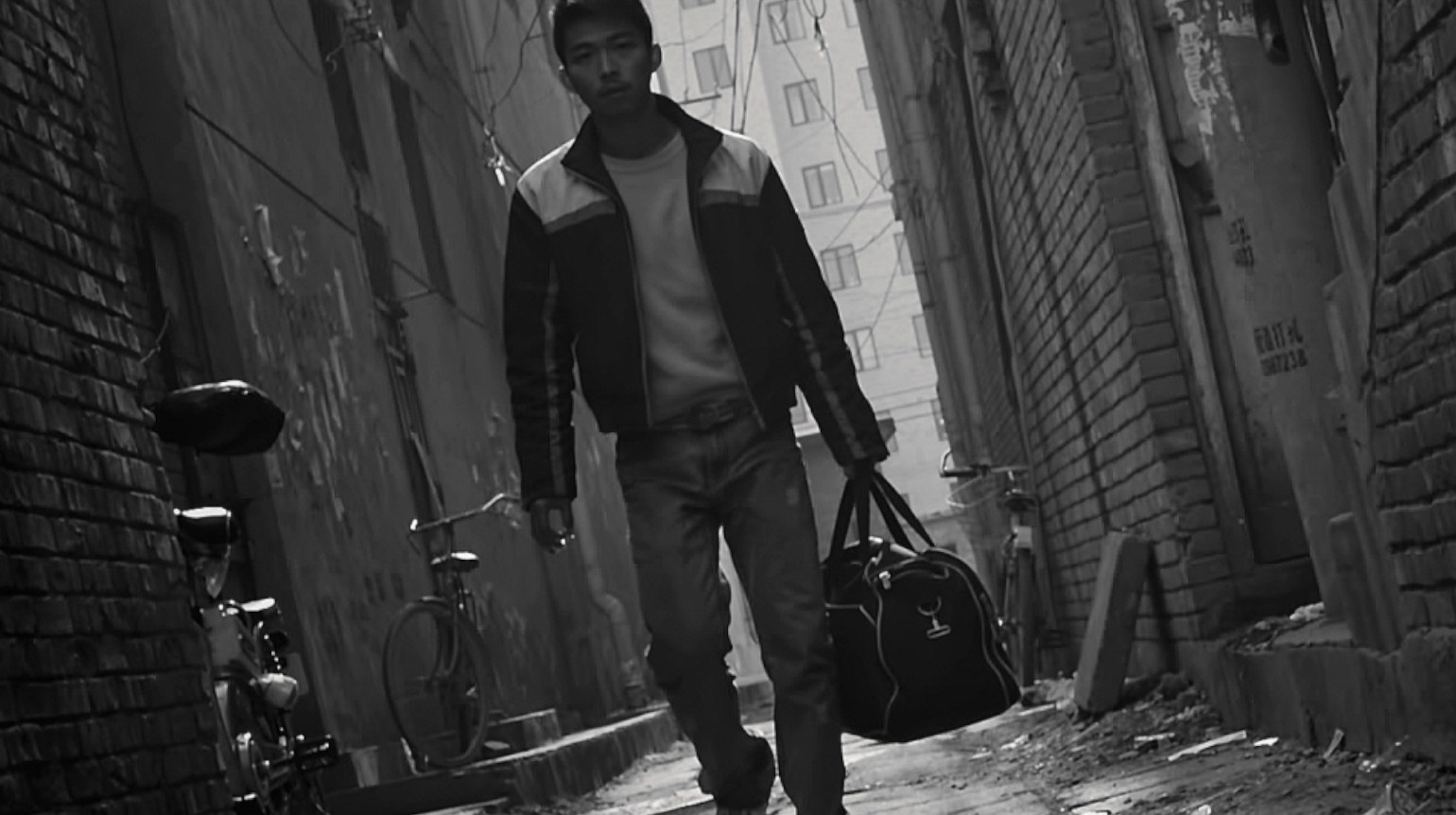
Construction worker Mengzi (Zhang Yu) claims he likes Beijing, after all it’s an “international city” always busy with crowds. Many people long to come here, as perhaps he once did, though you can’t say the city has served him particularly well. He lives in a tiny room with a bunk bed and no functioning bathroom which is why he pees in a bottle into which he’s already discarded his cigarette and digs a hole in the woods every time he needs to do a number two. The only thing keeping him going is his doomed relationship with sex worker Yaoyao (Wang Zhener) who just wants to make as much money as she can while she’s young. Mengzi may have stolen the “international city” line from her, he often seems to repeat things said to him when he speaks at all, but Yaoyao also claims to like Beijing because of the opportunities it offers her, citing the story of a woman she knew who quit sex work after only three years with enough money to buy house in her home town, now walking around dripping with jewellery like the queen of all the land. When Yaoyao goes missing, Mengzi fetches up at the salon where she worked that’s really a front for a brothel run by a local gangster and raises hell, picking a fight with the gangster’s wife and in the first of many flashes of spontaneous violence smashing her mirror. 

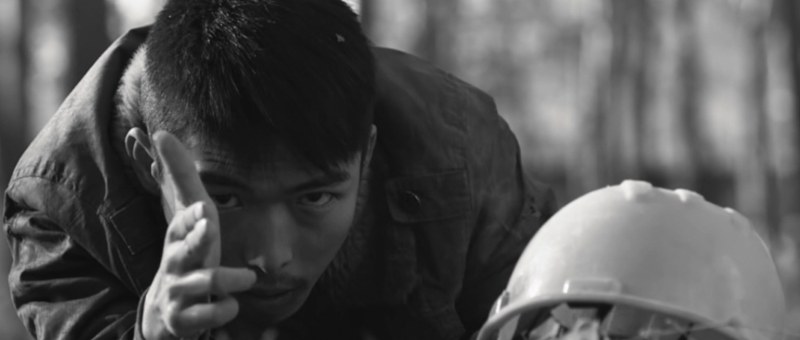
The ill-advised rescue mission gets him nowhere, the gangster turning up at the restaurant where he’s once again adding to his tab to tell him she’s been sold on to a club before teaching him a lesson. This is where we came in, or it might as well be, with Mengzi chased through the narrow city alleyways until finally cornered and beaten. Mengzi is in many ways a man on the run from himself. His room is papered with posters for macho crime dramas such as Dirty Harry, The Man With No Name Trilogy, and A Better Tomorrow 2, Taxi Driver pinned incongruously between boy band Super Junior and a girl group in air hostess outfits. He is God’s lonely man, obsessing over misplacing his high school graduation certificate while failing to convince his boss to give him a better job. At his lowest point, he digs a hole and crouches down pointing his fingers at gaggle of chickens and pretending to shoot only to hear a gunshot and on closer inspection discover a very dead hen. 

In the days since losing Yaoyao, Mengzi hadn’t done much of anything save mope around, having a tourist day with streetwise kid Laizi (Hou Xiang) visiting Tiananmen Square and the Olympic stadium, both places Yaoyao lied to her mother about visiting trying to make her think her Beijing life was better than it was. His strange visions and violent meditations are often intercut with comforting memories of his time with Yaoyao alone in her bohemian flat, a poster of Chicken Run ironically hanging on her wall. Flashing into colour, the billboards around the stadium are filled with pretty pink flowers and play the Olympic song about being one big family, red solarised footage of the opening ceremony later filling Mengzi’s mind. Family seems to be something Mengzi doesn’t really have, a perpetual orphan wandering around unanchored and resentful of the society that won’t let him prosper. Losing Yaoyao he vows revenge with his new weapon, which for some reason only works with his rear end partially exposed, literally taking aim at social inequality in the midst of a trendy club from which he concludes he may never be able to retrieve his lost love. 

Shot in a washed out black and white reflecting Mengzi’s sense of despair, Lv’s frantic handheld photography mimics his paranoid psychology with its noirish canted angles and extreme sense of claustrophobia while introducing a note of psychedelic uncertainty as even Mengzi himself cannot be sure if his fingers really shoot bullets or he’s in the midst of a psychotic break possibility connected to the traumatic event that opened the film reflected in his own eventual solarisation. An elliptical, ethereal journey through the backstreets of Beijing as they exist in the mind of a crazed young man denied a future and the home he’s so desperate find, Pistol has few kind words for the modern China but perhaps sympathy for its frustrated hero. 


Pistol screened as part of this year’s London East Asia Film Festival.
Fish and Elephant (今年夏天, Li Yu, 2001)

513cslBr5wL

The first narrative feature from former documentarian and TV presenter Li Yu, Fish and Elephant (今年夏天, Jīn Nián Xià Tiān) is touted as the first film from mainland China to explicitly deal with lesbian life in modern Beijing. Necessarily shot under the radar to get around China’s strict censorship requirements, the film almost disappeared after “getting lost” on return from the Venice Film Festival (where a mishap with missing reels apparently led to a less than stellar reception though Li did eventually pick up an award) but went on to feature in a number of international festivals even if not quite welcomed at home. Imperfect and somewhat clumsy in execution, Fish and Elephant is nevertheless as whimsical as its title might suggest if only in its ironically abstracted need for detachment.

Xiaoqun is approaching 30 and unmarried. Despite her mother’s pleas and the needling of relatives Xiaoqun has no desire to marry. She supports herself well enough as an elephant keeper at the zoo and lives alone in a small apartment. A desire for independence is not the only reason Xiaoqun chooses to remain single – she is gay. Unable to state this fact openly, Xiaoqun is often forced to attend various blind dates set up by her mother who emotionally blackmails her by bursting into tears on the phone. Nevertheless, she eventually develops a flirtation with a young woman, Xiaoling, who owns her own clothing store at the market. Before long the women have moved in together and established an easy domesticity only for Xiaoqun’s mother to turn up unannounced determined to see her daughter wed. As if that weren’t enough, Xiaoqun’s long lost ex, Junjun, also arrives without warning apparently on the run from the police for “bank robbing”.

Perhaps because of the need to shoot covertly, Li’s script is structurally threadbare involving several large narrative jumps but the quality of unseen incompleteness plays into the film’s central theme in that the lives of women like Xiaoqun and Xiaoling are often invisible and hidden from view. We observe the two women’s courtship obliquely and in stages as they flirt (tentatively), wait for each other, are frustrated by exes, and finally come to a kind of agreement framed against the turquoise of of Xiaoqun’s bedroom wall which makes the pair look uncomfortably like the goldfish trapped inside her aquarium. Even this is unspoken and uncertain, hands tentatively grasped in trying to confirm that the situation has been read correctly until it is quite literally sealed with a kiss.

Xiaoqun, at least, is not so afraid to tell people what she is, only they never seem to believe her. Her uncle, berating her for turning down all the suitors he finds and reminding her that it’s the “proper thing” for women to marry and bear children, asks her what the problem is, to which Xiaoqun replies that she’s told him plenty of times before – she’s “no interest in men”. The uncle cannot process this information and offers to find a therapist to help with Xiaoqun’s supposed “issues”. Similarly, she decides to tell it straight to one of her dates – “I don’t like men, I like women”, but he refuses to listen. It seems he’s familiar with the concept, but doesn’t really believe in it and assumes Xiaoqun is trying to skip out on the date without giving him a proper chance by saying something outrageous.

Each time Xiaoqun calmly explains her life choices, everyone just ignores her. Either they simply don’t understand or refuse to accept that her sexuality is a good enough “excuse” for refusing to conform to the social order. Not until she finally attempts to come out to her mother does Xiaoqun actually say “I am gay” and then only very quickly followed directly by an explicit explanation of what she means. Unfortunately her mother still can’t quite get it, the language and cultural gap too vast to bridge. Like the young person’s pop song she’s always listening to, it’s not that she doesn’t understand, it’s just that the world is moving so fast.   

Eventually Xiaoqun’s mother starts to come round and considers going against the social order by marrying again herself despite her supposedly inappropriate age. Marriage, however, seems an unhappy business all round and none of the men we are introduced to are particularly appealing. The men in Xiaoling’s shop bark at their girlfriends and criticise the slutty clothes, or try to harass Xiaoling into dropping the price while her boyfriend hovers in the background and places a territorial hand on her shoulder almost as if he knew why she just gave a quite massive discount on an expensive shirt to the woman currently trying it on for size. Xiaoqun’s mother is divorced, her father having left the family (and an apparently unhappy marriage) for another woman. Yet everyone seems intent on railroading the two women into this culturally demanded alleyway of misery.

For the most part, Xiaoqun and Xiaoling are content to simply ignore the world around them and live peacefully together like two fish in a bowl. Conspiratorially linking hands under the table as Xiaoqun’s mum reels off her marriage spiel and leaning in close to light one cigarette from another, they perhaps take pleasure in mocking the social order directly under her nose while worrying what the fall out might be should the truth be discovered. The relationship is threatened not particularly by the marriage plots, but by the presence of Junjun who places a wedge between the verbally uncommunicative lovers and another burden of secrecy on the already burdened Xiaoqun.

Li concludes by splitting the narrative into its three component strands, opting for a perhaps unwise slide into absurdity as Junjun embarks on a last stand though it does provide an opportunity for another (accidentally?) misogynistic/homophobic remark from a police officer. The film ends on a wedding, at which Xiaoqun and Xiaoling are conspicuously absent despite being expected and as a couple. Perhaps they are just “busy” having recently recovered from their momentary romantic drama, but their failure to appear also reinforces their committed isolation in which they are content (for good or ill) to hide themselves away, existing only for each other.


US release trailer (English subtitles, NSFW)