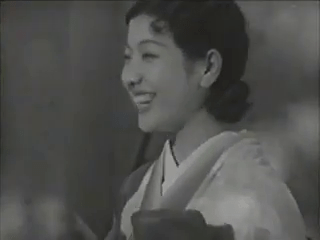
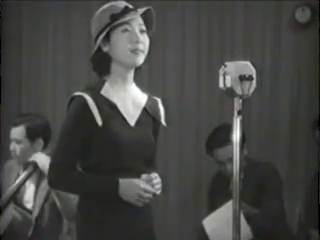
Radio Queen (ラヂオの女王, Shigeo Yagura, 1935)

The conflict between warring neighbours of differing dispositions deepens when their children want to get married in Shigeo Yagura’s modernising comedy, Radio Queen (ラヂオの女王, Radio no Oujo). Against a backdrop of rising militarism, the film explores a generational shift in a new world increasingly dominated by mass media that quite literally speaks to the young not only through the newly established ubiquity of wireless radio but the talkie too leaving the old somewhat left behind confused by the rapid motion of progress.

In fact, the film opens with Kawamura, owner of a factory that makes aeroplanes that can’t fly, being woken up by his neighbours performing radio taiso callisthenics exercises. Kawamura dislikes radio on a conceptual level, though his dislike of it may also have a slightly subversive quality given the underlying element of coercive conformity that sees the nation performatively warm up for another day of national unity and hard work towards the growth of the empire. Then again, Kawamura is the film’s most ridiculous character finally giving a speech that he would be proud to sacrifice his son’s life for the nation by getting him to fly one of their biplanes to China as a kind of publicity stunt.

Publicity stunts are, however, a particular talent for Kingo who has very modern ideas about how to make not only his business but that of his father’s neighbour and frenemy Misome a success. Soon to finish university, Kingo plans to marry Misome’s daughter, Kimiko (Sachiko Chiba), who is currently working as a primary school teacher though both father fiercely object to the union. Kingo puts the kibosh on the idea of eloping mainly for practical reasons that they will be unable to support themselves financially on a running start but also for reasons of filial piety which probably do correspond with the censorship demands of the time. One of his ideas for winning over Misobe is to help him make his business of selling cough sweets for stage performers more successful through modern advertising and publicity techniques. Though originally rejecting his ideas, Misobe often takes his advice but pretends it was all his own idea further souring their relationship.

In any case, he wants to Kimiko to marry his chosen suitor, Kyuichi, who is training to become a pharmacist but also struggles with maths and has secretly been embezzling money in contrast to Kingo who is much more organised than his own father and has real business talent. Misome describes Kimiko’s job as a “hobby” and regards it as something she’s doing to keep busy until she gets married, a notion perhaps encouraged by social expectation given that it involves taking care of children which places her in a quasi-maternal position. She could presumably support herself, but the option is never given to her as even she tries to chivvy Kingo along by warning him that if he fails to win her father over she’ll end up married to the pharmacist as if she had no say in it at all. 

In any case, in a rather strange turn of events her singing in the school is heard by a film crew who’ve just had their lead actress pinched by a rival studio. They cast her in the part of a Christian nun who is also a schoolmistress but in contradictory fashion is involved in a romance which scandalises Kimiko and leads her to walk off set refusing to be exploited by the unscrupulous directors insisting that no such thing had been mentioned to her when she agreed to take the job. But it’s this that finally propels her to become the “Radio Queen,” taking a much more wholesome role singing nursery rhymes and reading fairytales for children across the nation through the new medium of the wireless. Kingo does not object to her fame and sees it as a positive sign that may cause his father’s opinion of her to change for the better despite his dislike of the device, though he does later become put out that the demands of her career leave her less time to spend with him.

In that sense, it’s also “modernity” that disrupts their relationship along with changing gender and social roles while there is also a necessarily problematic element of then largely unregulated mass media. An unscrupulous consumerism seems to have taken hold with the foolish Kawamura also addicted to collecting “antiques” many of which are akin to religious relics of an age of modernity. We see a man drop a piece of wood on the floor outside which is later picked up by dealers and sold as a piece of the propeller of the first of ever plane which Misome jokingly offers to buy for Kawamura in the hope his aircraft might actually fly one day. On entering an antiques fair, they’re confronted by an object claimed to be the clasp from Rockerfeller’s wallet echoing some of Misome’s frequent allusions to his success as a self-made man while Kawamura conversely frequently alludes to Mussolini as if making plain his own slightly priggish attachment to militarism. 

Misome concedes that Kingo is a bright and promising young man and objects to him only on the grounds that he is Kawamura’s son and he prefers the pharmacist because he thinks it more advantageous to himself before realising what sort of a man Kyuichi is really is. In the end, they’re both bamboozled by mass media when Kimiko rushes to the airfield where Kingo is about to take off having petulantly agreed to the test flight after arguing with her. As she petitions the already in motion plane, he manages to pull her up into the passenger seat while the radio announcer announces their engagement live on air granting it a new legitimacy neither of the fathers can really argue with. The film ends with them flying off into a blue sky which suggests a victory for youth and freedom even if it seems a little too simple leaving the older generation behind on the ground with only the wireless for comfort.

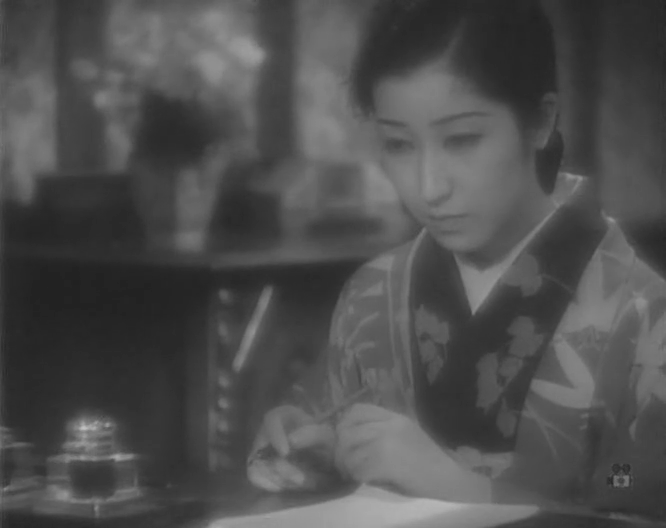
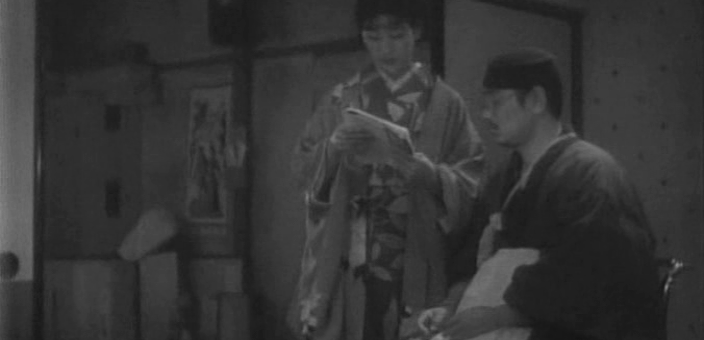
A Woman’s Sorrows (女人哀愁, Mikio Naruse, 1937)

Arriving perhaps in a moment preceding a major change, Mikio Naruse’s A Woman’s Sorrows (女人哀愁, Nyonin Aishu) finds itself on one side of a divide in which it is, paradoxically, a woman’s conservatism that is thought a barrier to her marriage. As usual slightly ahead of his times, Naruse doesn’t so much attack the idea of marriage either arranged or love, but subtly arcs out the patriarchal cage the bars of which only become visible to his conflicted heroine after she has wilfully allowed herself to be locked inside. 

Opening on location, a thriving Tokyo street scene, Naruse introduces us to the “conservative and indecisive” heroine Hiroko (Takako Irie) at her part-time job at a record store. We learn that Hiroko has recently been to an omiai marriage meeting, and that at least according to her friend she has been harbouring a longterm crush on her sensitive, progressive cousin Ryosuke. Hiroko denies having feelings for her cousin claiming that she thinks of him as a brother and that he dislikes her for being too “conservative”. One might think that a truly conservative woman wouldn’t be working in something as modern as selling records, but Hiroko is indeed a kimono-wearing holdout who has almost fully internalised the properness of the patriarchal order. Her indecisiveness, however, perhaps tells us that she isn’t quite as comfortable with it as she seems and is in a sense forcing herself to accept something she thinks she has no power to resist. 

It is also true that Hiroko’s family is poor. Despite confiding to Ryosuke that her husband gave her trouble, failing in one sense at least by dying and leaving his family with debts, Hiroko’s mother is keen that she marry and marry well. Her prospective match Shinichi is from a well to do family and has also offered to pay for the education of Hiroko’s younger brother Masao, so the marriage is undoubtedly financially advantageous if not immediately essential. “Since I cannot marry someone I love, anyone will do” Hiroko silently sighs, resigning herself to a conservative vision of a woman’s life. For his part, Ryosuke rejects Hiroko because he believes her conservatism runs so deep as to lead her to reject love as improper, that love would in fact be a barrier to her marriage which she would feel duty-bound to refuse. 

Hiroko feels that the match is in a sense too good for her, much better than she had a right to expect. Nevertheless, it’s her seeming conservatism that presents a potential problem in that it is assumed that despite working in a record shop she wouldn’t know how to dance in the modern fashion. Far from censorious, Hiroko’s mother is worried that the young girls these days all go to “dance halls” while Hiroko is quiet and demure. As it happens, Hiroko knows how to dance, though perhaps they should have been thinking about the problem from the other side in that men who like going to dance halls don’t necessarily like to go with their wives, and those looking for “conservative” women often do so because they want to lead “modern” lives outside the home. Having agreed to the marriage, Hiroko finds herself an outsider, treated as unwaged maid by her new in-laws who all exclaim how glad they are to have someone so reliable as their new daughter-in-law especially as they’ve recently disowned oldest daughter Yoko (Ranko Sawa) for running off with her lower class fiancé. 

As so often in Naruse’s cinema, modern girl Yoko acts as a mirror for the outwardly conservative Hiroko. Yoko determines to marry for love, but is actually far more conservative than she seems in that she is entirely unwilling to surrender her comfortable middle class life and continues to resent the man she married, Masuda, because he cannot keep her in the manner to which she had become accustomed. Shinichi had warned Yoko about “frivolous” men, an ironic comment seeing as we’d just heard him dismiss a woman he’d been seeing as “just a girlfriend” laying bare his rather misogynistic view of women as a means of passing time, but Masuda is the very opposite of frivolous, serious in his intentions even while Yoko rejects him solely because of his lack of socioeconomic status. Yet like Hiroko Yoko is perhaps herself also conflicted, forcing herself to reject Masuda whom she loves out of a mistaken pride that tells her it would be wrong to suffer for love when she could have done as Hiroko did and married well for a comfortable but emotionally unfulfilling life. 

Unhappy in her marriage, Hiroko claims that she could have put up with being treated as a maid but can’t stand being treated as a doll, believing herself mere decoration in Shinichi’s life. Nevertheless she continues to believe it’s her duty to “manage” as good wife, bearing her sorrow and loneliness gracefully until pushed into a moment of crisis by Yoko’s rather melodramatic love life. Overhearing the family declining to invite her to join their game of mahjong on the grounds she’s too conservative and is perfectly happy with her life of drudgery, Hiroko is stirred by Yoko’s assertion that she’d never be so “submissive” despite the fact that’s exactly what she’s been in leaving Masuda to return to her upper middle class life with the Hories who are not perhaps as grand as they seem with only the one maid and Mrs. Horie’s constant penny pinching. 

Yet the subversive conclusion isn’t so much that Hiroko begins to realise she has choices and agency after all along with the right to leave a marriage that isn’t working, but that she, temporarily at least, rejects marriage itself in favour of independence while Yoko chooses love in defying her family to return to Masuda who, by then, has done something quite foolish in a mistaken attempt to prove himself worthy of her. Rather than leaving Shinichi for Ryosuke, she tells him that she needs time to figure herself out, to “reconstruct my life by myself”, vowing to find out what is the most beautiful thing in the world so that she can see something more important in herself. It’s a startlingly progressive statement for the Japan of 1937 which is edging closer towards a kind of darkness despite the otherwise cheerfully internationalist atmosphere with its Western jazz music and record shops, dance halls, department stores, trains, and telephones, the contradictions of the age symbolised in the Horie’s awkward home with its mix of Western and Japanese furnishings. It turns out, Hiroko is the most “modern” woman of all, who ever would have thought?  


The Actress and the Poet (女優と詩人, Mikio Naruse, 1935)

Actress and the Poet title cardAmong the directors most closely associated with the golden age of Japanese cinema, Mikio Naruse is not usually remembered for his sense of humour but his pre-war work often saw him making uncomfortable forays into the shomin-geki comedy. The Actress and the Poet (女優と詩人, Joyu to shijin), Naruse’s second film after leaving Shochiku for P.C.L, is among the more successful but also tinged with characteristic irony that says this is funny because it’s not funny at all.

The generic shomin-geki setup finds us in a small community of suburban houses where mild-mannered poet Geppu (Hiroshi Uruki) lives with his successful actress wife Chieko (Sachiko Chiba). Amusingly enough, and in a motif which will be repeated, the film opens with an high impact scene of a woman screaming after being threatened with a knife, but thankfully it turns out that Chieko and her friends are simply rehearsing for a play. The actors dispatch Geppu to fetch them some cigarettes, which brings him into contact with his no good “friend” Nose (Kamatari Fujiwara), a struggling writer who is absolutely sure his latest work is going to win a big prize which is why it’s not a big problem that he’s so behind on his rent that he’s been coming and going through the upstairs window so he doesn’t attract the attention of his landlady.

When we first meet Geppu he’s wearing a pinny and cheerfully hanging up the washing. A young man passes by on a bicycle and seems surprised, asking if he himself really did all that laundry to which Geppu somewhat improbably replies that it’s all second nature when you’ve been in the army. Even though this is obviously a very “normal” day for Geppu, the questions keep coming. Ohama (Haruko Toda), the nosy woman from next-door, remarks that everyone in the neighbourhood loves Geppu because he’s just so nice but he’s also become a hot topic with the ladies at the bathhouse because no one’s quite sure what it is he “does”. In the modern parlance, Geppu is a basically househusband who dabbles in “poetry”, or as Ohama later explains “songs for children”.

In this fiercely modern environment, it’s Chieko who wields the financial power while her husband appears not to mind trailing behind. She wears kimono but often with luxurious furs which might lead to us ask why they live in this modest suburban house rather than in the bright lights of the city, but even so the marriage appears to be a happy and progressively equal one. In fact, as we later discover, there’s never been a cross word between Geppu and his wife, which is a problem because Chieko’s latest role involves a marital tiff and she’s struggling to get to grips with it because she doesn’t know what it’s like to fall out with your spouse. To figure it out she gets Geppu to read lines with her in a situation which eventually repeats in their real life when Nose bamboozles Geppu into letting him stay in the upstairs room rent free, leading to an almost identical fight watched calmly by Nose and Ohama who think they’ve got ringside seats to a play they could never afford to see.

Nose’s intervention unbalances the couple’s relationship in that it forces Geppu to reassert his masculinity. “A promise between men is a serious thing”, Geppu affirms “I can’t just go back on it because my wife says no”. Chieko reminds him, however, that this is technically her house – she pays all the bills, while his “writing” career is good only for the odd box of sponge cake. She doesn’t like it, perhaps understandably, that he’s “invited” a ne’er do well to come and live with them without even bothering to talk to her about it. She tries to put her foot down, but Geppu remains as irritatingly passive as ever only slightly putout to have his subjugated status suddenly used against him.

Naruse ends the picture with a comic sequence in which Chieko sees the light. Thanks to her real life argument with her husband, she’s figured out how to perfect her performance but she’s apparently so method that she also begins to embrace her role as a conventional wife off stage too. Rather than Geppu letting her sleep in and cooking the breakfast himself, this time it’s Geppu wrapped up in a futon while Chieko chops veg downstairs. Nevertheless, there is a minor irony in this moment of domestic bliss in that it directly follows the news that the nice young couple who just moved in across the road have committed double suicide because of his embezzlement and subsequent debts. Neatly underlining the consumerist trends of the age, the couple wanted to die in their own home even if it was only “theirs” for a few moments. Meanwhile, Ohama and her insurance salesman husband are busy having a blazing row next-door which just goes to show that old-fashioned marriages aren’t so happy either.

Chieko superficially plays the conventional wife, engaging in a little role-play with her husband while Nose listens on from the stairwell, but theirs remains a very modern marriage in which she is free to fulfil herself outside the home and her husband is seemingly unbothered (to a point at least) by the mild censure of the local ladies who both love him for his niceness and perhaps dislike him for it too. Naruse undercuts the conventionally “happy” ending in which traditional gender roles are restored and the family rebalanced by ending on a note of irony as the home of Ohama, a traditional wife dominating her henpecked husband in a comic yet socially accepted fashion, is thrown into violent discord while all is peaceful in the decidedly modern house of Geppu.