What Does That Nature Say to You (그 자연이 네게 뭐라고 하니, Hong Sang-soo, 2025)

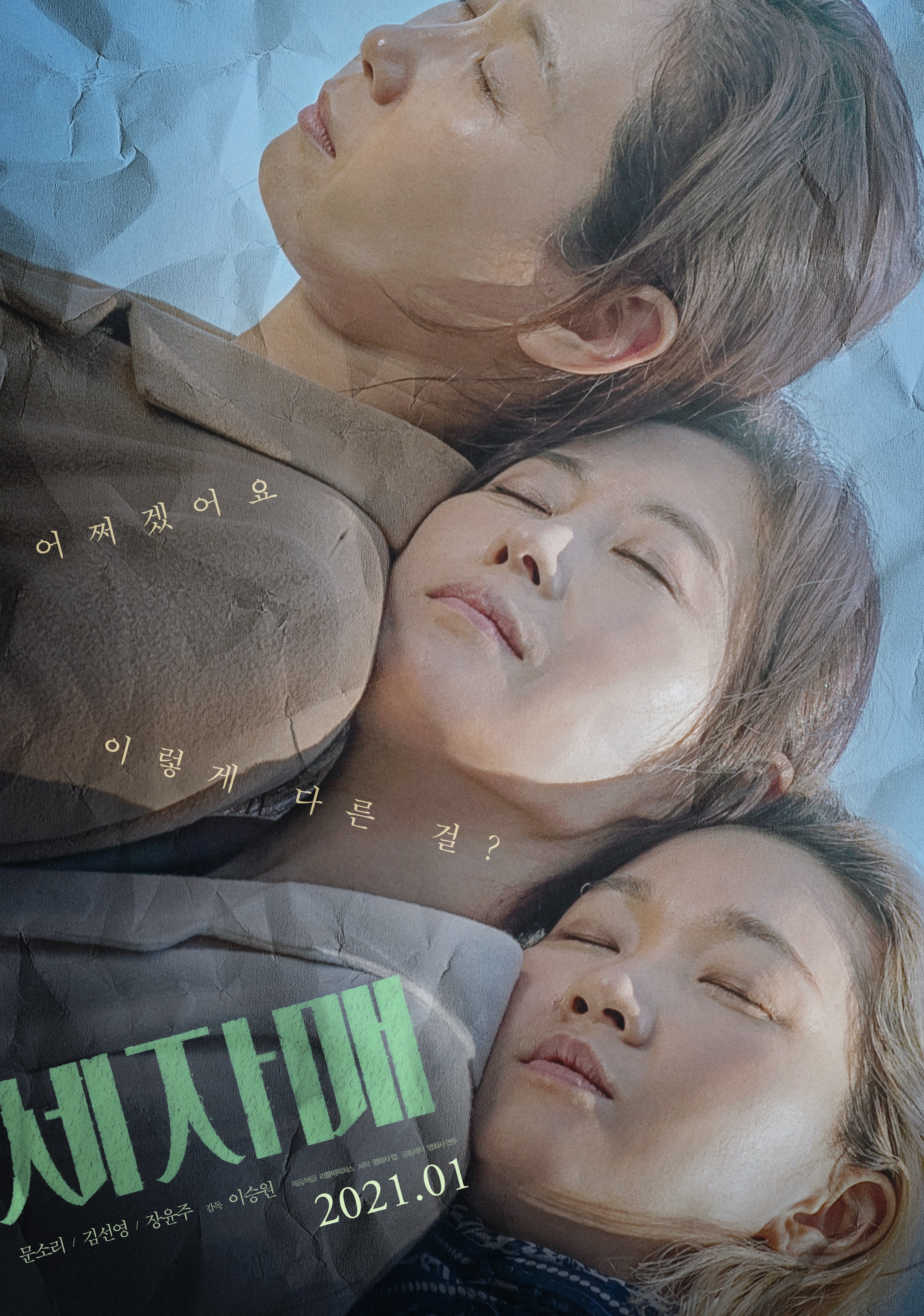
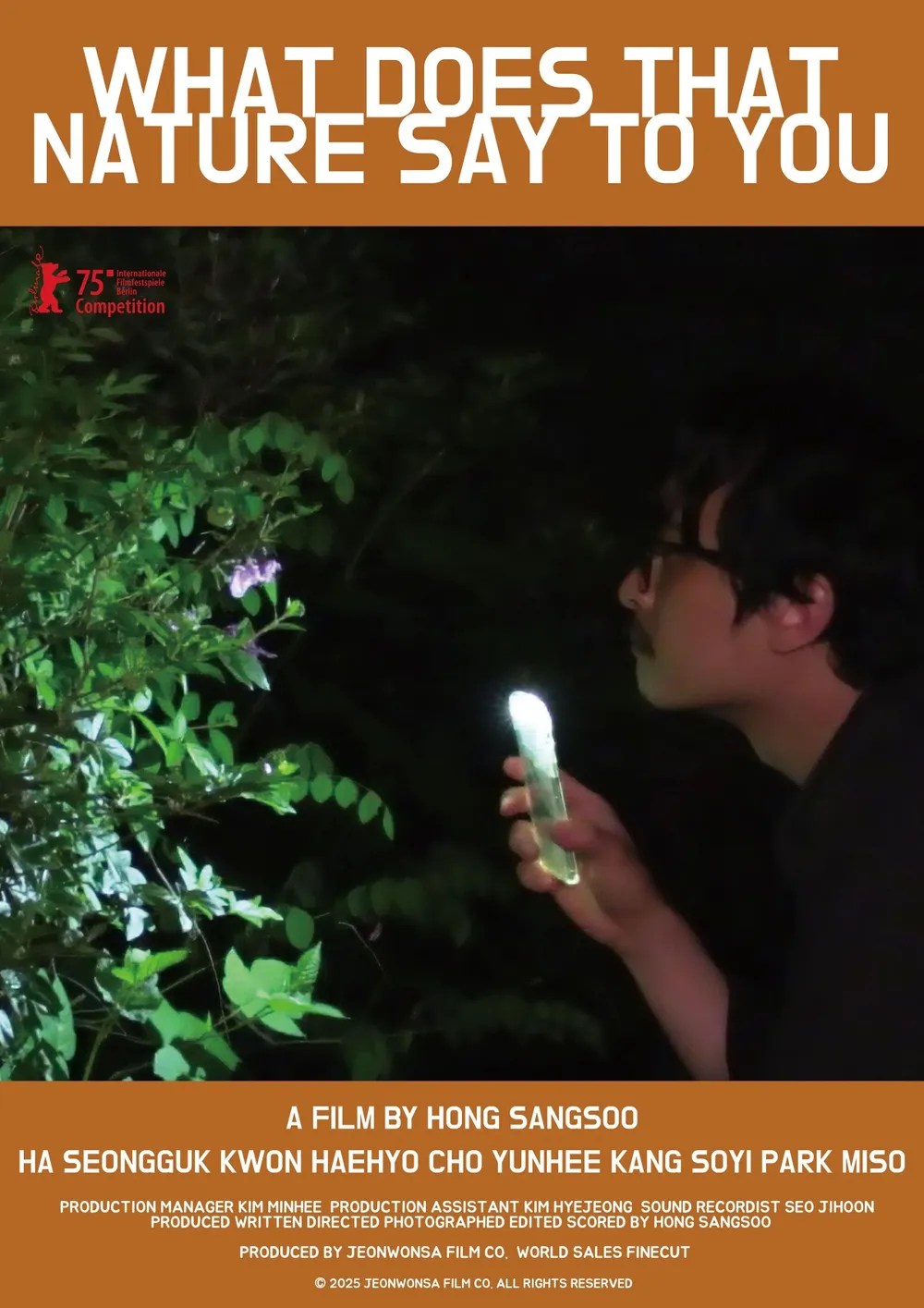
“But you’ve got your father behind you,” Junhee’s (Kang So-yi) older sister Neunghee (Park Mi-so) points to her sister’s boyfriend, Donghwa (Ha Seong-guk), meeting her family for the first time despite dating Junhee seriously for three years. But that’s not the way Donghwa likes to think about it, preferring to deny his privilege and insist that, as he does not take accept anything from his famous father, he’s an “independent” man. This notion is quickly squashed by Junhee who otherwise seems to have accepted Donghwa’s way of life when she admits that it’s more like Donghwa doesn’t like accepting anything from him, but will ask for money when he’s truly desperate. Neunghee subtly tries to remind him that whatever he might say about it, his life is only possible because he has a safety net and to insist otherwise is superficial and childish. But superficial and childish is exactly what Donghwa slowly exposes himself to be in Hong Sang-soo’s latest lacerating character drama, What Does That Nature Say to You? (그 자연이 네게 뭐라고 하니, Geu Jayeoni Nege Mworago Hani)

Donghwa is also, apparently, a little vain in that he needs glasses but doesn’t wear them so to him the world is always a little fuzzy around the edges. This might also explain why Hong films in low grade digital, much like In Water, rendering this otherwise idyllic mountain setting somewhat ugly and ill-defined. Donghwa wasn’t even supposed to be meeting Junhee’s parents today, which is why they sat in his car round the corner for ages after he drove her from Seoul before accidentally bumping into her father so he had little choice other than to stay. He said he’d come two years ago, but for whatever reason didn’t. Neunghee thinks it’s odd they’ve been putting off marriage, cautioning her sister that the “right time” never really exists and you don’t necessarily need to overthink these things, though increasingly she seems to come to the conclusion that the relationship isn’t strong enough because of Donghwa’s insecurities and Junhee’s lack of certainty. Junhee describes her as “depressed”, though Neunghee seems quite upbeat and though you could argue is basically doing the same as Donghwa in relying on her parents while she figures things out, seems to have more of a direction and self-awareness about the way she’s living her life. 

Though the initial meeting seems to go well and Donghwa bonds with his father-in-law Oryeong (Kwon Hae-hyo), he has a minor falling out with Junhee after she objects to some of his philosophical ramblings complaining that sometimes she thinks he waxes on about the ineffability of the universe in order to escape his problems. Oryeong later says something similar, that he spends his life evading things, while Jun-hee’s mother Sun-hee (Cho Yun-hee) laments that he hasn’t yet collided with reality and that’s why his poetry lacks substance even though he claimed to be a “poet”. When he says he likes the simple life and is wary of materialism, it’s difficult to know whether it’s a real position or merely an attempt to gloss over his lack of financial standing.

A now irritated Oreyong criticises him for not having his life more in order at the age of 35. Son of a famous TV lawyer or not, he doubts Junhee will be happy with a man still working part time at a wedding venue and as an ad hoc photographer on the weekends. Everyone keeps needling Donghwa about his old banger of a car, a Kia Pride from 1996 for which Oreyong thinks he paid too much seeing as it’s not old enough to be a “classic” car nor reliable enough for use as an everyday vehicle. Donghwa says he just likes it, before admitting that he doesn’t have the money for a new one anyway. The same goes for his recent adoption of facial hair with Oreyong criticising him for only doing it half-heartedly rather than going for the full bohemian poet aesthetic, though he’s likely done it to look a bit more manly and distinguished to gloss over his increasing insecurities about being the only son of a successful man who can’t escape his father’s shadow and still doesn’t seem to have figured himself out as an independent person.

Asking Donghwa what he likes about Junhee might not be entirely fair. It’s not as if love needs a reason. But his characterisation of her as an “angel” is also superficial, even if her family’s constant remarking on her upright character might be the same. Yet for all that, this awkward meeting filled with social niceties, and the wisdom of Junhee’s parents who think this relationship is not likely to last but know it’s better to let Junhee figure that out for herself, might be the collision with reality that Donghwa has been needing in showing him how childish and superficial his behaviour and lifestyle and have really been. Or at least, he’s beginning to realise they’re right about the car and maybe it’s time he set himself up straight if he is actually serious about his future with Junhee.


What Does That Nature Say to You screens as part of this year’s San Diego Asian Film Festival.
Walk Up (탑, Hong Sang-soo, 2022)

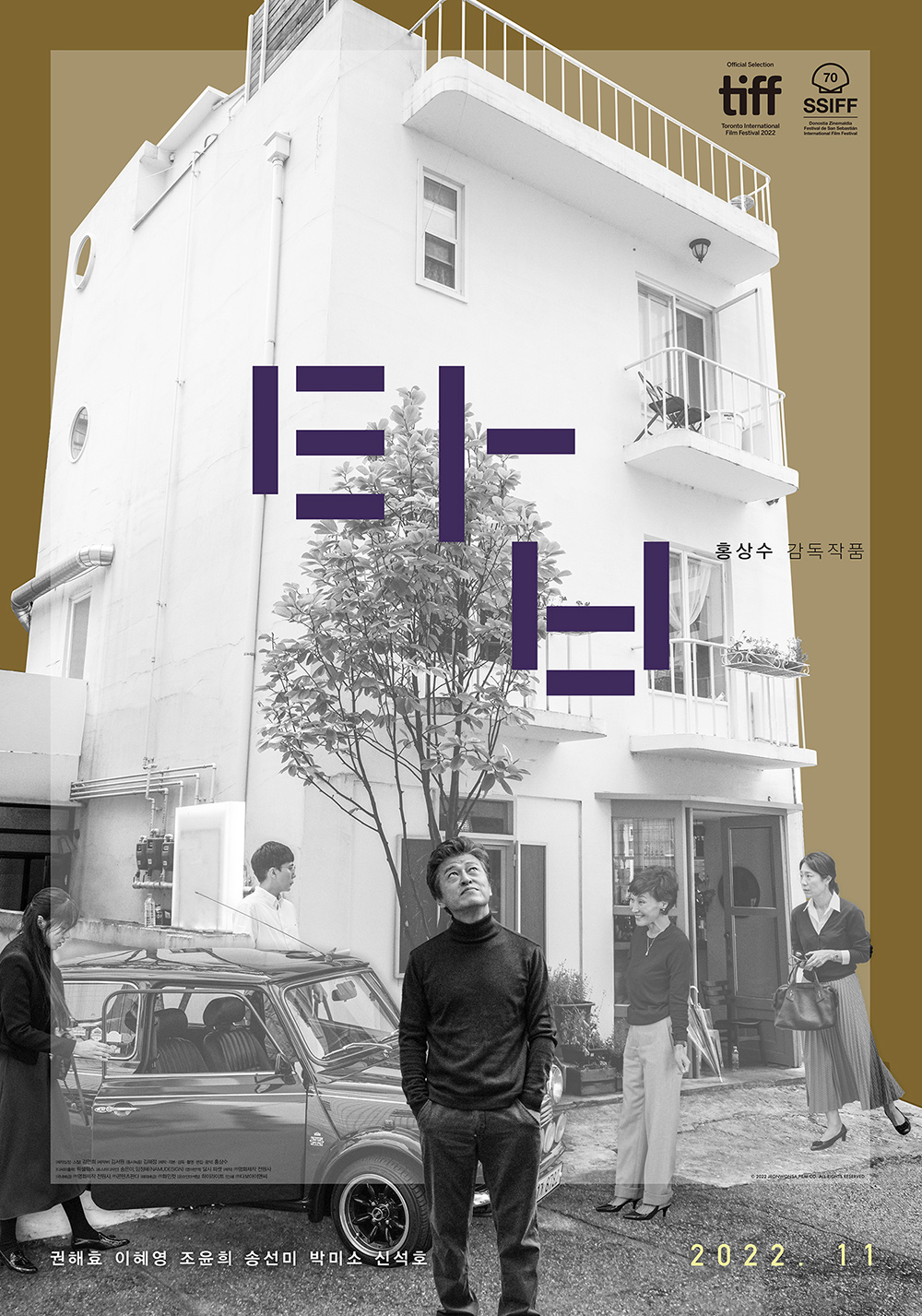
“Really all of us are like that. We’re different when we go out” an older woman tries to console, ”you want to believe that the person you see at home is the real him”. The second remark may come out more cuttingly than she means it, unsubtly suggesting that really you never know anyone and the intimacy you might believe exists within a family is just a performance. The director at the centre of Hong Sang-soo’s Walk Up (탑, tab) is indeed several different people with several different women across multiple floors of a small building owned by an old friend, Mrs Kim (Lee Hye-young), with whom he repeatedly checks in across the space of several years. 

Distance does seem to define Byungsoo’s (Kwon Hae-hyo) existence. When he turns up at Mrs Kim’s the first time, it’s with his daughter, Jung-soo (Park Mi-so), whom he later reveals he had not seen for five years. Jung-soo is there trying to make a connection, hoping Mrs Kim will take her on as an apprentice interior designer having experienced a moment of crisis on leaving art school and discovering that “art has nothing to do with money”. That’s also a problem that repeatedly plagues Byungsoo. During their conversation he’s called away to a meeting with a film producer, and later reveals that a project has fallen through after the funding was pulled at the last minute. Byungsoo embarks on a small rant about the commercialisation of the film industry in which artistic decisions are overruled by investors and no one really cares anymore about whether the film is any good only if it’s going to make money. 

Jungsoo had described her father as “feminine” and “domesticated” during her early childhood before her parents’ divorce, explaining that he seemed to change after his film career took off. Where once he’d been content to spend time a home, suddenly he was out all the time partying with actresses. Jungsoo seems to regard this personality shift as a kind of betrayal, hurt by Mrs Kim’s suggestion that Byungsoo may have been repressing himself at home and the “real” Byungsoo was the one who liked to go out on the town. Then again, people can be many things at once and perhaps there’s no one “real” Byungsoo so much as there’s the Byungsoo of the moment. Sunhee (Song Seon-mi), another failed painter who now runs a restaurant on the second floor, panders to his wounded ego repeatedly telling him how much she likes his films, though mostly for the things they’re not, and that she hopes that he will go on making films for many years to come. 

But it’s obvious that Byungsoo is deeply insecure, eventually drifting into an affair with Sunhee and living with her in the second floor apartment having taken a break from filmmaking due to ill health. He bristles when she tells him she’s going to visit a friend who slighted him on a previous occasion and tries to guilt her into not going, repeatedly texting her while she’s out to a degree that seems uncomfortably possessive and controlling. Yet he eventually ends up hugging his pillow and admitting to himself that perhaps he’s no good at relationships and deep down gets along better on his own. Even so, he later ends up with a third woman, an estate agent, who brings him wild ginseng to help with his health worries while he moves up to the studenty top floor flat which while barely big enough to turn around in comes with a spacious roofgarden. By this point his relationship with Mrs Kim, who basically begged him to move in when he first visited with Jungsoo, has clearly become strained, she perhaps also a little hurt in appearing to have carried a torch for him while hinting at feeling trapped in an unsatisfying marriage as the building itself continues on a course of disrepair. 

Mrs Kim too appears to have differing personas as she shuffles between the floors of the building she owns while each of the episodes replays with only slight differences and subject to the consequences of the last. Failed artists moving to Jeju to start again becomes a repeated theme, though it’s as if Byungsoo is resisting the pattern, talking of buying a dog with Sunhee when they relocate but then putting it off for another three years while they save money. By the time he’s made it to the top floor it’s like he’s hit rock bottom, raving about a vision from God telling him to move to Jeju and make 12 films while still ostensibly on an extended break from filmmaking. Shooting once again in a crisp black and white, Hong finally brings us back to where we came in leading us to wonder how much of what we’ve just seen really happened and how much was just a kind of thought experiment created by a bored and insecure director feeling maudlin and trying to figure himself out while his career collapses around his ears. Maybe you have to go up so you can come back down, but it doesn’t seem to leave you any less lonely as the melancholy Byungsoo discovers smoking a solitary cigarette looking up at the house from outside as if trying to decide where exactly he belongs. 


Walk Up screens at Ultrastar Mission Valley on Nov. 9 as part of this year’s San Diego Asian Film Festival.
Trailer

Three Sisters (세자매, Lee Seung-won, 2020)

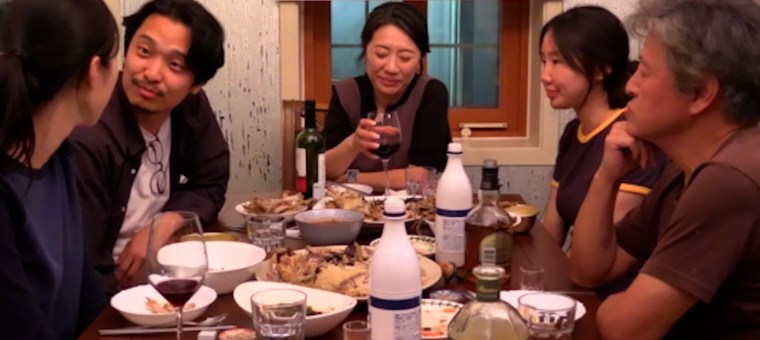
Lee Seung-won’s lightly humorous family drama is not an adaptation of the Chekhov play, but like its namesake does find Three Sisters (세자매, Se Jamae) trapped in the past, their lives “messed up” by the demands of living in a patriarchal society. A showcase for the three actresses at its centre, Lee’s drama works towards a gradual sisterly solidarity brokered by an awkward confrontation with the source of all their trauma but also lays bare the radiating consequences of unchecked male failure as the three women struggle to lead successful adult lives in the shadow of their childhood suffering. 

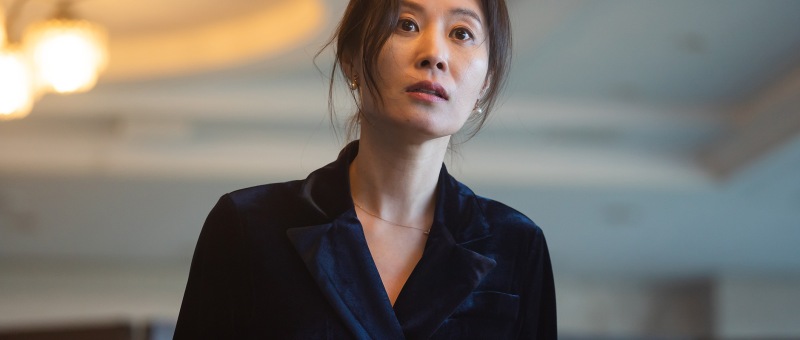
Opening with a black and white sequence in which two young girls run hand in hand quite clearly away from something bad rather than just for the joy of it, Lee switches to the present day in which oldest sister Hee-sook (Kim Sun-young) is an anxious middle-aged woman perpetually making apology for her existence, while middle sister Mi-yeon (Moon So-ri) is a cooly controlled deaconess and mother of two, and little sister Mi-ok (Jang Yoon-ju) is an unstable drunk and struggling playwright married to a moderately wealthy greengrocer with a teenage son from a previous marriage. 

They have all quite obviously chosen different methods in effort to suppress the effects of their childhood trauma, raised as we later realise in a violent home abused by their drunken father but apparently expected to put up with it out of filial piety. A half-sister Hee-sook finds herself apologising for anything and everything, filled with intense shame for her very existence. Mi-yeon by contrast has chosen order, devoutly religious she maintains high standards for her family but is filled with barely repressed rage unable it seems to express any other emotion. On realising that her professor husband (Jo Han-chul) is having a highly inappropriate affair with a much younger student she reacts with both violence and cunning, unilaterally putting a stop to his philandering while subtly letting him know that she knows and has dealt with it. Further emasculated, he tries to get some kind of normal reaction from her, hoping she will shout or hit him but she continues in the same calm and controlled fashion as if nothing had happened. Meanwhile, in another echo of her father’s violence she finds herself taking out her frustrations on her young daughter, Ha-eun (Kyung Daeun), who rebels against her need for order by refusing to say grace. 

Mi-ok by contrast has in a sense chosen chaos, drinking herself into oblivion while often ringing Mi-yeon in intense confusion unable to recall a seemingly unimportant detail from their mutual past. Taking on the big sister role, Mi-yeon finds herself in a similar position with Hee-sook who apparently doesn’t remember an event that was important to her of their dining together in the same cafe they are currently visiting back when she first came to the city and Hee-sook worked in a nearby office. Later the three sisters will attempt to visit another cafe that Mi-ok had struggled to remember but will find it closed, their past perhaps locked to them but in a sense also pushing them towards a happier future as they reaffirm their sisterly bonds after living lives of highly individualised suffering. 

Failed by a feckless father, the three women find themselves at the mercy of problematic men Hee-sook apparently re-victimised as the wife of an abusive partner who returns periodically to extort money and undermine her self-esteem, while Mi-yeon attempts to evade subjugation by dominating her husband only to find him rebelling against her through an extra-marital affair. Only Mi-ok seems to have made a better marriage to a mild-mannered, patient and caring husband but is also accused of marrying him for his money while taken to task by others for her “failure” to play the part of the conventional wife and mother, her ability to do so perhaps corrupted by her traumatic childhood. “Just treat them with love” Mi-yeon ironically advises seconds after unfairly scolding her own daughter, simultaneously explaining that no one learns to be a mother, though of course in some senses they do, and that anyone can be one as long as they work at it. Nevertheless, after confronting the source of all their pain and suffering the three women manage to rediscover a sense of solidarity that perhaps allows them to reclaim their agency and live better, more fulfilling lives free of the shadow of the past. 


Three Sisters screened as part of the 2021 Osaka Asian Film Festival

Original trailer (English subtitles)