A Coachman (馬夫 / 마부, Kang Dae-jin, 1961)

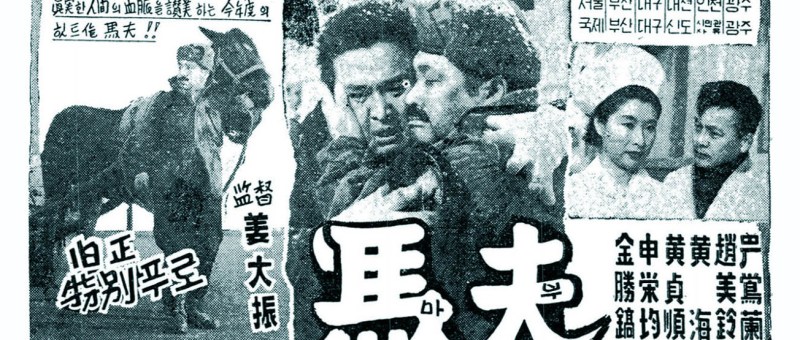
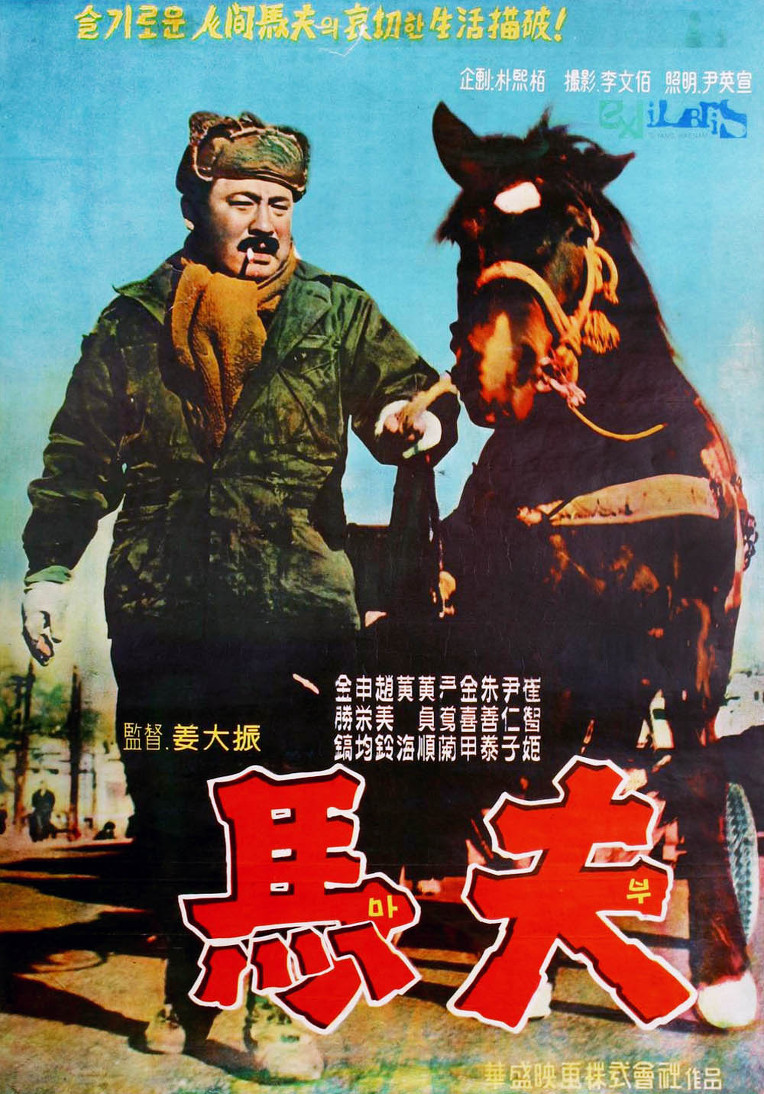
A coachman poster 1The Korea of 1961 was one of societal flux, mired in post-war poverty but striving towards a brighter economic future. The rising tides of affluence had given birth to a new middle-class with the old feudal attitudes while others were largely left behind on the shores of prosperity. Kang Dae-jin’s A Coachman (馬夫 /마부, Mabu), the first Korean film to win a major international award with the Silver Bear Extraordinary Jury Prize at the 1961 Berlin Film Festival, finds itself at just this juncture as an old man pulling a horse and cart is forced to face up the automobile age while worrying what is to become of his family in the perilous modern society.

Ageing patriarch Chun-sam (Kim Seung-ho) has been guiding a horse and cart since his father died in Manchuria when he was 14. Technically speaking, he is not the owner of his horse, Dragon, but operates it on behalf of the owner, the mistress of an upper middle-class salaryman. As business is slow, she is always threatening to sell the horses which would leave Chun-sam and the other coachmen without a means to support themselves. Meanwhile, Chun-sam’s four children whom he raised alone after his wife passed away at a young age are each looking for different ways out of their impoverished existence. Chun-sam married off his eldest daughter Ok-nyeo (Jo Mi-ryeong) who is deaf and mute to a man he saved during the Korean War but he is abusive and treats her like a servant while openly inviting his mistress into their home. Oldest son Su-eop (Shin Young-kyun) is currently studying to retake the bar exam for the third time, middle daughter Ok-hee (Um Aing-ran) has begun dating a shady salaryman, and youngest boy Soo-up has become a high school delinquent.

Kang opens with an exciting sequence following Soo-up who has attempted to steal a bicycle as he tries to escape from its owner chasing him. Returning home covered in mud, slowing to a walk and putting his student’s cap back on to avoid suspicion, he makes his way from the modern houses of the new city back through traditional Korean homes towards his rather makeshift family abode which they share with the horse stabled in a side room. Chun-sam is obviously not a wealthy man, but the family bear their struggles with fortitude, perhaps to some extent avoiding each other but rarely arguing directly. Even the news that Ok-hee has once again quit her latest job, working in a cafe, in record time is greeted with exasperated acceptance rather than anger or resentment.

Ok-hee quit the cafe to fall in with her ultramodern friend Mi-ja (Choi Ji Hee) who has arranged a double date with a pair of sleazy executives, telling them that Ok-hee is a university graduate and daughter of a wealthy CEO. Intensely ashamed of her working class background as a mere coachman’s daughter, Ok-hee tries to catapult herself into the middle classes by weaponising her sex appeal, too proud to take the long way round through honest work. She rejects the attentions of family friend Chung-soo (Hwang Hae) who is good and kind because he is only a driver, taking little notice of his earnest warning that nothing good ever comes of hanging around with shady types like her boyfriend. He keeps trying to persuade her to take a job in a nearby factory, but she still thinks she’s above that kind of life and is convinced she can get the executive to marry her.

Chang-soo’s interest is of course romantic, but the advice he gives her is honest and altruistic. Unlike his unsavoury money lender father, Chang-soo is a salt of the earth type, but good men are hard to find and trying to escape poverty through marriage is a road fraught with danger as Ok-nyeo discovers. Chun-sam thought he’d done the right thing in marrying her off, believing a match would be hard to come by because of her disability and worrying she’d be left alone with no-one to look after her, but she is forced to endure mistreatment and humiliation at the hands of her husband. Ok-nyeo repeatedly returns to her family home, only able to show them the bruises to explain what’s happening, but Chun-sam always sends her back unable to break with the old patriarchal rules which insist that once married she must forever remain this man’s wife.

Chun-sam faces a similar dilemma of his own when he strikes up a tentative relationship with the kindly maid at his boss’ mansion who often heats up rice wine for him and goes out of her way to give him little treats. The odious moneylender is also after Suwon (Hwang Jung-seun) who is considered “old” to be unmarried at 37, but she favours Chun-sam because, as she says, she has always known him to be a “good man”. The “courtship”, if you could call it that, is innocent in the extreme with Suwon largely taking the lead while Chun-sam lags bashfully behind, childishly excited but also embarrassed because he cannot afford a wife and would be ashamed to ask her to share his life of poverty.

Looked down on by everyone, Chun-sam is forced to go cap in hand to his employer where he is made to “know his place” and reminded he is “just a coachman” with no right to talk back. When Hwang, the boss’ lover, injures Chun-sam through reckless driving, Su-eop becomes fed up with persistent feudalism and intends to have a polite word but is quickly shut down, reminded that he is nothing more than coachman’s son and told that his dreams of becoming a lawyer are not only unrealistic but an offence to the social order.

Su-eop alone takes the conventional route out of poverty in pursuing education and a steady government job, but is repeatedly told that he’s getting above himself and should be content with becoming a coachman like his dad, despite the fact that being a coachman is already close to an obsolete profession given the increasing affordability of the motorcar. He alternates between guilt and despair, wondering if he’s being irresponsible in pinning all his hopes on the bar exam and worrying that he’s not doing enough to support the family.

Yet Chun-sam, forced to consider his own obsolescence, is keen for him to succeed, not only because the family needs him to make a success of himself but because he wants his son to have a better kind of life than he had taking full advantage of the possibilities of the new society. Though their lives are hard, Chun-sam and his family remain kind and honest (even Ok-hee and Suo-up eventually conclude that hard work is the way after all), bonding with others of the same mindset like the maid Suwon who eventually quits her job in protest, and Chang-soo who rejects his father’s underhanded venality for simple human decency. United by friendly solidarity, the family is repaired and resolves to live on as a tiny unit of cheerful resistance against the feudalistic greed and selfishness of the modern society.


A Coachman was screened as part of the 2019 London Korean Film Festival.

The Daughters of Kim’s Pharmacy (김약국의 딸들 / 金薬局의딸들, Yu Hyun-mok, 1963)

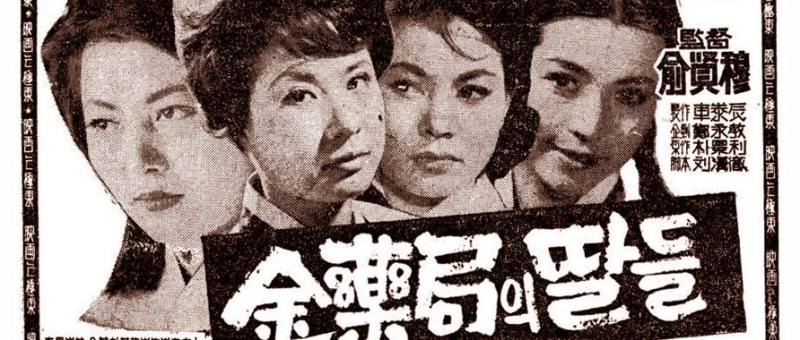
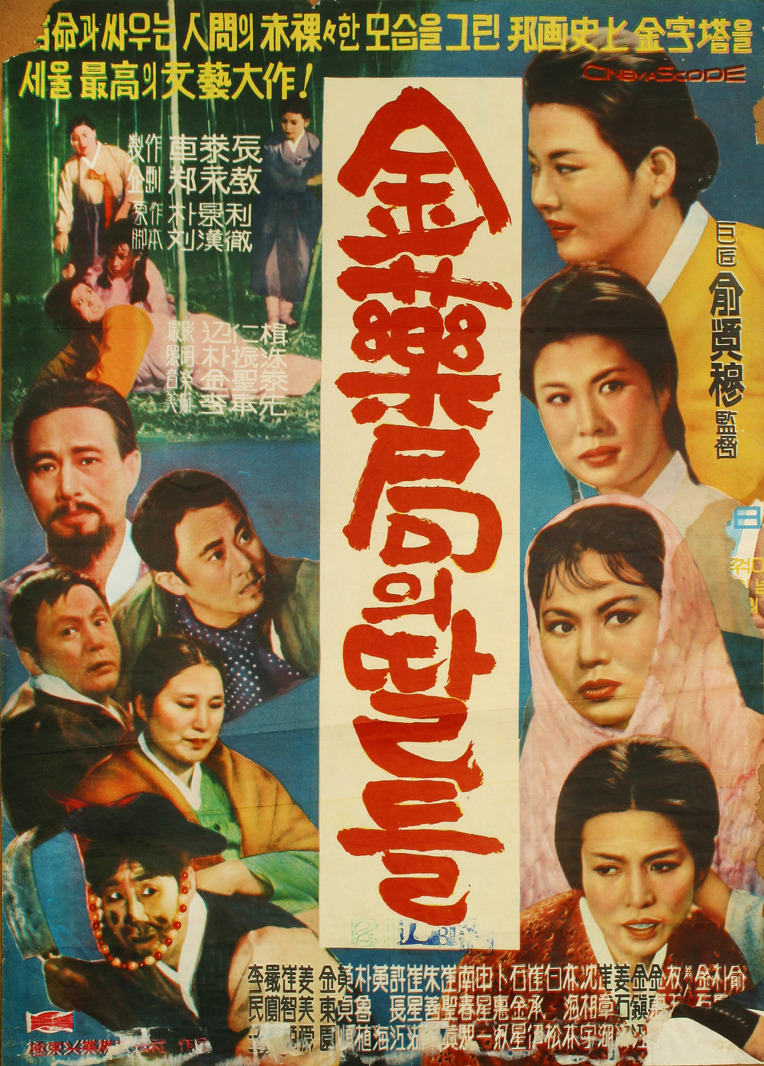
Daughters of Kim's Pharmacy poster“Literary Film” had become a kind of genre of its own in Korean cinema, both embracing and rejecting the nation’s taste for melodrama with differing degrees of artiness. Director Yu Hyun-mok, however, was not generally associated with the kind of affectation coupled intense sentimentality that sometimes marked the worst examples of the genre but with a unique brand of cinematic realism which attempted to address the social issues of the day whilst still getting past the censors who were hot on politics but increasingly lax on sex and violence. Nevertheless, The Daughters of Kim’s Pharmacy (김약국의 딸들, Kim yakgukjib daldeul) is a “literary film” adapted from a novel by Park Gyoung-li and set firmly in the recent past. Yu eventually gives in to the inherent melodrama of a small family battling a legacy of pain and destruction, but tellingly subverts it by discarding the tragic ending of the original novel for something that offers a degree of hope albeit in an all but hopeless world.

The film begins at the close of the Joseon Dynasty as a young man runs into another man’s house and desperately reaffirms his love for a woman who is now married to someone else while he is also married to woman from his village. The woman refuses to see him while he pleads with her, sobbing, but when her husband returns home unexpectedly he doubts his wife’s virtue. Threatening her and then chasing off the lover, the husband kills him by accident and is forced to flee while the woman takes poison and kills herself in her misery leaving her son, who will later become Kim the pharmacist, orphaned and alone, and the family forever “cursed” by her unquiet spirit.

18 years later Kim himself is forced into an arranged marriage which he wanders away from on the wedding day, leaving his aunts to wonder if he hasn’t been “possessed” by the vengeful spirit of his late mother. Despite the “curse” the marriage is successful in that it is not particularly unhappy and produces four daughters who are each of age when the story begins thirty years after Kim’s wedding.

The central heroine, Yong-bin (Um Aing-ran), is a “modern woman” of the colonial era, taking advantage of a shift forward into a progressive new world by leaving her tiny home village for university in Seoul. Though she longs to be free of the primitivism of her origins with its shamanistic rituals and patriarchal traditions, she is also of an elegant, conservative disposition and loves her parents deeply – something that provokes conflict in her desire for the comforts of home and the promise of away.

Of the other three daughters, each represents a particular kind of trap of the age. The oldest, Yong-sook (Lee Min-ja), has given birth to a child out of wedlock and lives alone independently raising her son in penury. Meanwhile third sister Yong-ran (Choi Ji-hee) is no longer a child but continues to loll around the house showing off her legs and posing provocatively. Her father is thinking of marrying her off to a local fisherman who has taken a liking to her, but the plan is scuppered when it is revealed that Yong-ran has been taking frequent nighttime excursions to the graveyard in the forest for secret trysts with one of the servants. When they are discovered, Kim chases the man away leaving Yong-ran publicly shamed and heartbroken. Eventually she is married off to someone befitting her social class only to discover that her new husband is impotent thanks to an opium addiction. She is routinely beaten and abused but can do nothing to escape her life of violence and terror. Yong-oak (Kang Mi-ae), the youngest sister, will eventually suffer a similar fate if one more usual, when she marries Yong-ran’s fisherman suitor only to find him rough and resentful as the fishing industry continues to fluctuate.

When Yong-bin’s mother (Hwang Jung-seun) meets her at the harbour on her return from Seoul she mentions the family curse by way of bemoaning their increasing ill fortunes. Yong-bin dismisses her mother’s concerns, preferring to think that its one’s own deeds that determine one’s future, but her mother sadly shakes her head and repeats that it’s all fated. Yong-bin’s modern way of thinking will increasingly come into conflict with her superstitious upbringing, but there’s no denying her family has had a run of bad luck – one which is only set to intensify as time moves on.

This is the central tragedy – the Kim family, trapped in the past, is unable to move beyond its “curse” and whether fated or not is set to destroy itself through outdated thinking. Though it is undoubtedly not the message the film is intended to convey, it’s impossible to ignore the degree of unhappiness which has been caused by the system of arranged marriages and the convention that true feelings must be suppressed in order to maintain ancient social codes. The Kims’ “curse” comes from the death of a woman scorned in love and betrayed by a prideful husband. If only she had been allowed to marry the man she chose, there would be no curse, no violence, no fear. As long as personal happiness is undervalued, there will be only suffering and misery for all but most particularly for the young women of Korea.

Yong-bin, an urban sophisticate, knows this more than most. Her father thinks he ought to marry her off first so he can marry off Yong-ran whose precociousness is beginning to alarm him. Yong-bin, however, wants to finish her education before submitting herself to a lifetime of servitude as someone’s wife and later mother. Her father has his eye on a match – the son of a usurious loanshark who is also a Japanese collaborator. Luckily, Yong-bin likes the man her father has chosen and sees only a romantic fantasy in marrying a childhood friend despite a warning from another mutual acquaintance that Hong-sub is a timid yet ambitious man – a dangerous combination which is unlikely to yield much happiness. She is going to get her heartbroken in more ways than one, her illusions of innocent romantic destiny shattered and her heart wounded by a spiritual as well as physical betrayal by the feckless Hong-sub who turns out to be not the man she thought he was but the one she was warned about.

Yet there is something in Yong-bin’s modernism that cannot be denied. This being the colonial era, the influence of the Japanese is felt even in this tiny village. Kim has sold the family pharmacy because of the influx of Western medicine coming in through Japan. He invested heavily in fishing, but the Japanese are ruining that too through invading local waters and overfishing them. Yet Kim still thinks of himself as a feudal lord with a real duty towards the people of his village. When his boat is ruined in a shipwreck and many sailors killed, he feels he must compensate the victims’ families who are now without the means to support themselves. This leaves him open to exploitation by Hong-sub’s usurious father who is in big with the Japanese who are, to an extent, the route cause of all these problems. Hong-sub’s father laughs when Kim declares his need of extra cash to support those who’ve suffered because of his failed fishing venture, thinking his sense of duty merely stupid but also seeing that it’s another hook for him to exploit that brings him closer to his goal of harnessing Kim’s ancestral estate with its large amount of farmland and property.

The Japanese play into a small sub-plot in which Yong-bin’s cousin (Shin Seong-il) is engaged in the resistance movement and eventually leaves for a covert mission in Japan. Before he leaves he introduces Yong-bin to a friend, Kang-geuk, who has been arrested and is being carted off to Japan for trial but has apparently fallen in love with her based only on his friend’s stories and a photograph. She’s back to a romantic fantasy once again and gravitating towards the spectre of arranged marriage which the film has already done such a great job of discrediting. It is, however, the perfect symbiosis of the film’s themes allowing Yong-bin to embrace both sides of herself. Meeting again after the liberation and a succession of terrible tragedies for the Kim family, Kang-geuk responds to Yong-bin’s intention to leave her hometown forever by asking her to name a place which is not tinged by loss and tragedy, and of course she can’t. Suddenly, her village doesn’t seem so bad anymore.

The “curse” is broken in being acknowledged and Yong-bin exercises her freedom to choose, consenting to a marriage, and making a decision to stay rather than being forced to leave. Yu’s comparatively hopeful ending in which Yong-bin nevertheless places herself back within a patriarchal value system stands in sharp contrast to that of the novel in which the Kim family’s failure to reconcile themselves to modernity provokes their downfall, but there is only so much hope in this hopeless world and Yong-bin, like her surviving sisters, will continue to suffer in an existence which offers little else to Korea’s oppressed women, remaining complicit in her own misery.   


Available on DVD as part of the Korean Film Archive’s Yu Hyun-mok boxset. Also available to stream via the Korean Film Archive’s official YouTube Channel.

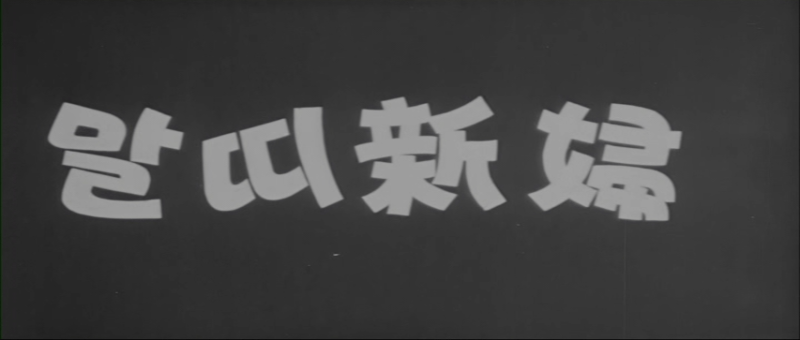
Horse-Year Bride (말띠新婦 / 말띠신부, Kim Ki-duk, 1966)

In the relatively conservative Korean society of 1966 it’s surprising that film like the Horse-Year Bride (말띠新婦 / 말띠신부, Maltti Sinbu) could have been made at all. On the one hand it embraces and subverts common notions of gender by positioning its “horse year women” as somehow deviant from the norm, difficult to deal with and undesirable, but also places them centerstage as individuals making independent choices in their own lives rather than simply trailing along behind their men. Technically the second in a trilogy of films, the first and last being directed by Lee Hyung-pyo, Kim Ki-duk’s Horse Year Bride is a raucous sex comedy, tame by modern standards but transgressive by those of the time. Adopting a mild, if ironic, issue movie stance, Kim also satirises social attitudes to “horse year women” and councils against a trend of aborting babies set to be born in the year of the horse lest they be female and turn into vicious harridans.

The film opens with a wedding in which middle-aged (presumably 35 or 36 year old) Bok-soon (Hwang Jung-seun) marries the extremely miserable looking professor Seok-du (Park Am). The wedding photographer who later turns out to be a horse woman herself and a private eye is surprised to notice that Bok-soon has horse’s hoofs rather than fancy shoes under her wedding dress. A fortune teller (Kim Hee-kap) then introduces us to his matchmaking service and claims the wedding we have just witnessed is a result of his best ever match before introducing us to two more couples – Soo-in (Nam Mi-ri) whose husband Sang-won (Yoon Il-bong) has gone full on domestic to look after her while she’s pregnant, while Mi-hae (Um Aing-ran), also pregnant, fends off the sexual advances of her frustrated husband Keun-ho (Shin Seong-il). The two as yet unmarried horses include the aforementioned private detective, Young-hee (Bang Seong-ja), and a dancer, Suk-ja (Choi Ji-hee), who is engaged but not above making use of her sex appeal for material gain.

Bok-soon, one horse cycle ahead of Soo-in and Mi-hae, laments her long period of matronly virginity and is keen to make up for lost time. Seok-du, however, is not exactly a love machine and is completely worn out by his wife’s appetites, even going so far as to return to the fortune teller and complain that his excellent matchmaking has turned him into an exhausted sex slave. The matchmaker suddenly grabs a picture of Napoleon and has a novel explanation for where the famous general’s hand might be. Anyway, his advice is to practice yoga to increase stamina and keep Bok-soon happy.

Meanwhile, Soo-in and Mi-hae have both lied to their husbands about being pregnant in order to avoid sex so that they don’t conceive a daughter that, like them, will be born in the year of the horse. This particular “White Horse” year is thought to be especially inauspicious and daughters born as White Horses will apparently be total nightmares and have terrible lives. The two relationships send up various culturally accepted norms of martial gender roles as the women both manipulate their husbands to get their own way. Soo-in’s Sang-won is so solicitous about the pregnancy that he’s put Soo-in on virtual bed rest and blossomed into a mother hen clucking around doing the housework but making a total mess of it (because, after all he’s a man, and men aren’t “built” for this sort of thing). Mi-hae’s problem is the opposite in that Keun-ho’s sexual needs are a constant source of frustration to him in which he resorts to pounding a giant mortar in an unsubtle attempt to relieve his pent-up energy. Bok-soon too is subtly manipulating Seok-du by feeding him an “aphrodisiac” and secretly practicing yoga herself to get the most out of her married life.

Unmarried Suk-ja attempts to manipulate men by promising more than she means to give but finds herself in hot water with a grumpy salaryman (Joo Sun-tae) who seems determined to take what he thinks he’s owed. Suk-ja later pays heavily for her rejection but the other women rally to her side to take revenge on the lecherous businessman whom they regard as “human scum” and intend to “re-educate” to treat women better. The vengeful band of women taking revenge on the male sex with each of its various double standards and chauvinistic assumptions derives part of its humour from the relative lack of power available to them but does manage to make a sensible point about the sexist world they inhabit.

Eventually, when the women have given up their power and allowed themselves to become pregnant by their men, even the doctor at the hospital assumes they will want abortions to avoid the threat of White Horse daughters. By this point the women have also resolved that there’s nothing wrong being Horse Women or even White Horse Women, with women excising power (even if in necessarily feminine ways), or with enjoying full relationships with their husbands, but they’re still bound by otherwise typical ideas of female gender roles in the importance of maternity and dream their daughters will be Miss Koreas rather than great scholars or forces for good in the world. The doctor raises an interesting point when he suggests the fear of White Horse Women is an unwelcome foreign import from Japan which both paints it as another symptom of colonial corruption and ignores the fact that the reasons for the ongoing stigma are part of the essential social fabric of Korea. He does, however, find some darkly comic reasons against abortion in citing the economic effects of empty schools and lonely classrooms while also suggesting the women’s daughters may have an easier ride thanks to the lack of competition.

In contrast to his previous films, Kim adopts a youthful, pop-culture infused approach which makes frequent use of domestic and foreign pop music with a lengthy animated title sequence plus extended scenes of music and dance often unconnected to the main drama. Extremely frank in its treatment of modern sexual relations, Horse-Year Bride is an unlikely ‘60s Korean sex comedy filled with silly gags and slapstick humour but proves an extremely effective satire of the complicated social mores of ‘60s Korea.


Available on DVD as part of the Korean Film Archive’s Kim Ki-duk box set. Also available to stream online for free via the Korean Film Archive’s YouTube Channel.