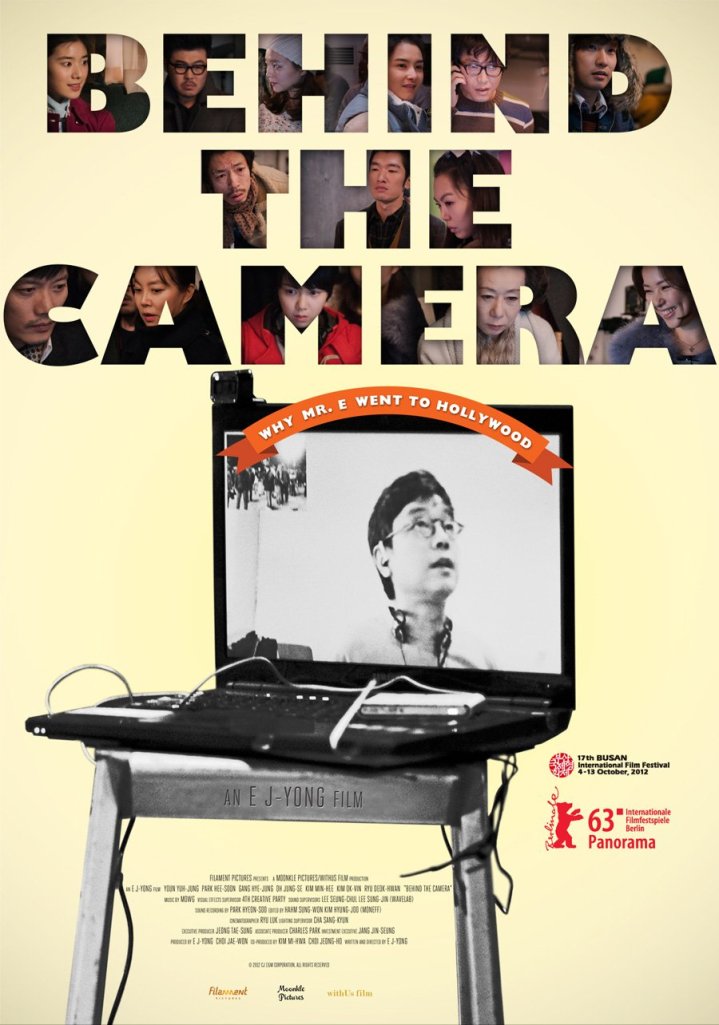
Behind the Camera (뒷담화: 감독이 미쳤어요, E J-yong, 2013)


fullsizephoto273825Review of Korean meta documentary style comedy up at UK-anime.net


When Korean director E J-yong was commissioned to make a short film as an advertisement for Samsung, he thought to himself what a wonderful idea it would be if he could test modern technology to its limits and direct the film remotely from a hotel room in LA. In particularly meta touch, the script he’s designed for the film also features a Korean director remotely directing a film the only difference being that the fake director is doing it because his overseas girlfriend is in town and he’s trying to avoid having to choose between love and money. Like E’s previous film, Actresses, which got some of Korea’s most talented actresses together for a fashion shoot where they proceeded to trash talk the industry and each other, Behind the Camera is fiercely funny behind the scenes style mockumentary where the lines between reality and fiction are anything but clear.

As the film begins, some of Korea’s best known talent has been assembled for a preliminary meeting regarding the short film they’re going to be making over the next two days – only there’s one very important person who doesn’t seem to have arrived yet. Coming as a surprise to some, the producer then stands up and makes an announcement that this film is going to be a little different, in fact the first of its kind, as the director will not be present on set at any point during the shoot but will be supervising from LA via Skype! Some members of cast take this better than others, especially as they lose wireless contact almost as soon E starts trying to explain the nature of the concept. Predictably, some don’t even believe he’s really in LA at all just engaging in a elaborate practical joke but others regard the whole thing as a farce and vaguely insulting to their status in the industry. As time moves on, the crew gradually start just ignoring E and doing their own thing and it’s clear one or two of them have their eyes on the director’s chair. Can you really direct a film from half way across the world and still realise your vision in the same way you would if you were really standing on the set? What’s more, is the idea of a director in itself anything more than vain conceit if all you do is say ‘yes’, ‘no’, and ‘cut’?

In the wrong hands, films with this sort of conceit can go horribly wrong. Often too clever by half, anything with a meta construct has a serious risk of ending up on the wrong side of pretentious but it’s clear that E J-yong’s intentions are a world away from any such self aggrandisement. Essentially a bolted on companion piece to his Samsung commercial (what a fantastic use of time!) what E has crafted is a warm and witty backstage look at the movie making business. Completely unafraid to poke fun at himself as the director with a high concept who may or may not be in Hollywood trying to make in America like his friends Park Chan-wook, Kim Ji-woon and Bong Joon-ho (now he’s made a film in Hollywood even if it wasn’t a Hollywood film), Behind the Camera takes what could be a fairly thin joke and unpacks it in such a witty fashion that it easily sustains itself over the course of a full length film.

Like Actresses, Behind the Camera assembles a whole host of Korean cinema talent with actors, actresses and industry personnel mostly playing themselves. Some of the funniest moments in the film occur when the cast and crew are just hanging out together and chatting generally about various things. Yun Yoe-jong had taken a brief break from filming Im Sang-soo’s A Taste of Money in order to take part in this mini-project as a favour to E who hasn’t even bothered to turn up! In fact she originally told him she was too busy but after he sent her a depressing photo of himself begging her to star in his film she gave in. If anyone has earned the right to a few salty and spiky retorts after such a long and illustrious career it’s certainly Yun Yeo-jong and witnessing her intense displeasure with the entire endeavour is one of the highlights of the film. There are also plenty of meta references to the Korean film industry and cinema history for those who are well versed enough to pick up on them.

At first glance, Behind the Camera might sound like one of those precious industry “mockmentaries”  that are never quite as funny as they think they are, but Behind the Camera is different precisely because it isn’t afraid to turn the camera around and expose what really goes on backstage. You genuinely can’t tell what is ‘real’ and what is ‘constructed’ but what is certainly true is that Behind the Camera’s warm and humorous outlook make it one of the funniest Korean comedies of recent times.
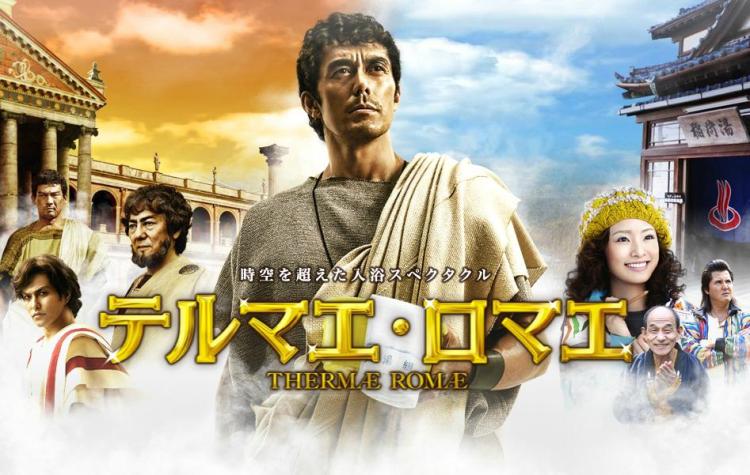
 

Thermae Romae

THERMAE ROMAE-T

Lucius ambulat in Tokyo? Review of improbable time travel comedy Thermae Romae up at UK-anime.net.


Pop quiz – what do modern day Japan and Ancient Rome have in common? Fish sauce? Emperor worship? Sandals? More than you thought, wasn’t it? Well, the correct answer is public bath houses and sure enough the people of modern day Tokyo still love going to the public bath even though they enjoy the luxury of being able to bathe at home! Of course, bath house culture with all its social and political uses and divisions was one of the things the Roman Empire took with it wherever it went. However, there must have been a time when some Romans began to feel their baths were getting a bit stale and in need of a new ‘modern’ twist, but what to do? What if they could leap forward in time and learn from the 21st century bath culture of modern Japan! Enter down on his luck architect Lucius who suddenly finds himself in a strange land full of strange looking people who seem to have taken bath technology to its very zenith.

Lucius Modestus (Hiroshi Abe) is a once successful bath architect with a case of serious designer’s block. Replaced on a prime project because he’s been unable to come up with any ideas he decides to go for a soak at the local bath house but whilst clearing his head underwater he finds himself sucked through a passage way only to reappear in a very strange looking place – it’s a bath house alright, but not as we know it! As they’re speaking a strange language he doesn’t understand, Lucius assumes the elderly men bathing here must be slaves and he’s been sucked into the “slaves only” part of the baths. Some of this stuff is kind of cool though – what are these funny spigot like things for, and these handy little buckets? Wait – they have baskets for their clothes?! We could do with some these in our bit! And so Lucius experiences the wonder of public bathing in Japan to the extent that it makes him cry with joy at which point he returns to Ancient Rome and begins to put some of these techniques to use in his designs. Travelling back and fore, Lucius always seems to run into the same Japanese girl who wants to make him the star of a manga and group of kindly old men. Can Lucius finally build the bath house of his dreams and stop a conspiracy against his beloved Emperor Hadrian at the same time?

Based on Mari Yamazaki’s manga of the same name (which also received an anime treatment from DLE), Thermae Romae sticks fairly closely to a fish out of water format for the the first half of the film as Lucius becomes by turns confused and then entranced by the various pieces of modern bathing technology he encounters on his travels. As a Roman encountering other people who are obviously not Roman, he of course adopts a superior attitude and assumes these people are either slaves or ought to be and so is extremely bewildered that their advancements seem to have eclipsed those of his own beloved Rome. These situations obviously provide a lot of room for humour as Lucius encounters various things that seem perfectly normal to us but strange and alien to him – his pure joy at discovering the wonder of the multifunctional Japanese toilet being particularly notable. It does though become fairly repetitive as Lucius finds himself in different situations which are essentially the same joke in different colours but then when the plot element begins to kick in later in the film it too fails to take off and feels a little too serious when taken with the wacky time travelling antics we began with.

Aided in his quest Lucius meets several amusing supporting characters including the group of elderly men from the baths who didn’t really need the help of an improbable ancient Roman to get themselves in trouble and Mami who functions as a kind of love interest who’s cast Lucius as the hero in her next manga. Mami begins learning about the Roman Empire and takes a course in Latin which helps a lot when she too finds herself in Ancient Rome and facilitates a kind of cross cultural exchange as she steals ideas from Rome for her manga as Lucius stole for the baths. However, the romantic comedy element never really comes together and even as Mami continues to pine over her noble Roman, Lucius remains aloof in the universal belief that all non-Romans are inferior. Though he does come to grudgingly acknowledge that the ‘flat faced people’ as he calls them have particular strengths such as their willingness to work as a team and put collective success ahead of personal gain, he never quite sheds his Roman arrogance.

It’s all very silly but undeniably quite funny if often absurd. We hear everyone in Rome speaking in Japanese and Lucius continues to think in Japanese wherever he actually is but obviously once he gets to Japan he can’t understand what anyone’s saying and attempts to communicate with them in Latin (whilst still giving his interior monologue in Japanese). Likewise, when Mami learns Latin she uses it to communicate with Lucius in Japan but once they get to Rome, all their ‘Latin’ is Japanese too which causes problems when the old men arrive because they’re speaking the same language as everyone else yet can’t understand anyone or be understood – which might be why they don’t get to say very much other than to Mami. It’s all quite strange and disorientating but kind of works as does the largely Puccini based score which screams 19th century Italy much more than Ancient Rome but helps to give the film the air of classical pomposity it’s aiming for. Big, ridiculous, silly fun – no one could accuse Thermae Romae of having any kind of serious message but it does provide genuinely entertaining silliness for the majority of its running time.


Sawako Decides – Review


Sawako (Hikari Mitsushima) has been living in Tokyo for five years. She has a part time job at a toy company as an assistant, mostly making tea but doing any other slightly unpleasant menial tasks her petulant boss decides to throw her. She has a quite useless boyfriend who once worked at the toy company as a designer but has resigned (or was asked to leave following a total flop of his newest toy with a toddler focus group) in order to lead an ‘eco life’. His main hobbies appear to be knitting and recycling. A divorcée he has a daughter who he looks after, but isn’t terribly interested in and keeps referring to Sawako as her ‘new mother’.  Into this fairly dismal life is thrown the bombshell that Sawako’s father is seriously ill in hospital and it’s thought she ought to return home. Despite her protestations that she hasn’t been home for five years for a good reason and has no intention of going now, the boyfriend somehow convinces her to go as part of a naive plan to live on the land in an ‘eco’ way. As it turns out there are a few good reasons Sawako didn’t want to go home, it seems she’s none too popular there. Eventually ending up running her father’s clam packing business in his stead, these are the problems she will have to overcome if she’s to lead a more satisfying life.

Sawako Decides (kawa no soko kara konichiwa) is a decidedly bittersweet comedy about learning to accept yourself for what you are and doing your best with it. The humour is quirky and off the wall as might be expected, but mostly very true to life and the film is very funny. Unlike a most light comedies this one manages to be quite emotionally engaging and the audience quickly empathises with Sawako and her situation and is eager to see her move away from her disappointment. It’s a very charming film with an usual message delivered in an usual way, well worth looking at.


Arsenic and Old Lace

http://www.youtube.com/watch?v=2QvozC_uW-g


There is a happydale, far, far away….


This is one of  my most favourite films. Theatre critic and prominent anti-marriage advocate Mortimer (Cary Grant) has just married nextdoor’s vicar’s daughter, Elaine (Priscilla Lane). Understandably embarrassed, Mortimer is desperately trying to keep the marriage under wraps but nevertheless returns home to let his sweet maiden aunts know the good news. Unfortunately he’s not the only one with a surprise, as he discovers opening the window seat. Believing his uncle Teddy, who is under the delusion that he is Teddy Roosevelt, has finally gone too far and harmed someone, he confronts his aunts and suggests they look into finding a better place for Teddy. Casually they reveal the body is ‘one of theirs’ and our whole macabre farce kicks off. Oh and did I mention Mortimer’s sadistic older brother Jonathan, who’s had plastic surgery to change identities but wound up looking like Karloff in Frankenstein, the doctor who did that to him and their own guest they’re bringing to this bizarre gathering? Not to mention the police turning up, one of whom has theatrical ambitions! Hilarious!