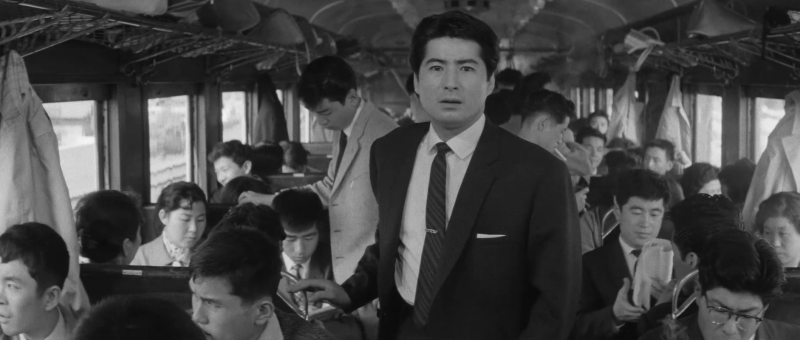
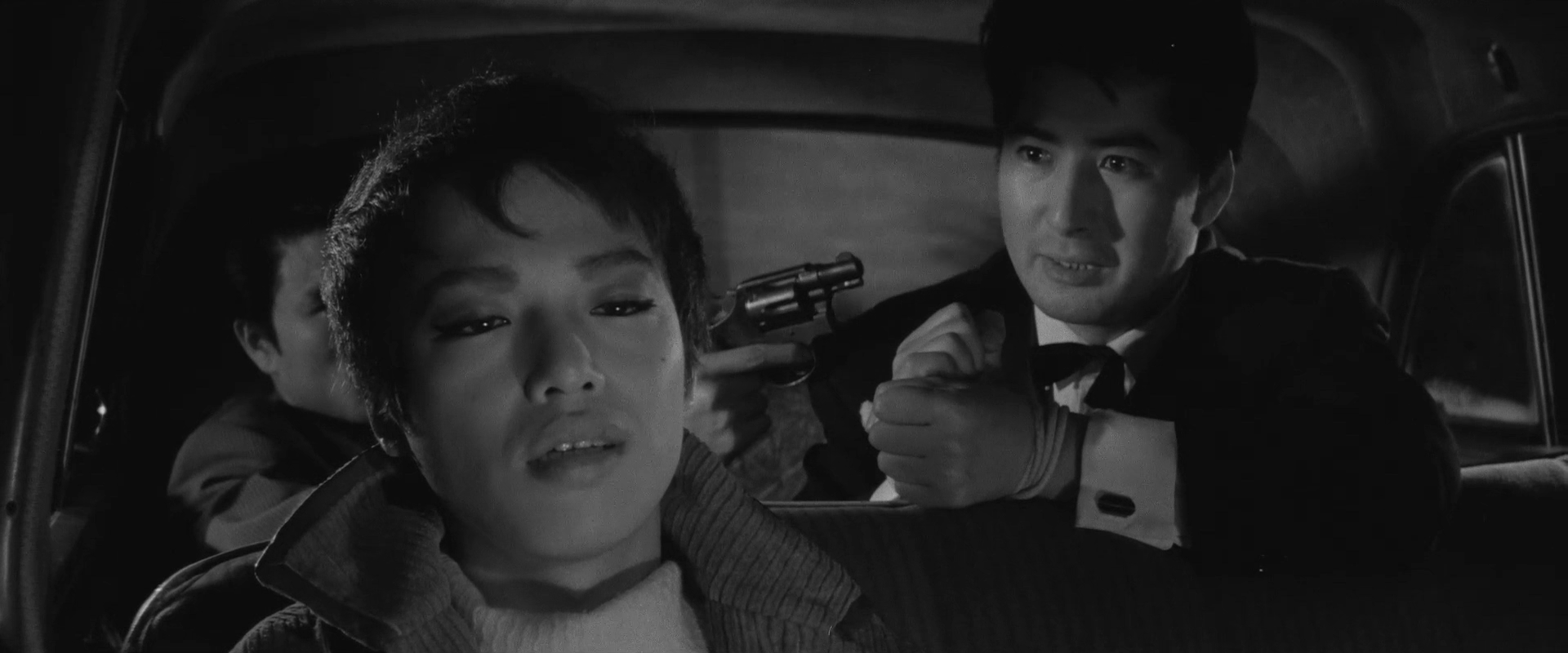
Another of Seijun Suzuki’s early Nikkatsu noirs, Passport to Darkness (暗黒の旅券, Ankoku no Ryoken) starts out like The Lady Vanishes and then turns into the 39 Steps while drawing influence from hardboiled Hollywood movies such as The Big Sleep. It is, however, very much about the confusing landscape of late 1950s Japan in which nothing is quite as it seems and shady forces are constantly operating in the background out of view. “Darkness can descend on our lives just like that, can’t it?” the hero remarks, “there’s only so much an individual can do,” he sighs, “who’s going to protect us?”
Probably not the policeman, who replies that that’s just how Japan is now. Though, in general, the police are doing something even if there are hints they’re also mixed up in this swirling darkness. They don’t really hang on to jazz trumpeter Ibuki (Ryoji Hayama) as a suspect for very long, though they do keep him under a watchful eye just in case. Ibuki marries the singer from his nightclub band and is about to depart on his honeymoon, an all expenses paid gift from his bosses, when he gets off the train to look for a friend who’s running late, Moriwaki. When he gets back on the train, his new wife, Hiromi, is nowhere to be found.
Rather than thinking she may ironically have got off the train to look for him and not made it back on, Ibuki jumps to the conclusion that she’s got cold feet and jilted him before their honeymoon. Though he gets off at the next station, he’s too embarrassed to call any of his friends fearing they’ll make fun of him for being a guy whose wife left right after the wedding. It’s this sense of insecurity that makes him a little less sympathetic, thinking mostly about himself rather than seriously considering something may have happened to Hiromi or that she’s just on the next train. That’s probably why he doesn’t do anything sensible, like going back to their apartment to see if she’s there, and only makes cryptic phone calls before asking a friend to meet him in a bar and explaining the situation. He spends the evening on an endless pub crawl supposedly looking for her while drowning his sorrows. When does eventually get home, he discovers Hiromi dead in their flat having been strangled with a tie. Obviously, this makes him the prime suspect, though the police are unusually open to the idea someone else was involved.
Ibuki turns private detective trying to work out what happened to Hiromi and who might have wanted to hurt her. The police tell him there was heroin in her handbag and they therefore suspect the crime has something to do with drugs, but that doesn’t add up with the Hiromi that Ibuki knew. Either they’re wrong, or Hiromi was somehow hiding a massive drug problem from him and maybe he didn’t know her at all. This sense of uncertainty is echoed in Suzuki’s dreamlike aesethetic which already leans towards the surreal. When the club MC announces Ibuki’s marriage onstage, he dissolves to be replaced by Moriwaki who hands the pair their honeymoon tickets suggesting that sudden appearances, disappearances, and missing time are common in this world. Later Ibuki listens to a secret conversation through a wall of jagged glass echoing the confusing nature of the story he’s beginning to trace.
That story itself largely revolves around drugs and displacement. Hiromi had been looking for her missing brother with the police suggesting he’d probably become a yakuza and might not be worth looking for. Others are motivated solely by a determination to liberate their loved ones from a drug addiction that has been forced on them as a means of control by an organisation that’s dealing drugs from bar called Tsubo on which Ibuki stumbled during his drunken pub crawl. One of the ringleaders, Ishimaru, is said to be from a zaibatsu family, which the heir to a large conglomerate and a member of the economic elite. He mentions a past in the navy and his conversation steers toward the nationalist, lending a nasty flavour to his already shady activities.
Eventually the trail leads back to a Frenchman named Franc and a “gay boy”, to use the parlance of the time, named Kenny who is also trapped due to being a drug user. It’s not particularly unusual to see places like these, essentially host bars where men pay to drink with effeminate male hosts, in films of the time, but Passport to Darkness is particularly sympathetic towards the community. It’s clear that the evil is drugs and that Kenny is an innocent who’s been swept into intrigue. Gay bars and gay people are just normal parts of life, not evidence of a seedy underbelly or the moral turpitude of the post-war society. What is rather surprising is that the film features a kiss between two men, which is pretty progressive for 1959.
Nevertheless, as Ibuki says, there’s not much the individual can do defend against the forces of darkness and even some of his closest friends turned out to be no good, while those he doubted were actually on his side. He keeps getting mysterious letters warning him off all signed “K” which is inconvenient, because most of the people he knows have a claim to the initial, and really it could be anyone. There doesn’t seem to be a clear answer to the question of who is going to take responsibility, but Ibuki simply goes back to his life, deciding music is the best way to honour Hiromi’s memory by playing American jazz in a bar that’s mainly frequented by an international clientele hinting at the nation’s new global ambitions.
 Windows on Worlds