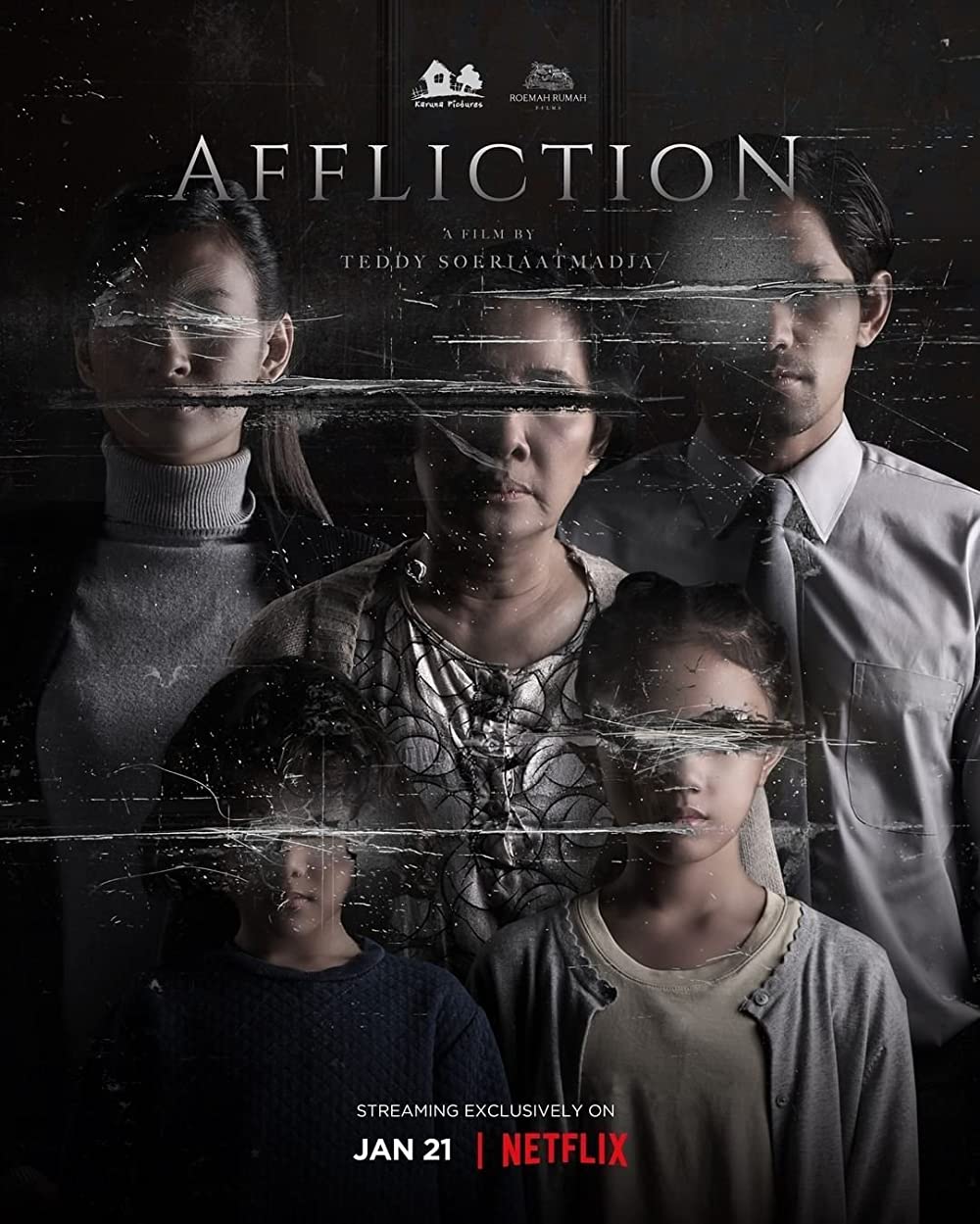
Affliction (Teddy Soeriaatmadja, 2021)

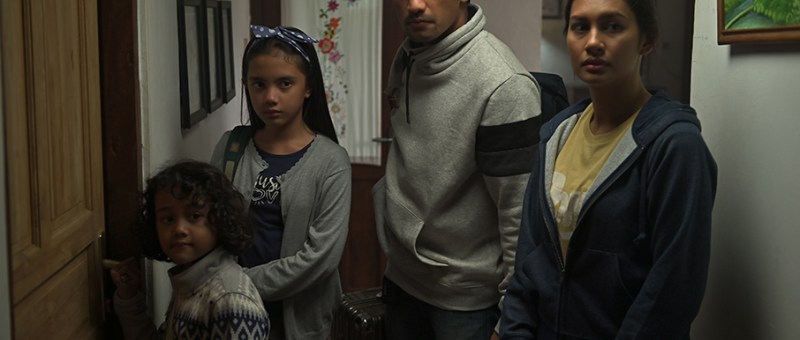
The lives of an affluent urban family are disrupted when they receive a call from a mysterious visitor informing them that she is no longer prepared to look after the husband’s ageing mother in Teddy Soeriaatmadja’s eerie familial horror, Affliction. What posits itself as a meditation on the effects of childhood trauma turns out to be its reverse, but nevertheless contemplates contemporary filiality as the wife, blaming herself for her mother’s unexpected death by suicide, tries to repair her familial bonds by resolving to look after her estranged mother-in-law. 

The fact that Nina (Raihaanun Soeriaatmadja) has never met her mother-in-law Bunda (Tutie Kirana) despite long years of marriage to her husband Hasan (Ibnu Jamil) doesn’t seem to have felt odd to her, at least until she’s visited by a young woman who informs her that Bunda has advanced dementia and needs more comprehensive care than she can give her. Her words that it’s time a son should look after his mother further add to Nina’s sense of guilt especially as she is still grieving for her own mother whose ghost she saw slightly before she died leading her to believe that there might have been something more she could have done to save her. But when she mentions the strange encounter to her husband, he becomes angry and belligerent explaining that he has a “different” relationship with his mother than Nina had with hers and has no desire to return home or ever see her again though open to the idea of hiring a new live-in nurse. 

Nevertheless, the family to eventually make it out to the incredibly remote mountain area where Hasan grew up. To Nina there seems to be something not quite right with the house, a sense of discomfort and unease that is something more than her mother-in-law’s strange manner though bar a strange episode on their first meeting she appears to be in much better health than the young woman who visited implied. Even so, Bunda is indeed very territorial over her home, citing herself as its guardian and point blank refusing to leave it despite the worrying presence of a mysterious woman who turns up at night to stare in at them through the eerie fog gathering outside. 

Much of the drama centres on Nina and Bunda who are neither divided mother and daughter-in-law nor bonded in solidarity as women trapped by a patriarchal system that turns them into the carer and the cared for whether they like it or not. Despite having agreed to take responsibility for his mother, Hasan is incredibly ambivalent the entire time, constantly banging on about needing to get back to the city for an important interview and accusing Nina of trying to sabotage his career in pointing out that it’s going to take a little more time to sort things out with Bunda than just packing all her stuff and bundling her into the car. A child psychologist, Hasan ironically had little time for his own children and family prioritising his career prospects ahead of his role as a father, but on arrival at the cabin his manner turns towards the controlling and narcissistic, eventually taking off and leaving Nina and the kids behind while he finishes his big presentation back in the city. 

Hasan hints at a traumatic past in an opening speech insisting that a lack of parental love is responsible when a child becomes violent towards their peers but it turns out that there’s a reason beyond toxic parenting in Bunda’s raucous laughter on hearing her son’s occupation that implies both an intense love for him along with shame and resentment that he seems only to have rejected her. The house is indeed haunted as Nina had feared, though by something much darker and more human than she could ever have expected. Where a happier resolution might have been expected in Hasan suddenly realising that his narcissistic obsession with career success is ruining his family life, we find only the toxicity of familial bonds as Nina is asked to make the same choice that Bunda had but chooses a different way to save her family, easing another mother’s pain rather than allow the unresolved past to erode her relationship with her children as she tries to salvage what she can from the ruins of a seemingly perfect life.


Affliction screened as part of this year’s Five Flavours Film Festival.

Trailer (no subtitles)

Gundala (Joko Anwar, 2019)

“If we see injustice before our eyes and do nothing then we’re no longer humans” the idealistic father of a future superhero instructs his young son, trying to impart a sense of humanitarianism as a basic moral good. It’s a lesson the boy will find himself unlearning and resuming later, his innocence well and truly destroyed by an often cruel and cynical society only to be reawakened to the idea that it doesn’t need to stay that way. Among the most recognisable names of Indonesian cinema, Joko Anwar turns his hand to the creation of a local comic book cinematic universe, adapting the 1969 comic Gundala by Harya “Hasmi” Suraminata for the present day filtering contemporary Jakarta through classic Gotham. 

Operating as an origin story for the titular hero, Gundala opens with the young hero Sancaka (Muzakki Ramdhan) unable to prevent his father’s (Rio Dewanto) death due to his fear of electrical storms when he is first set up by a duplicitous factory boss and then assassinated while leading a protest for fair pay and conditions. Soon after, Sancaka loses his mother (Marissa Anita) too after she is forced to go to the city for work and never returns. Ending up a ragged street kid, he’s saved from an attack by a rival gang by an older boy (Faris Fadjar Munggaran) who teaches him how to protect himself physically and mentally by convincing him that the only way to survive on the street is keep his head down and walk on by even if it looks like others are in trouble. 20 years later the adult Sancaka (Abimana Aryasatya) is an aloof young man working as a security guard at a print house where his sympathetic mentor Agung (Pritt Timothy) begins to remind him of his father in his conviction that “living is no use if you stop caring and only think about yourself”, while he also finds himself defending the woman next-door, Wulan (Tara Basro), and her young brother Teddy (Bimasena Prisai Susilo), from hired thugs sent to intimidate them because of their involvement in a protest against the forced redevelopment of a local marketplace.  

Events seem echo around him. The major villain Pengkor (Bront Palarae) is also an orphan but on the opposing side as the son of a cruel plantation owner murdered by his not altogether ideologically pure workers whose desire for fair pay and conditions he had resolutely ignored. According to cynical politician Ridwan (Lukman Sardi), Pengkor became a union organiser of his own, leading an uprising at the abusive orphanage he was placed into by a cruel uncle hoping he’d die and free up the inheritance, thereafter becoming a kind of godfather to the fatherless with a thousands strong army of eternally grateful orphans he saved acting as sleeper agents for a coming revolution. 

Pengkor’s nefarious plan involves fostering a conspiracy surrounding contaminated rice said to make the unborn children of the women who eat it turn out “immoral”, a generation of psychopaths unable to tell right from wrong. Fairly unscientific, it has to be said, but playing directly into the central questions of the nature of “morality” in a “immoral” society. Can it really be “moral” for bosses to exploit their workers and get away with it, for politicians to cosy up to gangsters and remain complicit with corruption, and for a man like Pengkor to be the only hope for orphaned street kids otherwise abandoned and ignored by a wilfully indifferent society? Pengkor decries that hope is the opiate of the masses, but that’s exactly what Gundala eventually becomes for them in his “electric” ability to resist, eventually rediscovering his humanity as he designates himself as the embodiment of “the people” pushing back against the forces of oppression and seeming at least to win if only momentarily.  

Young Sancaka’s fear of lightning is, in essence, a fear of his power and his social responsibility something he is quite literally shocked into accepting. In a world of quite striking social inequality, he finds himself the lone defender of the oppressed whose very existence spurs others, including previously cynical politician Ridwan, into rediscovering their own humanity in the resurgent hope of a better future. As someone puts it, peace never lasts long but you keep fighting for it because every moment is precious. Not so much a battle of good versus evil as a battle for the meaning of good, Anwar’s Gundala recalibrates the anxieties of the late ‘60s for the modern era and creates an everyman hero not only to resist them but to foster a spirit of resistance and humanity in the face of heartless cynicism. 


Gundala streams in Poland until 6th December as part of the 14th Five Flavours Film Festival.

Original trailer (English subtitles)

Marlina the Murderer in Four Acts (Marlina Si Pembunuh Dalam Empat Babak, Mouly Surya, 2017)

Marlina posterIf a widow poisons a bunch of bandits before decapitating their leader but no one bothers to investigate, has she committed any crime? Adopting the trappings of the spaghetti western, Mouly Surya’s Marlina the Murderer in Four Acts (Marlina Si Pembunuh Dalam Empat Babak) is less a tale of revenge than of survival. Marlina’s world is out to get her – a lone widow with property (and debt) is a magnet for the unscrupulous who think they can take what she has with little resistance. They are very wrong. Marlina has had enough of stoically putting up with the various trials fate has seen fit to send, and this time she intends to fight back with whatever resources are available to her.

We first meet Marlina (Marsha Timothy) one evening, home alone (except for the mummified corpse of her late husband sitting silently in the corner) on the small ranch she now operates without assistance. An unexpected visitor arrives by motorcycle and lets himself in, literally invading her property safe in the knowledge that she lacks the strength to eject him. The man, Markus (Egy Fedly), informs her that his men will soon arrive and if she’s “lucky” and they have time, they intend to have their way with her in addition to making off with her cattle and anything else that will fit in the van. Markus also asks Marlina to make him some chicken soup, which is something he’ll later regret. Or would have regretted if Marlina hadn’t hacked his head off with a machete while he raped her. Having poisoned all but two of the bandits and beheaded Markus, Marlina neatly tidies the bodies away into a cupboard, trusses up Markus’ head, and takes it with her on a journey to the police station to report her crime (and hopefully gain their protection against the other two bandits still on the loose).

Marlina has had her share of troubles. Having lost a child and now her husband, Marlina is a lone woman which makes her particularly vulnerable in an intensely patriarchal society. The bandits think she’s easy pickings because she is undefended. Entirely alone with no close neighbours and no apparent family members to fall back on, Marlina has only herself. This has however made her tough and resourceful, acutely aware of her precarious position and instantly wise to the bandits’ plans. Terrified but biding her time, she attempts to placate them until she manages to retrieve her poison berries (carefully stored for just such an occasion?) and slide them into the chicken soup Markus has been so kind as to order.

Unsure what to do next, Marlina looks to the police for guidance. Her friend, Novi (Dea Panendra) – 10 months pregnant, reminds her that the police won’t do anything about the bandits and she’ll only get herself in trouble. Novi advises her to come to church instead and gain peace of mind by confessing her sins, only Marlina doesn’t think she’s committed any. Novi’s prognostication about the police proves (partly) correct. Marlina sits in the waiting room, anxious and irritated, while the policemen continue their game of ping pong. When one finally does take her statement, he listens patiently and asks relevant questions, but eventually declares that they won’t be able to investigate because they don’t have any cars today and, being underfunded, won’t have the proper tools for weeks. Likewise, they can’t investigate the rape because they don’t have any rape kits or access to doctors and without evidence there is no crime. Marlina leaves a free woman but one with seven bodies in her cupboard she doesn’t know what to do with and two crazed bandits after her to retrieve their boss’ head.

If anyone’s going to save Marlina, it’ll have to be Marlina herself. Unfortunately a literal busload of other people including Novi and an older lady trying to get some ponies to her nephew’s wedding to rectify a shortfall in the dowry have got mixed up with the bandits’ ongoing vendetta. Where Marlina has become tough and independent, Novi is intent on getting her useless husband to listen to her and not the voice of superstition which attributes the late arrival of their child to “breech birth” as a symptom of promiscuous infidelity. Despite her devotion to him, Novi’s husband kicks his heavily pregnant wife to the ground and leaves her in the hands of mischief making bandit Franz (Yoga Pratama). Alone with Franz in Marlina’s house, Novi fights back horror to grab one of the dead bandit’s machetes but finds herself unable to strike until struck by the twin pains of labour and the screams of another woman in distress.

Beautifully photographed and filled with the wide-open plains and middle distance perspective of the 70s exploitation-leaning western, Marlina the Murderer is also a marvel of magical realism where headless corpses contribute to the soundtrack and pester our heroine for a restitution to which they are not entitled. Absurdist humour undercuts the grimness of Marlina’s plight and allows a kind of warmth to shine through as our two heroines find the strength to save each other, united in female solidarity. 


Currently on release at selected UK cinemas courtesy of Filmhouse.

Original trailer (English subtitles)