
Ghost in the Cell (Joko Anwar, 2026)

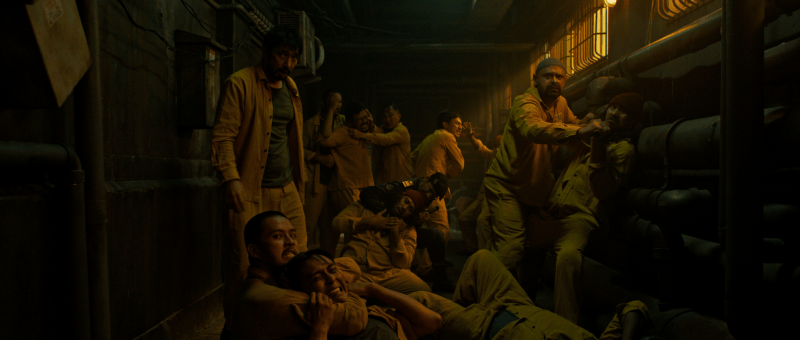
“This is Indonesia, not Norway,” the protagonists of Joko Anwar’s horror comedy Ghost in the Cell keep reminding each other as a means of explaining their dismal circumstances. The prison they’re confined within isn’t so different from the wider society, and even while inside they’re subject to the same hypocrisies, hierarchies, injustices and inequalities as they were outside. Ghosts, however, cannot be bound by prison walls and will seek bloody vengeance down to the last angry man.

Indeed, one of the ghost’s characteristics is that it seems to feed on negative energy, targeting the angriest man it can find to sustain itself. It generally manifests as a kind of doppelgänger in which the victim is essentially confronted by themselves, their own rage and frustration turned back on them. To that extent, the message seems to be that in the end your anger will consume you if you don’t do something to mitigate it, forcing the men to take advantage of the tools they’ve been given to calm themselves such as prayer and dancing. Every so often during a fight, one of the men will call out that their friend’s aura is turning red which places them at risk of being targeted by the ghost, so they should immediately bust out some dance moves to improve their mood.

But at the same time, their anger can be a powerful weapon if turned in the right direction as de facto leader of the prisoners Anggoro (Abimana Aryasatya) later says. Many of them are in here because of some kind political manipulation. He was cheated out of his house by land sharks who wanted to build a luxury resort, so he tried to rob them but got caught and ended up in prison. One of the other men is a university professor who tried to expose corruption in his institution but was framed for theft and incarcerated. “It’s easier to survive in this country if people think you’re dumb,” he later reflects on reassuming his intellectual persona during the mini revolution provoked by the arrival of the ghost.

Dimas (Endy Arfian) ought to understand this better than anyone after being framed for the brutal murder and dismemberment of his boss. He’d just finished an article on the illegal clearing of a protected forest to build a nickel mine with investment from people in the government. His editor did not, however, want the hassle of publishing it especially as the paper is on its last legs. He objects to Dimas’ focus on the series of mysterious deaths that have taken place there, something he describes as better suited to a trashy clickbait outlet whereas their last remaining readership has stuck around for their rigorous reporting. The implication being that rigorous reporting is not sustainable in Indonesia, though another prisoner suggests that Indonesians care more about celebrities than their own lives and journalists have simply followed the money to give them what they want with a constant flow of salacious stories to distract them from the bigger issues such as the inherent corruption in their society.

This corruption exists within the prison too as one wing is dedicated to hosting corrupt politicians who live in luxurious cells with fridges and air conditioning. They can even leave whenever they want and treat prison like some kind of retreat where they can deflect press interest while basically carrying on doing the same things while inside. The irony is that both the prison warden and the corrupt politician behind the nickel mine were both once former activists who wanted Indonesia to be a better place. The warden joined a political party because he thought he could change it from inside before coming to the conclusion that nothing was going to change, and if you can’t beat them, join them. “In Indonesia it’s the survival of the fittest,” he explains, “they call it corruption, I call it reward for the smarts.”

In a way, perhaps that’s the real ghost in the cell, the imprisoned spectre of their youthful idealism. “We just need to save ourselves,” the warden tells his underling, an argument immediately countered by Anggoro who points out that they could all continue to prioritise their own survival, but the ghost will come for them in the end unless they work together to try to stop it. The message seems to be that they could save Indonesia too, if only they stopped allowing themselves to be distracted and remained united. Reminiscent of Silence of the Lambs, the ghost likes to create gruesome and ironic tableaux of its victims while itself perhaps distracted, sating its lust for vengeance while searching for the real source of injustice, but only finally finding it when the people work together for a common cause.


Ghost in the Cell is on digital platforms 26 October 2026 from Blue Finch Film Releasing.

Trailer

Marlina the Murderer in Four Acts (Marlina Si Pembunuh Dalam Empat Babak, Mouly Surya, 2017)

Marlina posterIf a widow poisons a bunch of bandits before decapitating their leader but no one bothers to investigate, has she committed any crime? Adopting the trappings of the spaghetti western, Mouly Surya’s Marlina the Murderer in Four Acts (Marlina Si Pembunuh Dalam Empat Babak) is less a tale of revenge than of survival. Marlina’s world is out to get her – a lone widow with property (and debt) is a magnet for the unscrupulous who think they can take what she has with little resistance. They are very wrong. Marlina has had enough of stoically putting up with the various trials fate has seen fit to send, and this time she intends to fight back with whatever resources are available to her.

We first meet Marlina (Marsha Timothy) one evening, home alone (except for the mummified corpse of her late husband sitting silently in the corner) on the small ranch she now operates without assistance. An unexpected visitor arrives by motorcycle and lets himself in, literally invading her property safe in the knowledge that she lacks the strength to eject him. The man, Markus (Egy Fedly), informs her that his men will soon arrive and if she’s “lucky” and they have time, they intend to have their way with her in addition to making off with her cattle and anything else that will fit in the van. Markus also asks Marlina to make him some chicken soup, which is something he’ll later regret. Or would have regretted if Marlina hadn’t hacked his head off with a machete while he raped her. Having poisoned all but two of the bandits and beheaded Markus, Marlina neatly tidies the bodies away into a cupboard, trusses up Markus’ head, and takes it with her on a journey to the police station to report her crime (and hopefully gain their protection against the other two bandits still on the loose).

Marlina has had her share of troubles. Having lost a child and now her husband, Marlina is a lone woman which makes her particularly vulnerable in an intensely patriarchal society. The bandits think she’s easy pickings because she is undefended. Entirely alone with no close neighbours and no apparent family members to fall back on, Marlina has only herself. This has however made her tough and resourceful, acutely aware of her precarious position and instantly wise to the bandits’ plans. Terrified but biding her time, she attempts to placate them until she manages to retrieve her poison berries (carefully stored for just such an occasion?) and slide them into the chicken soup Markus has been so kind as to order.

Unsure what to do next, Marlina looks to the police for guidance. Her friend, Novi (Dea Panendra) – 10 months pregnant, reminds her that the police won’t do anything about the bandits and she’ll only get herself in trouble. Novi advises her to come to church instead and gain peace of mind by confessing her sins, only Marlina doesn’t think she’s committed any. Novi’s prognostication about the police proves (partly) correct. Marlina sits in the waiting room, anxious and irritated, while the policemen continue their game of ping pong. When one finally does take her statement, he listens patiently and asks relevant questions, but eventually declares that they won’t be able to investigate because they don’t have any cars today and, being underfunded, won’t have the proper tools for weeks. Likewise, they can’t investigate the rape because they don’t have any rape kits or access to doctors and without evidence there is no crime. Marlina leaves a free woman but one with seven bodies in her cupboard she doesn’t know what to do with and two crazed bandits after her to retrieve their boss’ head.

If anyone’s going to save Marlina, it’ll have to be Marlina herself. Unfortunately a literal busload of other people including Novi and an older lady trying to get some ponies to her nephew’s wedding to rectify a shortfall in the dowry have got mixed up with the bandits’ ongoing vendetta. Where Marlina has become tough and independent, Novi is intent on getting her useless husband to listen to her and not the voice of superstition which attributes the late arrival of their child to “breech birth” as a symptom of promiscuous infidelity. Despite her devotion to him, Novi’s husband kicks his heavily pregnant wife to the ground and leaves her in the hands of mischief making bandit Franz (Yoga Pratama). Alone with Franz in Marlina’s house, Novi fights back horror to grab one of the dead bandit’s machetes but finds herself unable to strike until struck by the twin pains of labour and the screams of another woman in distress.

Beautifully photographed and filled with the wide-open plains and middle distance perspective of the 70s exploitation-leaning western, Marlina the Murderer is also a marvel of magical realism where headless corpses contribute to the soundtrack and pester our heroine for a restitution to which they are not entitled. Absurdist humour undercuts the grimness of Marlina’s plight and allows a kind of warmth to shine through as our two heroines find the strength to save each other, united in female solidarity. 


Currently on release at selected UK cinemas courtesy of Filmhouse.

Original trailer (English subtitles)