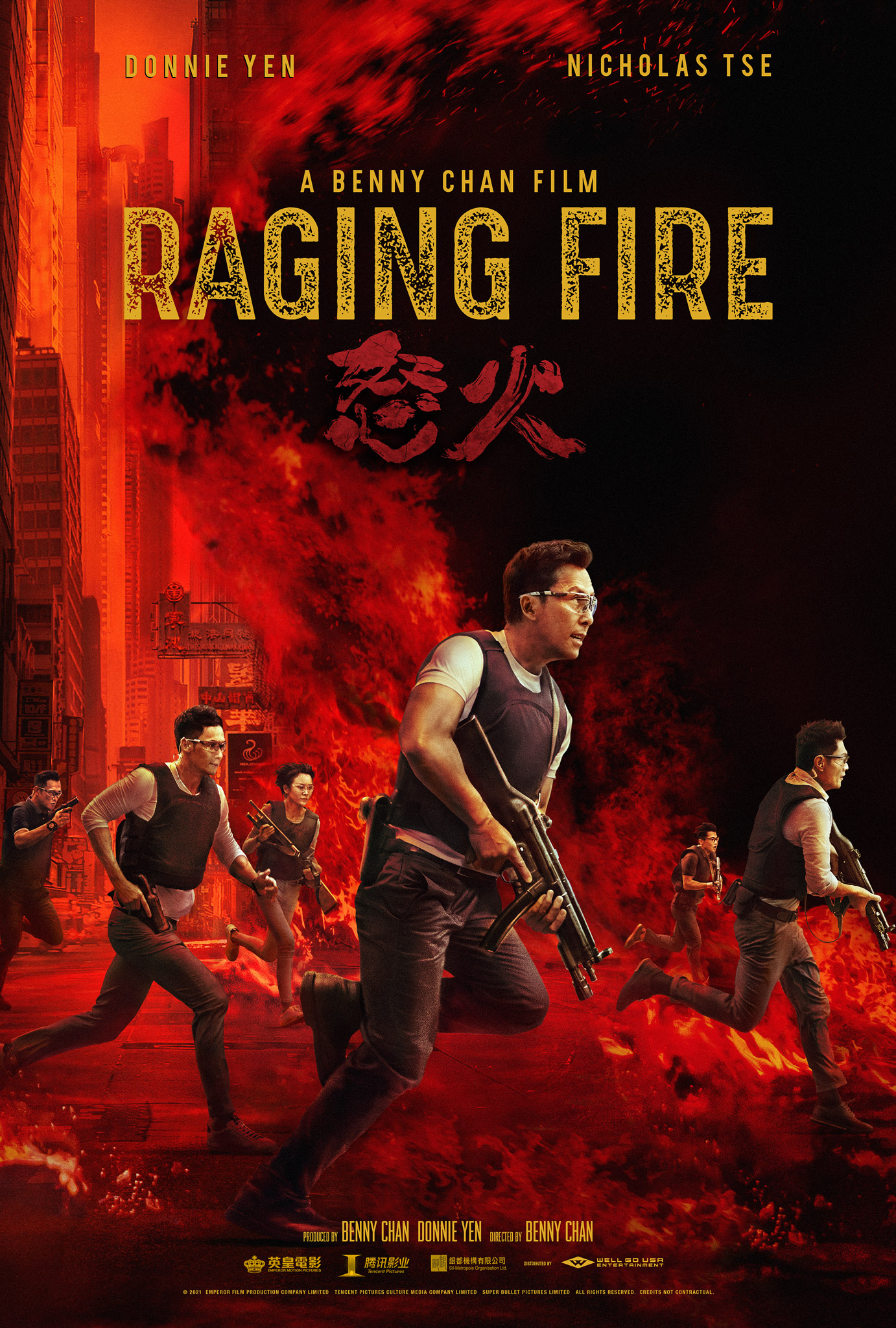
Raging Fire (怒火, Benny Chan, 2021)

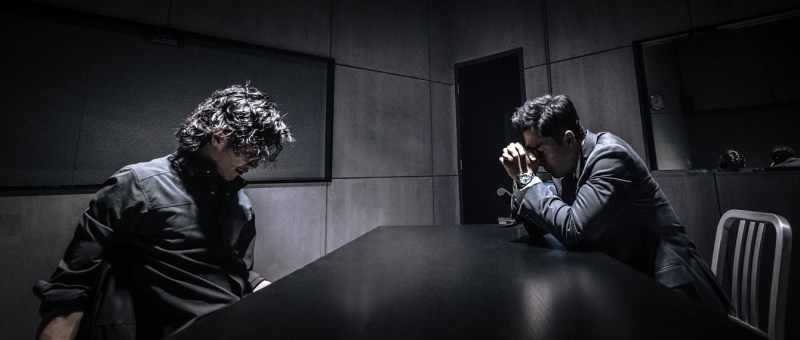
“If you had chased Coke that day, would our destinies have been reversed?” a cop turned villain asks of his righteous colleague, but his friend has no answer for him. The final film from director Benny Chan who sadly passed away last year after being diagnosed with cancer while filming, Raging Fire (怒火) pits a disgruntled police officer wronged by the system against an incorruptible detective but suggests that the real villain is an increasingly corrupt society in which the rich and powerful have a direct line to justice. 

As the film opens, noble officer Cheung (Donnie Yen) is racing towards some kind of altercation in a shipyard but later wakes up next to his much younger and very pregnant wife (Qin Lan). After a years long operation, his team is about to take out a petty criminal involved with a previous investigation which resulted in fellow officers getting sent to prison for excessive use of force. After refusing to to help a wealthy businessman make his son’s drunken car accident go away, Cheung is taken off the case while the raid turns out to have been a trap leaving eight of his friends dead and many more injured. Through his investigations, Cheung begins to realise that his former colleague Ngo (Nicholas Tse), recently released from prison, may be responsible for the deaths of his friends in pursuing a vigilante revenge against the police force he feels betrayed him. 

“This society doesn’t reward good men” Ngo later insists, though his total and relatively sudden transformation from earnest cop to bloodthirsty psychopathic killer seems something of a stretch. Cheung aside, the Hong Kong police force is depicted as infinitely corrupt and working at the behest of the rich and powerful to further agendas not always in the interests of justice. The case which caused so much trouble related to the kidnapping of a prominent financier and the secretary he was canoodling with at the time, the financier’s wife having obeyed the kidnappers’ instructions not to call the police by ringing a government contact instead which is why the operation is covert. Ngo and his team were told to do whatever it took to extract information from a suspect who later wound up dead but were hung out to dry by the superior officer who ordered it. Not unreasonably they see themselves as victims of a corrupt system but care little who might get in the way of their vicious bid for revenge. 

For his part, Chueng is also a thorn in the side of his colleagues because of his refusal to play along with the base level corruption all around him. Dragged to the meeting with the businessman by nervous colleague Beau (Patrick Tam), Cheung sips tea rather than the wine everyone else is drinking and eventually storms out making a point of paying for his exorbitantly priced beverage while refusing to be complicit with systemic corruption. So upright is he that he asks a passing driver if he has insurance before borrowing his car to chase down Ngo and when he himself is accused of breaking protocol the entire squad shows up to petition the disciplinary panel on his behalf. Ngo asks him if the situation would have been reversed had it been Cheung who had questioned the suspect that night, but of course it wouldn’t because Cheung would never have beaten a suspect to death in the first place. 

Chan places this debate front and centre by setting the final showdown in a church currently undergoing renovation, Ngo seemingly judged for his moral transgressions while Cheung meditates on the man he used to be in a bromance montage that laments the tragedy of Ngo’s fall from grace. The battle of wits between the two men, Ngo of course uniquely positioned to game the system he rails against, ends only in futility while the system which created him remains unchanged. Chan shoots with characteristic visual flare sending his compromised cops through a golden hellscape of the contemporary city veering between beautifully choreographed, high octane action sequences including a lengthy car chase through a highly populated area, and procedural thrills tinged with ambivalent social commentary in which justice itself has become commodified while police officers exceed their authority and bow to the rich and powerful. A throwback to classic Hong Kong action, Chan’s final film is a fitting finale for the career of a director taken far too soon. 


Raging Fire screened as part of this year’s New York Asian Film Festival and will be released in US cinemas on Aug, 13 courtesy of Well Go USA.

International trailer (English subtitles)

A Witness Out of the Blue (犯罪現場, Fung Chih-chiang, 2019)

“The world is not supposed to be like this” a failed revenger exclaims as he breathes his last in Fung Chih-chiang’s absurdist noir crime thriller A Witness Out of the Blue (犯罪現場) in which the career criminal on the run turns out to be the only noble soul. In a world like this, an eccentric policeman later suggests, good people can commit crimes while those who prosecute or are victimised by them are often no better than that which they claim to hate, eagerly taking advantage of a bad situation to take what they feel at least they are entitled to. 

It all links back to an unsolved murder, one of the many “crime scenes” referenced in the Chinese title. The dead man, Tsui (Deep Ng Ho-Hong), is believed to be part of a gang led by notorious underworld figure Sean Wong (Louis Koo Tin-lok) who was responsible for a botched jewellery store robbery which went south when the police stooge blew his cover trying to stop one of the gang members getting violent with a hostage. Wong shot the undercover policeman and opened fire on the police, eventually escaping our second scene of crime with the loot, while an old lady was so frightened she had a heart attack, and the store assistant who tried to raise the alarm was left paralysed. Police inspector Yip (Philip Keung Ho-man) who ran the undercover operation against Wong’s gang is convinced that Wong killed his associate during a dispute over dividing the loot and is fixated on bringing him in. Eccentric cop Larry Lam (Louis Cheung), however, is not convinced in part because he’s patiently listened to the only eye witness, a parrot, who says Wong didn’t do it. 

Nicknamed “garbage” and apparently a model cop until some kind of accident a few years previously, Lam is certainly an unusual law enforcement officer. For one thing, he’s in deep debt to loan sharks after borrowing money to start a cat sanctuary because he felt sorry for the abandoned felines left to cower in the rain in the face of the world’s indifference. Lam is convinced that he can get the parrot to talk, if only he can figure out how to communicate with it seeing as the only words it knows are “help me”, “genius”, and “idiot”. Based on the parrot’s testimony and his own gut feeling, Lam doesn’t think Wong is guilty so he has three other suspects: the son of the woman who died who works as a butcher at the market, the paralysed store assistant who has since got religion, and her security guard boyfriend (Andy On) who was rendered powerless in the attack, unable to protect her and apparently still carrying an immense amount of anger and resentment towards the criminals. Lam also comes, however, to doubt his superior wondering if his war against Wong is less in the pursuit of justice than revenge for the death of his officer. 

Yip and Wong are in some ways mirror images of each other, the morally questionable cop and the noble criminal. On the run, Wong takes up lodging with a cheerful woman named Joy (Jessica Hsuan) who is visually impaired but seems to think Wong is a good person even though she can’t “see” him. All of Joy’s other residents are extremely elderly, one of them sadly lamenting that the man who previously inhabited Wong’s room died peacefully in his sleep though he was “only 95”. “Money is no use after you die”, they tell him in an effort to persuade him to join in some 100th birthday celebrations, “life is all about contribution”. Quizzed on what he’d do with the money, all Wong wanted was to be able to sleep and as we see he seems to be suffering with some kind of psychosis, experiencing visual and auditory hallucinations of teeming ants and the ghostly voices of his former gang members. Yet he’s not “bad” in the way Yip characterised him to be, he never kills anyone he didn’t have to, is indignant about being accused of betraying his own, and is just as resentful towards Yip as Yip is towards him for the unfairness of his petty vendetta. 

But like all the best crime stories, all there is in the end is futility. The world shouldn’t be like this, but it is the way it is. Maybe Joy and her pensioners have it right, quietly living their lives of peaceful happiness being good to each other while evil developers breathe down their necks trying to destroy even their small idyll of goodness. Wong is drawn to them, but perhaps knows he’ll never belong in their world of infinite generosity though perhaps oddly he’s the only one who doesn’t really seem to care so much about the loot. Still, as Lam has it “Life is full of wonders” like crime-fighting parrots and eccentric policemen who stand in line buying limited edition trainers on behalf loansharks to finance their animal sanctuaries. Good people also break the law. “In memory of lost souls” reads the sign above the final scene of crime, and it’s not without its sense of irony. 


A Witness Out of the Blue streams in the US via the Smart Cinema app until Sept. 12 as part of this year’s New York Asian Film Festival.

Original trailer (English subtitles)